Get help with Physics 20
Most tutoring makes you sit through material you already know. MapleMind flips that: pick the exact skill that's causing trouble — any of the 45 below — and the tutor teaches just that one, step by step, as many times as it takes. Ask questions in plain words, any time of day, in English, French, or 12 other languages.
The official Alberta Physics 20 curriculum
Alberta defines Physics 20 by strands and outcomes. MapleMind teaches the same curriculum reorganized for one-skill-at-a-time tutoring — the table shows exactly where every official strand lands, and the ministry's own wording is quoted under each unit below.
Official source Alberta's official programs of studyRead it on the government site — alberta.ca ↗| Official strand | Outcomes | Where MapleMind teaches it |
|---|---|---|
| Unit A | 5 | Kinematics |
| Unit B | 13 | Dynamics |
| Unit C | 13 | Circular Motion, Work & Energy |
| Unit D | 14 | Oscillatory Motion & Mechanical Waves |
Every skill below, taught one on one.
 Try the first session free
How MapleMind teaches Physics 20 — every unit, lesson, and skill
Every skill below runs as a short session: a plain-words lesson, a worked example, solving it together, then a five-question skill check that earns up to three stars. Guided Mode keeps it teaching instead of answer-handing — turning it off needs a parent's password.
Unit 1KinematicsOfficial strand · Unit A
The language of motion — describing where things are, how fast they move, and how that motion changes, in one dimension and two. Vectors, graphs, and the equations that link displacement, velocity and acceleration.
Describing Motion: Vectors & Scalars
- Displacement, velocity and acceleration20-A1.1k — Define, qualitatively and quantitatively, displacement, velocity and acceleration, and use $v = \frac{d}{t}$ and $a = \frac{\Delta v}{\Delta t}$ to relate them.
- Scalars vs vectors20-A1.2k — Define, operationally, and compare and contrast scalar and vector quantities — distinguishing magnitude-only quantities (distance, speed) from magnitude-and-direction quantities (displacement, velocity).
- Uniform and uniformly accelerated motion20-A1.3k — Explain, qualitatively and quantitatively, uniform and uniformly accelerated motion from written descriptions and from numerical and graphical data, using the kinematics equations and $d$–$t$ / $v$–$t$ graphs.
Relative & Two-Dimensional Motion
- Relative motion20-A1.4k — Interpret, quantitatively, the motion of one object relative to another using displacement and velocity vectors (e.g. a swimmer in a current, a plane in a wind).
- Two-dimensional motion with vector components20-A1.5k — Explain, quantitatively, two-dimensional motion in a horizontal or vertical plane using vector components — including projectile motion resolved into independent $x$ and $y$ components.
The official wording — 5 outcomes in this unit
- 20-A1.1k
define, qualitatively and quantitatively, displacement, velocity and acceleration
- 20-A1.2k
define, operationally, and compare and contrast scalar and vector quantities
- 20-A1.3k
explain, qualitatively and quantitatively, uniform and uniformly accelerated motion when provided with written descriptions and numerical and graphical data
- 20-A1.4k
interpret, quantitatively, the motion of one object relative to another, using displacement and velocity vectors
- 20-A1.5k
explain, quantitatively, two-dimensional motion in a horizontal or vertical plane, using vector components
Unit 2DynamicsOfficial strand · Unit B
Why motion changes — force. Newton's three laws, friction, and adding forces as vectors; then the deepest force of all, gravity, from Newton's law of universal gravitation to the field it creates and the weight it gives objects on any planet.
Newton's Three Laws
- Net force changes velocity20-B1.1k — Explain that a nonzero net force $\vec{F}_{net}$ causes a change in velocity (an acceleration), while a zero net force leaves velocity unchanged.
- Newton's first law (inertia)20-B1.2k — Apply Newton's first law of motion to explain, qualitatively, an object's state of rest or uniform motion — the tendency of objects to keep doing what they are doing (inertia).
- Newton's second law20-B1.3k — Apply Newton's second law of motion to explain, qualitatively, the relationships among net force, mass and acceleration ($\vec{F}_{net} = m\vec{a}$).
- Newton's third law (action–reaction)20-B1.4k — Apply Newton's third law to explain, qualitatively, the interaction between two objects, recognizing that the two forces — equal in magnitude and opposite in direction — do not act on the same object.
Friction & Adding Forces
- Static and kinetic friction20-B1.5k — Explain, qualitatively and quantitatively, static and kinetic forces of friction acting on an object, using $F_f = \mu F_N$.
- Resultant force from vector components20-B1.6k — Calculate the resultant force, or its constituents, acting on an object by adding vector components graphically and algebraically.
- Solving problems with Newton's laws20-B1.7k — Apply Newton's laws of motion to solve, algebraically, linear motion problems in horizontal, vertical and inclined planes near the surface of Earth, ignoring air resistance.
Gravitation & Fields
- Gravity as a fundamental force20-B2.1k — Identify the gravitational force as one of the fundamental forces in nature.
- Newton’s law of universal gravitation20-B2.2k — Describe, qualitatively and quantitatively, Newton's law of universal gravitation, $F_g = \frac{Gm_1 m_2}{r^2}$ — an attractive force that grows with mass and falls off as the inverse square of distance.
- The Cavendish experiment20-B2.3k — Explain, qualitatively, the principles pertinent to the Cavendish experiment used to determine the universal gravitational constant, $G$.
- The concept of a field20-B2.4k — Define the term "field" as a concept that replaces "action at a distance" and apply the concept to describe gravitational effects.
- Linking $G$ to local $g$20-B2.5k — Relate, qualitatively and quantitatively, using Newton's law of universal gravitation, the gravitational constant to the local value of the acceleration due to gravity ($g = \frac{GM}{r^2}$).
- Weight on different planets20-B2.6k — Predict, quantitatively, differences in the weight of objects on different planets, using each planet’s local $g$.
The official wording — 13 outcomes in this unit
- 20-B1.1k
explain that a nonzero net force causes a change in velocity
- 20-B1.2k
apply Newton's first law of motion to explain, qualitatively, an object's state of rest or uniform motion
- 20-B1.3k
apply Newton's second law of motion to explain, qualitatively, the relationships among net force, mass and acceleration
- 20-B1.4k
apply Newton's third law of motion to explain, qualitatively, the interaction between two objects, recognizing that the two forces, equal in magnitude and opposite in direction, do not act on the same object
- 20-B1.5k
explain, qualitatively and quantitatively, static and kinetic forces of friction acting on an object
- 20-B1.6k
calculate the resultant force, or its constituents, acting on an object by adding vector components graphically and algebraically
- 20-B1.7k
apply Newton's laws of motion to solve, algebraically, linear motion problems in horizontal, vertical and inclined planes near the surface of Earth, ignoring air resistance
- 20-B2.1k
identify the gravitational force as one of the fundamental forces in nature
- 20-B2.2k
describe, qualitatively and quantitatively, Newton's law of universal gravitation
- 20-B2.3k
explain, qualitatively, the principles pertinent to the Cavendish experiment used to determine the universal gravitational constant
- 20-B2.4k
define the term "field" as a concept that replaces "action at a distance" and apply the concept to describe gravitational effects
- 20-B2.5k
relate, qualitatively and quantitatively, using Newton's law of universal gravitation, the gravitational constant to the local value of the acceleration due to gravity
- 20-B2.6k
predict, quantitatively, differences in the weight of objects on different planets
Unit 3Circular Motion, Work & EnergyOfficial strand · Unit C
Motion in a circle — why an object turning at steady speed is still accelerating, and how that explains satellites and orbits. Then the accounting of motion: work, power, and the conservation of mechanical energy.
Uniform Circular Motion
- Circular motion as 2-D motion20-C1.1k — Describe uniform circular motion as a special case of two-dimensional motion, where speed is constant but the velocity vector continuously changes direction.
- Centripetal acceleration20-C1.2k — Explain, qualitatively and quantitatively, that the acceleration in uniform circular motion is directed toward the centre of the circle ($a_c = \frac{v^2}{r}$).
- Speed, frequency, period and radius20-C1.3k — Explain, quantitatively, the relationships among speed, frequency, period and radius for circular motion ($v = \frac{2\pi r}{T}$, $f = \frac{1}{T}$).
- Circular motion and Newton's laws20-C1.4k — Explain, qualitatively, uniform circular motion in terms of Newton's laws of motion — an unbalanced (centripetal) net force is required to keep an object turning.
Orbits, Satellites & Kepler
- Satellite and planetary motion20-C1.5k — Explain, quantitatively, planetary and natural and artificial satellite motion, using circular motion to approximate elliptical orbits (gravity supplies the centripetal force).
- Finding the mass of a celestial body20-C1.6k — Predict the mass of a celestial body from the orbital data of a satellite in uniform circular motion around it, by setting gravitational force equal to centripetal force.
- Kepler's laws and Newton20-C1.7k — Explain, qualitatively, how Kepler's laws were used in the development of Newton's law of universal gravitation.
Mechanical Energy & Conservation
- Mechanical energy20-C2.1k — Define mechanical energy as the sum of kinetic and potential energy, $E_{mech} = E_k + E_p$.
- Kinetic, potential and total energy20-C2.2k — Determine, quantitatively, the relationships among the kinetic ($E_k = \frac{1}{2}mv^2$), gravitational potential ($E_p = mgh$) and total mechanical energies of a mass at any point between maximum potential and maximum kinetic energy.
- Conservation of mechanical energy20-C2.3k — Analyze, quantitatively, kinematics and dynamics problems that relate to the conservation of mechanical energy in an isolated system.
Work & Power
- Work and power20-C2.4k — Recall work as a measure of the mechanical energy transferred ($W = Fd$) and power as the rate of doing work ($P = \frac{W}{t}$).
- Describing power20-C2.5k — Describe power qualitatively and quantitatively — how quickly energy is transferred or work is done, measured in watts ($1\ \text{W} = 1\ \text{J/s}$).
- Energy change in a non-isolated system20-C2.6k — Describe, qualitatively, the change in mechanical energy in a system that is not isolated — where friction or an external force transfers energy in or out.
The official wording — 13 outcomes in this unit
- 20-C1.1k
describe uniform circular motion as a special case of two-dimensional motion
- 20-C1.2k
explain, qualitatively and quantitatively, that the acceleration in uniform circular motion is directed toward the centre of a circle
- 20-C1.3k
explain, quantitatively, the relationships among speed, frequency, period and radius for circular motion
- 20-C1.4k
explain, qualitatively, uniform circular motion in terms of Newton's laws of motion
- 20-C1.5k
explain, quantitatively, planetary and natural and artificial satellite motion, using circular motion to approximate elliptical orbits
- 20-C1.6k
predict the mass of a celestial body from the orbital data of a satellite in uniform circular motion around the celestial body
- 20-C1.7k
explain, qualitatively, how Kepler's laws were used in the development of Newton's law of universal gravitation
- 20-C2.1k
define mechanical energy as the sum of kinetic and potential energy
- 20-C2.2k
determine, quantitatively, the relationships among the kinetic, gravitational potential and total mechanical energies of a mass at any point between maximum potential energy and maximum kinetic energy
- 20-C2.3k
analyze, quantitatively, kinematics and dynamics problems that relate to the conservation of mechanical energy in an isolated system
- 20-C2.4k
recall work as a measure of the mechanical energy transferred and power as the rate of doing work
- 20-C2.5k
describe power qualitatively and quantitatively
- 20-C2.6k
describe, qualitatively, the change in mechanical energy in a system that is not isolated
Unit 4Oscillatory Motion & Mechanical WavesOfficial strand · Unit D
Motion that repeats — pendulums and springs in simple harmonic motion, and the energy they store. Then how that oscillation travels: mechanical waves, their properties and the universal wave equation, reflection, interference, resonance and the Doppler effect.
Oscillatory & Simple Harmonic Motion
- Period and frequency20-D1.1k — Describe oscillatory motion in terms of period ($T$, seconds per cycle) and frequency ($f$, cycles per second), related by $f = \frac{1}{T}$.
- Defining simple harmonic motion20-D1.2k — Define simple harmonic motion as a motion due to a restoring force that is directly proportional and opposite to the displacement from an equilibrium position ($F = -kx$).
- SHM: displacement, velocity, acceleration, time20-D1.3k — Explain, quantitatively, the relationships among displacement, acceleration, velocity and time for simple harmonic motion, as illustrated by a frictionless horizontal mass–spring system or a pendulum using the small-angle approximation.
- Energy in simple harmonic motion20-D1.4k — Determine, quantitatively, the relationships among kinetic, gravitational potential and total mechanical energies of a mass executing simple harmonic motion.
- Mechanical resonance20-D1.5k — Define mechanical resonance — the large-amplitude response when a system is driven at its natural frequency.
Mechanical Waves & Their Properties
- Waves as particles in SHM20-D2.1k — Describe mechanical waves as particles of a medium that are moving in simple harmonic motion — the medium oscillates while the wave (a disturbance) travels through it.
- Energy transport by matter vs waves20-D2.2k — Compare and contrast energy transport by matter and by waves — a wave carries energy through a medium without carrying the medium itself along with it.
- Longitudinal and transverse waves20-D2.3k — Define longitudinal and transverse waves in terms of the direction of motion of the medium particles in relation to the direction of propagation of the wave.
- Wave terminology20-D2.4k — Define the terms wavelength, wave velocity, period, frequency, amplitude, wave front and ray as they apply to describing transverse and longitudinal waves.
- Wave speed and the medium20-D2.5k — Describe how the speed of a wave depends on the characteristics of the medium — not on the source, but on the properties of what the wave travels through.
- The universal wave equation20-D2.6k — Predict, quantitatively, and verify the effects of changing one or a combination of variables in the universal wave equation, $v = f\lambda$.
Reflection, Interference & the Doppler Effect
- Reflection of waves20-D2.7k — Explain, qualitatively, the phenomenon of reflection as exhibited by mechanical waves — how a wave bounces back when it meets a boundary.
- Interference and acoustic resonance20-D2.8k — Explain, qualitatively, the conditions for constructive and destructive interference of waves and for acoustic resonance.
- The Doppler effect20-D2.9k — Explain, qualitatively and quantitatively, the Doppler effect on a stationary observer of a moving source — the apparent shift in frequency as a source approaches or recedes.
The official wording — 14 outcomes in this unit
- 20-D1.1k
describe oscillatory motion in terms of period and frequency
- 20-D1.2k
define simple harmonic motion as a motion due to a restoring force that is directly proportional and opposite to the displacement from an equilibrium position
- 20-D1.3k
explain, quantitatively, the relationships among displacement, acceleration, velocity and time for simple harmonic motion, as illustrated by a frictionless, horizontal mass-spring system or a pendulum, using the small-angle approximation
- 20-D1.4k
determine, quantitatively, the relationships among kinetic, gravitational potential and total mechanical energies of a mass executing simple harmonic motion
- 20-D1.5k
define mechanical resonance
- 20-D2.1k
describe mechanical waves as particles of a medium that are moving in simple harmonic motion
- 20-D2.2k
compare and contrast energy transport by matter and by waves
- 20-D2.3k
define longitudinal and transverse waves in terms of the direction of motion of the medium particles in relation to the direction of propagation of the wave
- 20-D2.4k
define the terms wavelength, wave velocity, period, frequency, amplitude, wave front and ray as they apply to describing transverse and longitudinal waves
- 20-D2.5k
describe how the speed of a wave depends on the characteristics of the medium
- 20-D2.6k
predict, quantitatively, and verify the effects of changing one or a combination of variables in the universal wave equation
- 20-D2.7k
explain, qualitatively, the phenomenon of reflection as exhibited by mechanical waves
- 20-D2.8k
explain, qualitatively, the conditions for constructive and destructive interference of waves and for acoustic resonance
- 20-D2.9k
explain, qualitatively and quantitatively, the Doppler effect on a stationary observer of a moving source
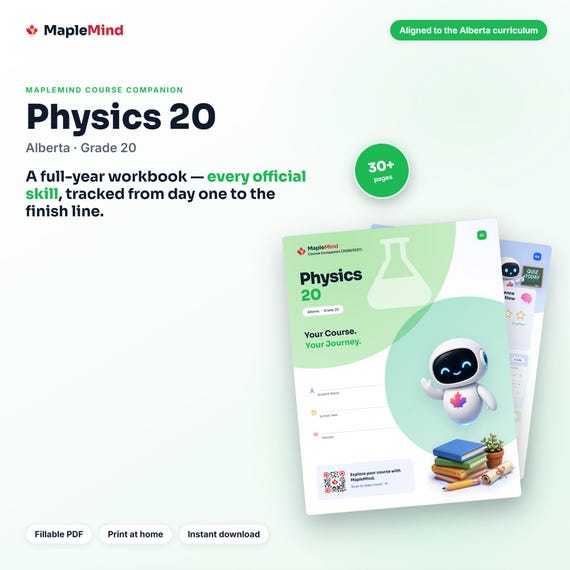
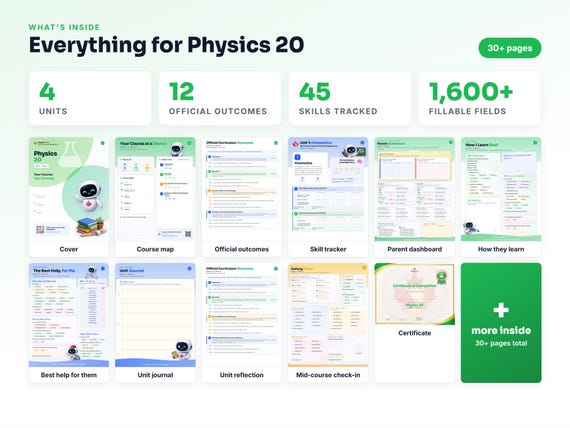


Printable workbook · A keepsake of the year
A Physics 20 workbook worth keeping
Built from the same official curriculum as this page. Before and after each skill above, your student colours in how sure they feel — so the two of you can see, on one page, what's clicking and what needs another look. It's a quiet way to follow how the year is really going.
By June it's full of their own handwriting: units worked through, confidence grown, a mid-year check-in, notes from parent-teacher night, and a certificate at the end. Less a worksheet, more a record of the year worth keeping on the shelf.
Instant download · see every page, reviews and the full description · five or more workbooks are $2.99 each
What it looks like in the app



Common questions
Can MapleMind help me with Physics 20?
Yes. MapleMind's AI tutor covers all 45 skills in Alberta's Physics 20 — you pick the exact skill, and the tutor teaches it step by step: a short lesson, a worked example, solving together, then a skill check to show it stuck.
Is MapleMind aligned to Alberta's official curriculum?
Yes. Every skill in this course maps to an official outcome code from Alberta's Grade 11 Science curriculum, and the ministry's own wording is quoted under each unit on this page — with the official government source linked so you can check it yourself.
What does MapleMind cost?
It's free to start — 5 tutoring chats and a practice quiz every day, no credit card. A Pro subscription ($9.99/month or $49.99/year CAD, 7-day free trial) unlocks unlimited tutoring, practice, and exam simulations.
What if I'm stuck on just one topic?
That's the point of skill-level tutoring: open Physics 20 in the app, tap the exact skill from the list on this page, and the tutor teaches just that — no wading through lessons you don't need.
Does MapleMind work in French or other languages?
Yes — 14 languages, including French. Both the app and the tutor's explanations switch to the language you choose.
Where can I see the official Alberta curriculum for Physics 20?
The official source is linked on this page — Alberta's official programs of study. The outline here follows it: every MapleMind skill carries its official outcome code, and the ministry's own wording is quoted under each unit.
Keep exploring
Ready when you are
Pick a skill from this page and see it taught properly — free, in the browser, in under a minute.