Get help with Biology 30
Most tutoring makes you sit through material you already know. MapleMind flips that: pick the exact skill that's causing trouble — any of the 55 below — and the tutor teaches just that one, step by step, as many times as it takes. Ask questions in plain words, any time of day, in English, French, or 12 other languages.
The official Alberta Biology 30 curriculum
Alberta defines Biology 30 by strands and outcomes. MapleMind teaches the same curriculum reorganized for one-skill-at-a-time tutoring — the table shows exactly where every official strand lands, and the ministry's own wording is quoted under each unit below.
Official source Alberta's official programs of studyRead it on the government site — alberta.ca ↗| Official strand | Outcomes | Where MapleMind teaches it |
|---|---|---|
| Unit A | 12 | Nervous & Endocrine Systems |
| Unit B | 13 | Reproduction & Development |
| Unit C | 19 | Cell Division, Genetics & Molecular Biology |
| Unit D | 11 | Population & Community Dynamics |
Every skill below, taught one on one.
 Try the first session free
How MapleMind teaches Biology 30 — every unit, lesson, and skill
Every skill below runs as a short session: a plain-words lesson, a worked example, solving it together, then a five-question skill check that earns up to three stars. Guided Mode keeps it teaching instead of answer-handing — turning it off needs a parent's password.
Unit 1Nervous & Endocrine SystemsOfficial strand · Unit A
The two great control systems of the body — the fast, wired nervous system and the slower, chemical endocrine system — and how they sense the world and hold the body in balance.
The Neuron & Nervous System
- Neurons and the action potential30-A1.1k — Describe the structure and function of a neuron and myelin sheath, explaining the action potential (all-or-none response, intensity of response), synaptic transmission, and the transmitters involved (norepinephrine, acetylcholine, cholinesterase).
- Central & peripheral nervous systems30-A1.2k — Identify the principal structures of the central and peripheral nervous systems and explain their roles in regulating the voluntary (somatic) and involuntary (autonomic) systems.
- Nerves and reflex arcs30-A1.3k — Describe, using an example, the organization of neurons into nerves and the composition and function of reflex arcs (e.g. the patellar reflex).
Sensing the Environment
- Structure and function of the eye30-A1.4k — Describe the structure and function of the parts of the human eye (cornea, lens, sclera, choroid, retina, rods and cones, fovea centralis, pupil, iris, optic nerve).
- Structure and function of the ear30-A1.5k — Describe the structure and function of the parts of the human ear (pinna, auditory canal, tympanum, ossicles, cochlea, organ of Corti, auditory nerve, semicircular canals, Eustachian tube).
- Other human senses30-A1.6k — Explain other ways humans sense their environment and spatial orientation (olfactory receptors, proprioceptors, taste receptors, skin receptors).
Endocrine Glands & Hormones
- The principal endocrine glands30-A2.1k — Identify the principal endocrine glands of humans (hypothalamus/pituitary complex, thyroid, parathyroid, adrenal glands, islet cells of the pancreas).
- Hormones and feedback30-A2.2k — Describe the function of the hormones of the principal endocrine glands (TSH/thyroxine, PTH, cortisol, glucagon/insulin, hGH, ADH, epinephrine, aldosterone) and how they maintain homeostasis through feedback.
- Metabolic roles of hormones30-A2.3k — Explain the metabolic roles hormones play in homeostasis (thyroxine in metabolism; insulin, glucagon and cortisol in blood sugar; hGH in growth; ADH in water; aldosterone in sodium).
Endocrine Control & Imbalance
- Sensing the internal environment30-A2.4k — Explain how the endocrine system allows humans to sense their internal environment and respond appropriately (e.g. calcium balance, osmotic pressure of blood).
- Comparing endocrine and nervous control30-A2.5k — Compare the endocrine and nervous control systems and explain how they act together (e.g. stress and the adrenal gland).
- Consequences of hormone imbalance30-A2.6k — Describe, using an example, the physiological consequences of hormone imbalances (e.g. diabetes mellitus, gigantism, goitre, Graves’ disease).
The official wording — 12 outcomes in this unit
- 30-A1.1k
describe the general structure and function of a neuron and myelin sheath, explaining the formation and transmission of an action potential, including all-or-none response and intensity of response
- 30-A1.2k
identify the principal structures of the central and peripheral nervous systems and explain their functions in regulating the voluntary (somatic) and involuntary (autonomic) systems of the human organism
- 30-A1.3k
describe, using an example, the organization of neurons into nerves and the composition and function of reflex arcs
- 30-A1.4k
describe the structure and function of the parts of the human eye
- 30-A1.5k
describe the structure and function of the parts of the human ear
- 30-A1.6k
explain other ways that humans sense their environment and their spatial orientation in it
- 30-A2.1k
identify the principal endocrine glands of humans
- 30-A2.2k
describe the function of the hormones of the principal endocrine glands
- 30-A2.3k
explain the metabolic roles hormones may play in homeostasis
- 30-A2.4k
explain how the endocrine system allows humans to sense their internal environment and respond appropriately
- 30-A2.5k
compare the endocrine and nervous control systems and explain how they act together
- 30-A2.6k
describe, using an example, the physiological consequences of hormone imbalances
Unit 2Reproduction & DevelopmentOfficial strand · Unit B
How humans reproduce — the anatomy of the reproductive systems, the hormones that regulate them, and the journey from fertilization to birth.
Reproductive Anatomy
- The female reproductive system30-B1.1k — Identify the structures in the human female reproductive system and describe their functions (ovaries, Fallopian tubes, uterus, endometrium, cervix, vagina).
- The male reproductive system30-B1.2k — Identify the structures in the human male reproductive system and describe their functions (testes, seminiferous tubules, epididymides, vasa deferentia, prostate gland, urethra, penis).
- Gametes and supporting structures30-B1.3k — Distinguish sperm and egg from their supporting structures (seminiferous tubules, interstitial cells, Sertoli cells, follicle, corpus luteum).
Sex Determination & Reproductive Health
- Chromosomes, hormones and sex determination30-B1.4k — Describe the chromosomal factors and hormonal influence on the formation of gonads and reproductive organs in the embryo and fetus (Y chromosome and role of testosterone).
- STIs and fertility30-B1.5k — Explain how sexually transmitted infections (STIs) can interfere with fertility and reproduction (e.g. chlamydia, gonorrhea, human papilloma virus).
Reproductive Hormones & the Menstrual Cycle
- Hormones and sex characteristics30-B2.1k — Describe the role of hormones (GnRH, FSH, LH, estrogen, progesterone, testosterone) in regulating primary and secondary sex characteristics in females and males.
- Hormones of the menstrual cycle30-B2.2k — Identify the principal female reproductive hormones and explain their interactions in maintaining the menstrual cycle (estrogen, progesterone, FSH, LH).
- Male reproductive hormones30-B2.3k — Identify the principal male reproductive hormones and explain their interactions in maintaining and functioning the male reproductive system (testosterone, FSH, LH).
Fertilization & Development
- Fertilization, pregnancy and birth30-B3.1k — Trace fertilization, implantation, extra-embryonic membrane formation, embryonic and fetal development, parturition and lactation, and the control mechanisms (progesterone, LH, hCG, prostaglandins, oxytocin, prolactin).
- Stages of development30-B3.2k — Describe development from fertilization to parturition through its main physiological events by trimester (zygote, blastocyst, gastrulation, general morphogenesis).
- Germ layers and tissue differentiation30-B3.3k — Identify major tissues and organs arising from differentiation of the ectoderm, mesoderm and endoderm (ectoderm: nervous system, epidermis; mesoderm: skeleton, muscles; endoderm: digestive and respiratory linings).
- Environmental factors in development30-B3.4k — Describe the influence of environmental factors on embryonic and fetal development (maternal lifestyle, teratogens such as alcohol, drugs, viral infections, radiation).
- Reproductive technologies30-B3.5k — Describe the physiological or mechanical basis of different reproductive technologies (conception control, in vitro fertilization, infertility reversal).
The official wording — 13 outcomes in this unit
- 30-B1.1k
identify the structures in the human female reproductive system and describe their functions
- 30-B1.2k
identify the structures in the human male reproductive system and describe their functions
- 30-B1.3k
distinguish sperm and egg from their supporting structures
- 30-B1.4k
describe the chromosomal factors and hormonal influence on the formation of the gonads and reproductive organs in the female and male embryo and fetus
- 30-B1.5k
explain how sexually transmitted infections (STIs) can interfere with fertility and reproduction
- 30-B2.1k
describe the role of hormones
- 30-B2.2k
identify the principal reproductive hormones in the female and explain their interactions in the maintenance of the menstrual cycle
- 30-B2.3k
identify the principal reproductive hormones in the male and explain their interactions in the maintenance and functioning of the male reproductive system
- 30-B3.1k
trace the processes of fertilization, implantation and extra-embryonic membrane formation
- 30-B3.2k
describe development from fertilization to parturition in the context of the main physiological events that occur in the development of organ systems during each major stage
- 30-B3.3k
identify major tissues and organs that arise from differentiation and morphological development of the ectoderm, mesoderm and endoderm in the embryo
- 30-B3.4k
describe the influence of environmental factors on embryonic and fetal development
- 30-B3.5k
describe the physiological or mechanical basis of different reproductive technologies
Unit 3Cell Division, Genetics & Molecular BiologyOfficial strand · Unit C
How cells divide to pass on chromosomes, how traits are inherited through the rules Mendel discovered, and how DNA itself stores, copies and expresses the code of life.
Chromosomes & Cell Division
- Chromosome number30-C1.1k — Define and explain the significance of chromosome number in somatic and sex cells (haploidy, diploidy, polyploidy).
- The cell cycle and mitosis30-C1.2k — Explain, in general terms, the events of the cell cycle (interphase, mitosis, cytokinesis).
- Meiosis30-C1.3k — Describe the process of meiosis (spermatogenesis and oogenesis) and the necessity for reducing chromosome number.
- Comparing mitosis and meiosis30-C1.4k — Compare the processes of mitosis and meiosis.
Crossing Over & Reproductive Strategies
- Crossing over and nondisjunction30-C1.5k — Describe the processes of crossing over and nondisjunction and evaluate their significance to inheritance and development.
- Fraternal and identical offspring30-C1.6k — Compare the formation of fraternal and identical offspring in a single birthing event.
- Diversity of reproductive strategies30-C1.7k — Describe the diversity of reproductive strategies by comparing the alternation of generations in a range of organisms (e.g. Daphnia, sea anemone, moss, pine).
Mendelian Genetics
- Mendel's evidence and laws30-C2.1k — Describe the evidence for dominance, segregation and independent assortment of genes on different chromosomes, as investigated by Mendel.
- Genotype and phenotype ratios30-C2.2k — Compare ratios and probabilities of genotypes and phenotypes for dominant and recessive, multiple, incompletely dominant, and codominant alleles.
- Gene linkage and crossing over30-C2.3k — Explain the influence of gene linkage and crossing over on variability.
- Number of genes and variability30-C2.4k — Explain the relationship between variability and the number of genes controlling a trait (one pair, as for Rh factor, versus two or more pairs, as for skin colour and height).
- Sex-linked inheritance30-C2.5k — Compare the pattern of inheritance produced by genes on the sex chromosomes to that produced by genes on autosomes, as investigated by Morgan.
DNA: Structure & Expression
- Discovery of DNA structure30-C3.1k — Summarize the historical events leading to the discovery of the structure of the DNA molecule, including the work of Franklin and Watson and Crick.
- DNA information and replication30-C3.2k — Describe, in general, how genetic information is contained in the sequence of bases in DNA and how DNA molecules replicate themselves.
- Transcription and translation30-C3.3k — Describe, in general, how genetic information is transcribed into RNA and finally translated into sequences of amino acids in proteins.
Genetic Engineering & Mutation
- Restriction enzymes and ligases30-C3.4k — Explain, in general, how restriction enzymes cut DNA molecules into smaller fragments and how ligases reassemble them.
- Cell transformation30-C3.5k — Explain, in general, how cells may be transformed by inserting new DNA sequences into their genomes.
- Mutation and genetic variability30-C3.6k — Explain how a random change (mutation) in the sequence of bases results in abnormalities or provides a source of genetic variability.
- DNA evidence for relationships30-C3.7k — Explain how base sequences in nucleic acids in the nucleus, mitochondrion and chloroplast give evidence for the relationships among organisms of different species.
The official wording — 19 outcomes in this unit
- 30-C1.1k
define and explain the significance of chromosome number in somatic and sex cells
- 30-C1.2k
explain, in general terms, the events of the cell cycle
- 30-C1.3k
describe the process of meiosis (spermatogenesis and oogenesis) and the necessity for the reduction of chromosome number
- 30-C1.4k
compare the processes of mitosis and meiosis
- 30-C1.5k
describe the processes of crossing over and nondisjunction and evaluate their significance to organism inheritance and development
- 30-C1.6k
compare the formation of fraternal and identical offspring in a single birthing event
- 30-C1.7k
describe the diversity of reproductive strategies by comparing the alternation of generations in a range of organisms
- 30-C2.1k
describe the evidence for dominance, segregation and the independent assortment of genes on different chromosomes, as investigated by Mendel
- 30-C2.2k
compare ratios and probabilities of genotypes and phenotypes for dominant and recessive, multiple, incompletely dominant, and codominant alleles
- 30-C2.3k
explain the influence of gene linkage and crossing over on variability
- 30-C2.4k
explain the relationship between variability and the number of genes controlling a trait
- 30-C2.5k
compare the pattern of inheritance produced by genes on the sex chromosomes to that produced by genes on autosomes
- 30-C3.1k
summarize the historical events that led to the discovery of the structure of the DNA molecule
- 30-C3.2k
describe, in general, how genetic information is contained in the sequence of bases in DNA molecules in chromosomes and how the DNA molecules replicate themselves
- 30-C3.3k
describe, in general, how genetic information is transcribed into sequences of bases in RNA molecules and is finally translated into sequences of amino acids in proteins
- 30-C3.4k
explain, in general, how restriction enzymes cut DNA molecules into smaller fragments and how ligases reassemble them
- 30-C3.5k
explain, in general, how cells may be transformed by inserting new DNA sequences into their genomes
- 30-C3.6k
explain how a random change (mutation) in the sequence of bases results in abnormalities or provides a source of genetic variability
- 30-C3.7k
explain how base sequences in nucleic acids contained in the nucleus, mitochondrion and chloroplast give evidence for the relationships among organisms of different species
Unit 4Population & Community DynamicsOfficial strand · Unit D
How gene pools change across generations, how species interact within communities, and how populations grow, level off and crash — the mathematics and ecology of change.
Gene Pools & Change
- The Hardy-Weinberg principle30-D1.1k — Describe the Hardy-Weinberg principle and explain its significance in gene-pool stability and nonequilibrium values.
- Factors that change the gene pool30-D1.2k — Describe the factors that cause gene-pool diversity to change (natural selection, genetic drift, gene flow, nonrandom mating, bottleneck effect, founder effect, migration, mutation).
- Applying Hardy-Weinberg30-D1.3k — Apply, quantitatively, the Hardy-Weinberg principle to data to determine allele and genotype frequencies, using p + q = 1 and p² + 2pq + q² = 1.
- Molecular basis of gene-pool change30-D1.4k — Describe the molecular basis of gene-pool change and its significance over time (mutations and natural selection — e.g. drug-resistant bacteria, herbicide-resistant plants).
Species Interactions & Succession
- Species interactions and symbiosis30-D2.1k — Describe the basis of species interactions and symbiotic relationships (predator-prey, commensalism, mutualism, parasitism, competition) and their influence on population changes.
- Defence mechanisms30-D2.2k — Explain the role of defence mechanisms in predation and competition (mimicry, protective coloration, toxins, behaviour).
- Ecological succession30-D2.3k — Explain how communities change over time or remain as a climax community (primary succession, secondary succession).
Population Growth
- Factors in population growth30-D3.1k — Describe and explain, quantitatively, the factors that influence population growth (mortality, natality, immigration, emigration) using ΔN = [natality + immigration] − [mortality + emigration].
- Carrying capacity and growth math30-D3.2k — Describe population growth in terms of the mathematical relationship among carrying capacity, biotic potential, environmental resistance and population size (growth rate, per capita growth rate, population density).
- Population growth patterns30-D3.3k — Explain the different population growth patterns — logistic (S-shaped curve) and exponential (J-shaped curve), and open versus closed populations.
- r-selected and K-selected organisms30-D3.4k — Describe the characteristics and reproductive strategies of r-selected and K-selected organisms.
The official wording — 11 outcomes in this unit
- 30-D1.1k
describe the Hardy-Weinberg principle and explain its significance in population gene-pool stability and nonequilibrium values
- 30-D1.2k
describe the factors that cause the diversity in the gene pool to change
- 30-D1.3k
apply, quantitatively, the Hardy-Weinberg principle to observed and published data to determine allele and genotype frequencies
- 30-D1.4k
describe the molecular basis of gene-pool change and the significance of these changes over time
- 30-D2.1k
describe the basis of species interactions and symbiotic relationships and describe the influence of these interactions on population changes
- 30-D2.2k
explain the role of defence mechanisms in predation and competition
- 30-D2.3k
explain how mixtures of populations that define communities may change over time or remain as a climax community
- 30-D3.1k
describe and explain, quantitatively, factors that influence population growth
- 30-D3.2k
describe the growth of populations in terms of the mathematical relationship among carrying capacity, biotic potential, environmental resistance and the number of individuals in the population
- 30-D3.3k
explain the different population growth patterns
- 30-D3.4k
describe the characteristics and reproductive strategies of r -selected and K -selected organisms

Printable workbook · A keepsake of the year
A Biology 30 workbook worth keeping
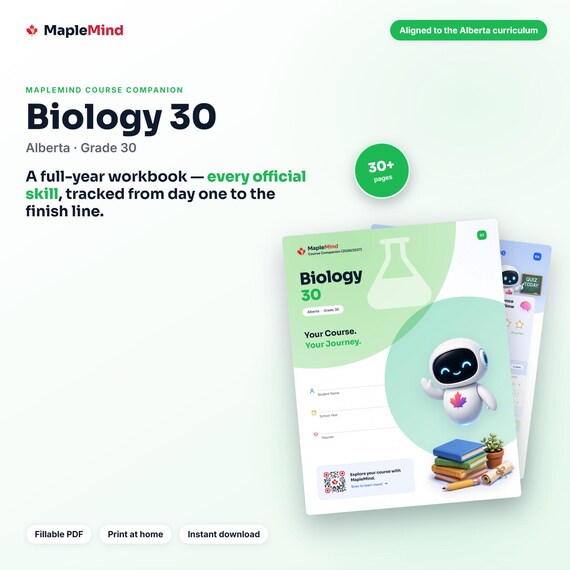
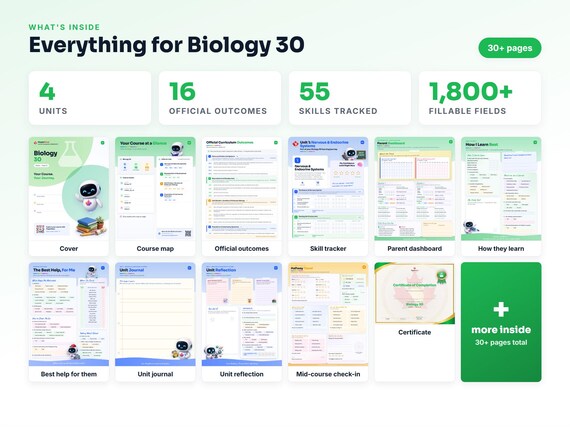
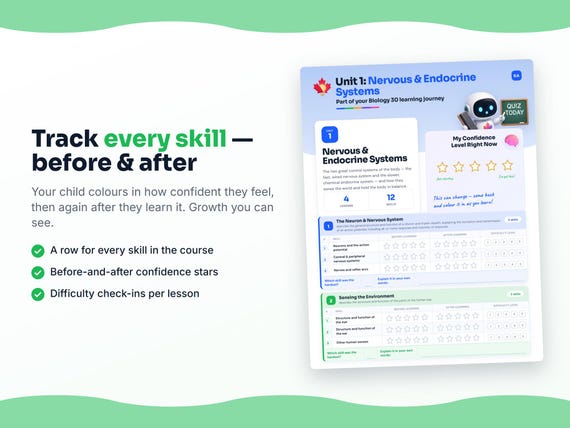
Built from the same official curriculum as this page. Before and after each skill above, your student colours in how sure they feel — so the two of you can see, on one page, what's clicking and what needs another look. It's a quiet way to follow how the year is really going.
By June it's full of their own handwriting: units worked through, confidence grown, a mid-year check-in, notes from parent-teacher night, and a certificate at the end. Less a worksheet, more a record of the year worth keeping on the shelf.
Instant download · see every page, reviews and the full description · five or more workbooks are $2.99 each
What it looks like in the app
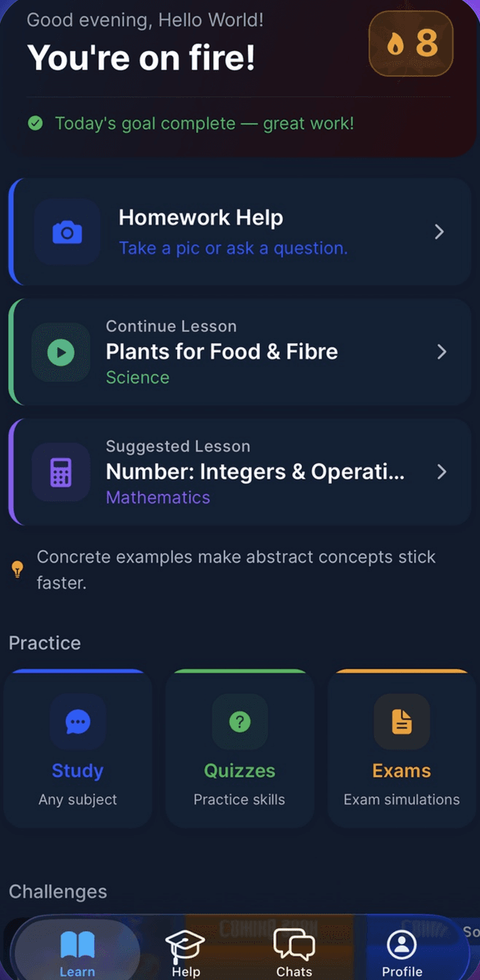

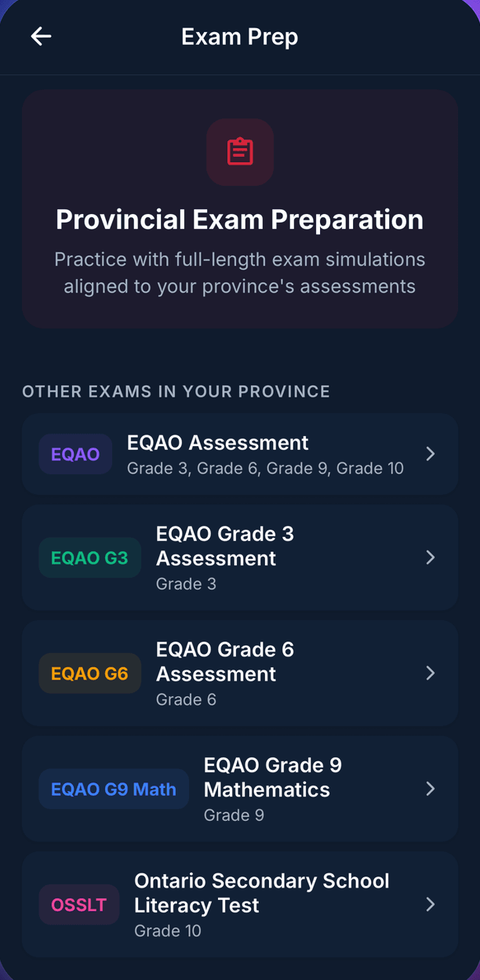
Preparing for the Biology 30 Diploma Exam?
Biology 30 ends in a provincial Diploma Exam worth a big part of the final mark. MapleMind's exam mode builds a full simulation from the course — timed sections, written responses, and a graded result that shows which skills to review. Our Diploma Exam prep guide has a full study plan.
Common questions
Can MapleMind help me with Biology 30?
Yes. MapleMind's AI tutor covers all 55 skills in Alberta's Biology 30 — you pick the exact skill, and the tutor teaches it step by step: a short lesson, a worked example, solving together, then a skill check to show it stuck.
Is MapleMind aligned to Alberta's official curriculum?
Yes. Every skill in this course maps to an official outcome code from Alberta's Grade 12 Science curriculum, and the ministry's own wording is quoted under each unit on this page — with the official government source linked so you can check it yourself.
What does MapleMind cost?
It's free to start — 5 tutoring chats and a practice quiz every day, no credit card. A Pro subscription ($9.99/month or $49.99/year CAD, 7-day free trial) unlocks unlimited tutoring, practice, and exam simulations.
What if I'm stuck on just one topic?
That's the point of skill-level tutoring: open Biology 30 in the app, tap the exact skill from the list on this page, and the tutor teaches just that — no wading through lessons you don't need.
Does MapleMind work in French or other languages?
Yes — 14 languages, including French. Both the app and the tutor's explanations switch to the language you choose.
Where can I see the official Alberta curriculum for Biology 30?
The official source is linked on this page — Alberta's official programs of study. The outline here follows it: every MapleMind skill carries its official outcome code, and the ministry's own wording is quoted under each unit.
Does MapleMind help with the Biology 30 Diploma Exam?
Yes. Biology 30 ends in a provincial Diploma Exam worth a big part of the final mark. MapleMind's exam mode builds a full simulation from the course — timed sections, written responses, and a graded result that shows which skills to review.
Keep exploring
Ready when you are
Pick a skill from this page and see it taught properly — free, in the browser, in under a minute.