Get help with Science 20
Most tutoring makes you sit through material you already know. MapleMind flips that: pick the exact skill that's causing trouble — any of the 58 below — and the tutor teaches just that one, step by step, as many times as it takes. Ask questions in plain words, any time of day, in English, French, or 12 other languages.
The official Alberta Science 20 curriculum
Alberta defines Science 20 by strands and outcomes. MapleMind teaches the same curriculum reorganized for one-skill-at-a-time tutoring — the table shows exactly where every official strand lands, and the ministry's own wording is quoted under each unit below.
Official source Alberta's official programs of studyRead it on the government site — alberta.ca ↗| Official strand | Outcomes | Where MapleMind teaches it |
|---|---|---|
| Unit A | 16 | Chemical Changes |
| Unit B | 10 | Changes in Motion |
| Unit C | 17 | The Changing Earth |
| Unit D | 15 | Changes in Living Systems |
Every skill below, taught one on one.
 Try the first session free
How MapleMind teaches Science 20 — every unit, lesson, and skill
Every skill below runs as a short session: a plain-words lesson, a worked example, solving it together, then a five-question skill check that earns up to three stars. Guided Mode keeps it teaching instead of answer-handing — turning it off needs a parent's password.
Unit 1Chemical ChangesOfficial strand · Unit A
How solutions, oxidation-reduction reactions and hydrocarbons drive the chemistry of everyday life — from batteries and metal extraction to the fuels and plastics of Alberta's petrochemical industry.
Solutions & Concentration
- Dissolving as a prerequisite for reactions20-A1.1k — Explain how dissolving substances in water is often a prerequisite for chemical reactions and chemical changes (e.g. batteries, baking, medications).
- Electrolytes vs nonelectrolytes20-A1.2k — Differentiate, on the basis of properties, between electrolytes and nonelectrolytes.
- Expressing concentration20-A1.3k — Compare and explain how concentrations of solutions are expressed in moles per litre, percent by volume and parts per million.
- Calculating concentration20-A1.4k — Determine the concentration of solutions in moles per litre, percent by volume and parts per million.
- Diluting solutions20-A1.5k — Determine the concentration of diluted solutions and the quantities of a concentrated solution and of water to use when diluting.
Oxidation-Reduction & Electrochemistry
- Balancing single-replacement equations20-A2.1k — Balance provided single-replacement reaction equations, building on knowledge from Science 10, Unit A.
- Reactivity of metals20-A2.2k — Determine the reactivity of metals by comparing their reaction in various aqueous solutions.
- Single-replacement reactions and mole ratios20-A2.3k — Relate single-replacement reactions to oxidation-reduction and apply mole ratios from given equations to predict moles of metals consumed or produced.
- Defining oxidation, reduction and spontaneity20-A2.4k — Define, operationally, oxidation and reduction and spontaneous and nonspontaneous reactions — loss of electrons is oxidation, gain of electrons is reduction; a spontaneous redox reaction produces electrical energy, a nonspontaneous one requires it.
- Voltaic and electrolytic cells20-A2.5k — Apply the principles of oxidation-reduction and half-reactions to describe, in general terms, the operation of voltaic and electrolytic cells (e.g. batteries, metal extraction, cathodic protection, galvanizing, electroplating).
- Metal extraction and corrosion protection20-A2.6k — Compare modern and traditional methods for the extraction of metals and for protection from corrosion (e.g. glazes in traditional Aboriginal pottery manufacturing).
Hydrocarbons & the Petrochemical Industry
- Materials from the petrochemical industry20-A3.1k — Identify materials used in daily life that are based upon Alberta's petrochemical industry and that involve changes in energy (e.g. plastics, cosmetics, gasoline).
- Physical characteristics of hydrocarbons20-A3.2k — Identify the physical characteristics of hydrocarbons, including trends with respect to melting and boiling points and solubility of alkanes, alkenes and alkynes.
- IUPAC naming and structural formulas20-A3.3k — Provide IUPAC names and structural formulas for simple, noncyclic hydrocarbons in the homologous series of alkanes, alkenes and alkynes with up to eight carbon atoms in the parent chain.
- Refining and catalytic cracking20-A3.4k — Identify hydrocarbons as a source of fossil fuels and explain fractional distillation to refine petroleum and catalytic cracking to produce ethene (ethylene).
- Important hydrocarbon reactions20-A3.5k — Classify, balance and apply mole ratios to important hydrocarbon reactions: combustion, production of ethene from catalytic cracking, hydrogenation of alkenes, and polymerization of ethene to polyethene.
The official wording — 16 outcomes in this unit
- 20-A1.1k
explain how dissolving substances in water is often a prerequisite for chemical reactions and chemical changes
- 20-A1.2k
differentiate, on the basis of properties, between electrolytes and nonelectrolytes
- 20-A1.3k
compare and explain how concentrations of solutions are expressed in moles per litre, percent by volume and parts per million
- 20-A1.4k
determine the concentration of solutions in moles per litre, percent by volume and parts per million
- 20-A1.5k
determine the concentration of diluted solutions and the quantities of a concentrated solution and of water to use when diluting
- 20-A2.1k
balance provided single-replacement reaction equations
- 20-A2.2k
determine the reactivity of metals by comparing their reaction in various aqueous solutions
- 20-A2.3k
relate single-replacement reactions to oxidation-reduction and apply mole ratios from given equations to predict moles of metals consumed or produced
- 20-A2.4k
loss of electrons is oxidation, gain of electrons is reduction, a spontaneous oxidation-reduction reaction produces electrical energy from chemical change
- 20-A2.5k
apply the principles of oxidation-reduction and half-reactions to describe, in general terms, the operation of voltaic and electrolytic cells
- 20-A2.6k
compare modern and traditional methods for the extraction of metals and for protection from corrosion
- 20-A3.1k
identify materials used in daily life that are based upon Alberta’s petrochemical industry and that involve changes in energy
- 20-A3.2k
identify the physical characteristics of hydrocarbons, including trends with respect to melting and boiling points and solubility of alkanes, alkenes and alkynes
- 20-A3.3k
provide International Union of Pure and Applied Chemistry (IUPAC) names and structural formulas for simple and noncyclic hydrocarbons in the homologous series of alkanes, alkenes and alkynes
- 20-A3.4k
identify hydrocarbons as a source of fossil fuels and explain the processes of fractional distillation to refine petroleum and catalytic cracking to produce ethene
- 20-A3.5k
classify, balance and apply mole ratios to important hydrocarbon reactions
Unit 2Changes in MotionOfficial strand · Unit B
The physics of moving objects — describing motion with vectors, predicting it with kinematics, and explaining collisions and safety with momentum, Newton's laws and energy.
Describing & Predicting Motion
- Scalars and vectors20-B1.1k — Distinguish between scalar and vector quantities, including distance and displacement, speed and velocity.
- Velocity and acceleration20-B1.2k — Define velocity as $v=\frac{d}{t}$ and acceleration as $a=\frac{\Delta v}{t}$, using consistent SI units.
- Uniform vs uniformly accelerated motion20-B1.3k — Compare and contrast displacement in uniform motion and uniformly accelerated motion using the standard kinematics relationships (rearrangements requiring the quadratic formula are not expected).
Momentum, Impulse & Newton's Laws
- Defining momentum20-B2.1k — Define momentum as a vector quantity equal to the product of the mass and velocity of an object, $p=mv$.
- Conservation of momentum20-B2.2k — Apply the law of conservation of momentum to one-dimensional collisions and explosions.
- Impulse and safety devices20-B2.3k — Define change in momentum as impulse, relate impulse to acceleration and Newton's second law, and apply it to explain safety devices (air bags, seat belts, crumple zones) that increase stopping time to reduce force.
- Newton's first law and inertia20-B2.4k — Explain how an unbalanced force causes change in motion and apply Newton's first law to explain an object's state of rest or uniform motion (e.g. passengers in an accelerating or braking car).
- Newton's second law20-B2.5k — Apply Newton's second law of motion, $F=ma$, to relate force, mass and motion (e.g. explaining a whiplash injury from a rear-end collision).
- Newton's third law20-B2.6k — Apply Newton's third law of motion to explain the interaction between two objects (e.g. a collision between two cars).
- Potential energy, kinetic energy and work20-B2.7k — Relate, quantitatively, potential and kinetic energy to work done, using $E_k=\frac{1}{2}mv^2$ and $W=Fd$.
The official wording — 10 outcomes in this unit
- 20-B1.1k
distinguish between scalar and vector quantities, including distance and displacement, speed and velocity
- 20-B1.2k
define velocity and acceleration
- 20-B1.3k
compare and contrast displacement in uniform motion and uniformly accelerated motion
- 20-B2.1k
define momentum as a vector quantity equal to the product of the mass and velocity of an object
- 20-B2.2k
apply the law of conservation of momentum to one-dimensional collisions and explosions
- 20-B2.3k
define change in momentum as impulse , relate impulse to acceleration and Newton’s second law of motion and apply the concept of impulse to explain the functioning of a variety of safety devices
- 20-B2.4k
explain how an unbalanced force causes change in motion and apply Newton’s first law of motion to explain an object’s state of rest or uniform motion
- 20-B2.5k
apply Newton’s second law of motion and use it to relate force, mass and motion
- 20-B2.6k
apply Newton’s third law of motion to explain the interaction between two objects
- 20-B2.7k
relate, quantitatively, potential and kinetic energy to work done
Unit 3The Changing EarthOfficial strand · Unit C
Reading Earth's deep history — from seismic waves and plate tectonics to the fossil and glacial records that reveal how the planet, its climate and its life have changed over billions of years.
Investigating Deep Time
- Challenges of studying deep time20-C1.1k — Describe the challenges in investigating changes that take place over hundreds of millions of years to Earth's crustal plates, past climates and life forms.
- How geologic theories have changed20-C1.2k — Describe, in general terms, how the theories of geologic processes have changed over time.
Earthquakes & Plate Tectonics
- Seismic waves and earthquake energy20-C2.1k — Describe how energy from earthquakes is transmitted by seismic waves.
- The Richter scale20-C2.2k — Describe the relationship between the Richter scale and an earthquake's ground motion and energy.
- P-waves, S-waves and surface waves20-C2.3k — Identify primary and secondary seismic waves (P- and S-waves) and longitudinal and transverse surface waves on the basis of vibration, direction of propagation and potential for destruction.
- Seismic waves and Earth's interior20-C2.4k — Explain how seismic waves are used to better understand the internal structure of Earth.
- The layers of Earth20-C2.5k — Identify and describe the layers of Earth (lithosphere, asthenosphere, mesosphere, outer core, inner core) as classified by density, rigidity and thickness.
- Evidence for plate tectonics20-C2.6k — List and describe the evidence that supports the theory of plate tectonics: volcano and earthquake locations, ocean floor spreading, mountain ranges, age of sediments and paleomagnetism.
- Convection and the driving force of plate tectonics20-C2.7k — Explain how convection of molten material provides the driving force of plate tectonics, and the tentativeness of the explanation that radioactive decay is the source of geothermal energy for it.
The Fossil Record & Geologic Eras
- Radioisotopes and dating20-C3.1k — Explain how knowledge of radioisotopes, radioactive decay and half-lives is used to estimate the age of minerals and fossils.
- Types of fossilization20-C3.2k — Describe common types of fossilization (actual remains, molds or imprints, tracks, trails or burrows) as direct evidence of evolution, and the significance of the Burgess Shale.
- Reading sedimentary rock layers20-C3.3k — Explain how sedimentary rock layers and their fossils provide evidence of chronology, paleoclimate, evolution and mass extinctions (e.g. index and transitional fossils).
- The four geologic eras20-C3.4k — Describe, in general terms, the major characteristics and life forms of the four eras: Precambrian, Paleozoic, Mesozoic and Cenozoic.
- The rise of atmospheric oxygen20-C3.5k — Explain why oxygen became a significant component of Earth's atmosphere after the evolution of plants and chlorophyll.
Ice Ages & Climate Change
- Evidence of glaciation20-C4.1k — Describe the geologic evidence for repeated glaciation over large areas of Canada and the local area (e.g. the Cypress Hills, erratics, U-shaped valleys, drainage patterns).
- Ice cores as climate records20-C4.2k — Explain how ice cores from polar icecaps provide evidence of warming and cooling in the past hundred thousand years.
- Causes of climate change and mass extinctions20-C4.3k — Explain, in general terms, how changes to Earth's climate and mass extinctions could be caused by variation in Earth's orbit, axial tilt, solar output, geography, volcanism, ocean currents, atmospheric composition or asteroid impact.
The official wording — 17 outcomes in this unit
- 20-C1.1k
describe the challenges in investigating the changes that take place over hundreds of millions of years to Earth’s crustal plates, to past climates and to life forms
- 20-C1.2k
describe, in general terms, how the theories of geologic processes have changed over time
- 20-C2.1k
describe how energy from earthquakes is transmitted by seismic waves
- 20-C2.2k
describe the relationship between the Richter scale and an earthquake’s ground motion and energy
- 20-C2.3k
identify primary and secondary seismic waves (P- and S-waves, respectively) and longitudinal and transverse surface waves on the basis of vibration and direction of propagation and potential for destruction
- 20-C2.4k
explain how seismic waves are used to better understand the internal structure of Earth
- 20-C2.5k
identify and describe the layers of Earth (i.e., lithosphere, asthenosphere, mesosphere, outer core and inner core) as classified by the physical properties of density, rigidity and thickness
- 20-C2.6k
list and describe the evidence that supports the theory of plate tectonics
- 20-C2.7k
explain how convection of molten material provides the driving force of plate tectonics
- 20-C3.1k
explain how knowledge of radioisotopes, radioactive decay and half-lives are used to estimate the age of minerals and fossils
- 20-C3.2k
describe common types of fossilization, i.e., actual remains, molds or imprints, tracks, trails or burrows, as direct evidence of evolution
- 20-C3.3k
explain how sedimentary rock layers along with fossils can provide evidence of chronology, paleoclimate, evolution and mass extinctions
- 20-C3.4k
describe, in general terms, the major characteristics and life forms of the four eras: Precambrian, Paleozoic, Mesozoic and Cenozoic
- 20-C3.5k
explain why oxygen became a significant component of Earth’s atmosphere after the evolution of plants and chlorophyll
- 20-C4.1k
describe the geologic evidence for repeated glaciation over large areas of Canada and in their local area
- 20-C4.2k
explain how ice cores from polar icecaps provide evidence of warming and cooling in the past hundred thousand years
- 20-C4.3k
explain, in general terms, how changes to Earth’s climate and how mass extinctions could be caused by changes or variation in the following
Unit 4Changes in Living SystemsOfficial strand · Unit D
How living systems change — the ecology of ecosystems and succession, the biogeochemical cycles and energy flow that sustain them, and the evolution and population dynamics that reshape life over time.
Ecosystems, Succession & Change
- Analyzing a local ecosystem20-D1.1k — Investigate and analyze a local ecosystem, distinguishing biotic from abiotic factors and inferring how abiotic factors, biotic interactions and biota affect population size and the local environment.
- Primary succession and climax communities20-D1.2k — Describe the key stages of primary succession in a specific ecosystem and the nature of its climax community (e.g. spruce bog, sand dune, pond, prairie).
- Primary vs secondary succession20-D1.3k — Differentiate primary from secondary succession in specific aquatic and terrestrial ecosystems, and compare natural and artificial means of initiating secondary succession (e.g. reforestation, controlled burns).
- Impact of habitat destruction20-D1.4k — Describe the potential impact of habitat destruction on an ecosystem.
- Introducing or removing a species20-D1.5k — Describe the effects of introducing a new species into, or largely removing an established species from, an environment (e.g. zebra mussel, purple loosestrife, the buffalo in the plains region of Alberta).
Biogeochemical Cycles & Energy Flow
- The biogeochemical cycles20-D2.1k — Outline the biogeochemical cycles of nitrogen, carbon, oxygen and water and, in general terms, describe their interconnectedness.
- Factors affecting the cycles20-D2.2k — Describe artificial and natural factors that affect the nitrogen, carbon and water cycles (e.g. NOx and nitric acid, carbon oxides from fossil fuels, ground-water extraction and dams).
- Energy flow in an ecosystem20-D2.3k — Analyze and describe how energy flows in an ecosystem using conservation of energy (second law of thermodynamics), trophic levels, food webs, chains and pyramids, and autotroph/heterotroph examples.
- Trophic levels and ecological pyramids20-D2.4k — Explain why population size and biomass are directly related to trophic level, and how trophic levels can be described in terms of pyramids of numbers, biomass or energy.
Evolution & Population Change
- Variation and the forces of evolution20-D3.1k — Describe mutation as the principal cause of genetic variation, identify the role of sexual reproduction in generating variability, and describe the forces that drive evolution.
- Adaptation of species over time20-D3.2k — Describe the adaptation of species over time due to variation, population size and environmental change (e.g. bacterial resistance to antibiotics, giraffe neck length, gazelle speed).
- Evidence for natural selection20-D3.3k — Describe evidence for evolution by natural selection (e.g. fossils, biogeography, embryology, homologous and vestigial structures, biochemical research).
- Gradualism vs punctuated equilibrium20-D3.4k — Compare gradual evolution with punctuated equilibrium.
- Factors affecting population size20-D3.5k — Describe how factors including space, accumulation of wastes, competition, technological innovations, irrigation practices and the availability of food impact the size of populations.
- Human population growth20-D3.6k — Compare the growth pattern of the human population to that of other species.
The official wording — 15 outcomes in this unit
- 20-D1.1k
investigate and analyze an aquatic or a terrestrial local ecosystem, distinguish between biotic and abiotic factors, describe how these factors affect population size and infer the abiotic effects on life
- 20-D1.2k
describe the key stages of primary succession in a specific ecosystem and the nature of its climax community
- 20-D1.3k
differentiate between primary and secondary succession in a specific aquatic and a specific terrestrial ecosystem
- 20-D1.4k
describe the potential impact of habitat destruction on an ecosystem
- 20-D1.5k
describe the effects of introducing a new species into, or largely removing an established species from, an environment
- 20-D2.1k
outline the biogeochemical cycles of nitrogen, carbon, oxygen and water and, in general terms, describe their interconnectedness
- 20-D2.2k
describe artificial and natural factors that affect the biogeochemical cycles
- 20-D2.3k
analyze and describe how energy flows in an ecosystem, using the concepts of conservation of energy
- 20-D2.4k
explain why population size and biomass are both directly related to the trophic level of the species
- 20-D3.1k
describe mutation as the principal cause for variation of genes in species and populations, identify the role of sexual reproduction in generating variability among individuals and describe the forces that drive evolution
- 20-D3.2k
describe the adaptation of species over time due to variation in a population, population size and environmental change
- 20-D3.3k
describe evidence for evolution by natural selection
- 20-D3.4k
compare gradual evolution with punctuated equilibrium
- 20-D3.5k
describe how factors including space, accumulation of wastes (e.g., salinization of soil), competition, technological innovations, irrigation practices (e.g., Hohokam farmers) and the availability of food impact the size of populations
- 20-D3.6k
compare the growth pattern of the human population to that of other species
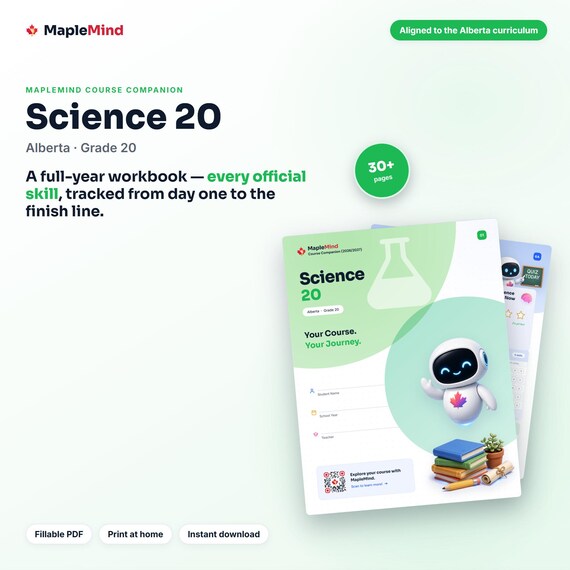


Printable workbook · A keepsake of the year
A Science 20 workbook worth keeping
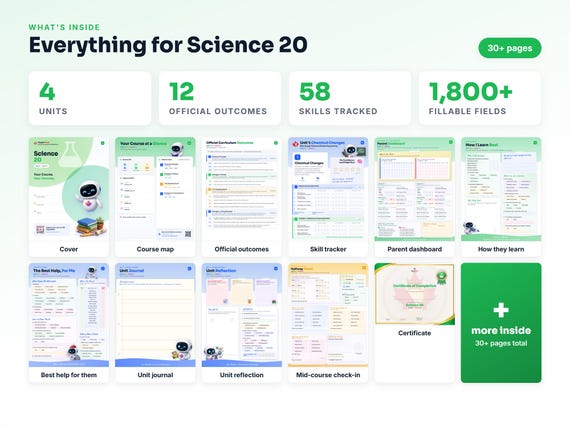
Built from the same official curriculum as this page. Before and after each skill above, your student colours in how sure they feel — so the two of you can see, on one page, what's clicking and what needs another look. It's a quiet way to follow how the year is really going.
By June it's full of their own handwriting: units worked through, confidence grown, a mid-year check-in, notes from parent-teacher night, and a certificate at the end. Less a worksheet, more a record of the year worth keeping on the shelf.
Instant download · see every page, reviews and the full description · five or more workbooks are $2.99 each
What it looks like in the app



Common questions
Can MapleMind help me with Science 20?
Yes. MapleMind's AI tutor covers all 58 skills in Alberta's Science 20 — you pick the exact skill, and the tutor teaches it step by step: a short lesson, a worked example, solving together, then a skill check to show it stuck.
Is MapleMind aligned to Alberta's official curriculum?
Yes. Every skill in this course maps to an official outcome code from Alberta's Grade 11 Science curriculum, and the ministry's own wording is quoted under each unit on this page — with the official government source linked so you can check it yourself.
What does MapleMind cost?
It's free to start — 5 tutoring chats and a practice quiz every day, no credit card. A Pro subscription ($9.99/month or $49.99/year CAD, 7-day free trial) unlocks unlimited tutoring, practice, and exam simulations.
What if I'm stuck on just one topic?
That's the point of skill-level tutoring: open Science 20 in the app, tap the exact skill from the list on this page, and the tutor teaches just that — no wading through lessons you don't need.
Does MapleMind work in French or other languages?
Yes — 14 languages, including French. Both the app and the tutor's explanations switch to the language you choose.
Where can I see the official Alberta curriculum for Science 20?
The official source is linked on this page — Alberta's official programs of study. The outline here follows it: every MapleMind skill carries its official outcome code, and the ministry's own wording is quoted under each unit.
Keep exploring
Ready when you are
Pick a skill from this page and see it taught properly — free, in the browser, in under a minute.