Get help with Science 14
Most tutoring makes you sit through material you already know. MapleMind flips that: pick the exact skill that's causing trouble — any of the 21 below — and the tutor teaches just that one, step by step, as many times as it takes. Ask questions in plain words, any time of day, in English, French, or 12 other languages.
The official Alberta Science 14 curriculum
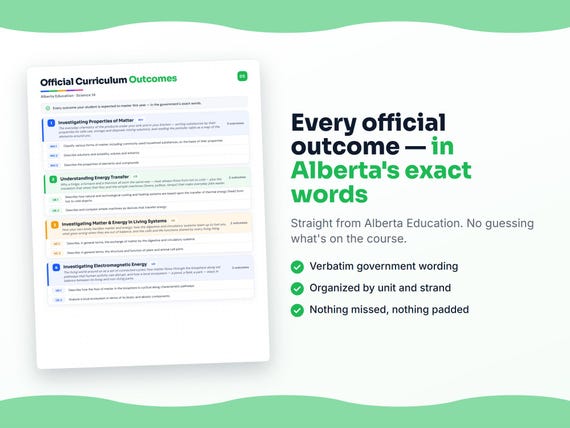
Alberta defines Science 14 by strands and outcomes. MapleMind teaches the same curriculum reorganized for one-skill-at-a-time tutoring — the table shows exactly where every official strand lands, and the ministry's own wording is quoted under each unit below.
Official source Alberta's official programs of studyRead it on the government site — alberta.ca ↗| Official strand | Outcomes | Where MapleMind teaches it |
|---|---|---|
| Unit A | 3 | Investigating Properties of Matter |
| Unit B | 3 | Understanding Energy Transfer |
| Unit C | 4 | Investigating Matter & Energy in Living Systems |
| Unit D | 2 | Investigating Electromagnetic Energy |
Every skill below, taught one on one.
 Try the first session free
How MapleMind teaches Science 14 — every unit, lesson, and skill
Every skill below runs as a short session: a plain-words lesson, a worked example, solving it together, then a five-question skill check that earns up to three stars. Guided Mode keeps it teaching instead of answer-handing — turning it off needs a parent's password.
Unit 1Investigating Properties of MatterOfficial strand · Unit A
The everyday chemistry of the products under your sink and in your kitchen — sorting substances by their properties for safe use, storage and disposal, mixing solutions, and reading the periodic table as a map of the elements around you.
Classifying Household Matter
- Classifying matter by its properties14.A.1 — Classify various forms of matter, including commonly used household substances, on the basis of observable properties like state, colour, smell, flammability and whether it is acidic or basic.
- Safe use, storage and disposal14.A.1 — Relate a household substance's properties to its safe use, storage and disposal — reading WHMIS/hazard labels and knowing which products must be kept apart or taken to proper disposal.
Solutions & Solubility
- Solutions, solubility, solutes and solvents14.A.2 — Describe what a solution is and define solubility, solute and solvent — a solute (like sugar) dissolving in a solvent (like water), and how much a solvent can hold.
- Solutions in prepared foods and everyday materials14.A.2 — Describe how the ideas of solutions and solubility are applied to the production of prepared foods and other useful everyday materials — drinks, sauces, cleaning products.
Elements, Compounds & the Periodic Table
- Properties of elements and compounds14.A.3 — Describe the properties of elements and compounds — an element is one kind of atom (copper, oxygen), a compound is two or more elements chemically joined into something new (table salt, water).
- Reading trends on the periodic table14.A.3 — Use the periodic table to identify trends in properties — metals on the left, non-metals on the right, and columns (groups) holding elements that behave alike.
The official wording — 3 outcomes in this unit
- 14.A.1
Classify various forms of matter, including commonly used household substances, on the basis of their properties
- 14.A.2
Describe solutions and solubility, solutes and solvents
- 14.A.3
Describe the properties of elements and compounds
Unit 2Understanding Energy TransferOfficial strand · Unit B
Why a fridge, a furnace and a thermos all work the same way — heat always flows from hot to cold — plus the insulation that slows that flow and the simple machines (levers, pulleys, ramps) that make everyday jobs easier.
Heating, Cooling & Controlling Heat Transfer
- How heating & cooling systems move heat14.B.1 — Describe how natural and technological cooling and heating systems — like a refrigerator or a home furnace — work by transferring thermal energy (heat) from hot to cold objects.
- Devices that control heat transfer14.B.2 — Explain how common methods and devices — insulation, a thermos, weather-stripping — are designed to control the transfer of thermal energy.
Simple Machines at Work
- Simple machines that transfer energy14.B.3 — Describe and compare simple machines — levers, pulleys, ramps, gears, wheels-and-axles — as devices that transfer energy from your effort to the load.
- Multiplying force or distance14.B.3 — Explain how simple machines multiply forces or distances — trading a small force over a long distance for a big force over a short one, without ever giving you free energy.
The official wording — 3 outcomes in this unit
- 14.B.1
Describe how natural and technological cooling and heating systems are based upon the transfer of thermal energy (heat) from hot to cold objects
- 14.B.2
Explain the functioning of common methods and devices designed to control the transfer of thermal energy
- 14.B.3
Describe and compare simple machines as devices that transfer energy
Unit 3Investigating Matter & Energy in Living SystemsOfficial strand · Unit C
How your own body handles matter and energy: how the digestive and circulatory systems team up to fuel you, what goes wrong when they are out of balance, and the cells and life functions shared by every living thing.
Digestion, Circulation & a Healthy Lifestyle
- How the two systems exchange matter14.C.1 — Describe, in general terms, the exchange of matter by the digestive and circulatory systems — digestion breaks food into small nutrients absorbed into the blood, which carries them onward.
- How digestion and circulation work together14.C.1 — Describe the functional relationship between the digestive and circulatory systems — how the two systems hand matter off to each other to fuel every cell in the body.
- Why a healthy diet and lifestyle matter14.C.1 — Explain the need for a healthy diet and lifestyle — balanced food, water, activity and not smoking — to keep the digestive and circulatory systems working well.
- Disorders of the digestive & circulatory systems14.C.2 — Describe disorders of the digestive and circulatory systems as imbalances induced by genetic, lifestyle and environmental factors — like heartburn, high blood pressure or heart disease.
Cells & the Functions of Life
- Plant and animal cell parts14.C.3 — Describe, in general terms, the structure and function of plant and animal cell parts — nucleus, membrane, cytoplasm, and the cell wall and chloroplasts that plant cells add.
- How the cell theory developed14.C.3 — Trace the development of the cell theory — built up over time as better microscopes let many scientists add the evidence that all living things are made of cells.
- Life functions common to all living systems14.C.4 — Identify and compare, in general terms, the life functions common to living systems, from a single cell all the way up to organ systems.
The official wording — 4 outcomes in this unit
- 14.C.1
Describe, in general terms, the exchange of matter by the digestive and circulatory systems
- 14.C.2
Describe disorders of the digestive and circulatory systems as imbalances induced by genetic, lifestyle and environmental factors
- 14.C.3
Describe, in general terms, the structure and function of plant and animal cell parts
- 14.C.4
Identify and compare, in general terms, the life functions common to living systems, from cells to organ systems
Unit 4Investigating Electromagnetic EnergyOfficial strand · Unit D
The living world around us as a set of connected cycles: how matter flows through the biosphere along set pathways that human activity can disrupt, and how a local ecosystem — a pond, a field, a park — stays in balance between its living and non-living parts.
Matter Cycles in the Biosphere
- Cyclical flow of matter along set pathways14.D.1 — Describe how the flow of matter in the biosphere is cyclical along characteristic pathways — water, carbon and nitrogen moving through set loops so the same atoms get reused again and again.
- How human activity disrupts the cycles14.D.1 — Describe how the flow of matter can be disrupted by human activity — burning fuels, fertilizer runoff and pollution overloading a natural cycle so "away" is never really away.
Local Ecosystems in Balance
- Biotic and abiotic components of an ecosystem14.D.2 — Analyze a local ecosystem — a pond, field or park — in terms of its biotic (living) and abiotic (non-living) components, and how the living things depend on the non-living conditions.
- What keeps an ecosystem in balance14.D.2 — Describe the factors of the equilibrium that keep a local ecosystem in balance — predator and prey, producers and consumers, water and nutrient supply — and what happens when one shifts.
The official wording — 2 outcomes in this unit
- 14.D.1
Describe how the flow of matter in the biosphere is cyclical along characteristic pathways
- 14.D.2
Analyze a local ecosystem in terms of its biotic and abiotic components
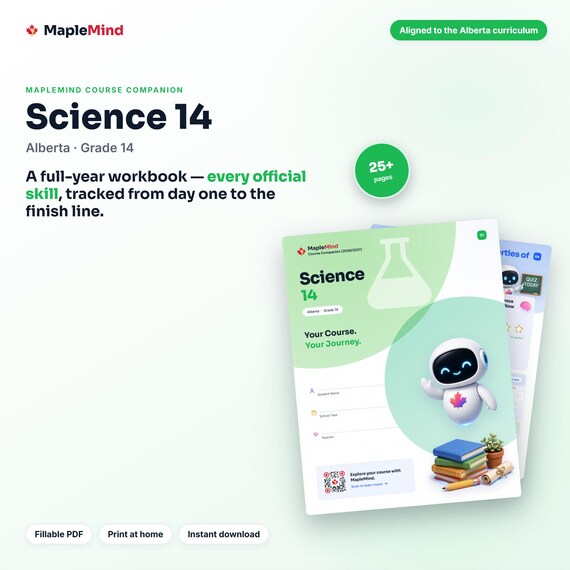
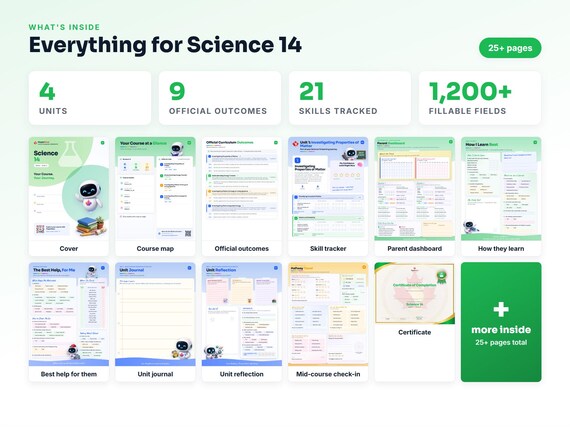
Printable workbook · A keepsake of the year
A Science 14 workbook worth keeping
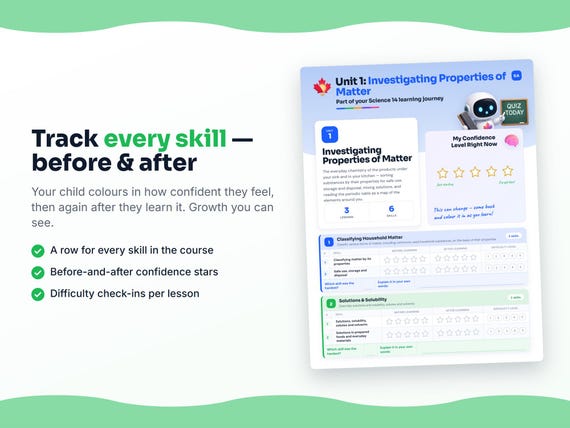
Built from the same official curriculum as this page. Before and after each skill above, your student colours in how sure they feel — so the two of you can see, on one page, what's clicking and what needs another look. It's a quiet way to follow how the year is really going.
By June it's full of their own handwriting: units worked through, confidence grown, a mid-year check-in, notes from parent-teacher night, and a certificate at the end. Less a worksheet, more a record of the year worth keeping on the shelf.
Instant download · see every page, reviews and the full description · five or more workbooks are $2.99 each
What it looks like in the app
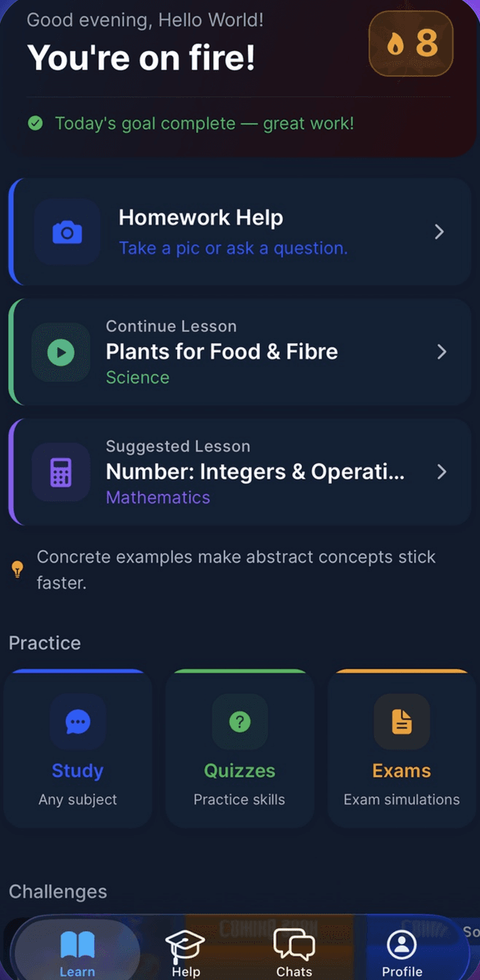
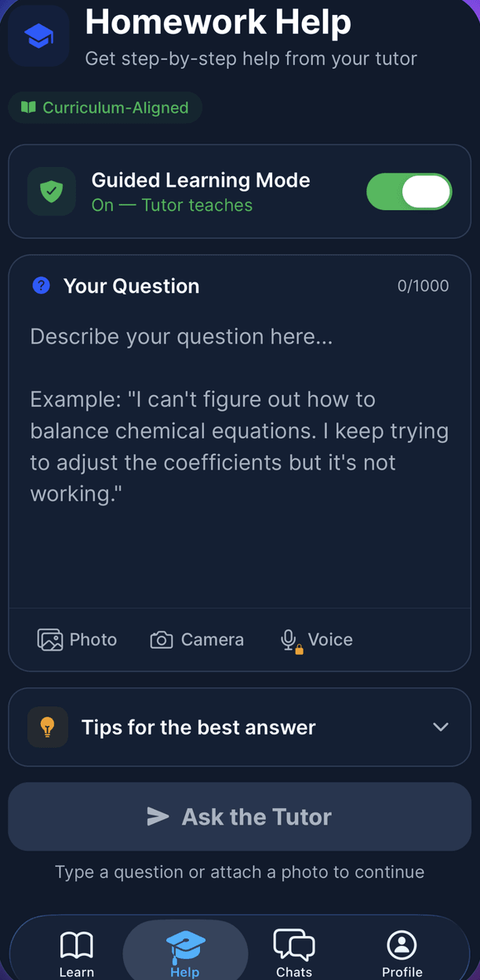
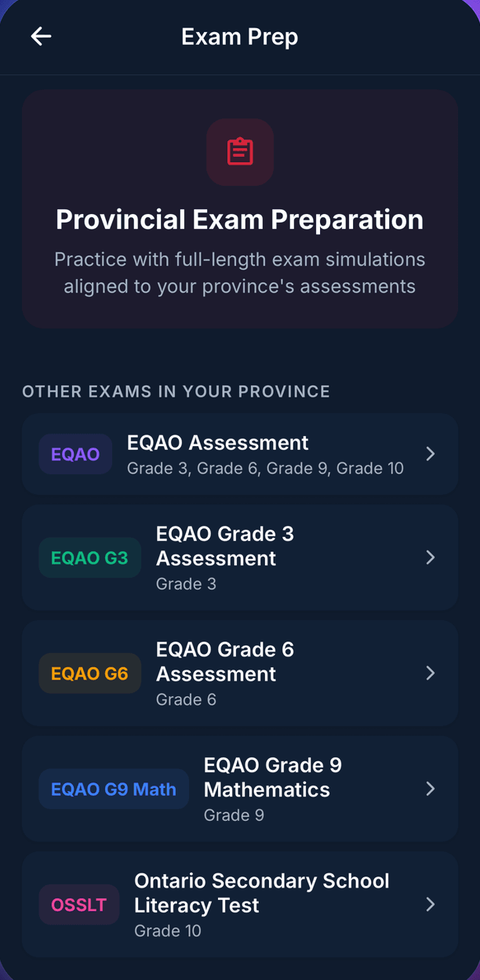
Common questions
Can MapleMind help me with Science 14?
Yes. MapleMind's AI tutor covers all 21 skills in Alberta's Science 14 — you pick the exact skill, and the tutor teaches it step by step: a short lesson, a worked example, solving together, then a skill check to show it stuck.
Is MapleMind aligned to Alberta's official curriculum?
Yes. Every skill in this course maps to an official outcome code from Alberta's Grade 10 Science curriculum, and the ministry's own wording is quoted under each unit on this page — with the official government source linked so you can check it yourself.
What does MapleMind cost?
It's free to start — 5 tutoring chats and a practice quiz every day, no credit card. A Pro subscription ($9.99/month or $49.99/year CAD, 7-day free trial) unlocks unlimited tutoring, practice, and exam simulations.
What if I'm stuck on just one topic?
That's the point of skill-level tutoring: open Science 14 in the app, tap the exact skill from the list on this page, and the tutor teaches just that — no wading through lessons you don't need.
Does MapleMind work in French or other languages?
Yes — 14 languages, including French. Both the app and the tutor's explanations switch to the language you choose.
Where can I see the official Alberta curriculum for Science 14?
The official source is linked on this page — Alberta's official programs of study. The outline here follows it: every MapleMind skill carries its official outcome code, and the ministry's own wording is quoted under each unit.
Keep exploring
Ready when you are
Pick a skill from this page and see it taught properly — free, in the browser, in under a minute.