Get help with Science 9
Most tutoring makes you sit through material you already know. MapleMind flips that: pick the exact skill that's causing trouble — any of the 15 below — and the tutor teaches just that one, step by step, as many times as it takes. Ask questions in plain words, any time of day, in English, French, or 12 other languages.
The official British Columbia Science 9 curriculum
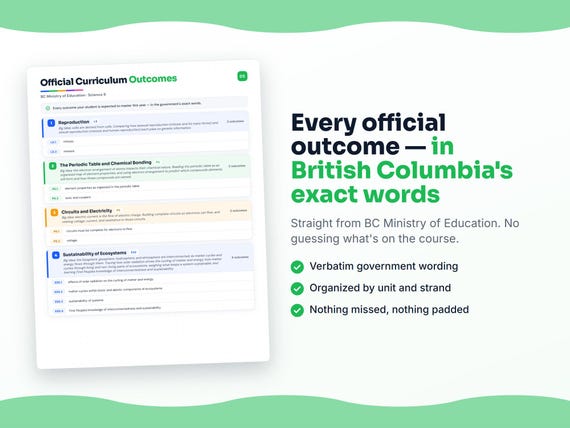
British Columbia defines Science 9 by strands and outcomes. MapleMind teaches the same curriculum reorganized for one-skill-at-a-time tutoring — the table shows exactly where every official strand lands, and the ministry's own wording is quoted under each unit below.
Official source BC's official science curriculumRead it on the government site — curriculum.gov.bc.ca ↗| Official strand | Outcomes | Where MapleMind teaches it |
|---|---|---|
| Life Science | 4 | Reproduction |
| Physical Science | 7 | The Periodic Table and Chemical Bonding · Circuits and Electricity |
| Earth and Space Science | 4 | Sustainability of Ecosystems |
Every skill below, taught one on one.
 Try the first session free
How MapleMind teaches Science 9 — every unit, lesson, and skill
Every skill below runs as a short session: a plain-words lesson, a worked example, solving it together, then a five-question skill check that earns up to three stars. Guided Mode keeps it teaching instead of answer-handing — turning it off needs a parent's password.
Unit 1ReproductionOfficial strand · Life Science
Big Idea: cells are derived from cells. Comparing how asexual reproduction (mitosis and its many forms) and sexual reproduction (meiosis and human reproduction) each pass on genetic information.
Asexual Reproduction
- Mitosis9.AR.1 — Explain mitosis as the process by which a pre-existing cell makes two genetically identical copies of itself, and connect it to how organisms grow and repair tissue.
- Forms of asexual reproduction9.AR.2 — Identify different forms asexual reproduction takes across organisms — fission, budding, cloning, spores, and grafting — and recognize that each produces offspring genetically identical to the single parent.
Sexual Reproduction
- Meiosis9.SXR.1 — Explain meiosis as the process by which a parent cell divides twice to form sex cells (eggs and sperm), each carrying half the genetic information, resulting in four daughter cells.
- Human sexual reproduction9.SXR.2 — Describe the basic process of human sexual reproduction and explain that because humans have two parents, offspring are genetically similar to, but not identical to, either parent.
The official wording — 4 outcomes in this unit
- 9.AR.1
mitosis
- 9.AR.2
forms of asexual reproduction
- 9.SXR.1
meiosis
- 9.SXR.2
human sexual reproduction
Unit 2The Periodic Table and Chemical BondingOfficial strand · Physical Science
Big Idea: the electron arrangement of atoms impacts their chemical nature. Reading the periodic table as an organized map of element properties, and using electron arrangement to predict which compounds elements will form and how those compounds are named.
How the Periodic Table Is Organized
- Element properties in the periodic table9.PTB.1 — Use the periodic table to identify how elements are grouped by atomic number and properties — atomic size, metal/non-metal/semi-metal status, chemical families, and diatomic elements.
Compounds Formed by Elements
- Ionic and covalent compounds9.CMP.1 — Distinguish ionic compounds (formed when electrons are transferred between a metal and a non-metal) from covalent compounds (formed when electrons are shared between non-metals).
- Names and formulas of compounds9.CMP.2 — Write the chemical formula for a simple compound from its name, and name a simple compound from its chemical formula, using standard chemical notation.
The official wording — 3 outcomes in this unit
- 9.PTB.1
element properties as organized in the periodic table
- 9.CMP.1
ionic and covalent
- 9.CMP.2
names and formulas
Unit 3Circuits and ElectricityOfficial strand · Physical Science
Big Idea: electric current is the flow of electric charge. Building complete circuits so electrons can flow, and relating voltage, current, and resistance in those circuits.
What Makes a Circuit Complete
- Complete circuits let electrons flow9.CIR.1 — Explain that a circuit must be complete (an unbroken loop through a power source, a load such as a lightbulb, a conductor, and a switch) for electrons to flow, and identify why a break anywhere in the loop stops current.
Voltage, Current, and Resistance
- Voltage9.VCR.1 — Describe voltage as the electrical push that drives electrons through a circuit, measured in volts, and relate it to the relative dangers of high-voltage sources.
- Current9.VCR.2 — Describe current as the flow of electric charge through a circuit, measured in amps, and distinguish alternating current (AC) from direct current (DC).
- Resistance9.VCR.3 — Describe resistance as whatever slows the flow of current in a circuit, measured in ohms, and use Ohm's Law (V = IR) to relate voltage, current, and resistance in a simple circuit.
The official wording — 4 outcomes in this unit
- 9.CIR.1
circuits must be complete for electrons to flow
- 9.VCR.1
voltage
- 9.VCR.2
current
- 9.VCR.3
resistance
Unit 4Sustainability of EcosystemsOfficial strand · Earth and Space Science
Big Idea: the biosphere, geosphere, hydrosphere, and atmosphere are interconnected, as matter cycles and energy flows through them. Tracing how solar radiation drives the cycling of matter and energy, how matter cycles through living and non-living parts of ecosystems, weighing what keeps a system sustainable, and learning First Peoples knowledge of interconnectedness and sustainability.
Solar Radiation and the Cycling of Matter and Energy
- How the sun drives matter and energy cycles9.SOL.1 — Explain how solar radiation provides the energy required for most life on Earth and drives the cycling of matter and energy — powering wind and ocean currents that distribute energy and nutrients, and driving the water cycle.
Matter Cycling Through Ecosystems
- Matter moving between living and non-living parts9.MCY.1 — Trace how matter (such as water, nitrogen, carbon, and phosphorus) cycles within the biotic (living) and abiotic (non-living) components of an ecosystem, including how human impacts like climate change, deforestation, and agriculture disrupt these cycles through bioaccumulation and biomagnification.
What Keeps a System Sustainable
- Judging whether a system is sustainable9.SUS.1 — Evaluate whether a system is sustainable using a systems approach that sees matter and energy as interconnected and existing in dynamic equilibrium, using evidence such as carbon's role in climate change, the greenhouse effect, and the water cycle.
First Peoples Knowledge of Interconnectedness
- First Peoples knowledge of interconnectedness and sustainability9.FPS.1 — Learn First Peoples knowledge that shows how everything is connected, from local to global, and how First Peoples perspectives on interconnectedness and sustainability of systems have guided sustainable relationships with land, water, and resources over many generations.
The official wording — 4 outcomes in this unit
- 9.SOL.1
effects of solar radiation on the cycling of matter and energy
- 9.MCY.1
matter cycles within biotic and abiotic components of ecosystems
- 9.SUS.1
sustainability of systems
- 9.FPS.1
First Peoples knowledge of interconnectedness and sustainability
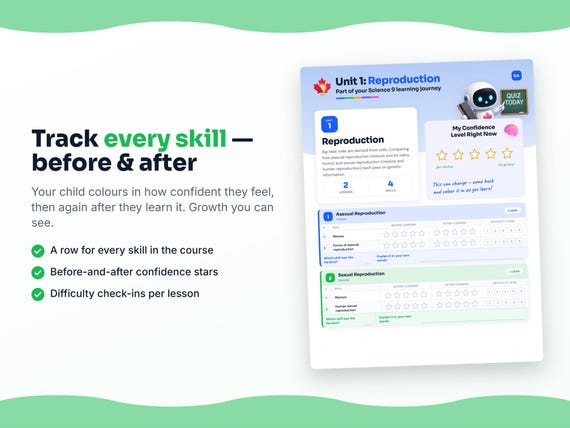
Printable workbook · A keepsake of the year
A Science 9 workbook worth keeping
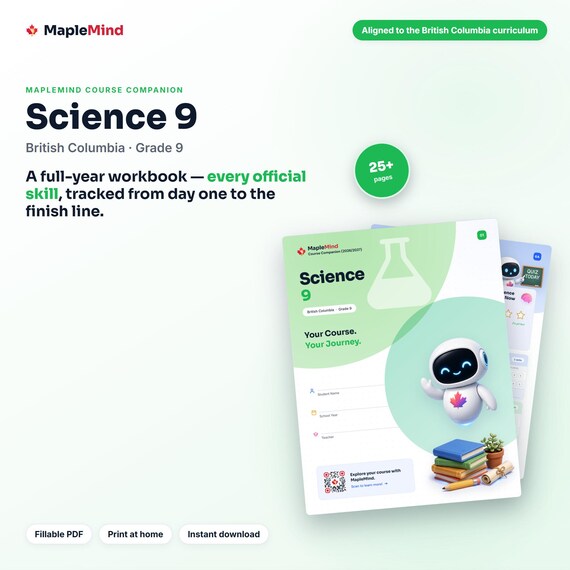
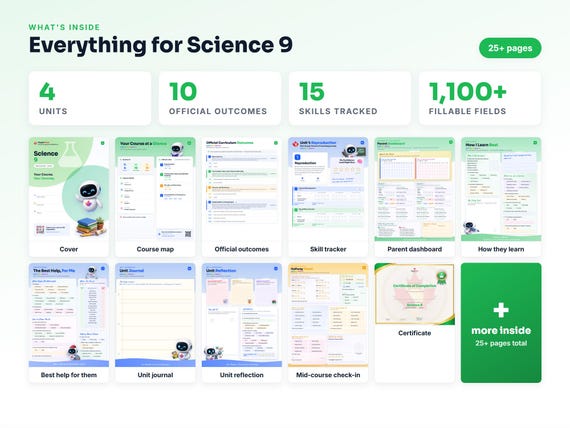
Built from the same official curriculum as this page. Before and after each skill above, your student colours in how sure they feel — so the two of you can see, on one page, what's clicking and what needs another look. It's a quiet way to follow how the year is really going.
By June it's full of their own handwriting: units worked through, confidence grown, a mid-year check-in, notes from parent-teacher night, and a certificate at the end. Less a worksheet, more a record of the year worth keeping on the shelf.
Instant download · see every page, reviews and the full description · five or more workbooks are $2.99 each
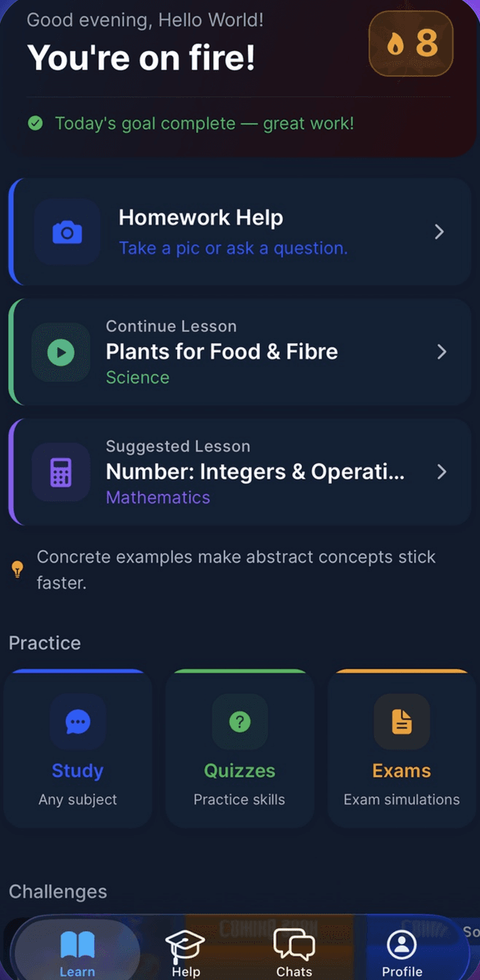
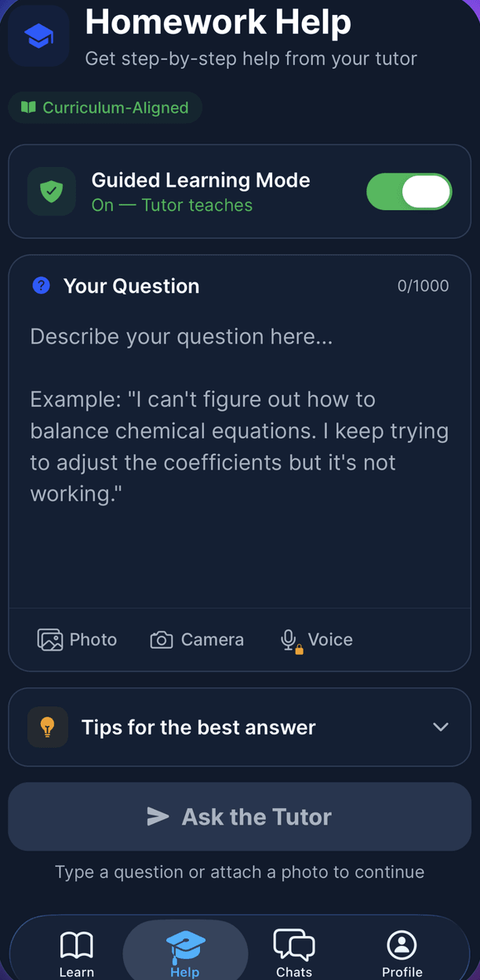
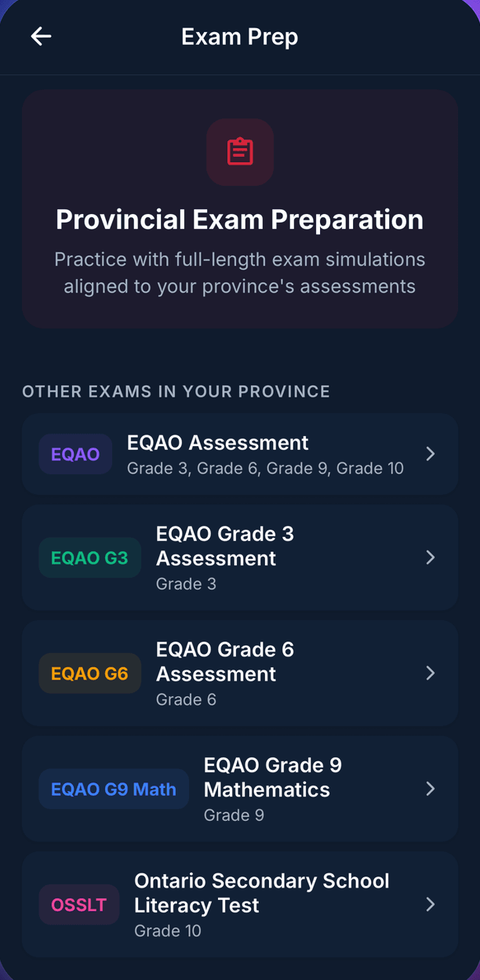
What it looks like in the app
Common questions
Can MapleMind help me with Science 9?
Yes. MapleMind's AI tutor covers all 15 skills in British Columbia's Science 9 — you pick the exact skill, and the tutor teaches it step by step: a short lesson, a worked example, solving together, then a skill check to show it stuck.
Is MapleMind aligned to British Columbia's official curriculum?
Yes. Every skill in this course maps to an official outcome code from British Columbia's Grade 9 Science curriculum, and the ministry's own wording is quoted under each unit on this page — with the official government source linked so you can check it yourself.
What does MapleMind cost?
It's free to start — 5 tutoring chats and a practice quiz every day, no credit card. A Pro subscription ($9.99/month or $49.99/year CAD, 7-day free trial) unlocks unlimited tutoring, practice, and exam simulations.
What if I'm stuck on just one topic?
That's the point of skill-level tutoring: open Science 9 in the app, tap the exact skill from the list on this page, and the tutor teaches just that — no wading through lessons you don't need.
Does MapleMind work in French or other languages?
Yes — 14 languages, including French. Both the app and the tutor's explanations switch to the language you choose.
Where can I see the official British Columbia curriculum for Science 9?
The official source is linked on this page — BC's official science curriculum. The outline here follows it: every MapleMind skill carries its official outcome code, and the ministry's own wording is quoted under each unit.
Keep exploring
Ready when you are
Pick a skill from this page and see it taught properly — free, in the browser, in under a minute.