Get help with Science 8
Most tutoring makes you sit through material you already know. MapleMind flips that: pick the exact skill that's causing trouble — any of the 25 below — and the tutor teaches just that one, step by step, as many times as it takes. Ask questions in plain words, any time of day, in English, French, or 12 other languages.
The official British Columbia Science 8 curriculum
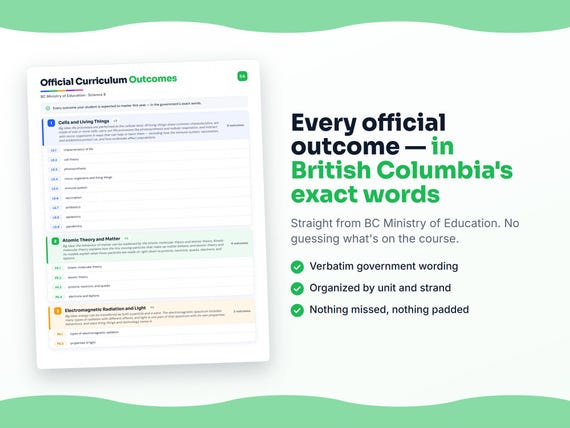
British Columbia defines Science 8 by strands and outcomes. MapleMind teaches the same curriculum reorganized for one-skill-at-a-time tutoring — the table shows exactly where every official strand lands, and the ministry's own wording is quoted under each unit below.
Official source BC's official science curriculumRead it on the government site — curriculum.gov.bc.ca ↗| Official strand | Outcomes | Where MapleMind teaches it |
|---|---|---|
| Life Science | 11 | Cells and Living Things |
| Physical Science | 10 | Atomic Theory and Matter · Electromagnetic Radiation and Light |
| Earth and Space Science | 4 | Plate Tectonics and Earth's Structure |
Every skill below, taught one on one.
 Try the first session free
How MapleMind teaches Science 8 — every unit, lesson, and skill
Every skill below runs as a short session: a plain-words lesson, a worked example, solving it together, then a five-question skill check that earns up to three stars. Guided Mode keeps it teaching instead of answer-handing — turning it off needs a parent's password.
Unit 1Cells and Living ThingsOfficial strand · Life Science
Big Idea: life processes are performed at the cellular level. All living things share common characteristics, are made of one or more cells, carry out life processes like photosynthesis and cellular respiration, and interact with micro-organisms in ways that can help or harm them — including how the immune system, vaccination, and antibiotics protect us, and how outbreaks affect populations.
What Makes Something Alive?
- The characteristics of life8.COL.1 — Identify the characteristics that all living things share — respiring, growing, taking in nutrients, producing waste, responding to stimuli, and reproducing — and use them to decide whether something is alive.
Cell Theory and Types of Cells
- Cell theory8.CT.1 — Explain cell theory — that living things are made of one or more cells, all cells come from pre-existing cells, and the cell is the basic unit of life.
- Types of cells8.CT.2 — Compare types of cells — prokaryotic and eukaryotic, plant and animal — and identify structures within a cell that carry out essential functions.
Photosynthesis and Cellular Respiration
- Photosynthesis8.PR.1 — Explain photosynthesis as the process plant cells use to capture light energy and make food.
- Cellular respiration8.PR.2 — Explain cellular respiration as the process cells use to release energy from food, and describe how it connects to photosynthesis.
Micro-organisms and Living Things
- How micro-organisms interact with living things8.MO.1 — Describe how micro-organisms act as decomposers that recycle nutrients in ecosystems, and how viruses and bacteria can cause disease but can also be used in industry and agriculture.
The Immune System
- The immune system8.MO.2 — Describe the basic functions of the immune system in providing a barrier to infection and mounting non-specific and specific responses, and explain why different populations can have different immunity to certain infections.
Vaccination
- Vaccination8.MO.3 — Explain how vaccination can prevent the spread of infectious disease.
Antibiotics
- Antibiotics8.MO.4 — Explain that antibiotics are effective only against living organisms such as bacteria and not against viruses, and describe how overusing antibiotics can lead to antibiotic-resistant "superbugs".
Epidemics
- Epidemics8.MO.5 — Describe epidemics as regional disease outbreaks and give examples of their impact on human populations.
Pandemics
- Pandemics8.MO.6 — Describe pandemics as global disease outbreaks and give examples of their impact on human populations.
The official wording — 11 outcomes in this unit
- 8.COL.1
characteristics of life
- 8.CT.1
cell theory
- 8.CT.2
types of cells
- 8.PR.1
photosynthesis
- 8.PR.2
cellular respiration
- 8.MO.1
micro-organisms and living things
- 8.MO.2
immune system
- 8.MO.3
vaccination
- 8.MO.4
antibiotics
- 8.MO.5
epidemics
- 8.MO.6
pandemics
Unit 2Atomic Theory and MatterOfficial strand · Physical Science
Big Idea: the behaviour of matter can be explained by the kinetic molecular theory and atomic theory. Kinetic molecular theory explains how the tiny moving particles that make up matter behave, and atomic theory and its models explain what those particles are made of, right down to protons, neutrons, quarks, electrons, and leptons.
Kinetic Molecular Theory
- Kinetic molecular theory8.KMT.1 — Use kinetic molecular theory to explain how particles move differently in solids, liquids, and gases.
Atomic Theory and Models of the Atom
- Atomic theory8.AT.1 — Describe atomic theory as the body of evidence that provides support for the existence of atoms and molecules.
- Models of the atom8.AT.2 — Describe how models represent the arrangement and motion of particles in different phases, the arrangement of and forces that bind protons, neutrons, and electrons in an atom, and the quarks and leptons inside them.
Protons, Neutrons, and Quarks
- Protons, neutrons, and quarks8.PNQ.1 — Identify protons and neutrons as the particles held together in the nucleus by the strong nuclear force, and describe quarks as the smaller particles that make them up.
Electrons and Leptons
- Electrons and leptons8.ELN.1 — Identify electrons as a type of lepton held at a distance from the nucleus through electromagnetism.
The official wording — 5 outcomes in this unit
- 8.KMT.1
kinetic molecular theory
- 8.AT.1
atomic theory
- 8.AT.2
models
- 8.PNQ.1
protons, neutrons, and quarks
- 8.ELN.1
electrons and leptons
Unit 3Electromagnetic Radiation and LightOfficial strand · Physical Science
Big Idea: energy can be transferred as both a particle and a wave. The electromagnetic spectrum includes many types of radiation with different effects, and light is one part of that spectrum with its own properties, behaviours, and ways living things and technology sense it.
Types and Effects of Electromagnetic Radiation
- Types of electromagnetic radiation8.EMR.1 — Identify the types of electromagnetic radiation across the electromagnetic spectrum — radio, microwave, infrared, light, UV, X-ray, and gamma rays.
- Effects of electromagnetic radiation8.EMR.2 — Describe positive and negative effects of electromagnetic radiation, such as cancer treatments and sunburns.
Light: Properties, Behaviours, and Sensing
- Properties of light8.LT.1 — Describe the properties of light — that it acts like both a wave and a particle, and has wavelength, amplitude, and frequency.
- Behaviours of light8.LT.2 — Describe the behaviours of light — reflection, refraction, absorption, transmission, and scattering — and how lenses and mirrors form images, and how translucent, transparent, and opaque objects affect light differently.
- Ways of sensing light8.LT.3 — Describe the ways living things and technology sense light — human vision, optical instruments, and cameras.
The official wording — 5 outcomes in this unit
- 8.EMR.1
types of electromagnetic radiation
- 8.EMR.2
effects of electromagnetic radiation
- 8.LT.1
properties of light
- 8.LT.2
behaviours of light
- 8.LT.3
ways of sensing light
Unit 4Plate Tectonics and Earth's StructureOfficial strand · Earth and Space Science
Big Idea: the theory of plate tectonics is the unifying theory that explains Earth's geological processes. The movement of Earth's tectonic plates explains major geological events, Earth is made of distinct layers, and First Peoples hold knowledge of local geological formations and events passed down through generations.
How Tectonic Plates Move
- Plate tectonic movement8.PT.1 — Explain plate tectonic movement — the types of plate movements, plate boundaries, and how that movement causes earthquakes and volcanoes.
Major Geological Events Near Us
- Major geological events of local significance8.GE.1 — Describe major geological events of local significance and connect them to plate tectonic activity.
First Peoples Knowledge of the Land
- First Peoples knowledge of local geological formations and events8.FPG.1 — Learn First Peoples knowledge of local geological formations and significant local geological events, passed down through oral history and observation over many generations.
The Layers of Earth
- Earth's layers8.LE.1 — Identify the layers of Earth and describe how their differing properties relate to plate tectonic movement.
The official wording — 4 outcomes in this unit
- 8.PT.1
plate tectonic movement
- 8.GE.1
major geological events of local significance
- 8.FPG.1
First Peoples knowledge of local geological formations and events
- 8.LE.1
layers of Earth
Printable workbook · A keepsake of the year
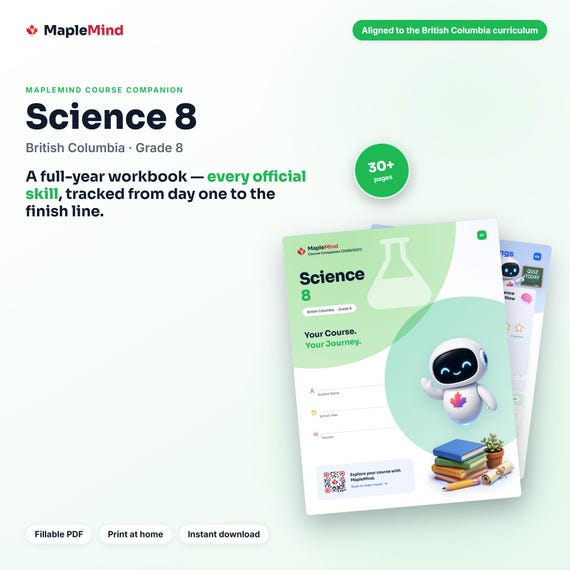
A Science 8 workbook worth keeping
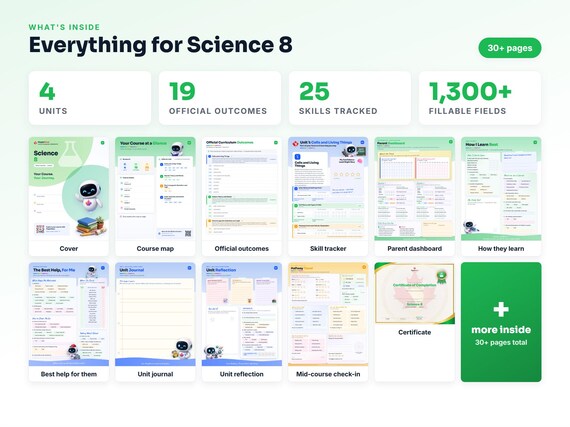
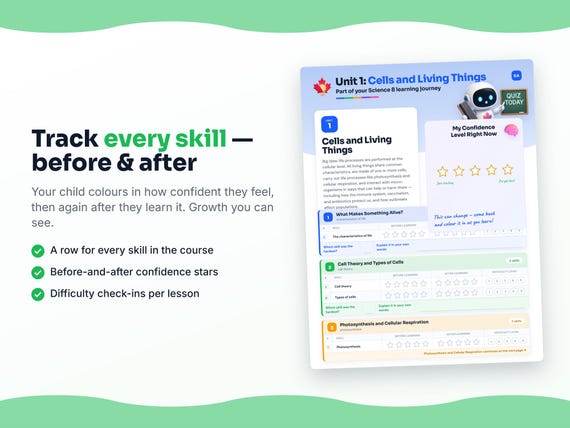
Built from the same official curriculum as this page. Before and after each skill above, your student colours in how sure they feel — so the two of you can see, on one page, what's clicking and what needs another look. It's a quiet way to follow how the year is really going.
By June it's full of their own handwriting: units worked through, confidence grown, a mid-year check-in, notes from parent-teacher night, and a certificate at the end. Less a worksheet, more a record of the year worth keeping on the shelf.
Instant download · see every page, reviews and the full description · five or more workbooks are $2.99 each
What it looks like in the app
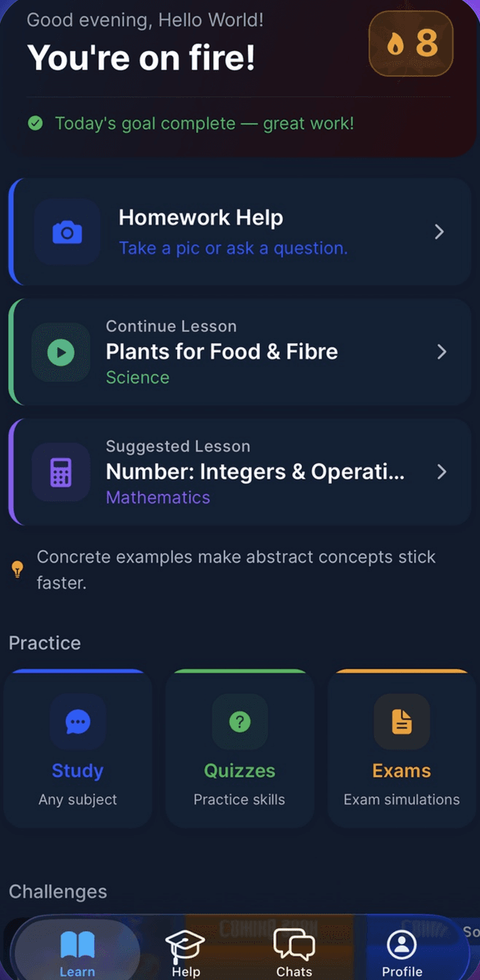
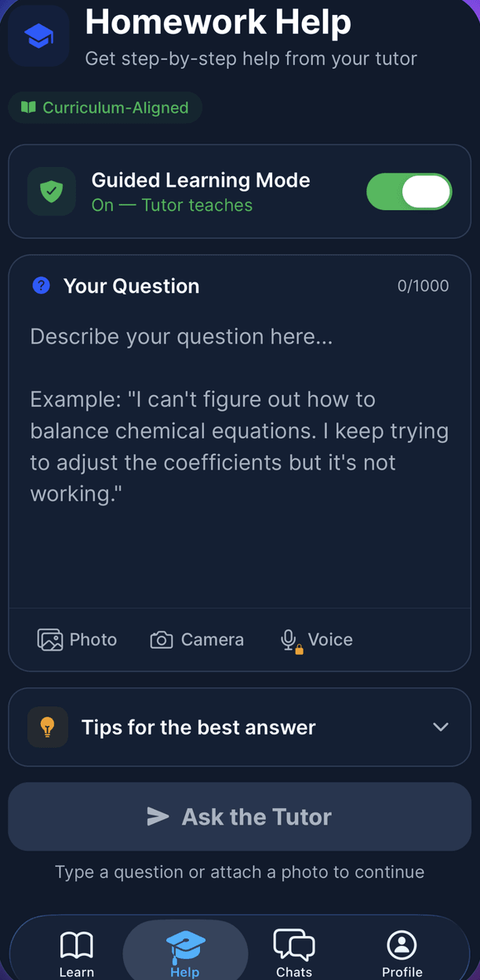
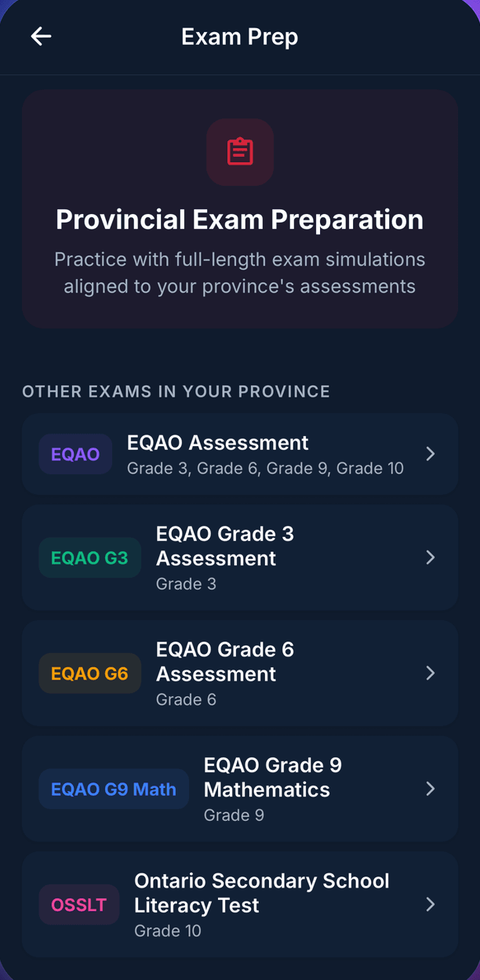
Common questions
Can MapleMind help me with Science 8?
Yes. MapleMind's AI tutor covers all 25 skills in British Columbia's Science 8 — you pick the exact skill, and the tutor teaches it step by step: a short lesson, a worked example, solving together, then a skill check to show it stuck.
Is MapleMind aligned to British Columbia's official curriculum?
Yes. Every skill in this course maps to an official outcome code from British Columbia's Grade 8 Science curriculum, and the ministry's own wording is quoted under each unit on this page — with the official government source linked so you can check it yourself.
What does MapleMind cost?
It's free to start — 5 tutoring chats and a practice quiz every day, no credit card. A Pro subscription ($9.99/month or $49.99/year CAD, 7-day free trial) unlocks unlimited tutoring, practice, and exam simulations.
What if I'm stuck on just one topic?
That's the point of skill-level tutoring: open Science 8 in the app, tap the exact skill from the list on this page, and the tutor teaches just that — no wading through lessons you don't need.
Does MapleMind work in French or other languages?
Yes — 14 languages, including French. Both the app and the tutor's explanations switch to the language you choose.
Where can I see the official British Columbia curriculum for Science 8?
The official source is linked on this page — BC's official science curriculum. The outline here follows it: every MapleMind skill carries its official outcome code, and the ministry's own wording is quoted under each unit.
Keep exploring
Ready when you are
Pick a skill from this page and see it taught properly — free, in the browser, in under a minute.