Get help with Science 7
Most tutoring makes you sit through material you already know. MapleMind flips that: pick the exact skill that's causing trouble — any of the 14 below — and the tutor teaches just that one, step by step, as many times as it takes. Ask questions in plain words, any time of day, in English, French, or 12 other languages.
The official British Columbia Science 7 curriculum
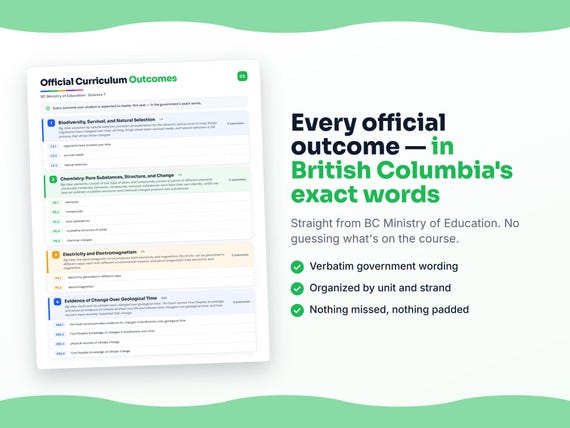
British Columbia defines Science 7 by strands and outcomes. MapleMind teaches the same curriculum reorganized for one-skill-at-a-time tutoring — the table shows exactly where every official strand lands, and the ministry's own wording is quoted under each unit below.
Official source BC's official science curriculumRead it on the government site — curriculum.gov.bc.ca ↗| Official strand | Outcomes | Where MapleMind teaches it |
|---|---|---|
| Life Science | 3 | Biodiversity, Survival, and Natural Selection |
| Physical Science | 7 | Chemistry: Pure Substances, Structure, and Change · Electricity and Electromagnetism |
| Earth and Space Science | 4 | Evidence of Change Over Geological Time |
Every skill below, taught one on one.
 Try the first session free
How MapleMind teaches Science 7 — every unit, lesson, and skill
Every skill below runs as a short session: a plain-words lesson, a worked example, solving it together, then a five-question skill check that earns up to three stars. Guided Mode keeps it teaching instead of answer-handing — turning it off needs a parent's password.
Unit 1Biodiversity, Survival, and Natural SelectionOfficial strand · Life Science
Big Idea: evolution by natural selection provides an explanation for the diversity and survival of living things. Organisms have changed over time, all living things share basic survival needs, and natural selection is the process that drives those changes.
Organisms Change Over Time
- Life on Earth has evolved7.EV.1 — Understand that the organisms living today are the product of evolution — a change in the traits of populations over time — with species changing, and new species appearing and disappearing, over long spans of time.
What Every Living Thing Needs
- Basic needs for survival7.SN.1 — Identify the basic needs every organism must meet to survive — space, food, water, and access to resources — and explain what happens when one of those needs is not met.
How Natural Selection Works
- Natural selection drives evolution7.NS.1 — Explain natural selection as the natural process by which certain traits with greater fitness for an environment lead to a reproductive advantage, so that — because of genetic variation within a population — those traits become more common over time.
The official wording — 3 outcomes in this unit
- 7.EV.1
organisms have evolved over time
- 7.SN.1
survival needs
- 7.NS.1
natural selection
Unit 2Chemistry: Pure Substances, Structure, and ChangeOfficial strand · Physical Science
Big Idea: elements consist of one type of atom, and compounds consist of atoms of different elements chemically combined. Elements, compounds, and pure substances each have their own identity, solids can have an ordered crystalline structure, and chemical changes produce new substances.
Elements: the Simplest Pure Substances
- What is an element?7.EC.1 — Define an element as a pure substance made of a single type of atom, distinguished by its atomic number, with examples like iron and copper.
Compounds: Elements Chemically Combined
- What is a compound?7.EC.2 — Define a compound as a pure substance made of two or more different atoms held together in a defined arrangement by chemical bonds, such as water or salt.
Pure Substances Have One Set of Properties
- What makes something a pure substance7.EC.3 — Identify a pure substance as matter made of only one type of particle with one consistent set of properties (like density, boiling point, solubility, or conductivity), unlike a mixture.
The Ordered Structure of Crystals
- Crystals repeat a pattern7.CR.1 — Describe how crystals — like rock candy, quartz, and snowflakes — are solids formed by a unique, repeating arrangement of particles, which gives the solid its characteristic shape.
Chemical Changes Make New Substances
- Spotting a chemical change7.CH.1 — Recognize chemical changes as changes where atoms rearrange into new products, accompanied by an energy change — such as rusting or the reaction of vinegar and baking soda — producing substances with different properties than the starting substances.
The official wording — 5 outcomes in this unit
- 7.EC.1
elements
- 7.EC.2
compounds
- 7.EC.3
pure substances
- 7.CR.1
crystalline structure of solids
- 7.CH.1
chemical changes
Unit 3Electricity and ElectromagnetismOfficial strand · Physical Science
Big Idea: the electromagnetic force produces both electricity and magnetism. Electricity can be generated in different ways, each with different environmental impacts, and electromagnetism links electricity and magnetism.
How We Generate Electricity
- Generating electricity, and its trade-offs7.ELC.1 — Compare ways electricity is generated — including wind, water, coal, geothermal, and solar — and weigh their different environmental impacts.
Electromagnetism: the Link Between Electricity and Magnetism
- How electricity and magnetism connect7.ELC.2 — Explain electromagnetism — that the same electromagnetic force is responsible for both electricity and magnetism, that a moving or changing magnetic field near a wire produces electric current (as in a turbine), and that an electric current passing through a wire produces a magnetic field (as in an electromagnet).
The official wording — 2 outcomes in this unit
- 7.ELC.1
electricity generated in different ways
- 7.ELC.2
electromagnetism
Unit 4Evidence of Change Over Geological TimeOfficial strand · Earth and Space Science
Big Idea: Earth and its climate have changed over geological time. The fossil record, First Peoples knowledge, and physical evidence of climate all show how life and climate have changed over geological time, and how humans have recently impacted that change.
What Fossils Tell Us
- Fossils as evidence of change7.FR.1 — Use the fossil record — the layered, ordered remains and traces of past life preserved in rock — as evidence that biodiversity has changed over geological time, with species appearing, changing, and disappearing.
First Peoples Knowledge of Changing Biodiversity
- What First Peoples knowledge tells us7.FPB.1 — Learn First Peoples knowledge — passed down through oral history, observation, and long relationship with the land — as another valid form of evidence for how biodiversity has changed over time.
Physical Records of Climate Change
- Reading climate from physical records7.CCL.1 — Use physical records — such as ice cores and the fossil record — as evidence of climate change over geological time, and connect this evidence to the recent impacts of humans on climate.
First Peoples Knowledge of Climate Change
- What First Peoples knowledge tells us about climate7.CCL.2 — Learn local First Peoples knowledge of climate change — passed down through oral history and observed changes in traditional practice, like harvest timing — as evidence of climate change over geological time and its recent human impacts.
The official wording — 4 outcomes in this unit
- 7.FR.1
the fossil record provides evidence for changes in biodiversity over geological time
- 7.FPB.1
First Peoples knowledge of changes in biodiversity over time
- 7.CCL.1
physical records of climate change
- 7.CCL.2
First Peoples knowledge of climate change
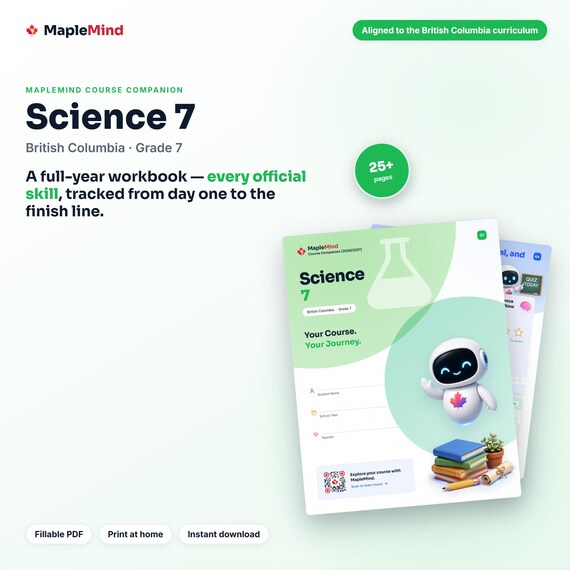
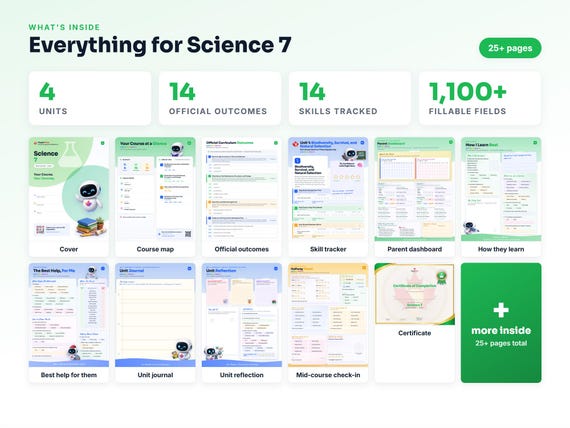
Printable workbook · A keepsake of the year
A Science 7 workbook worth keeping
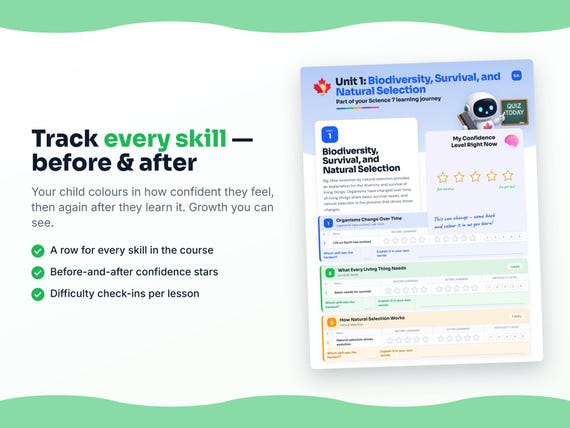
Built from the same official curriculum as this page. Before and after each skill above, your student colours in how sure they feel — so the two of you can see, on one page, what's clicking and what needs another look. It's a quiet way to follow how the year is really going.
By June it's full of their own handwriting: units worked through, confidence grown, a mid-year check-in, notes from parent-teacher night, and a certificate at the end. Less a worksheet, more a record of the year worth keeping on the shelf.
Instant download · see every page, reviews and the full description · five or more workbooks are $2.99 each
What it looks like in the app



Common questions
Can MapleMind help me with Science 7?
Yes. MapleMind's AI tutor covers all 14 skills in British Columbia's Science 7 — you pick the exact skill, and the tutor teaches it step by step: a short lesson, a worked example, solving together, then a skill check to show it stuck.
Is MapleMind aligned to British Columbia's official curriculum?
Yes. Every skill in this course maps to an official outcome code from British Columbia's Grade 7 Science curriculum, and the ministry's own wording is quoted under each unit on this page — with the official government source linked so you can check it yourself.
What does MapleMind cost?
It's free to start — 5 tutoring chats and a practice quiz every day, no credit card. A Pro subscription ($9.99/month or $49.99/year CAD, 7-day free trial) unlocks unlimited tutoring, practice, and exam simulations.
What if I'm stuck on just one topic?
That's the point of skill-level tutoring: open Science 7 in the app, tap the exact skill from the list on this page, and the tutor teaches just that — no wading through lessons you don't need.
Does MapleMind work in French or other languages?
Yes — 14 languages, including French. Both the app and the tutor's explanations switch to the language you choose.
Where can I see the official British Columbia curriculum for Science 7?
The official source is linked on this page — BC's official science curriculum. The outline here follows it: every MapleMind skill carries its official outcome code, and the ministry's own wording is quoted under each unit.
Keep exploring
Ready when you are
Pick a skill from this page and see it taught properly — free, in the browser, in under a minute.