Get help with Science 6
Most tutoring makes your child sit through material your child already knows. MapleMind flips that: pick the exact skill that's causing trouble — any of the 16 below — and the tutor teaches just that one, step by step, as many times as it takes. Ask questions in plain words, any time of day, in English, French, or 12 other languages.
The official British Columbia Science 6 curriculum
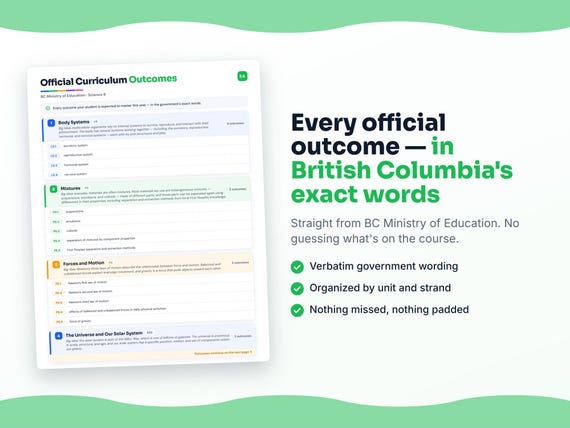
British Columbia defines Science 6 by strands and outcomes. MapleMind teaches the same curriculum reorganized for one-skill-at-a-time tutoring — the table shows exactly where every official strand lands, and the ministry's own wording is quoted under each unit below.
Official source BC's official science curriculumRead it on the government site — curriculum.gov.bc.ca ↗| Official strand | Outcomes | Where MapleMind teaches it |
|---|---|---|
| Life Science | 4 | Body Systems |
| Physical Science | 10 | Mixtures · Forces and Motion |
| Earth and Space Science | 2 | The Universe and Our Solar System |
Every skill below, taught one on one.
 Try the first session free
How MapleMind teaches Science 6 — every unit, lesson, and skill
Every skill below runs as a short session: a plain-words lesson, a worked example, solving it together, then a five-question skill check that earns up to three stars. Guided Mode keeps it teaching instead of answer-handing — turning it off needs a parent's password.
Unit 1Body SystemsOfficial strand · Life Science
Big Idea: multicellular organisms rely on internal systems to survive, reproduce, and interact with their environment. The body has several systems working together — including the excretory, reproductive, hormonal, and nervous systems — each with its own structures and jobs.
The Excretory System
- The excretory system6.BSY.1 — Describe the basic structures of the excretory system (like the kidneys, ureters, and bladder) and explain how they work together to remove waste and extra water from the body.
The Reproductive System
- The reproductive system6.BSY.2 — Describe, at a basic level, the structures of the reproductive system — such as the ovaries and testes — using respectful, age-appropriate scientific language for the body system responsible for producing offspring.
The Hormonal System
- The hormonal system6.BSY.3 — Describe the basic idea of the hormonal (endocrine) system — chemical messengers in the body, like insulin and adrenalin — and explain how hormones help control changes like growth and puberty.
The Nervous System
- The nervous system6.BSY.4 — Describe the basic structures of the nervous system (like the brain and spinal cord) and explain how the brain interprets signals from receptors to sense information and control the body — and can sometimes misinterpret them, as in an optical illusion.
The official wording — 4 outcomes in this unit
- 6.BSY.1
excretory system
- 6.BSY.2
reproductive system
- 6.BSY.3
hormonal system
- 6.BSY.4
nervous system
Unit 2MixturesOfficial strand · Physical Science
Big Idea: everyday materials are often mixtures. Most materials we use are heterogeneous mixtures — suspensions, emulsions, and colloids — made of different parts, and those parts can be separated again using differences in their properties, including separation and extraction methods from local First Peoples knowledge.
Suspensions
- Suspensions6.HM.1 — Identify a suspension — a heterogeneous mixture where visible particles are mixed through a liquid but will settle out over time, like salad dressing before you shake it.
Emulsions
- Emulsions6.HM.2 — Identify an emulsion — a heterogeneous mixture of two liquids that don't normally mix, like the fat droplets suspended in milk.
Colloids
- Colloids6.HM.3 — Identify a colloid — a heterogeneous mixture where tiny particles are spread evenly through another substance and stay mixed, like the tiny droplets in an aerosol spray.
Separating Mixtures by Properties
- Separating mixtures using properties6.SEP.1 — Explain how a mixture can be separated back into its parts using a difference in the parts' properties — like density (a centrifuge, or silt settling in a river delta) or particle size (a sieve or filter).
First Peoples Separation and Extraction Knowledge
- First Peoples separation and extraction knowledge6.SEP.2 — Learn about historical and current local First Peoples knowledge of separation and extraction methods, such as extracting eulachon oil or extracting medicines and pigments from plants.
The official wording — 5 outcomes in this unit
- 6.HM.1
suspensions
- 6.HM.2
emulsions
- 6.HM.3
colloids
- 6.SEP.1
separation of mixtures by component properties
- 6.SEP.2
First Peoples separation and extraction methods
Unit 3Forces and MotionOfficial strand · Physical Science
Big Idea: Newton's three laws of motion describe the relationship between force and motion. Balanced and unbalanced forces explain everyday movement, and gravity is a force that pulls objects toward each other.
Newton's First Law
- Newton's first law of motion6.NL.1 — Describe Newton's first law of motion: an object will stay stopped, or keep moving at a constant speed in a straight line, until an outside force acts on it.
Newton's Second Law
- Newton's second law of motion6.NL.2 — Describe Newton's second law of motion: only an unbalanced force causes an object to accelerate — to speed up, slow down, or change direction.
Newton's Third Law
- Newton's third law of motion6.NL.3 — Describe Newton's third law of motion: every force has an equal and opposite reaction force, so every push or pull back has a push or pull in return.
Balanced and Unbalanced Forces
- Forces in everyday physical activities6.BUF.1 — Explain the effects of balanced forces (equal and opposite, like sitting still in a chair) and unbalanced forces (one force is larger, like a race car accelerating) in daily physical activities such as school sports and PE.
The Force of Gravity
- Gravity as a force6.GR.1 — Describe the force of gravity as the force of attraction that pulls all objects toward each other, and explain why objects on Earth fall toward the centre of the planet.
The official wording — 5 outcomes in this unit
- 6.NL.1
Newton's first law of motion
- 6.NL.2
Newton's second law of motion
- 6.NL.3
Newton's third law of motion
- 6.BUF.1
effects of balanced and unbalanced forces in daily physical activities
- 6.GR.1
force of gravity
Unit 4The Universe and Our Solar SystemOfficial strand · Earth and Space Science
Big Idea: the solar system is part of the Milky Way, which is one of billions of galaxies. The universe is enormous in scale, structure, and age, and our solar system has a specific position, motion, and set of components within our galaxy.
How Big, How Old
- The scale, structure, and age of the universe6.UNI.1 — Describe the overall scale of the universe (billions of galaxies, each with billions of stars), its structure (galaxies, stars, and solar systems organized within it), and its age (billions of years old).
Our Solar System in the Milky Way
- Our solar system's place, motion, and parts6.SS.1 — Describe the position of our solar system within the Milky Way galaxy, its motion (orbiting the galaxy's centre), and its components — planets, moons, asteroids, meteors, and comets.
The official wording — 2 outcomes in this unit
- 6.UNI.1
the overall scale, structure, and age of the universe
- 6.SS.1
the position, motion, and components of our solar system in our galaxy
Printable workbook · A keepsake of the year
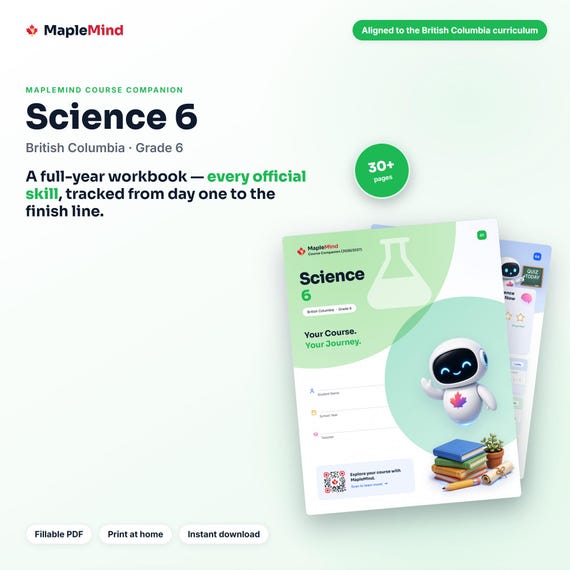
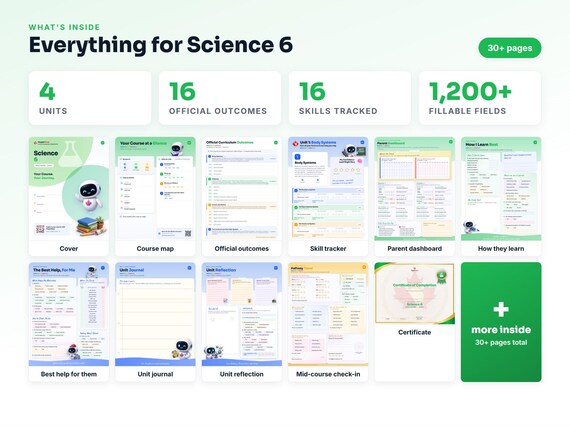
A Science 6 workbook worth keeping
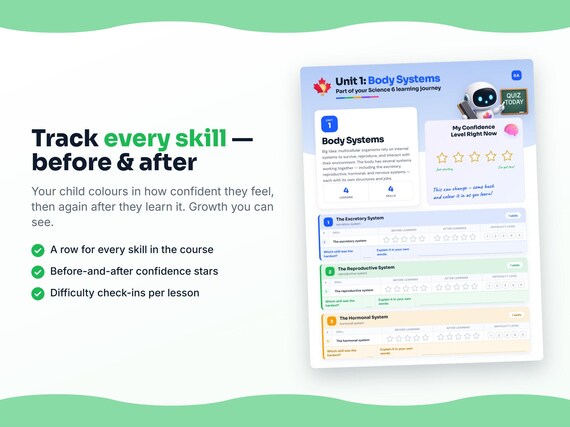
Built from the same official curriculum as this page. Before and after each skill above, your student colours in how sure they feel — so the two of you can see, on one page, what's clicking and what needs another look. It's a quiet way to follow how the year is really going.
By June it's full of their own handwriting: units worked through, confidence grown, a mid-year check-in, notes from parent-teacher night, and a certificate at the end. Less a worksheet, more a record of the year worth keeping on the shelf.
Instant download · see every page, reviews and the full description · five or more workbooks are $2.99 each
What it looks like in the app



Common questions
Can MapleMind help my child with Science 6?
Yes. MapleMind's AI tutor covers all 16 skills in British Columbia's Science 6 — your child picks the exact skill, and the tutor teaches it step by step: a short lesson, a worked example, solving together, then a skill check to show it stuck.
Is MapleMind aligned to British Columbia's official curriculum?
Yes. Every skill in this course maps to an official outcome code from British Columbia's Grade 6 Science curriculum, and the ministry's own wording is quoted under each unit on this page — with the official government source linked so you can check it yourself.
What does MapleMind cost?
It's free to start — 5 tutoring chats and a practice quiz every day, no credit card. A Pro subscription ($9.99/month or $49.99/year CAD, 7-day free trial) unlocks unlimited tutoring, practice, and exam simulations.
What if my child is stuck on just one topic?
That's the point of skill-level tutoring: open Science 6 in the app, tap the exact skill from the list on this page, and the tutor teaches just that — no wading through lessons your child doesn't need.
Does MapleMind work in French or other languages?
Yes — 14 languages, including French. Both the app and the tutor's explanations switch to the language your child chooses.
Where can I see the official British Columbia curriculum for Science 6?
The official source is linked on this page — BC's official science curriculum. The outline here follows it: every MapleMind skill carries its official outcome code, and the ministry's own wording is quoted under each unit.
Keep exploring
Ready when you are
Pick a skill from this page and see it taught properly — free, in the browser, in under a minute.