Get help with Science 5
Most tutoring makes your child sit through material your child already knows. MapleMind flips that: pick the exact skill that's causing trouble — any of the 21 below — and the tutor teaches just that one, step by step, as many times as it takes. Ask questions in plain words, any time of day, in English, French, or 12 other languages.
The official British Columbia Science 5 curriculum
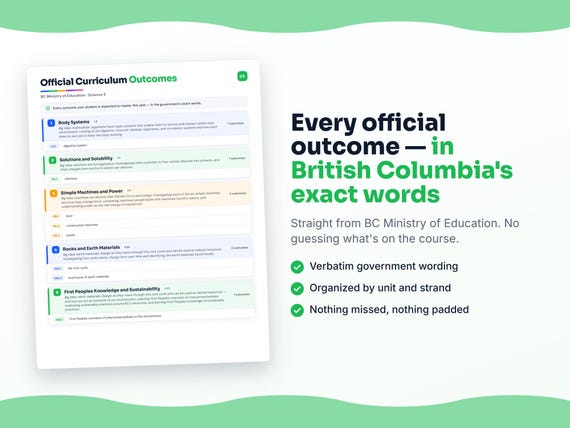
British Columbia defines Science 5 by strands and outcomes. MapleMind teaches the same curriculum reorganized for one-skill-at-a-time tutoring — the table shows exactly where every official strand lands, and the ministry's own wording is quoted under each unit below.
Official source BC's official science curriculumRead it on the government site — curriculum.gov.bc.ca ↗| Official strand | Outcomes | Where MapleMind teaches it |
|---|---|---|
| Life Science | 4 | Body Systems |
| Physical Science | 12 | Solutions and Solubility · Simple Machines and Power |
| Earth and Space Science | 5 | Rocks and Earth Materials · First Peoples Knowledge and Sustainability |
Every skill below, taught one on one.
 Try the first session free
How MapleMind teaches Science 5 — every unit, lesson, and skill
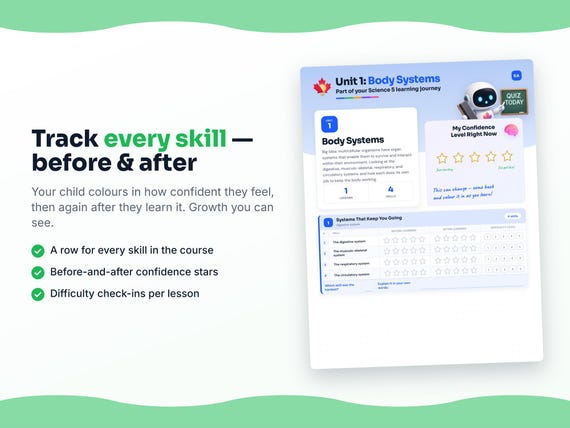
Every skill below runs as a short session: a plain-words lesson, a worked example, solving it together, then a five-question skill check that earns up to three stars. Guided Mode keeps it teaching instead of answer-handing — turning it off needs a parent's password.
Unit 1Body SystemsOfficial strand · Life Science
Big Idea: multicellular organisms have organ systems that enable them to survive and interact within their environment. Looking at the digestive, musculo-skeletal, respiratory, and circulatory systems and how each does its own job to keep the body working.
Systems That Keep You Going
- The digestive system5.BSY.1 — Trace the basic path food takes through the digestive system — mouth, stomach, intestines — and describe its job: breaking food down so the body can use it.
- The musculo-skeletal system5.BSY.2 — Describe how the muscles and skeleton work together — the skeleton gives the body its frame and protects organs, and muscles pull on bones to make the body move.
- The respiratory system5.BSY.3 — Describe how the trachea, lungs, and diaphragm work together to bring oxygen into the body and remove carbon dioxide.
- The circulatory system5.BSY.4 — Describe how the heart pumps blood through blood vessels to carry oxygen and nutrients to every part of the body.
The official wording — 4 outcomes in this unit
- 5.BSY.1
digestive system
- 5.BSY.2
musculo-skeletal system
- 5.BSY.3
respiratory system
- 5.BSY.4
circulatory system
Unit 2Solutions and SolubilityOfficial strand · Physical Science
Big Idea: solutions are homogeneous. Investigating what a solution is, how solutes dissolve into solvents, and what changes how much of a solute can dissolve.
Solutions and How Much Will Dissolve
- Solutions5.SOL.1 — Explain what a solution is — a solute dissolved evenly (homogeneously) into a solvent, like salt or apple juice in water — and how a solution can be separated again through distillation, evaporation, or crystallization.
- Solubility5.SOL.2 — Explore solubility — how much of a solid, liquid, or gas can dissolve into a solvent (like salt, honey, or carbon dioxide in water) — and how factors like temperature and stirring change that amount.
The official wording — 2 outcomes in this unit
- 5.SOL.1
solutions
- 5.SOL.2
solubility
Unit 3Simple Machines and PowerOfficial strand · Physical Science
Big Idea: machines are devices that transfer force and energy. Investigating each of the six simple machines and how they change force, comparing machines people build with machines found in nature, and understanding power as the rate energy is transferred.
The Six Simple Machines
- The lever5.SM.1 — Explore how a lever — a bar that pivots on a fixed point — changes the size or direction of a force to make lifting or moving something easier.
- The wedge5.SM.2 — Explore how a wedge — a shape that narrows to a thin edge, like an axe head or a doorstop — uses force to split or lift things apart.
- The inclined plane5.SM.3 — Explore how an inclined plane — a sloped surface like a ramp — lets a smaller force move a load over a longer distance instead of lifting it straight up.
- The wheel and axle5.SM.4 — Explore how a wheel and axle — a wheel turning around a central rod, like a doorknob or a steering wheel — makes turning or moving a force easier.
- The pulley5.SM.5 — Explore how a pulley — a wheel with a rope or belt around it, like on a flagpole — changes the direction of a force to make lifting easier.
- The screw5.SM.6 — Explore how a screw — an inclined plane wrapped around a cylinder — turns a small twisting force into a strong gripping or lifting force.
- How simple machines change force5.SM.7 — Explain the force effects simple machines share in common: changing the direction of a force and multiplying the size of a force to make a task easier.
Machines People Build and Machines in Nature
- Constructed machines5.MAC.1 — Identify how people build complex machines — like a wheelbarrow, scissors, or a bicycle — by combining two or more simple machines together.
- Machines found in nature5.MAC.2 — Identify simple machines at work in nature — like the lever action built into nearly every joint in the musculoskeletal system — and compare them to machines people construct.
Power: How Fast Energy Moves
- Power as a rate of energy transfer5.PW.1 — Explain power as the rate at which energy is transferred — comparing two machines, motors, or people (like students racing up a hill) doing the same task, the one that finishes faster is more powerful.
The official wording — 10 outcomes in this unit
- 5.SM.1
lever
- 5.SM.2
wedge
- 5.SM.3
inclined plane
- 5.SM.4
wheel and axle
- 5.SM.5
pulley
- 5.SM.6
screw
- 5.SM.7
force effects of simple machines
- 5.MAC.1
constructed machines
- 5.MAC.2
machines found in nature
- 5.PW.1
power
Unit 4Rocks and Earth MaterialsOfficial strand · Earth and Space Science
Big Idea: earth materials change as they move through the rock cycle and can be used as natural resources. Investigating how rocks slowly change form over time and identifying the earth materials found locally.
The Rock Cycle
- How rocks change over time5.RC.1 — Describe the rock cycle — how igneous, sedimentary, and metamorphic rocks slowly change into one another over long periods of time through heat, pressure, weathering, and erosion.
Earth Materials Near Us
- Identifying local earth materials5.EM.1 — Identify types of earth materials found in the local area — like mineral, rock, clay, boulder, gravel, sand, or soil — and describe some properties that help tell them apart.
The official wording — 2 outcomes in this unit
- 5.RC.1
the rock cycle
- 5.EM.1
local types of earth materials
Unit 5First Peoples Knowledge and SustainabilityOfficial strand · Earth and Space Science
Big Idea: earth materials change as they move through the rock cycle and can be used as natural resources — and how we act as stewards of our environment. Learning First Peoples concepts of interconnectedness, evaluating sustainable practices around BC's resources, and learning First Peoples knowledge of sustainable practices.
Interconnectedness and Using Resources Wisely
- First Peoples concepts of interconnectedness5.FPI.1 — Learn First Peoples concepts of interconnectedness in the environment — the idea that everything (the sun, sky, plants, and animals) is one and connected, and we have a responsibility to care for it.
- Sustainable use of BC's resources5.SUS.1 — Explore the nature of sustainable practices around BC's resources — like forests, fish, and water — using resources in ways that let them continue to be available in the future.
- First Peoples knowledge of sustainable practices5.FPS.1 — Learn First Peoples knowledge of sustainable practices — long-held ways of taking only what is needed and caring for the land so resources last for future generations.
The official wording — 3 outcomes in this unit
- 5.FPI.1
First Peoples concepts of interconnectedness in the environment
- 5.SUS.1
the nature of sustainable practices around BC resources
- 5.FPS.1
First Peoples knowledge of sustainable practices
Printable workbook · A keepsake of the year
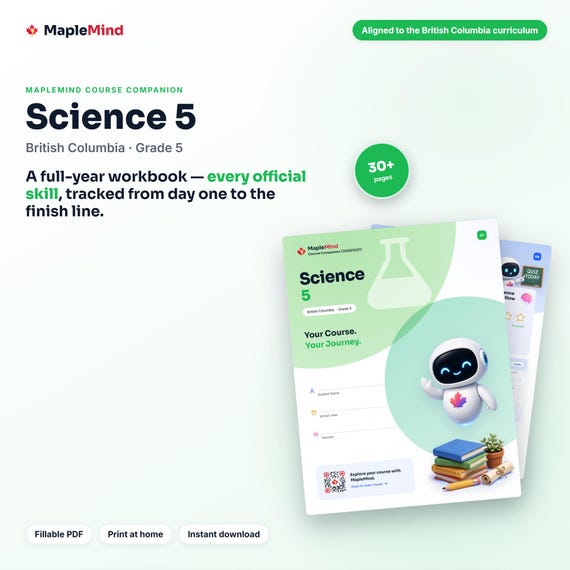
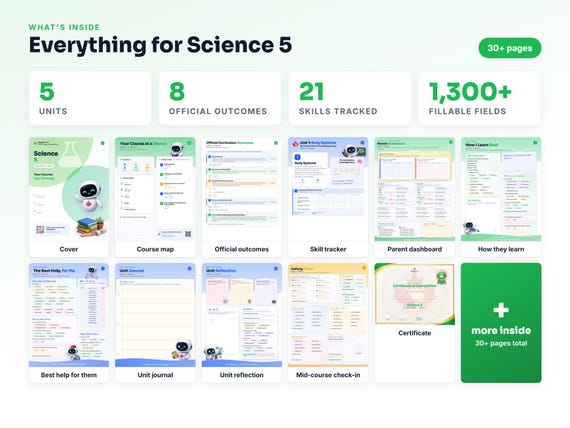
A Science 5 workbook worth keeping
Built from the same official curriculum as this page. Before and after each skill above, your student colours in how sure they feel — so the two of you can see, on one page, what's clicking and what needs another look. It's a quiet way to follow how the year is really going.
By June it's full of their own handwriting: units worked through, confidence grown, a mid-year check-in, notes from parent-teacher night, and a certificate at the end. Less a worksheet, more a record of the year worth keeping on the shelf.
Instant download · see every page, reviews and the full description · five or more workbooks are $2.99 each
What it looks like in the app



Common questions
Can MapleMind help my child with Science 5?
Yes. MapleMind's AI tutor covers all 21 skills in British Columbia's Science 5 — your child picks the exact skill, and the tutor teaches it step by step: a short lesson, a worked example, solving together, then a skill check to show it stuck.
Is MapleMind aligned to British Columbia's official curriculum?
Yes. Every skill in this course maps to an official outcome code from British Columbia's Grade 5 Science curriculum, and the ministry's own wording is quoted under each unit on this page — with the official government source linked so you can check it yourself.
What does MapleMind cost?
It's free to start — 5 tutoring chats and a practice quiz every day, no credit card. A Pro subscription ($9.99/month or $49.99/year CAD, 7-day free trial) unlocks unlimited tutoring, practice, and exam simulations.
What if my child is stuck on just one topic?
That's the point of skill-level tutoring: open Science 5 in the app, tap the exact skill from the list on this page, and the tutor teaches just that — no wading through lessons your child doesn't need.
Does MapleMind work in French or other languages?
Yes — 14 languages, including French. Both the app and the tutor's explanations switch to the language your child chooses.
Where can I see the official British Columbia curriculum for Science 5?
The official source is linked on this page — BC's official science curriculum. The outline here follows it: every MapleMind skill carries its official outcome code, and the ministry's own wording is quoted under each unit.
Keep exploring
Ready when you are
Pick a skill from this page and see it taught properly — free, in the browser, in under a minute.