Get help with Science 7
Most tutoring makes you sit through material you already know. MapleMind flips that: pick the exact skill that's causing trouble — any of the 41 below — and the tutor teaches just that one, step by step, as many times as it takes. Ask questions in plain words, any time of day, in English, French, or 12 other languages.
The official Alberta Science 7 curriculum
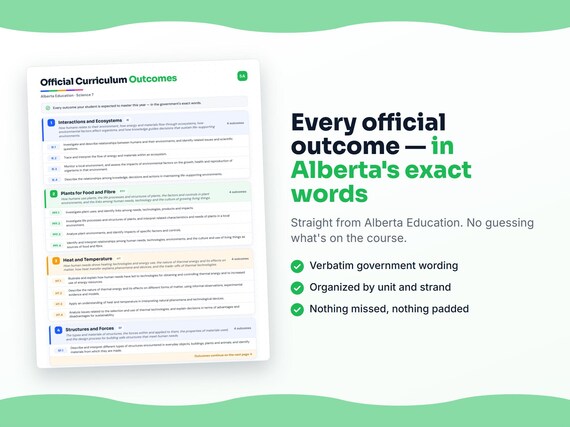
Alberta defines Science 7 by strands and outcomes. MapleMind teaches the same curriculum reorganized for one-skill-at-a-time tutoring — the table shows exactly where every official strand lands, and the ministry's own wording is quoted under each unit below.
Official source Alberta's official programs of studyRead it on the government site — alberta.ca ↗| Official strand | Outcomes | Where MapleMind teaches it |
|---|---|---|
| Interactions and Ecosystems | 4 | Interactions and Ecosystems |
| Plants for Food and Fibre | 4 | Plants for Food and Fibre |
| Heat and Temperature | 4 | Heat and Temperature |
| Structures and Forces | 4 | Structures and Forces |
| Planet Earth | 4 | Planet Earth |
Every skill below, taught one on one.
 Try the first session free
How MapleMind teaches Science 7 — every unit, lesson, and skill
Every skill below runs as a short session: a plain-words lesson, a worked example, solving it together, then a five-question skill check that earns up to three stars. Guided Mode keeps it teaching instead of answer-handing — turning it off needs a parent's password.
Unit 1Interactions and EcosystemsOfficial strand · Interactions and Ecosystems
How humans relate to their environment, how energy and materials flow through ecosystems, how environmental factors affect organisms, and how knowledge guides decisions that sustain life-supporting environments.
Humans and the Environment
- Human–environment relationships7.A.1 — Describe ways humans depend on and affect their environment, and identify the give-and-take between people and ecosystems.
- Issues and scientific questions7.A.1 — Identify an environmental issue and turn it into a testable scientific question that could be investigated.
Energy and Matter in Ecosystems
- Food chains and food webs7.A.2 — Trace energy from the Sun through producers, consumers and decomposers in food chains and food webs.
- Energy flow and material cycling7.A.2 — Explain that energy flows one way (and lessens up a food chain) while materials cycle and are reused.
Monitoring a Local Environment
- Environmental factors7.A.3 — Identify abiotic and biotic factors (light, water, temperature, other organisms) that affect the growth, health and reproduction of organisms.
- Monitoring organisms over time7.A.3 — Describe how repeated observation and measurement reveal how a factor is affecting organisms in an environment.
Knowledge, Decisions and Stewardship
- Sustaining life-supporting environments7.A.4 — Describe how scientific knowledge informs decisions and actions that keep an environment able to support life.
- From knowledge to action7.A.4 — Connect a piece of environmental knowledge to a specific decision and the action it leads to, and weigh trade-offs.
The official wording — 4 outcomes in this unit
- 7.A.1
Investigate and describe relationships between humans and their environments, and identify related issues and scientific questions.
- 7.A.2
Trace and interpret the flow of energy and materials within an ecosystem.
- 7.A.3
Monitor a local environment, and assess the impacts of environmental factors on the growth, health and reproduction of organisms in that environment.
- 7.A.4
Describe the relationships among knowledge, decisions and actions in maintaining life-supporting environments.
Unit 2Plants for Food and FibreOfficial strand · Plants for Food and Fibre
How humans use plants, the life processes and structures of plants, the factors and controls in plant environments, and the links among human needs, technology and the culture of growing living things.
How We Use Plants
- Plant uses7.B.1 — Identify ways people use plants (food, fibre, medicine, building) and link those uses to human needs.
- Plant technologies and impacts7.B.1 — Describe a technology used to grow or process plants and one impact (positive or negative) it has.
Plant Processes and Structures
- Plant structures and their jobs7.B.2 — Identify the main plant structures (roots, stem, leaves, flowers) and the function of each.
- Photosynthesis and plant needs7.B.2 — Describe photosynthesis in general terms (light + carbon dioxide + water → sugar + oxygen) and the needs of plants.
Plant Environments and Controls
- Factors affecting plant growth7.B.3 — Analyze how factors such as light, water, soil, temperature and pests affect plant growth.
- Controlling growing conditions7.B.3 — Describe how growers control conditions (greenhouses, irrigation, fertilizer, pest control) and the trade-offs involved.
Plants, Needs and Culture
- Living things as food and fibre7.B.4 — Identify plants (and other living things) used as sources of food and fibre and how they are cultivated.
- Needs, technology and environment7.B.4 — Interpret how human needs, farming technology, and the environment interact in producing food and fibre.
The official wording — 4 outcomes in this unit
- 7.B.1
Investigate plant uses; and identify links among needs, technologies, products and impacts.
- 7.B.2
Investigate life processes and structures of plants, and interpret related characteristics and needs of plants in a local environment.
- 7.B.3
Analyze plant environments, and identify impacts of specific factors and controls.
- 7.B.4
Identify and interpret relationships among human needs, technologies, environments, and the culture and use of living things as sources of food and fibre.
Unit 3Heat and TemperatureOfficial strand · Heat and Temperature
How human needs drove heating technologies and energy use, the nature of thermal energy and its effects on matter, how heat transfer explains phenomena and devices, and the trade-offs of thermal technologies.
Heating Technologies and Energy
- Technologies for controlling heat7.C.1 — Describe how human needs led to technologies for producing, controlling and using thermal energy over time.
- Energy resources for heat7.C.1 — Identify renewable and non-renewable energy resources used to produce heat and why their use has increased.
The Nature of Thermal Energy
- Heat vs. temperature7.C.2 — Distinguish temperature (how hot, average particle motion) from heat (thermal energy that transfers from hot to cold).
- The particle model of heat7.C.2 — Use the particle model to explain that heating makes particles move faster, and cooling makes them slower.
- Heat and changes of state7.C.2 — Explain melting, freezing, evaporation and condensation as adding or removing thermal energy.
How Heat Moves
- Conduction, convection and radiation7.C.3 — Describe the three ways heat transfers — conduction (through contact), convection (through moving fluids), radiation (through waves) — with examples.
- Expansion and thermal devices7.C.3 — Explain thermal expansion (materials expand when heated) and how devices like thermometers and thermostats use it.
Choosing Thermal Technologies
- Comparing thermal technologies7.C.4 — Compare thermal technologies (heating systems, insulation, fuels) by their advantages and disadvantages.
- Sustainability trade-offs7.C.4 — Explain a decision about a thermal technology in terms of its trade-offs for sustainability (cost, energy use, environment).
The official wording — 4 outcomes in this unit
- 7.C.1
Illustrate and explain how human needs have led to technologies for obtaining and controlling thermal energy and to increased use of energy resources.
- 7.C.2
Describe the nature of thermal energy and its effects on different forms of matter, using informal observations, experimental evidence and models.
- 7.C.3
Apply an understanding of heat and temperature in interpreting natural phenomena and technological devices.
- 7.C.4
Analyze issues related to the selection and use of thermal technologies, and explain decisions in terms of advantages and disadvantages for sustainability.
Unit 4Structures and ForcesOfficial strand · Structures and Forces
The types and materials of structures, the forces within and applied to them, the properties of materials used, and the design process for building safe structures that meet human needs.
Types of Structures
- Solid, frame and shell structures7.D.1 — Classify structures as solid, frame or shell, and find examples in everyday objects, buildings, plants and animals.
- Materials of structures7.D.1 — Identify materials a structure is made from and why they suit the structure’s job.
Forces on Structures
- Internal and external forces7.D.2 — Distinguish external forces applied to a structure (loads, wind) from internal forces within it (compression, tension).
- Loads and how structures resist them7.D.2 — Describe static and dynamic loads and how a structure’s shape helps it resist forces (e.g., triangles, arches).
Properties of Materials
- Strength and flexibility7.D.3 — Investigate material properties — strength, flexibility, stiffness — and how they affect a structure’s performance.
- Choosing the right material7.D.3 — Match materials to a structure’s needs by their properties, and explain the choice.
Designing Safe Structures
- The design process7.D.4 — Describe the process of developing, testing and improving a structure to meet a need.
- Margin of safety7.D.4 — Explain what a margin of safety is and why structures are built stronger than the expected load.
The official wording — 4 outcomes in this unit
- 7.D.1
Describe and interpret different types of structures encountered in everyday objects, buildings, plants and animals; and identify materials from which they are made.
- 7.D.2
Investigate and analyze forces within structures, and forces applied to them.
- 7.D.3
Investigate and analyze the properties of materials used in structures.
- 7.D.4
Demonstrate and describe processes used in developing, evaluating and improving structures that will meet human needs with a margin of safety.
Unit 5Planet EarthOfficial strand · Planet Earth
Methods for studying Earth and its materials, evidence for the rock cycle, evidence of major changes in landforms and rock layers, and the story told by the fossil record.
Studying the Earth
- How we study the Earth7.E.1 — Describe methods geologists use to study Earth — observing, sampling, comparing — and why direct observation is limited.
- Earth’s materials7.E.1 — Identify and describe Earth materials — minerals and rocks — by observable properties.
Rocks and the Rock Cycle
- The three rock types7.E.2 — Distinguish igneous, sedimentary and metamorphic rocks by how they form and their features.
- The rock cycle7.E.2 — Explain how the rock cycle transforms one rock type into another over long times, using evidence.
Changing Landforms
- Evidence of landform change7.E.3 — Investigate evidence (erosion, deposition, uplift) that landforms change over time.
- Reading rock layers7.E.3 — Interpret rock layers (strata), recognizing that lower layers are usually older, to read Earth’s history.
The Fossil Record
- Fossils as evidence7.E.4 — Describe how fossils form and what they reveal about past life and environments.
- Interpreting the fossil record7.E.4 — Interpret and evaluate what the sequence of fossils in rock layers tells us about change over time.
The official wording — 4 outcomes in this unit
- 7.E.1
Describe and demonstrate methods used in the scientific study of Earth and in observing and interpreting its component materials.
- 7.E.2
Identify evidence for the rock cycle, and use the rock cycle concept to interpret and explain the characteristics of particular rocks.
- 7.E.3
Investigate and interpret evidence of major changes in landforms and the rock layers that underlie them.
- 7.E.4
Describe, interpret and evaluate evidence from the fossil record.
Printable workbook · A keepsake of the year
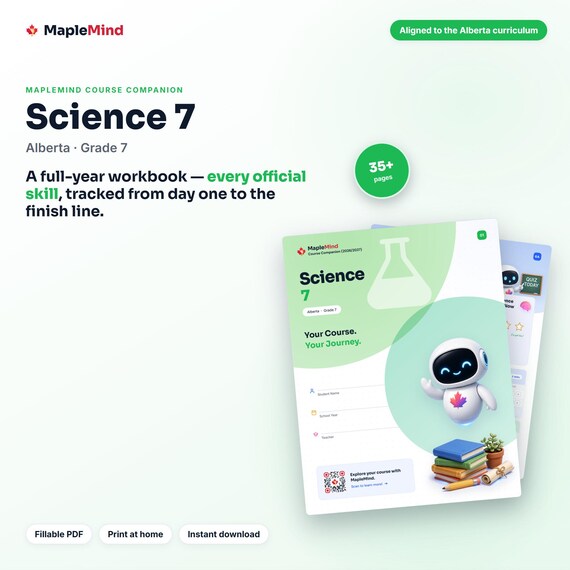
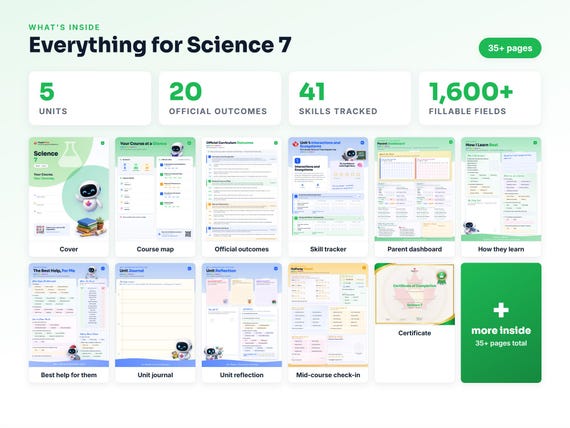
A Science 7 workbook worth keeping
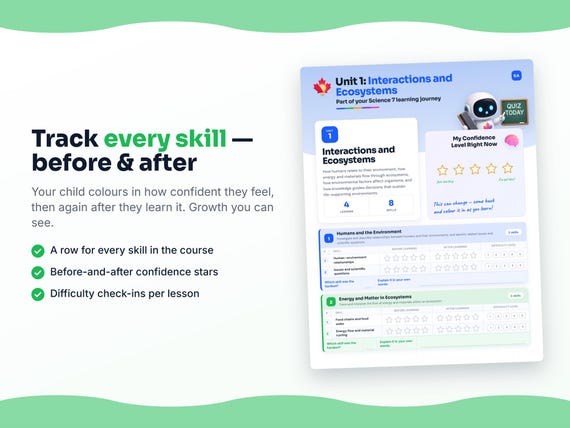
Built from the same official curriculum as this page. Before and after each skill above, your student colours in how sure they feel — so the two of you can see, on one page, what's clicking and what needs another look. It's a quiet way to follow how the year is really going.
By June it's full of their own handwriting: units worked through, confidence grown, a mid-year check-in, notes from parent-teacher night, and a certificate at the end. Less a worksheet, more a record of the year worth keeping on the shelf.
Instant download · see every page, reviews and the full description · five or more workbooks are $2.99 each
What it looks like in the app



Common questions
Can MapleMind help me with Science 7?
Yes. MapleMind's AI tutor covers all 41 skills in Alberta's Science 7 — you pick the exact skill, and the tutor teaches it step by step: a short lesson, a worked example, solving together, then a skill check to show it stuck.
Is MapleMind aligned to Alberta's official curriculum?
Yes. Every skill in this course maps to an official outcome code from Alberta's Grade 7 Science curriculum, and the ministry's own wording is quoted under each unit on this page — with the official government source linked so you can check it yourself.
What does MapleMind cost?
It's free to start — 5 tutoring chats and a practice quiz every day, no credit card. A Pro subscription ($9.99/month or $49.99/year CAD, 7-day free trial) unlocks unlimited tutoring, practice, and exam simulations.
What if I'm stuck on just one topic?
That's the point of skill-level tutoring: open Science 7 in the app, tap the exact skill from the list on this page, and the tutor teaches just that — no wading through lessons you don't need.
Does MapleMind work in French or other languages?
Yes — 14 languages, including French. Both the app and the tutor's explanations switch to the language you choose.
Where can I see the official Alberta curriculum for Science 7?
The official source is linked on this page — Alberta's official programs of study. The outline here follows it: every MapleMind skill carries its official outcome code, and the ministry's own wording is quoted under each unit.
Keep exploring
Ready when you are
Pick a skill from this page and see it taught properly — free, in the browser, in under a minute.