Get help with Science 6
Most tutoring makes your child sit through material your child already knows. MapleMind flips that: pick the exact skill that's causing trouble — any of the 20 below — and the tutor teaches just that one, step by step, as many times as it takes. Ask questions in plain words, any time of day, in English, French, or 12 other languages.
The official Alberta Science 6 curriculum
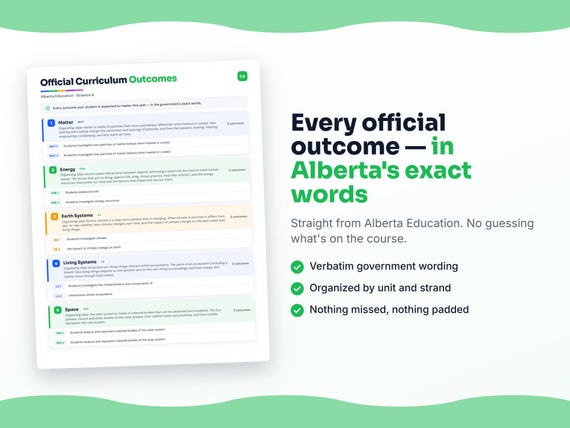
Alberta defines Science 6 by strands and outcomes. MapleMind teaches the same curriculum reorganized for one-skill-at-a-time tutoring — the table shows exactly where every official strand lands, and the ministry's own wording is quoted under each unit below.
Official source Alberta's official programs of studyRead it on the government site — alberta.ca ↗| Official strand | Outcomes | Where MapleMind teaches it |
|---|---|---|
| Matter | 1 | Matter |
| Energy | 2 | Energy |
| Earth Systems | 1 | Earth Systems |
| Living Systems | 1 | Living Systems |
| Space | 1 | Space |
| Computer Science | 1 | Computer Science |
| Scientific Methods | 1 | Scientific Methods |
Every skill below, taught one on one.
 Try the first session free
How MapleMind teaches Science 6 — every unit, lesson, and skill
Every skill below runs as a short session: a plain-words lesson, a worked example, solving it together, then a five-question skill check that earns up to three stars. Guided Mode keeps it teaching instead of answer-handing — turning it off needs a parent's password.
Unit 1MatterOfficial strand · Matter
Organizing idea: matter is made of particles that move and behave differently when heated or cooled. How heating and cooling change the movement and spacing of particles, and how that explains melting, freezing, evaporating, condensing, and why warm air rises.
Particles When Heated and Cooled
- How heating and cooling move particles6.M.1 — Explain that all matter is made of tiny particles that are always moving, and that heating makes them move faster and spread apart while cooling makes them move slower and pack closer.
- Melting, freezing, evaporating and condensing6.M.1 — Use the particle idea to explain changes of state — melting, freezing, evaporating and condensing — in solids, liquids and gases, and predict what a change in temperature will do.
Warm Air and Expansion
- Why warm air rises6.M.1 — Investigate how heating spreads particles out so a gas takes up more space and gets lighter for its size, and connect this to why warm air rises above cool air.
The official wording — 1 outcome in this unit
- 6.M.1
Students investigate how particles of matter behave when heated or cooled
Unit 2EnergyOfficial strand · Energy
Organizing idea: forces cause interactions between objects, and energy resources are used to meet human needs. The forces that act on flying objects (lift, drag, thrust, gravity), how they interact, and the energy resources that power our lives and the factors that shape how we use them.
Forces on Moving and Flying Objects
- The forces that act on objects6.E.1 — Identify and describe forces acting on objects — pushes and pulls, gravity, friction and air resistance (drag) — and represent a force by its direction and strength.
- How forces interact to make flight6.E.1 — Explain how paired forces interact on a flying object: lift versus gravity and thrust versus drag, and predict what happens when one force is larger than the force opposing it.
Energy Resources and How We Use Them
- Renewable and non-renewable energy resources6.E.2 — Investigate the energy resources people use to power devices and homes, and sort them into renewable (sun, wind, moving water) and non-renewable (coal, oil, natural gas) resources.
- What shapes the energy we choose6.E.2 — Explain factors that influence which energy resource gets used — cost, availability, and effects on the environment — and describe simple ways to conserve energy.
The official wording — 2 outcomes in this unit
- 6.E.1
Students analyze forces
- 6.E.2
Students investigate energy resources
Unit 3Earth SystemsOfficial strand · Earth Systems
Organizing idea: Earth’s climate is a long-term pattern that is changing. What climate is and how it differs from day-to-day weather, how climate changes over time, and the impact of climate change on the land, water and living things.
Climate and Its Changes
- Climate versus weather6.ES.1 — Investigate what climate means — the usual pattern of temperature and precipitation over many years in a place — and explain how it differs from weather, which changes day to day.
- How and why climate changes6.ES.1 — Interpret evidence that climate changes over time, and describe how greenhouse gases from human activity are warming Earth’s climate.
The Impact of Climate Change
- Effects of a changing climate6.ES.1 — Describe the impact of climate change on Earth — melting ice, rising seas, shifting habitats and more extreme weather — and connect it to actions people can take.
The official wording — 1 outcome in this unit
- 6.ES.1
Students investigate climate
Unit 4Living SystemsOfficial strand · Living Systems
Organizing idea: living and non-living things interact within ecosystems. The parts of an ecosystem (including a forest), how living things depend on one another and on the non-living surroundings, and how energy and matter move through food chains.
The Parts of an Ecosystem
- Living and non-living parts6.LS.1 — Investigate the characteristics and components of an ecosystem, such as a forest — its living things (plants, animals, fungi) and non-living parts (soil, water, air, sunlight).
Interactions Within an Ecosystem
- Food chains and dependencies6.LS.1 — Explain how the parts of an ecosystem interact: producers, consumers and decomposers linked by food chains, and how energy from the Sun flows through them.
- When an ecosystem changes6.LS.1 — Predict how a change to one part of an ecosystem — losing a tree species, adding a predator — ripples out to affect other living things.
The official wording — 1 outcome in this unit
- 6.LS.1
Students investigate the characteristics and components of
Unit 5SpaceOfficial strand · Space
Organizing idea: the solar system is made of celestial bodies that can be observed and modelled. The Sun, planets, moons and other bodies of the solar system, their relative sizes and positions, and how models represent this vast system.
Celestial Bodies of the Solar System
- The Sun, planets and moons6.SP.1 — Analyze the main celestial bodies of the solar system — the Sun, the eight planets, moons, and smaller bodies like asteroids and comets — and describe what makes each type different.
- Why the Moon shines6.SP.1 — Explain that stars like the Sun make their own light, while moons and planets shine only by reflecting sunlight — the Moon does not make its own light.
Modelling the Solar System
- Representing size, order and distance6.SP.1 — Represent the solar system with a model that shows the order of the planets and their huge differences in size and distance, and explain what a model can and cannot show to scale.
The official wording — 1 outcome in this unit
- 6.SP.1
Students analyze and represent celestial bodies of the solar system
Unit 6Computer ScienceOfficial strand · Computer Science
Organizing idea: abstraction lets us design and code by focusing on what matters and hiding the rest. Using abstraction in design and coding — hiding unnecessary detail, reusing steps — and describing how technologies affect people and the world.
Abstraction in Design and Coding
- Hiding detail to focus on what matters6.CS.1 — Examine abstraction — leaving out unnecessary detail so a plan or program is easier to follow — and use it when designing instructions or code, for example naming a reusable block of steps.
The Impact of Technologies
- How technologies affect us6.CS.1 — Describe the impacts of technologies on people and the environment — both helpful and harmful — and give examples from everyday life.
The official wording — 1 outcome in this unit
- 6.CS.1
Students examine abstraction in relation to design and coding
Unit 7Scientific MethodsOfficial strand · Scientific Methods
Organizing idea: explanation is at the heart of science. What a scientific explanation is, how it connects evidence to a claim, and how investigating a question — like solving a mystery from clues — builds explanations we can trust.
Explanation in Science
- Evidence, claim and reasoning6.SM.1 — Investigate what a scientific explanation is: a claim backed by evidence and reasoning, and explain the difference between an explanation, a guess and an opinion.
- Building an explanation from clues6.SM.1 — Describe how investigating a question — gathering evidence and interpreting clues, as in evidence and investigation — leads to an explanation, and revise an explanation when new evidence appears.
The official wording — 1 outcome in this unit
- 6.SM.1
Students investigate and describe the role of explanation in science
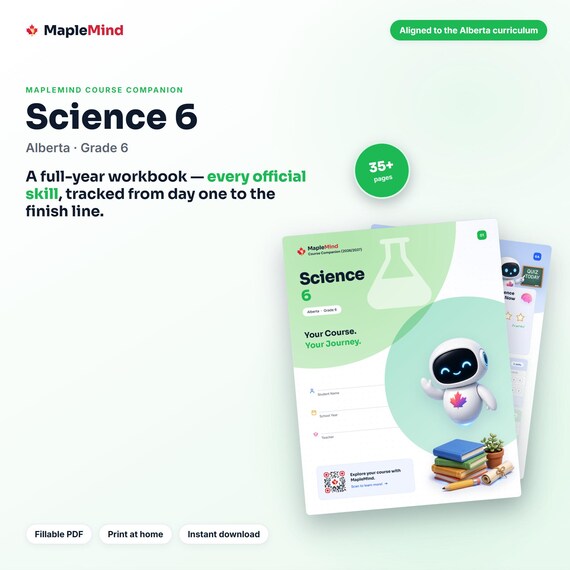
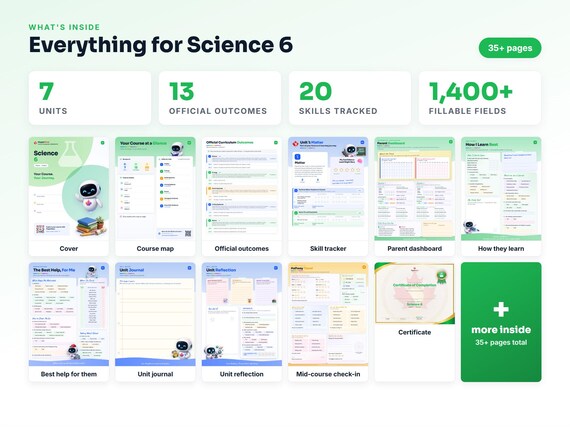
Printable workbook · A keepsake of the year
A Science 6 workbook worth keeping
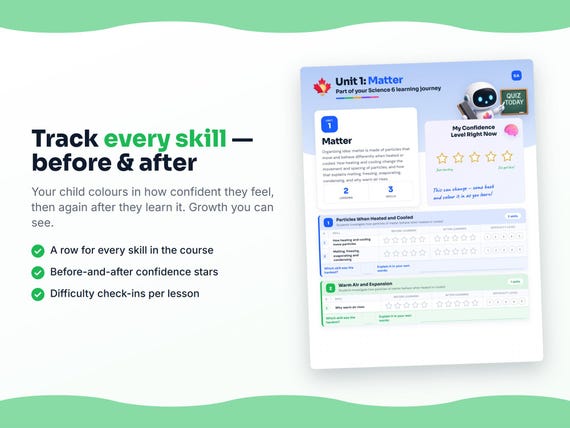
Built from the same official curriculum as this page. Before and after each skill above, your student colours in how sure they feel — so the two of you can see, on one page, what's clicking and what needs another look. It's a quiet way to follow how the year is really going.
By June it's full of their own handwriting: units worked through, confidence grown, a mid-year check-in, notes from parent-teacher night, and a certificate at the end. Less a worksheet, more a record of the year worth keeping on the shelf.
Instant download · see every page, reviews and the full description · five or more workbooks are $2.99 each
What it looks like in the app
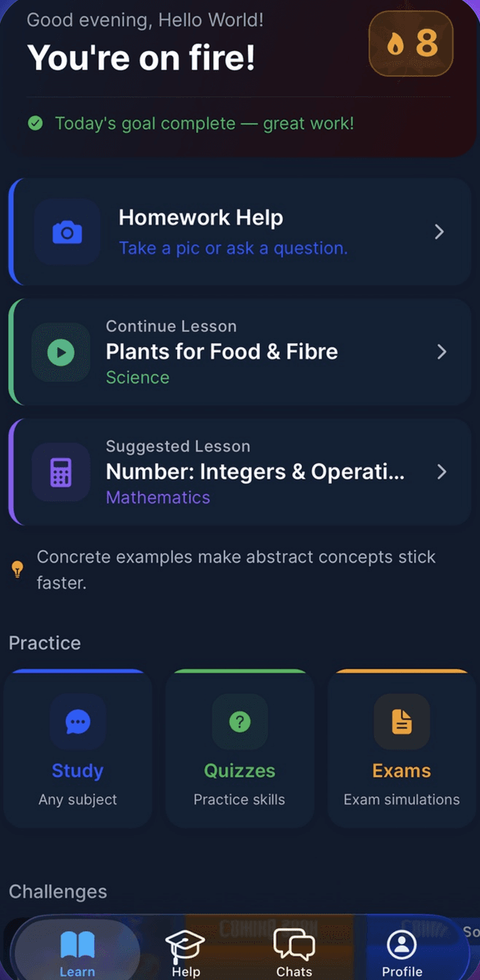
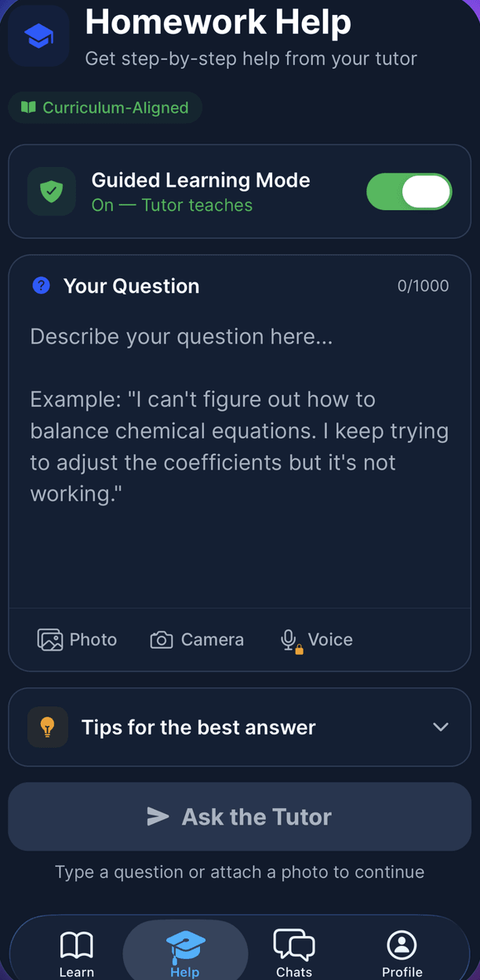
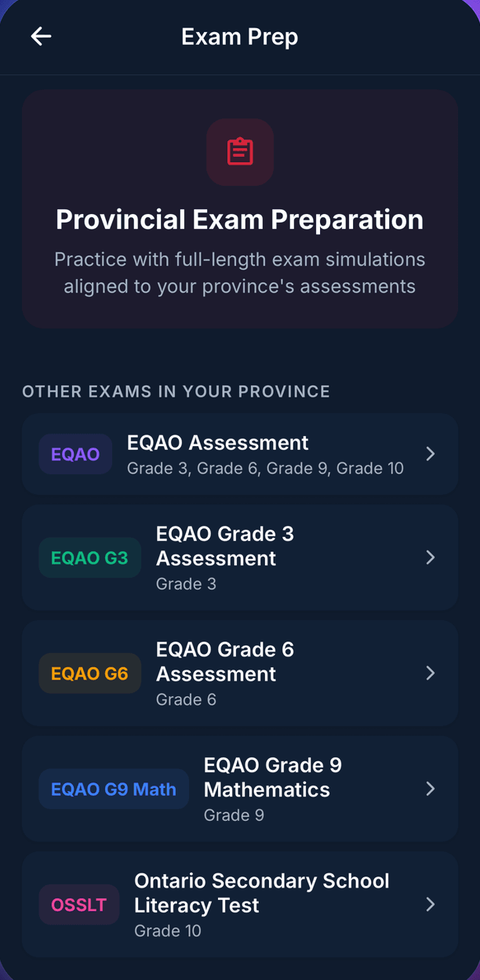
Preparing for the Grade 6 Provincial Achievement Test (PAT)?
Alberta students write a Provincial Achievement Test in Grade 6. MapleMind's exam mode simulates it from this course's skills, then shows exactly which ones to shore up.
Common questions
Can MapleMind help my child with Science 6?
Yes. MapleMind's AI tutor covers all 20 skills in Alberta's Science 6 — your child picks the exact skill, and the tutor teaches it step by step: a short lesson, a worked example, solving together, then a skill check to show it stuck.
Is MapleMind aligned to Alberta's official curriculum?
Yes. Every skill in this course maps to an official outcome code from Alberta's Grade 6 Science curriculum, and the ministry's own wording is quoted under each unit on this page — with the official government source linked so you can check it yourself.
What does MapleMind cost?
It's free to start — 5 tutoring chats and a practice quiz every day, no credit card. A Pro subscription ($9.99/month or $49.99/year CAD, 7-day free trial) unlocks unlimited tutoring, practice, and exam simulations.
What if my child is stuck on just one topic?
That's the point of skill-level tutoring: open Science 6 in the app, tap the exact skill from the list on this page, and the tutor teaches just that — no wading through lessons your child doesn't need.
Does MapleMind work in French or other languages?
Yes — 14 languages, including French. Both the app and the tutor's explanations switch to the language your child chooses.
Where can I see the official Alberta curriculum for Science 6?
The official source is linked on this page — Alberta's official programs of study. The outline here follows it: every MapleMind skill carries its official outcome code, and the ministry's own wording is quoted under each unit.
Does MapleMind help with the Grade 6 Provincial Achievement Test (PAT)?
Yes. Alberta students write a Provincial Achievement Test in Grade 6. MapleMind's exam mode simulates it from this course's skills, then shows exactly which ones to shore up.
Keep exploring
Ready when you are
Pick a skill from this page and see it taught properly — free, in the browser, in under a minute.