Provincial Achievement Test · Alberta
Grade 6 Science Provincial Achievement Test
- Grade 6
Dates and details can change. We do our best to keep this page up to date, but check the official sources before relying on it.
- Total time
- 1 h
- Marked questions
- 50
- Calculator
- Not allowed
- Format
- On a computer
Grade 6 Science PAT practice test
The whole exam or the parts you choose, in its own format, on the clock.
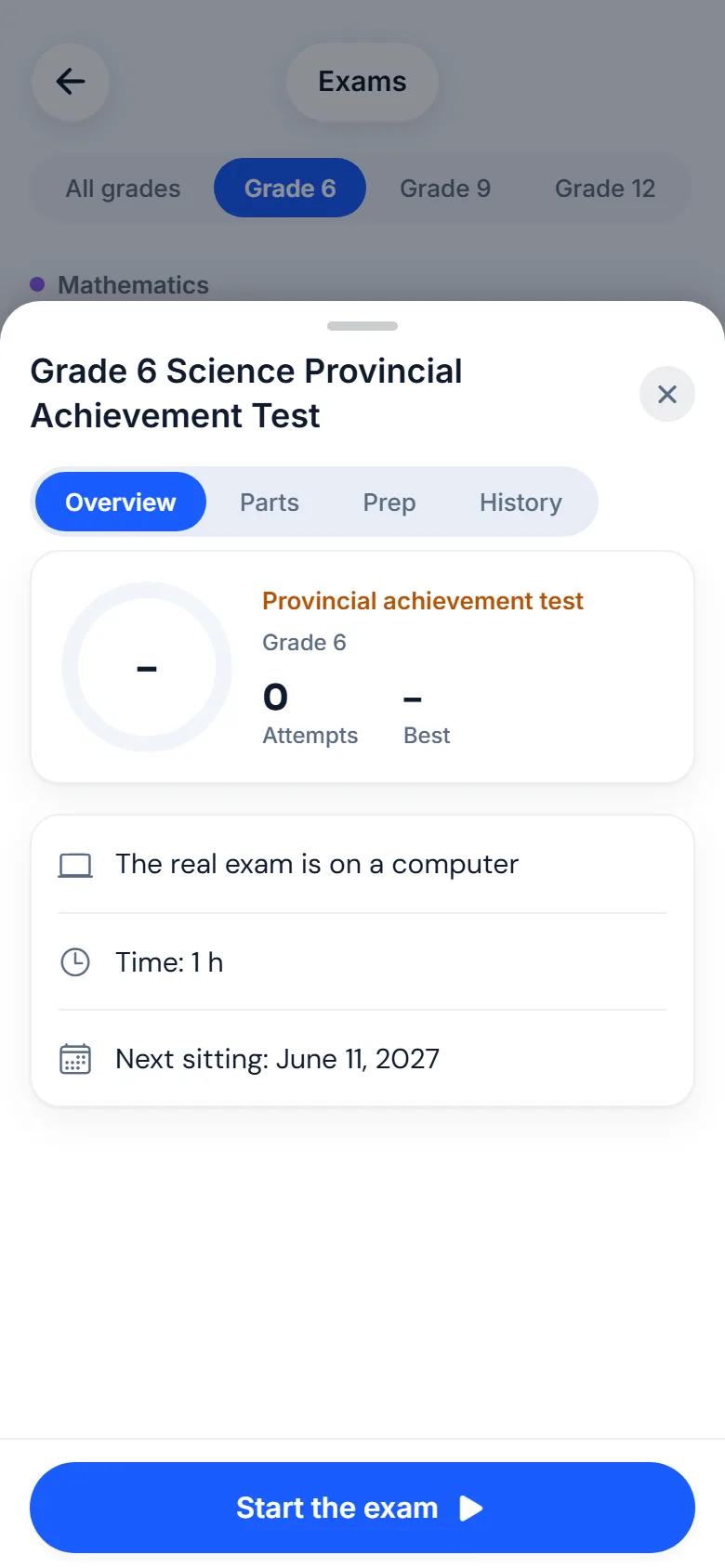 The exam in the app
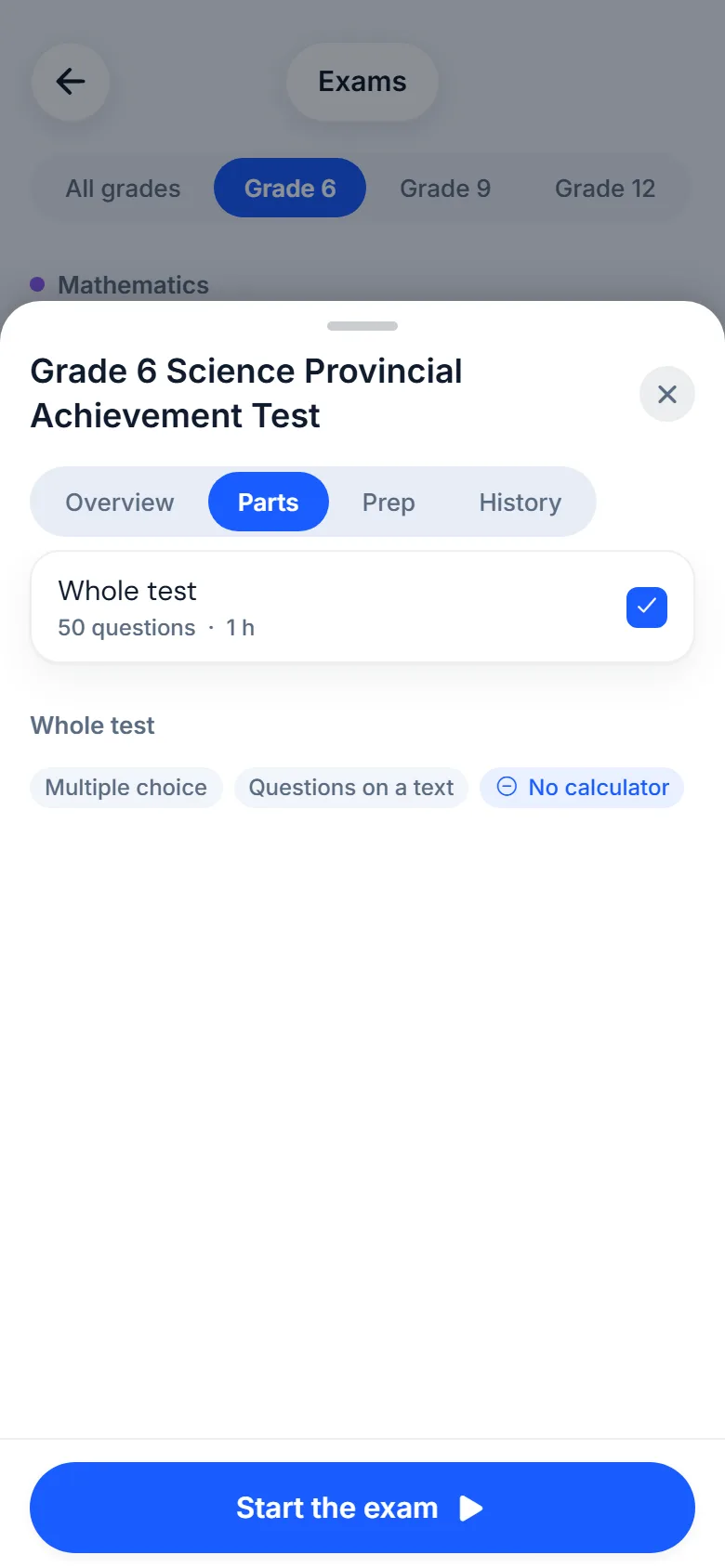 Its parts, and what you can use in each
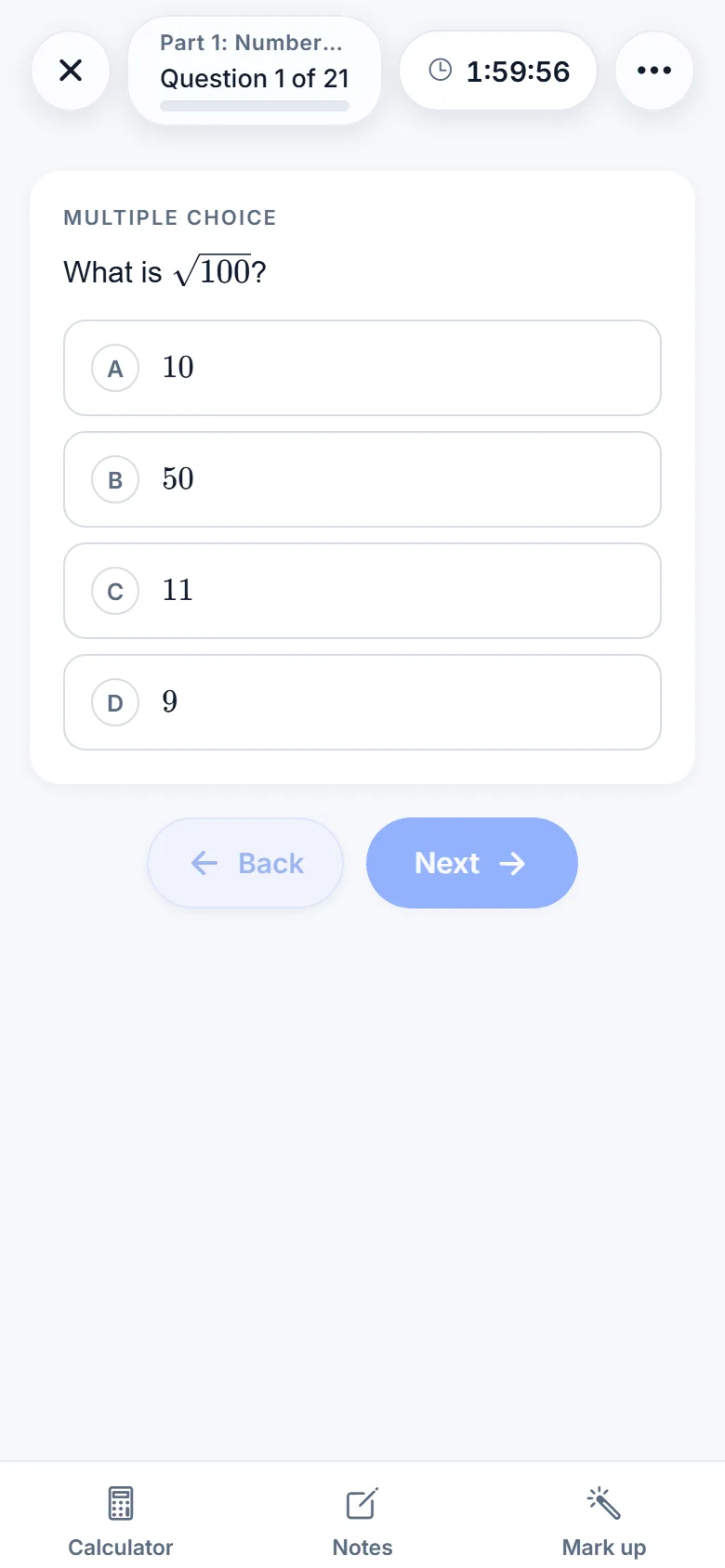 A question, timed, with the exam’s tools
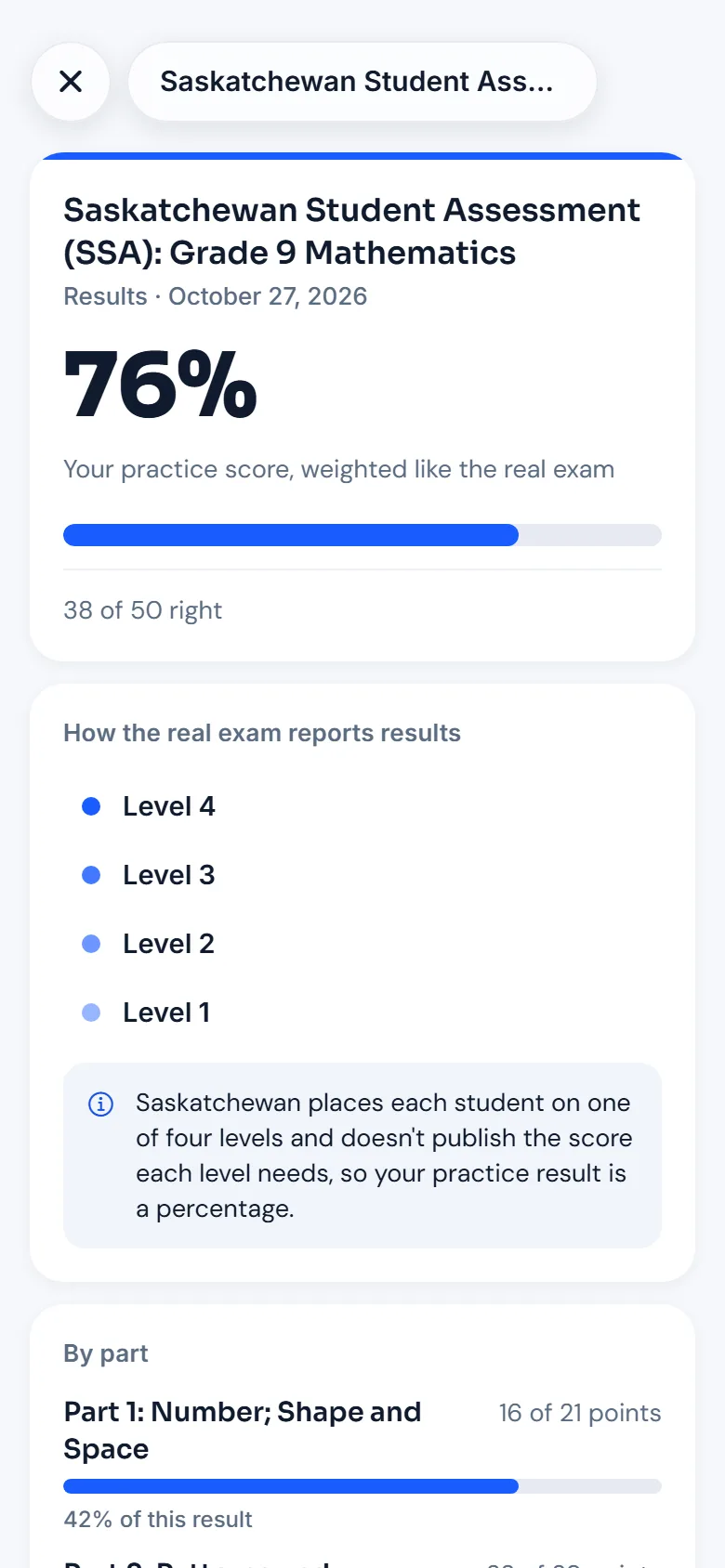 The marked result, part by part
A practice run of Saskatchewan’s Grade 9 math assessment.
Free with a MapleMind account
When
June 2027
- Friday, June 11, 20279:00–10:00 AM · Whole test
The dates are Alberta’s own, read on September 28, 2026. See the official schedule (alberta.ca)
What’s on it
6 topics. Climate and Ecosystems counts most, at 26–32%.
- Matter and Energy resources22–28%11–14 questions
- Interactions12–16%6–8 questions
- Climate and Ecosystems26–32%13–16 questions
- Solar systems8–12%4–6 questions
- Computational thinking10–14%5–7 questions
- Scientific method14–18%7–9 questions
The skills it tests · 55 skills
- Abstraction in design and coding
- Action and reaction forces
- Bodies that emit or reflect light
- Celestial bodies of the solar system
- Characteristics of celestial bodies
- Choosing energy resources
- Climate and Earth's systems
- Climate change and farming
- Climate change and traditional ways of living
- Communicating explanations
- Design and coding in society
- Designing for expansion and contraction
- Diversity in ecosystems
- Ecosystems that store carbon
- Effects of a changing climate
- Energy before and after processing
- Energy in daily life
- Examining a local ecosystem
- Expansion and contraction
- External forces
- Extreme weather
- First Nations, Métis and Inuit explanations
- Heating and cooling particles
- How photosynthesis works
- How the parts of an ecosystem depend on each other
- Hypotheses
- Impacts of computers, coding and technology
- Information and everyday abstractions
- Internal forces
- Knowledge Keepers and scientists together
- Living and non-living parts
- Living and working in space
- Location and climate
- Managing energy resources responsibly
- Measuring climate change
- Modelling the solar system
- Natural and human causes of climate change
- Personal actions on climate change
- Phase changes
- Sacred plants
- Satellites and orbits
- Science corrects itself
- Sequences, conditionals and loops
- Technologies that explore space
- Temporary and permanent changes in shape
- Testing for photosynthesis
- The planets, the asteroid belt and Pluto
- The roles of plants
- Thermometers and the Celsius scale
- Trustworthy evidence
- Types of ecosystems
- Water's unusual behaviour
- What a scientific explanation is
- When an ecosystem changes
- Why the dinosaurs died out
How it’s built
- Whole test
- Time
- 60 min
- Questions
- 50
- Marks
- 50
- Of the marks
- 100%
- Multiple choice
- Questions in sets
50 questions, each worth 1 mark, often in groups around a shared real-life situation.
How it’s marked
- Below the acceptable standard
- Acceptable standard
- Standard of excellence
A computer marks every question. Your results are reported against two provincial standards: the acceptable standard and the standard of excellence.
On the day
One session on the computer, and everyone may take up to 120 minutes. You can't use a calculator or a dictionary, but a ruler and a protractor are allowed.
Getting ready
1 official document to practise with, and 4 tips.
Official practice
Tips from the people who write it
- There's no calculator, so practise arithmetic by hand.
- Questions often share a real-life situation: read it before its questions.
- A ruler and protractor are allowed, but you don't need them to do well.
- Words you need are explained on the page.
After the exam
- Results
The school shares early results with families by the end of the school year. The Individual Student Profile follows in early September 2027, on myPass and from the school.
- Marks
Whether the test counts in a school mark is up to the school authority.
- If you miss it
A student absent on test day writes it when they’re back, before the last scheduled day. The principal, with the parents, can ask for a student to be excused where writing would harm them or they can’t take part in a meaningful way.
From General Information Bulletin 2026–2027, Grades 6 and 9 Provincial Achievement Testing (alberta.ca), read on October 27, 2026.
More for you
Students
Start with the topics worth the most marks, then write full practice exams under the real time limit.
Practise itParents
Put the dates on the family calendar. The Parent Dashboard shows each practice exam’s result and the skills that need another look.
See the Parent DashboardEducators
The topic weights and the official practice above make a review plan. Students can practise each skill on its own in MapleMind, free with daily limits.
For schools
Questions about this exam
When is the Grade 6 Science Provincial Achievement Test in 2026–27?
The next sitting is June 11, 2027, 9:00–10:00 AM.
How long is the Grade 6 Science Provincial Achievement Test?
It takes 1 hour in all, over 1 part.
How many questions are on the Grade 6 Science Provincial Achievement Test?
It has 50 marked questions.
Can you use a calculator on the Grade 6 Science Provincial Achievement Test?
No. Calculators aren’t allowed.
How are Grade 6 Science Provincial Achievement Test results reported?
At 3 levels: Below the acceptable standard, Acceptable standard and Standard of excellence.
Where can I find practice tests for the Grade 6 Science Provincial Achievement Test?
Alberta publishes Grade 6 science practice + parent guide. MapleMind also builds a full practice exam in its format, free with an account.

Practise for the Grade 6 Science Provincial Achievement Test
Every skill on the Grade 6 Science Provincial Achievement Test, taught one at a time, then practised on questions written like the real ones.


