Provincial Achievement Test · Alberta
Grade 6 Mathematics Provincial Achievement Test
- Grade 6
Dates and details can change. We do our best to keep this page up to date, but check the official sources before relying on it.
- Total time
- 1 h 45 min
- Marked questions
- 55
- Parts
- 2
- Calculator
- Not allowed
- Format
- On a computer
Grade 6 Math PAT practice test
The whole exam or the parts you choose, in its own format, on the clock.
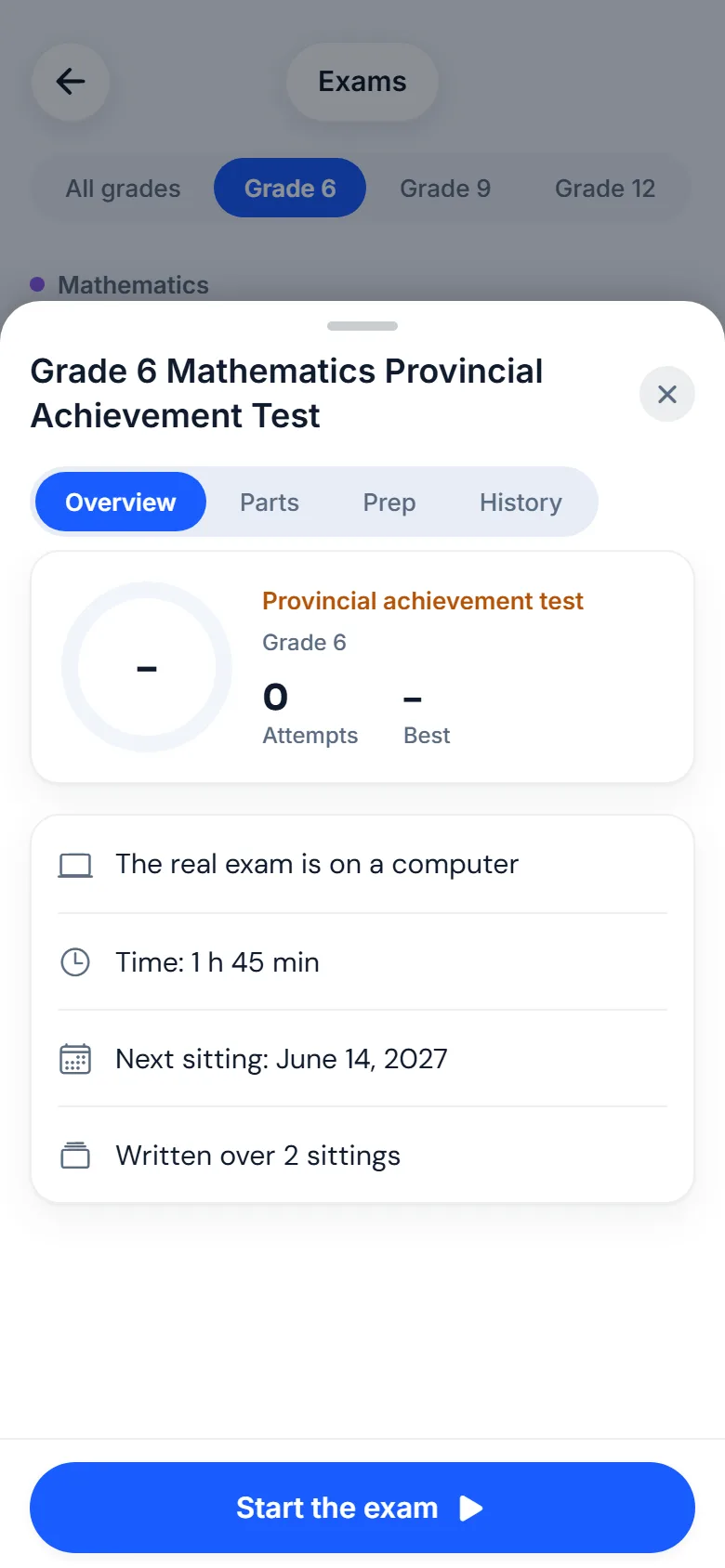 The exam in the app
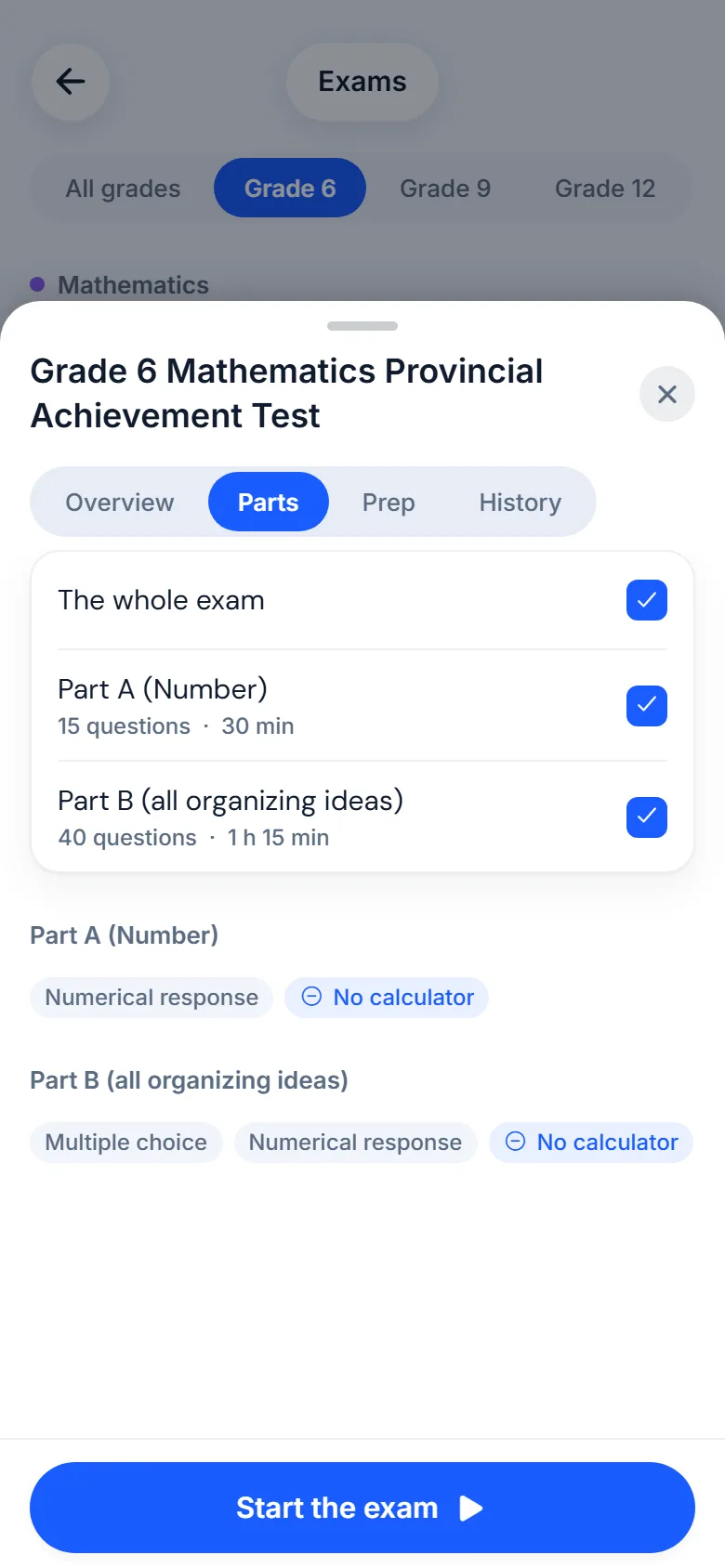 Its parts, and what you can use in each
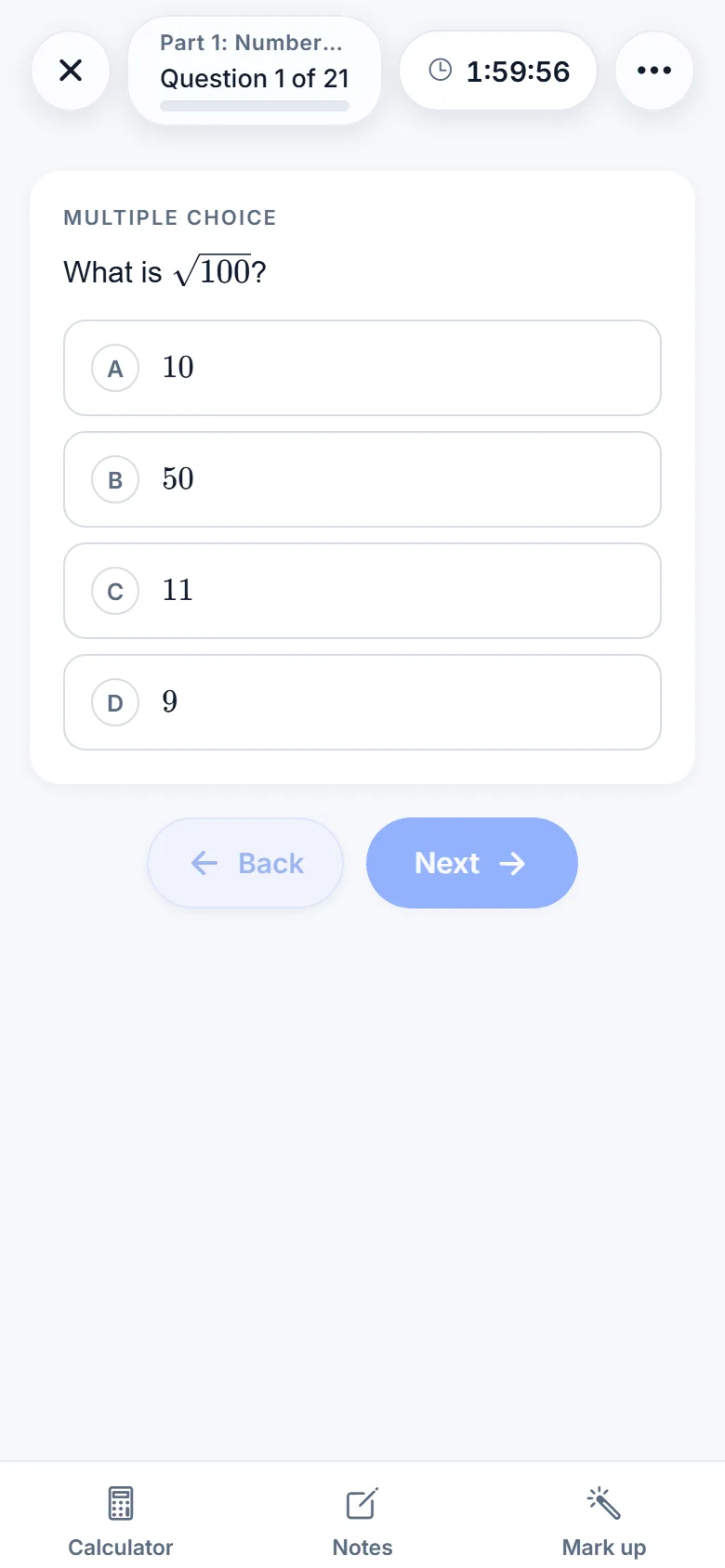 A question, timed, with the exam’s tools
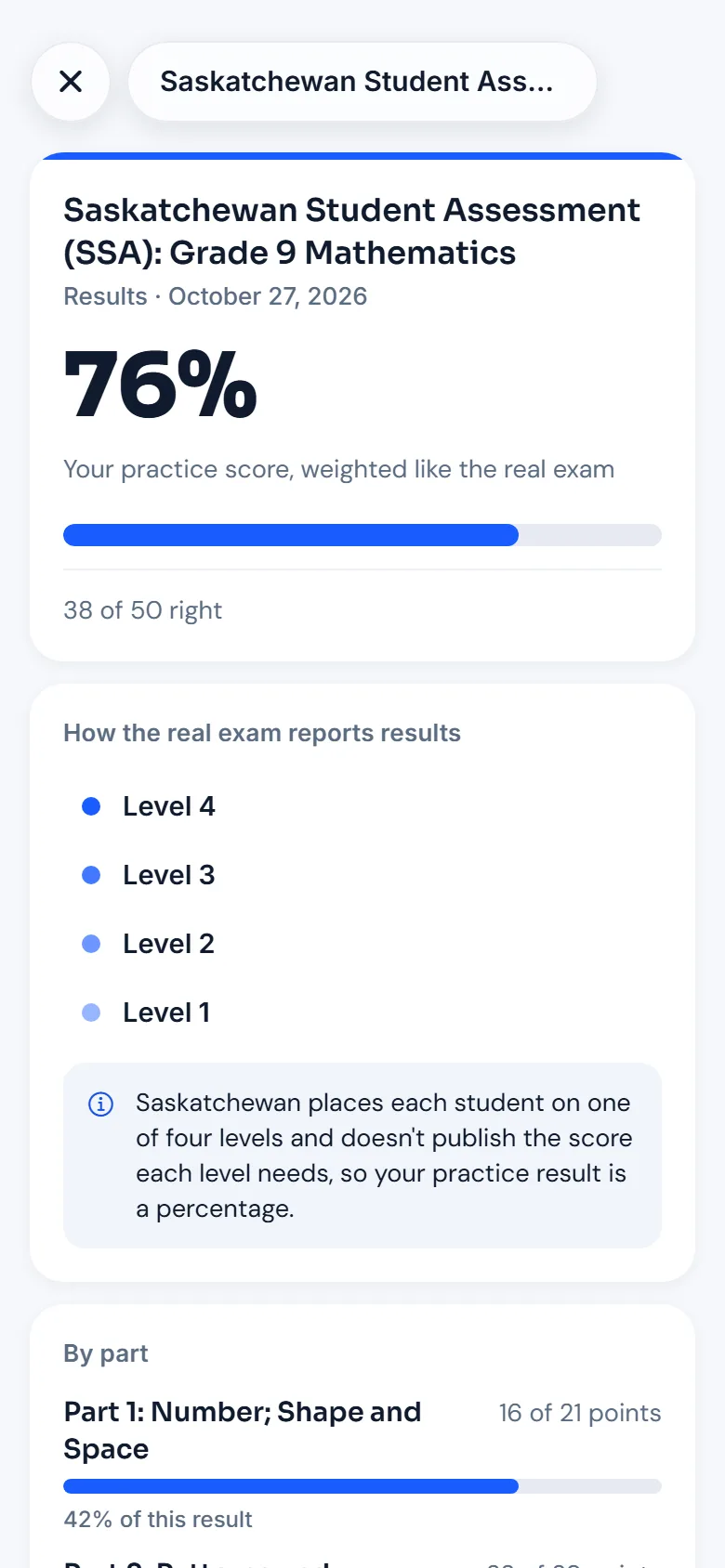 The marked result, part by part
A practice run of Saskatchewan’s Grade 9 math assessment.
Free with a MapleMind account
When
June 2027
- Monday, June 14, 20279:00–9:30 AM · Part A
- Wednesday, June 16, 20279:00–10:15 AM · Part B
The dates are Alberta’s own, read on September 28, 2026. See the official schedule (alberta.ca)
What’s on it
Part A
- Number: Integers, Decimals, and Powers and Fractions, Rates, and Ratios100%Split not published
Part B
- Number: Integers, Decimals, and Powers20–30%
- Number: Fractions, Rates, and Ratios20–30%
- Algebra and Patterns20–30%
- Geometry and Coordinate Geometry5–15%
- Measurement and Statistics10–20%
The skills it tests · 33 skills
- Adding and subtracting with integers
- Areas of composite shapes
- Common denominator strategies
- Congruence
- Coordinates and plotting
- Dividing with decimal quotients
- Equivalent ratios and proportions
- Experiments and likelihood
- Factors, primes and composites
- Fractions as equal sharing
- From fractions to decimals by division
- Like terms and algebraic properties
- Money and measurement problems
- Movement in the plane
- Multiplying by unit fractions
- Multiplying decimal and natural numbers
- Multiplying naturals by any fraction
- Order of operations with powers
- Parallelogram and triangle areas
- Percent as a proportional relationship
- Powers and exponents
- Prime factorization
- Rates and unit rates
- Related denominators
- Relative frequency
- Solving simple equations
- Standard algorithms for addition and subtraction
- Symmetry and tessellations
- Tables and graphs of change
- Understanding negative numbers
- Variables and functions
- Volume and its units
- Volume of right rectangular prisms
How it’s built
Numerical-response questions and multiple-choice questions.
- Part A (Number)
- Time
- 30 min
- Questions
- 15
- Marks
- 15
- Of the marks
- 20%
- Numerical response
15 number questions, each worth 1 mark: integers, decimals and powers, and fractions, rates and ratios.
- Part B (all organizing ideas)
- Time
- 75 min
- Questions
- 40
- Marks
- 40
- Of the marks
- 80%
- Multiple choice
- Numerical response
40 questions, each worth 1 mark, from every area of the Grade 6 curriculum.
How it’s marked
- Below the acceptable standard
- Acceptable standard
- Standard of excellence
A computer marks every question. Your results are reported against two provincial standards: the acceptable standard and the standard of excellence.
On the day
- First sittingPart A, on number, set for 30 minutes.
- Two days laterPart B, on the whole course, set for 75 minutes.
Two parts, on the computer, with no calculator in either. Everyone may take up to double the time: 60 minutes for Part A and 150 for Part B.
Getting ready
1 official document to practise with, and 4 tips.
Official practice
Tips from the people who write it
- Part A is number work in 30 minutes: integers, decimals, powers, fractions, rates and ratios, worked quickly and surely.
- Part B covers every area of the Grade 6 math curriculum.
- You can't use a calculator, so practise working by hand.
- Practise the platform's question formats before the test day.
After the exam
- Results
The school shares early results with families by the end of the school year. The Individual Student Profile follows in early September 2027, on myPass and from the school.
- Marks
Whether the test counts in a school mark is up to the school authority.
- If you miss it
A student absent on test day writes it when they’re back, before the last scheduled day. The principal, with the parents, can ask for a student to be excused where writing would harm them or they can’t take part in a meaningful way.
From General Information Bulletin 2026–2027, Grades 6 and 9 Provincial Achievement Testing (alberta.ca), read on October 27, 2026.
More for you
Students
Start with the topics worth the most marks, then write full practice exams under the real time limit.
Practise itParents
Put the dates on the family calendar. The Parent Dashboard shows each practice exam’s result and the skills that need another look.
See the Parent DashboardEducators
The topic weights and the official practice above make a review plan. Students can practise each skill on its own in MapleMind, free with daily limits.
For schools
Questions about this exam
When is the Grade 6 Mathematics Provincial Achievement Test in 2026–27?
The next sitting is June 14, 2027, 9:00–9:30 AM.
How long is the Grade 6 Mathematics Provincial Achievement Test?
It takes 1 hour 45 minutes in all, over 2 parts.
How many questions are on the Grade 6 Mathematics Provincial Achievement Test?
It has 55 marked questions: 15 in Part A (Number) and 40 in Part B (all organizing ideas).
Can you use a calculator on the Grade 6 Mathematics Provincial Achievement Test?
No. Calculators aren’t allowed.
How are Grade 6 Mathematics Provincial Achievement Test results reported?
At 3 levels: Below the acceptable standard, Acceptable standard and Standard of excellence.
Where can I find practice tests for the Grade 6 Mathematics Provincial Achievement Test?
Alberta publishes Grade 6 math practice + parent guide. MapleMind also builds a full practice exam in its format, free with an account.

Practise for the Grade 6 Mathematics Provincial Achievement Test
Every skill on the Grade 6 Mathematics Provincial Achievement Test, taught one at a time, then practised on questions written like the real ones.


