Get help with Mathematics 6
Most tutoring makes your child sit through material your child already knows. MapleMind flips that: pick the exact skill that's causing trouble — any of the 33 below — and the tutor teaches just that one, step by step, as many times as it takes. Ask questions in plain words, any time of day, in English, French, or 12 other languages.
The official Alberta Mathematics 6 curriculum
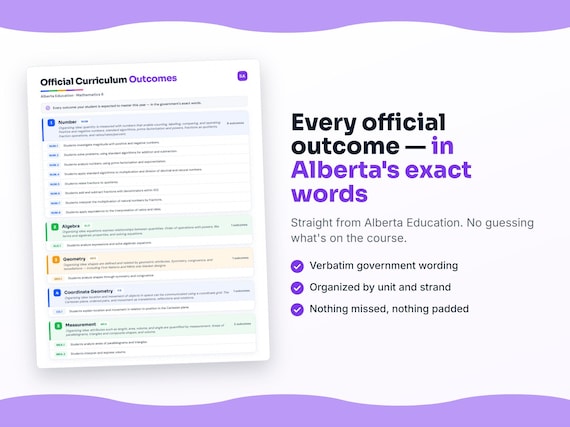
Alberta defines Mathematics 6 by strands and outcomes. MapleMind teaches the same curriculum reorganized for one-skill-at-a-time tutoring — the table shows exactly where every official strand lands, and the ministry's own wording is quoted under each unit below.
Official source Alberta's official programs of studyRead it on the government site — alberta.ca ↗| Official strand | Outcomes | Where MapleMind teaches it |
|---|---|---|
| Number | 8 | Number |
| Algebra | 1 | Algebra |
| Geometry | 1 | Geometry |
| Coordinate Geometry | 1 | Coordinate Geometry |
| Measurement | 2 | Measurement |
| Patterns | 1 | Patterns |
| Statistics | 1 | Statistics |
Every skill below, taught one on one.
 Try the first session free
How MapleMind teaches Mathematics 6 — every unit, lesson, and skill
Every skill below runs as a short session: a plain-words lesson, a worked example, solving it together, then a five-question skill check that earns up to three stars. Guided Mode keeps it teaching instead of answer-handing — turning it off needs a parent's password.
Unit 1NumberOfficial strand · Number
Organizing idea: quantity is measured with numbers that enable counting, labelling, comparing, and operating. Positive and negative numbers, standard algorithms, prime factorization and powers, fractions as quotients, fraction operations, and ratios/rates/percent.
Positive and Negative Numbers
- Understanding negative numbers6.N.1 — Locate negative numbers on horizontal and vertical number lines, connect them to real contexts (temperature, debt, elevation), and understand magnitude and opposites (zero is neither positive nor negative).
- Adding and subtracting with integers6.N.1 — Investigate integer sums using additive inverses (a number plus its opposite is zero; positive+positive is positive, negative+negative is negative) and understand that subtracting a number is the same as adding its additive inverse.
Addition and Subtraction Problem Solving
- Standard algorithms for addition and subtraction6.N.2 — Use standard algorithms fluently and reliably for multi-digit addition and subtraction.
- Money and measurement problems6.N.2 — Solve real-context problems involving money and metric measurement using addition and subtraction.
Prime Factorization and Powers
- Factors, primes and composites6.N.3 — Express composite numbers as products of smaller numbers, using the associative property of multiplication.
- Prime factorization6.N.3 — Represent a number as a product of prime numbers and determine composite factors from its prime factors.
- Powers and exponents6.N.3 — Represent repeated multiplication as a power (base and exponent), including expressing repeated prime factors within a prime factorization as powers.
Multiplying and Dividing with Decimals
- Multiplying decimal and natural numbers6.N.4 — Apply standard algorithms to multiplication of decimal and natural numbers.
- Dividing with decimal quotients6.N.4 — Apply standard algorithms to division, expressing a quotient with a remainder as a decimal number.
Fractions as Quotients
- Fractions as equal sharing6.N.5 — Represent equal-sharing situations as fractions where the numerator is the quantity shared and the denominator is the number of shares.
- From fractions to decimals by division6.N.5 — Divide the numerator by the denominator to find the decimal equivalent of a fraction.
Adding and Subtracting Fractions
- Common denominator strategies6.N.6 — Find common denominators (including the product of the two denominators) to add and subtract fractions with denominators within 100.
Multiplying Natural Numbers by Fractions
- Multiplying by unit fractions6.N.7 — Interpret multiplication by a unit fraction as division by its denominator (a × 1/b = a/b).
- Multiplying naturals by any fraction6.N.7 — Multiply a natural number by a fraction (a × b/c = ab/c): multiply by the numerator and divide by the denominator.
Ratios, Rates and Percent
- Equivalent ratios and proportions6.N.8 — Create equivalent ratios by multiplying or dividing both terms by the same number, and express proportions as equivalence between two ratios.
- Rates and unit rates6.N.8 — Describe proportional relationships as rates and express them as unit rates (second term of 1).
- Percent as a proportional relationship6.N.8 — Interpret a percentage as a proportional relationship between a quantity and 100, and find the percent of a number.
The official wording — 8 outcomes in this unit
- 6.N.1
Students investigate magnitude with positive and negative numbers.
- 6.N.2
Students solve problems, using standard algorithms for addition and subtraction.
- 6.N.3
Students analyze numbers, using prime factorization and exponentiation.
- 6.N.4
Students apply standard algorithms to multiplication and division of decimal and natural numbers.
- 6.N.5
Students relate fractions to quotients.
- 6.N.6
Students add and subtract fractions with denominators within 100.
- 6.N.7
Students interpret the multiplication of natural numbers by fractions.
- 6.N.8
Students apply equivalence to the interpretation of ratios and rates.
Unit 2AlgebraOfficial strand · Algebra
Organizing idea: equations express relationships between quantities. Order of operations with powers, like terms and algebraic properties, and solving equations.
Expressions and Equations
- Order of operations with powers6.A.1 — Evaluate numerical expressions using the conventional order of operations: parentheses first, then powers, then the other operations.
- Like terms and algebraic properties6.A.1 — Combine like terms through addition and subtraction, and rearrange expressions using the commutative, associative and distributive properties.
- Solving simple equations6.A.1 — Solve algebraic equations, understanding that all simplified forms of an equation share the same solution.
The official wording — 1 outcome in this unit
- 6.A.1
Students analyze expressions and solve algebraic equations.
Unit 3GeometryOfficial strand · Geometry
Organizing idea: shapes are defined and related by geometric attributes. Symmetry, congruence, and tessellations — including First Nations and Métis star blanket designs.
Symmetry and Congruence
- Symmetry and tessellations6.G.1 — Map symmetrical shapes with combinations of reflections and rotations, and explore tessellations — including those evident in First Nations and Métis star blanket designs.
- Congruence6.G.1 — Recognize that shapes related by symmetry are congruent, and that congruent shapes are not necessarily related by symmetry.
The official wording — 1 outcome in this unit
- 6.G.1
Students analyze shapes through symmetry and congruence.
Unit 4Coordinate GeometryOfficial strand · Coordinate Geometry
Organizing idea: location and movement of objects in space can be communicated using a coordinate grid. The Cartesian plane, ordered pairs, and movement as translations, reflections and rotations.
The Cartesian Plane
- Coordinates and plotting6.CG.1 — Locate and plot points in the Cartesian plane using ordered pairs (x, y), understanding the axes, the origin, and coordinate distances.
- Movement in the plane6.CG.1 — Describe movement in the Cartesian plane as translations (combined horizontal/vertical movement), reflections (across a line), and rotations (around a centre, clockwise or counter-clockwise).
The official wording — 1 outcome in this unit
- 6.CG.1
Students explain location and movement in relation to position in the Cartesian plane.
Unit 5MeasurementOfficial strand · Measurement
Organizing idea: attributes such as length, area, volume, and angle are quantified by measurement. Areas of parallelograms, triangles and composite shapes, and volume.
Areas of Parallelograms and Triangles
- Parallelogram and triangle areas6.M.1 — Analyze the area of parallelograms (any side as base, perpendicular height) and triangles (half of a parallelogram with the same base and height).
- Areas of composite shapes6.M.1 — Find the area of composite shapes as the sum of the areas of triangles and parallelograms.
Volume
- Volume and its units6.M.2 — Measure volume in standard units (cubic centimetres and cubic metres) derived from units of length.
- Volume of right rectangular prisms6.M.2 — Interpret the volume of a right rectangular prism as the product of its base area and perpendicular height.
The official wording — 2 outcomes in this unit
- 6.M.1
Students analyze areas of parallelograms and triangles.
- 6.M.2
Students interpret and express volume.
Unit 6PatternsOfficial strand · Patterns
Organizing idea: awareness of patterns supports problem solving in various situations. Functions as changing quantities, tables of values, and graphs of change.
Functions and Change
- Variables and functions6.P.1 — Interpret variables as values of changing quantities and functions as relationships between quantities that change (height over time, temperature, distance travelled).
- Tables and graphs of change6.P.1 — Represent functions with tables of values (independent variable first, dependent second) and plot them as x- and y-coordinates in the Cartesian plane.
The official wording — 1 outcome in this unit
- 6.P.1
Students investigate functions to enhance understanding of change.
Unit 7StatisticsOfficial strand · Statistics
Organizing idea: the science of collecting, analyzing, visualizing, and interpreting data can inform understanding and decision making. Relative frequency and experimental data.
Relative Frequency
- Relative frequency6.ST.1 — Determine and represent relative frequency to compare categories of data across data sets.
- Experiments and likelihood6.ST.1 — Describe events as outcomes of experiments with equally likely outcomes, and understand that more trials give better estimates of likelihood (the law of large numbers).
The official wording — 1 outcome in this unit
- 6.ST.1
Students investigate relative frequency, using experimental data.
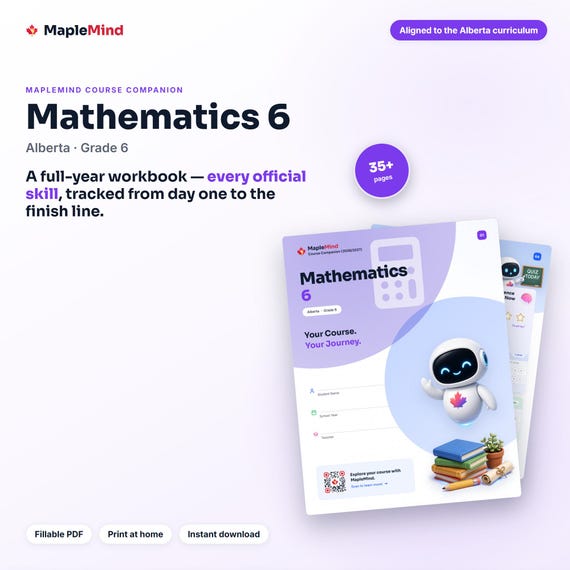
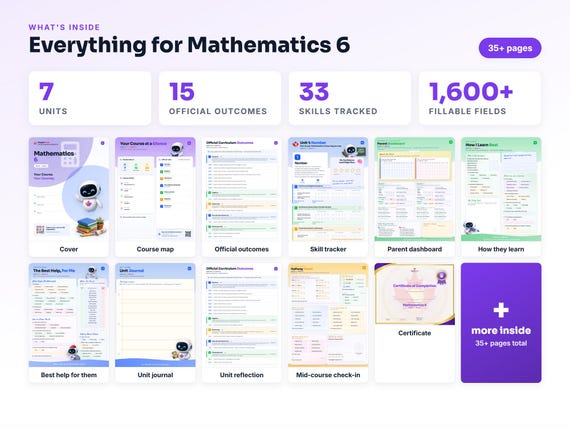
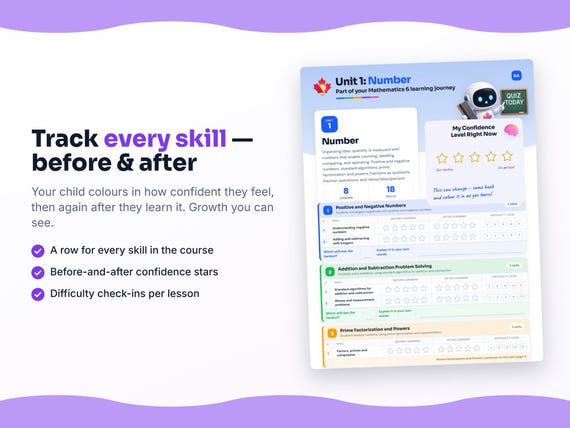
Printable workbook · A keepsake of the year
A Mathematics 6 workbook worth keeping
Built from the same official curriculum as this page. Before and after each skill above, your student colours in how sure they feel — so the two of you can see, on one page, what's clicking and what needs another look. It's a quiet way to follow how the year is really going.
By June it's full of their own handwriting: units worked through, confidence grown, a mid-year check-in, notes from parent-teacher night, and a certificate at the end. Less a worksheet, more a record of the year worth keeping on the shelf.
Instant download · see every page, reviews and the full description · five or more workbooks are $2.99 each
What it looks like in the app
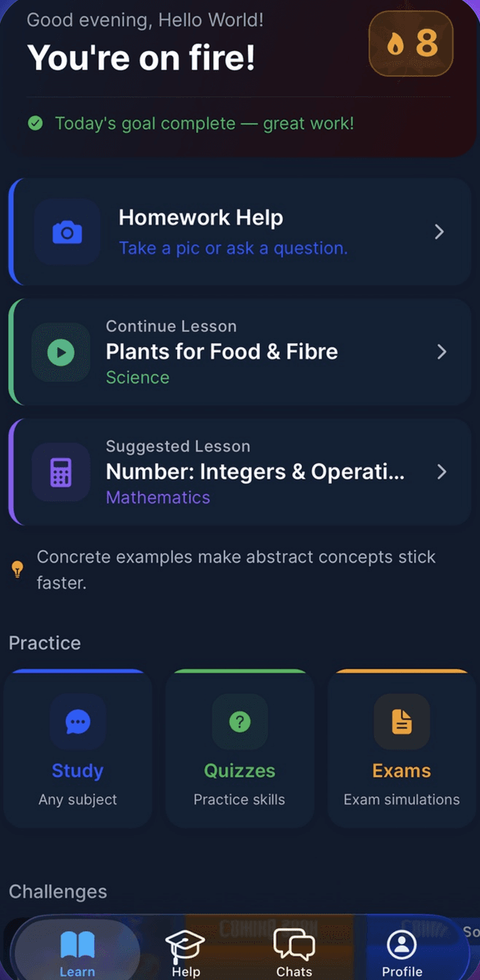
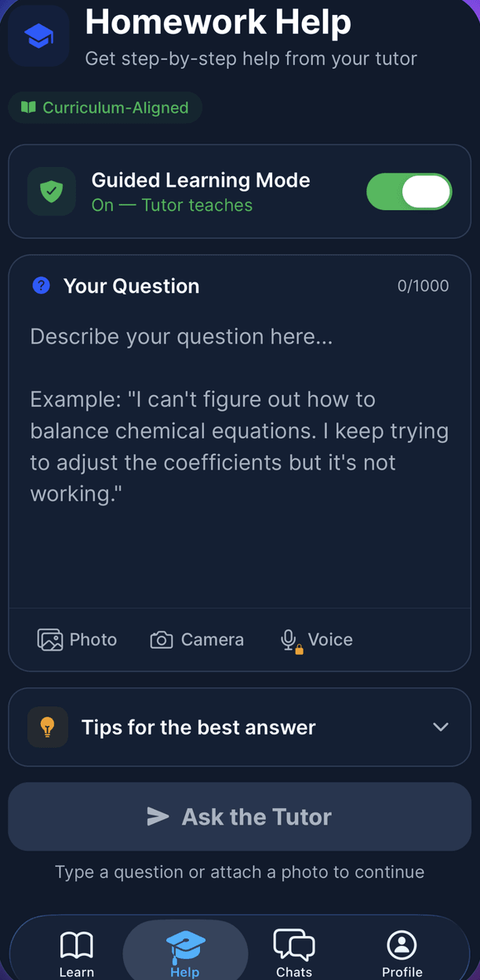
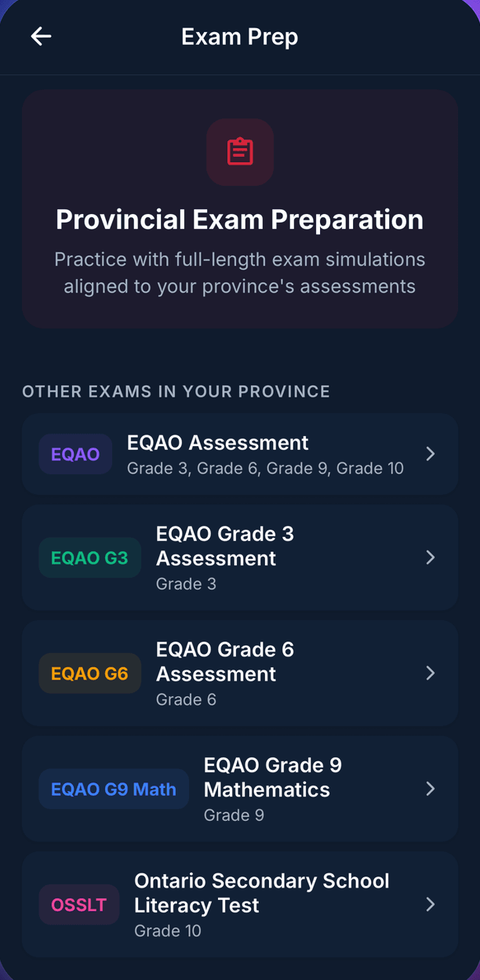
Preparing for the Grade 6 Provincial Achievement Test (PAT)?
Alberta students write a Provincial Achievement Test in Grade 6. MapleMind's exam mode simulates it from this course's skills, then shows exactly which ones to shore up.
Common questions
Can MapleMind help my child with Mathematics 6?
Yes. MapleMind's AI tutor covers all 33 skills in Alberta's Mathematics 6 — your child picks the exact skill, and the tutor teaches it step by step: a short lesson, a worked example, solving together, then a skill check to show it stuck.
Is MapleMind aligned to Alberta's official curriculum?
Yes. Every skill in this course maps to an official outcome code from Alberta's Grade 6 Mathematics curriculum, and the ministry's own wording is quoted under each unit on this page — with the official government source linked so you can check it yourself.
What does MapleMind cost?
It's free to start — 5 tutoring chats and a practice quiz every day, no credit card. A Pro subscription ($9.99/month or $49.99/year CAD, 7-day free trial) unlocks unlimited tutoring, practice, and exam simulations.
What if my child is stuck on just one topic?
That's the point of skill-level tutoring: open Mathematics 6 in the app, tap the exact skill from the list on this page, and the tutor teaches just that — no wading through lessons your child doesn't need.
Does MapleMind work in French or other languages?
Yes — 14 languages, including French. Both the app and the tutor's explanations switch to the language your child chooses.
Where can I see the official Alberta curriculum for Mathematics 6?
The official source is linked on this page — Alberta's official programs of study. The outline here follows it: every MapleMind skill carries its official outcome code, and the ministry's own wording is quoted under each unit.
Does MapleMind help with the Grade 6 Provincial Achievement Test (PAT)?
Yes. Alberta students write a Provincial Achievement Test in Grade 6. MapleMind's exam mode simulates it from this course's skills, then shows exactly which ones to shore up.
Keep exploring
Ready when you are
Pick a skill from this page and see it taught properly — free, in the browser, in under a minute.