Get help with Mathematics 6
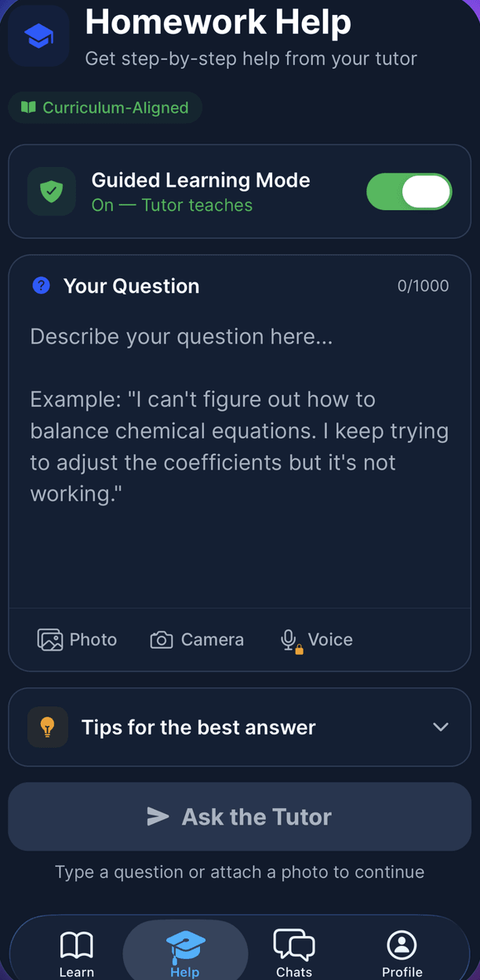
Most tutoring makes your child sit through material your child already knows. MapleMind flips that: pick the exact skill that's causing trouble — any of the 19 below — and the tutor teaches just that one, step by step, as many times as it takes. Ask questions in plain words, any time of day, in English, French, or 12 other languages.
The official British Columbia Mathematics 6 curriculum
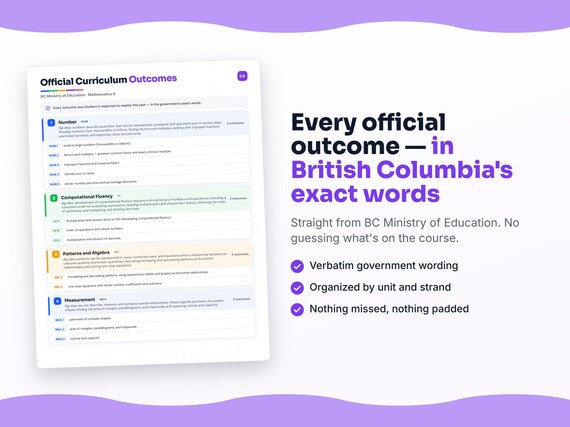
British Columbia defines Mathematics 6 by strands and outcomes. MapleMind teaches the same curriculum reorganized for one-skill-at-a-time tutoring — the table shows exactly where every official strand lands, and the ministry's own wording is quoted under each unit below.
Official source BC's official mathematics curriculumRead it on the government site — curriculum.gov.bc.ca ↗| Official strand | Outcomes | Where MapleMind teaches it |
|---|---|---|
| Number | 5 | Number |
| Computational Fluency | 3 | Computational Fluency |
| Patterning | 2 | Patterns and Algebra |
| Measurement | 3 | Measurement |
| Geometry | 3 | Geometry |
| Data and Probability | 3 | Data, Probability, and Financial Literacy |
Every skill below, taught one on one.
 Try the first session free
How MapleMind teaches Mathematics 6 — every unit, lesson, and skill
Every skill below runs as a short session: a plain-words lesson, a worked example, solving it together, then a five-question skill check that earns up to three stars. Guided Mode keeps it teaching instead of answer-handing — turning it off needs a parent's password.
Unit 1NumberOfficial strand · Number
Big Idea: numbers describe quantities that can be represented, compared, and operated upon in various ways. Reading numbers from thousandths to billions, finding factors and multiples, working with improper fractions and mixed numbers, and beginning ratios and percents.
Numbers from Thousandths to Billions
- Reading and comparing very small and very large numbers6.C.1 — Read, write, and compare numbers across a huge range — from thousandths (like 0.004) up to billions (like 3 200 000 000) — using place value to understand what each digit is worth.
Factors and Multiples
- Greatest common factor and least common multiple6.C.4 — Find the factors and multiples of whole numbers, then use them to find the greatest common factor (GCF) shared by two numbers and the least common multiple (LCM) of two numbers.
Improper Fractions and Mixed Numbers
- Switching between improper fractions and mixed numbers6.C.5 — Represent and convert between improper fractions (like 7/2) and mixed numbers (like 3 1/2), using models and number lines to show they name the same amount.
Introduction to Ratios
- What a ratio compares6.C.6 — Understand a ratio as a comparison between two quantities (like 2 cups of flour for every 1 cup of sugar), and write and interpret ratios in context.
Percents and Discounts
- Whole-number percents and figuring out a discount6.C.7 — Understand whole-number percents (like 25% or 60%) as parts out of 100, and use them to calculate a percentage discount on a price, such as 20% off a $40 item.
The official wording — 5 outcomes in this unit
- 6.C.1
small to large numbers (thousandths to billions)
- 6.C.4
factors and multiples — greatest common factor and least common multiple
- 6.C.5
improper fractions and mixed numbers
- 6.C.6
introduction to ratios
- 6.C.7
whole-number percents and percentage discounts
Unit 2Computational FluencyOfficial strand · Computational Fluency
Big Idea: development of computational fluency requires a strong sense of numbers and operations, including a consistent order for evaluating expressions. Building multiplication and division fact fluency, following the order of operations, and multiplying and dividing decimals.
Quick Multiplication and Division Facts to 100
- Fast and sure with facts to 1006.C.2 — Build speed and confidence recalling multiplication and division facts to 100, using known facts, patterns, and strategies rather than counting or guessing.
Order of Operations
- What to calculate first6.C.3 — Evaluate expressions with whole numbers using the correct order of operations — brackets, then multiplication and division, then addition and subtraction — instead of working strictly left to right.
Multiplying and Dividing Decimals
- Multiplying and dividing decimal numbers6.C.8 — Multiply and divide decimal numbers (like 4.5 × 3 or 12.6 ÷ 2), using place value and estimation to decide where the decimal point belongs in the answer.
The official wording — 3 outcomes in this unit
- 6.C.2
multiplication and division facts to 100 (developing computational fluency)
- 6.C.3
order of operations with whole numbers
- 6.C.8
multiplication and division of decimals
Unit 3Patterns and AlgebraOfficial strand · Patterning
Big Idea: patterns can be represented in many connected ways, and equations show a relationship between an unknown quantity and known quantities. Describing increasing and decreasing patterns as functional relationships, and solving one-step equations.
Patterns as Functional Relationships
- Showing a pattern with expressions, tables, and graphs6.C.9 — Represent an increasing or decreasing pattern as a functional relationship — using an expression, a table of values, and a graph — and use each representation to predict further terms.
Solving One-Step Equations
- Finding the missing whole number6.C.10 — Solve one-step equations that have whole-number coefficients and whole-number solutions, such as finding the value of n in 4n = 24.
The official wording — 2 outcomes in this unit
- 6.C.9
increasing and decreasing patterns, using expressions, tables, and graphs as functional relationships
- 6.C.10
one-step equations with whole-number coefficients and solutions
Unit 4MeasurementOfficial strand · Measurement
Big Idea: we can describe, measure, and compare spatial relationships. Measuring the perimeter of complex shapes, finding the area of triangles, parallelograms, and trapezoids, and exploring volume and capacity.
Perimeter of Complex Shapes
- Measuring around an irregular, many-sided shape6.C.11 — Find the perimeter of complex shapes made of several straight sides by measuring or reasoning out each side length and adding them all together.
Area of Triangles, Parallelograms, and Trapezoids
- Finding the area of three flat shapes6.C.12 — Find the area of triangles, parallelograms, and trapezoids using their base and height, connecting each shape’s formula back to the area of a rectangle.
Volume and Capacity
- How much space something takes up or holds6.C.14 — Explore volume (the space a 3D object takes up, built from unit cubes) and capacity (how much a container can hold), and compare objects using both ideas.
The official wording — 3 outcomes in this unit
- 6.C.11
perimeter of complex shapes
- 6.C.12
area of triangles, parallelograms, and trapezoids
- 6.C.14
volume and capacity
Unit 5GeometryOfficial strand · Geometry
Big Idea: we can describe, measure, and compare spatial relationships. Measuring and classifying angles, and sorting triangles by their sides and angles.
Measuring and Classifying Angles
- Measuring angles with a protractor and naming their type6.C.13 — Measure angles in degrees using a protractor, and classify them as acute, right, obtuse, straight, or reflex based on their size.
Triangles
- Sorting triangles by sides and angles6.C.15 — Identify and classify triangles by their side lengths (scalene, isosceles, equilateral) and by their angles (acute, right, obtuse), recognizing a triangle can be described both ways at once.
Combinations of Transformations
- Applying more than one transformation in a row6.C.16 — Apply a combination of transformations — translations, rotations, and/or reflections done one after another — to a shape and describe the overall change.
The official wording — 3 outcomes in this unit
- 6.C.13
angle measurement and classification
- 6.C.15
triangles
- 6.C.16
combinations of transformations
Unit 6Data, Probability, and Financial LiteracyOfficial strand · Data and Probability
Big Idea: analyzing data highlights and questions trends, and analyzing chance offers insight into predicting outcomes; concrete experiences with money build financial literacy. Reading and building line graphs, testing single-outcome probability both by predicting and by experimenting, and simple budgeting and consumer math.
Line Graphs
- Reading and building line graphs6.C.17 — Read, interpret, and create line graphs to show how a quantity changes over time, such as temperature over a day or height over months.
Single-Outcome Probability
- Comparing predicted and actual chance6.C.18 — Determine the theoretical probability of a single outcome and compare it to the experimental probability found by actually running the trials, explaining any difference.
Financial Literacy: Budgeting and Consumer Math
- Building a simple budget and smart shopping math6.C.19 — Create a simple budget that balances income and expenses, and use consumer math (like comparing unit prices or totaling a receipt with tax) to make informed spending decisions.
The official wording — 3 outcomes in this unit
- 6.C.17
line graphs
- 6.C.18
single-outcome probability, both theoretical and experimental
- 6.C.19
financial literacy — simple budgeting and consumer math
Printable workbook · A keepsake of the year
A Mathematics 6 workbook worth keeping
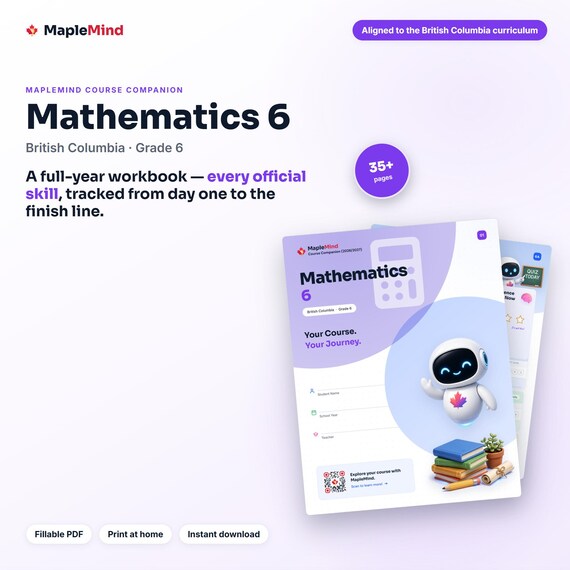
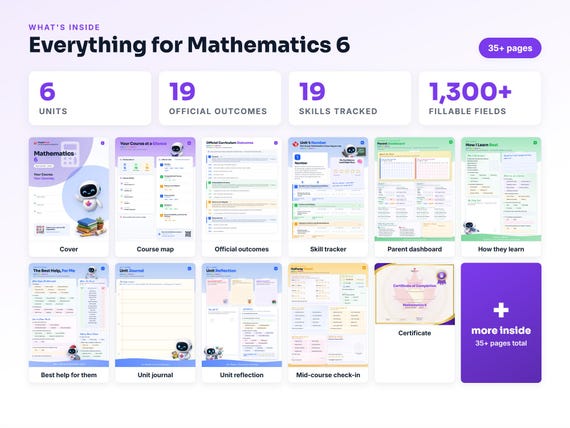
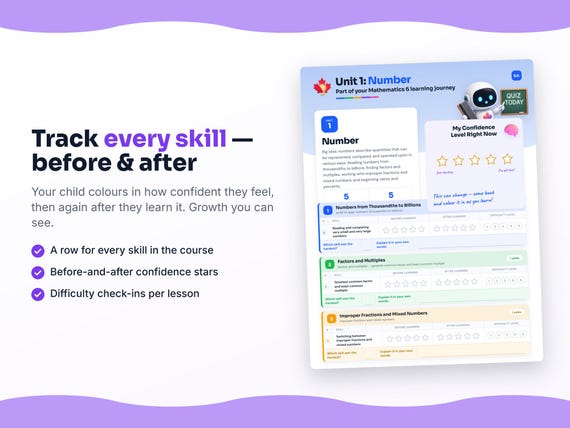
Built from the same official curriculum as this page. Before and after each skill above, your student colours in how sure they feel — so the two of you can see, on one page, what's clicking and what needs another look. It's a quiet way to follow how the year is really going.
By June it's full of their own handwriting: units worked through, confidence grown, a mid-year check-in, notes from parent-teacher night, and a certificate at the end. Less a worksheet, more a record of the year worth keeping on the shelf.
Instant download · see every page, reviews and the full description · five or more workbooks are $2.99 each
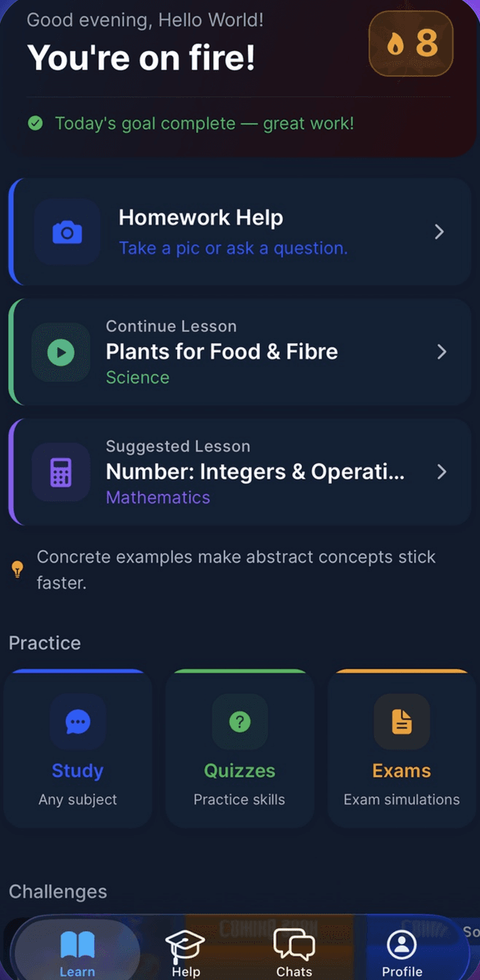
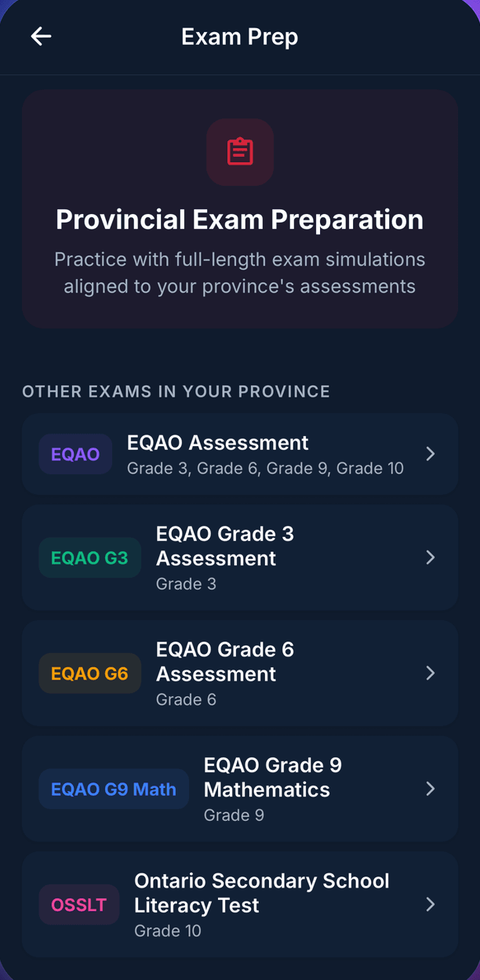
What it looks like in the app
Common questions
Can MapleMind help my child with Mathematics 6?
Yes. MapleMind's AI tutor covers all 19 skills in British Columbia's Mathematics 6 — your child picks the exact skill, and the tutor teaches it step by step: a short lesson, a worked example, solving together, then a skill check to show it stuck.
Is MapleMind aligned to British Columbia's official curriculum?
Yes. Every skill in this course maps to an official outcome code from British Columbia's Grade 6 Mathematics curriculum, and the ministry's own wording is quoted under each unit on this page — with the official government source linked so you can check it yourself.
What does MapleMind cost?
It's free to start — 5 tutoring chats and a practice quiz every day, no credit card. A Pro subscription ($9.99/month or $49.99/year CAD, 7-day free trial) unlocks unlimited tutoring, practice, and exam simulations.
What if my child is stuck on just one topic?
That's the point of skill-level tutoring: open Mathematics 6 in the app, tap the exact skill from the list on this page, and the tutor teaches just that — no wading through lessons your child doesn't need.
Does MapleMind work in French or other languages?
Yes — 14 languages, including French. Both the app and the tutor's explanations switch to the language your child chooses.
Where can I see the official British Columbia curriculum for Mathematics 6?
The official source is linked on this page — BC's official mathematics curriculum. The outline here follows it: every MapleMind skill carries its official outcome code, and the ministry's own wording is quoted under each unit.
Keep exploring
Ready when you are
Pick a skill from this page and see it taught properly — free, in the browser, in under a minute.