Provincial assessment · British Columbia
Foundation Skills Assessment, Grade 7
Foundation Skills Assessment — Grade 7 (Literacy + Numeracy)
- Grade 7
Dates and details can change. We do our best to keep this page up to date, but check the official sources before relying on it.
- Total time
- 3 h 45 min
- Marked questions
- 66
- Marked parts
- 4
- Calculator
- In some parts
- Format
- Paper and computer
FSA Grade 7 practice test
The whole exam or the parts you choose, in its own format, on the clock.
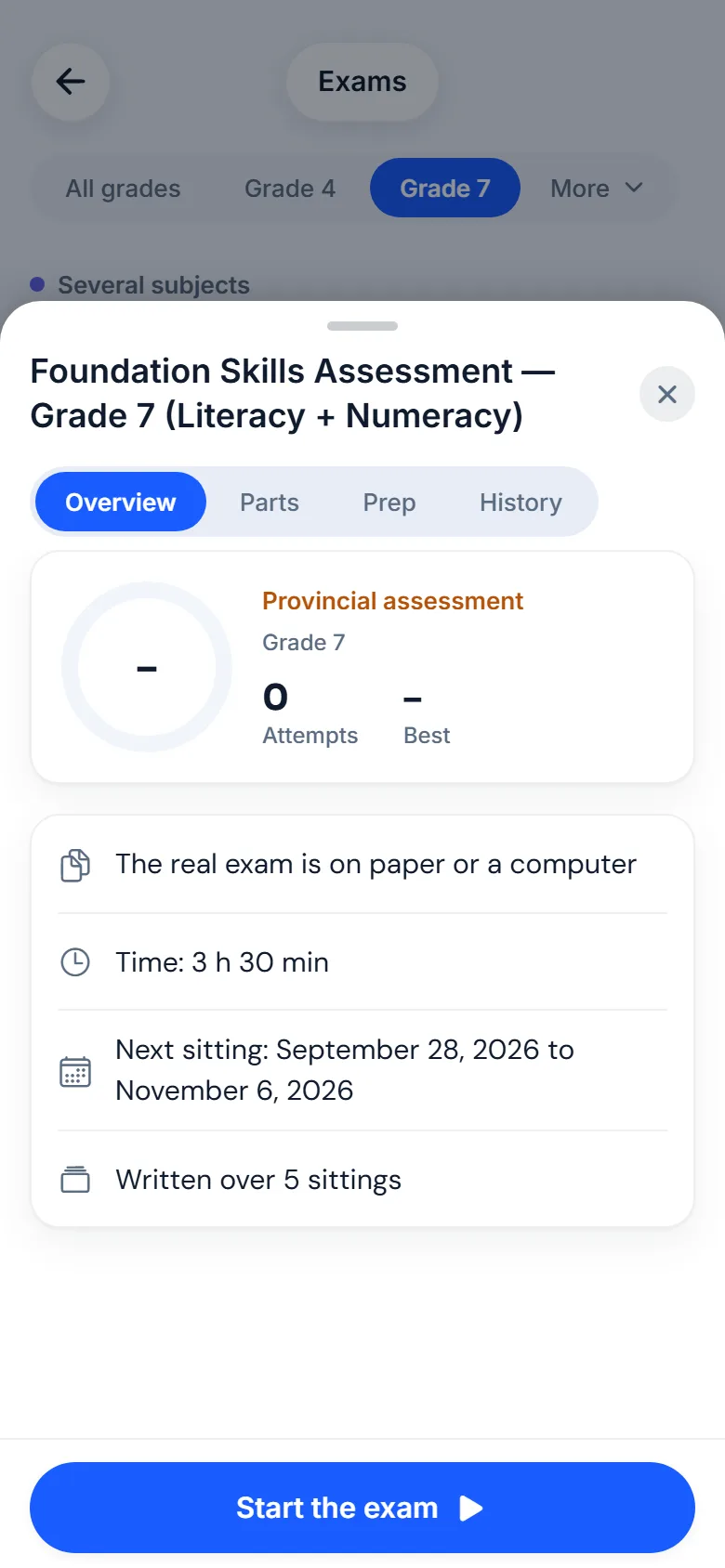 The exam in the app
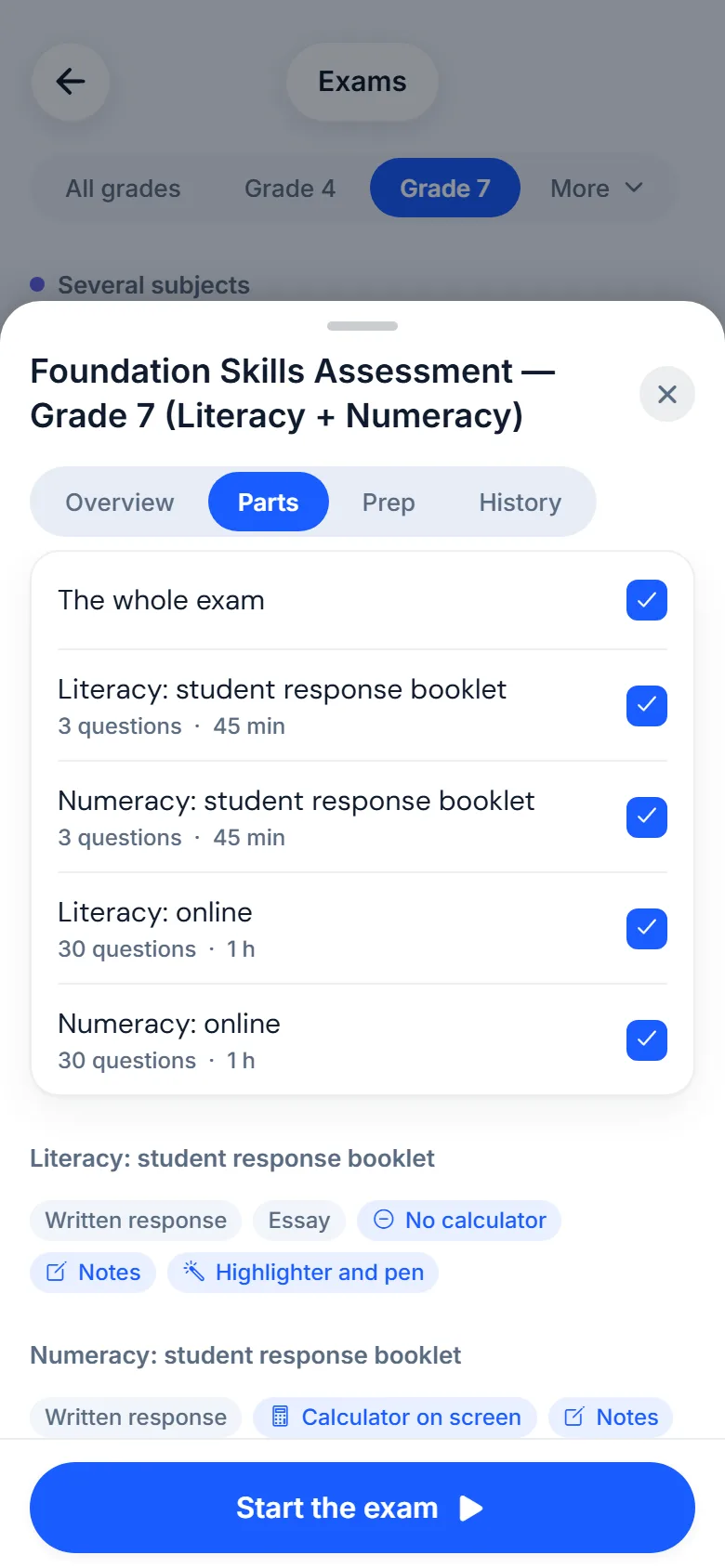 Its parts, and what you can use in each
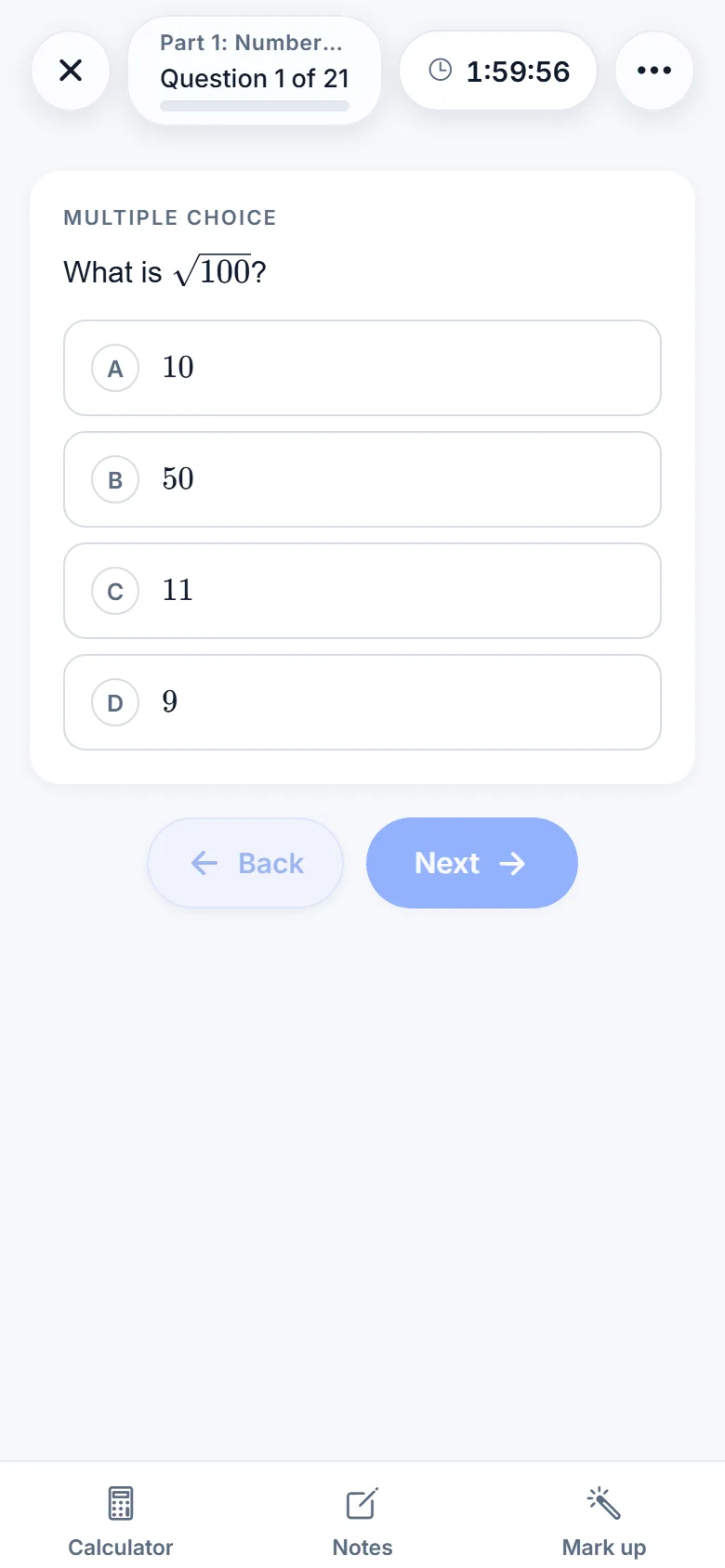 A question, timed, with the exam’s tools
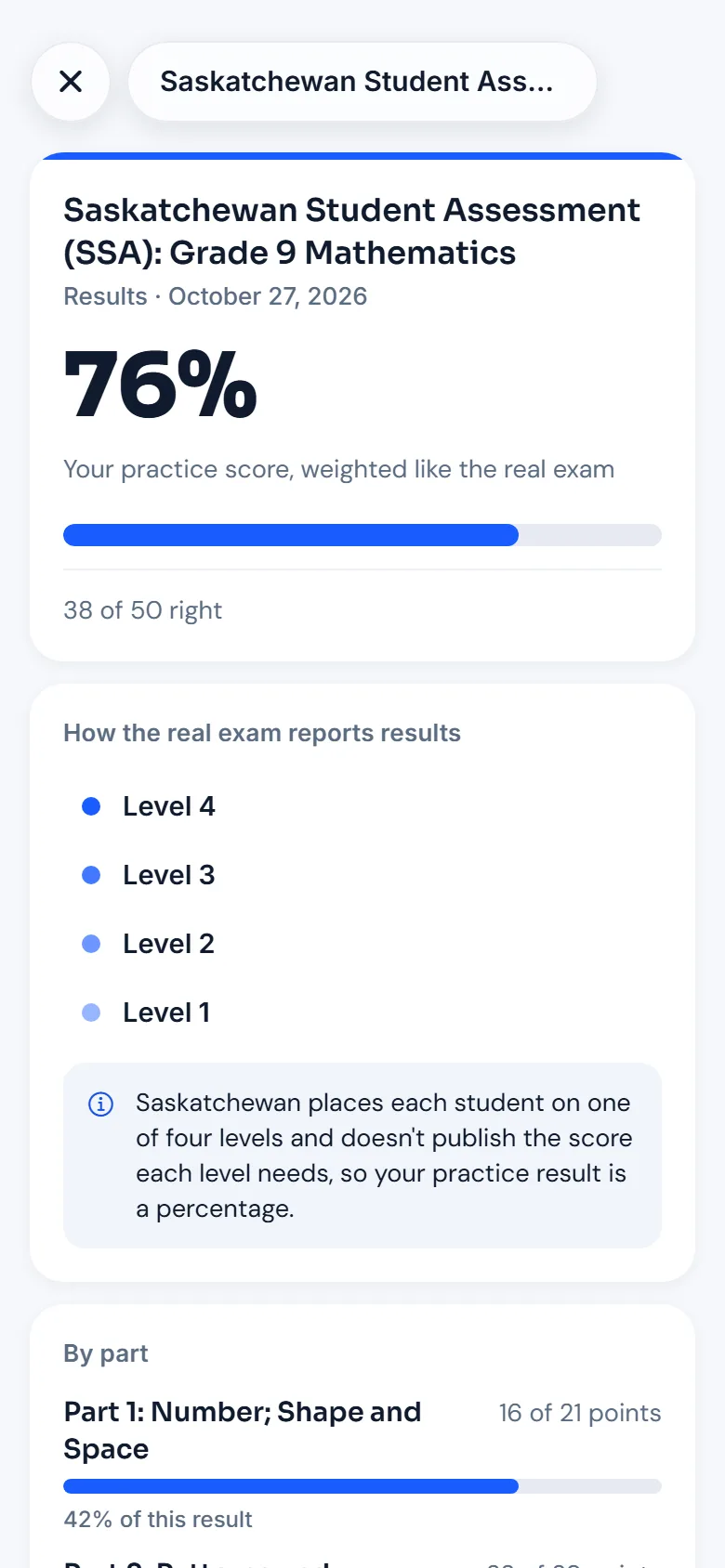 The marked result, part by part
A practice run of Saskatchewan’s Grade 9 math assessment.
Free with a MapleMind account
When
Fall 2026
- September 28 to November 6, 2026Online components 8 AM–4 PM, Monday to Friday · All FSA components (schools schedule the sessions)
The dates are British Columbia’s own, read on September 28, 2026. See the official schedule (gov.bc.ca)
What’s on it
- LiteracyBooklet 12 points + online 30 pointsReported on its own (proficiency level)
Numeracy
Booklet 12 points + online 30 points · Reported on its own (proficiency level)
- Number and Computational Fluency35–45%Of numeracy questions
- Patterns20–25%
- Geometry and Measurement20–25%
- Data and Probability15–25%
The skills it tests · 45 skills
- Applying more than one transformation in a row
- Building a simple budget and smart shopping math
- Capitalization
- Characterization
- Comparing predicted and actual chance
- Considering audience
- Editing
- Expressing opinions
- Fast and sure with facts to 100
- Figurative language
- Finding the area of three flat shapes
- Finding the missing whole number
- Forms of text
- Functions of text
- Genres of text
- Greatest common factor and least common multiple
- How much space something takes up or holds
- Making inferences
- Measuring angles with a protractor and naming their type
- Measuring around an irregular, many-sided shape
- Multiplying and dividing decimal numbers
- Narrative structures
- Paragraphing
- Predicting
- Previewing text
- Punctuation
- Questioning (reading)
- Reading and building line graphs
- Reading and comparing very small and very large numbers
- Revising
- Sensory detail
- Setting
- Showing a pattern with expressions, tables, and graphs
- Sorting triangles by sides and angles
- Summarizing
- Switching between improper fractions and mixed numbers
- Techniques of persuasion
- Use of transitional words
- Using contextual clues
- Using text features
- Varied sentence structure
- Visualizing
- What a ratio compares
- What to calculate first
- Whole-number percents and figuring out a discount
How it’s built
Written answers, an essay, multiple-choice questions, questions in sets and numerical-response questions.
- Collaboration activityNot marked
- Time
- 15 min
- A task
- Literacy: student response booklet
- Time
- 45 min
- Questions
- 3
- Marks
- 12
- Of the marks
- 14%
- Written answers
- Essay
Read the two texts of the theme you chose, answer one question on each, and one about your own connection, in writing. Each answer is worth 4 points.
- Numeracy: student response booklet
- Time
- 45 min
- Questions
- 3
- Marks
- 12
- Of the marks
- 14%
- Written answers
Three real-life problems, worth 4 points each, written out. They may need several parts and steps.
- Literacy: online
- Time
- 60 min
- Questions
- 30
- Marks
- 30
- Of the marks
- 36%
- Multiple choice
- Questions in sets
Thirty questions on different texts, with drop-down menus, drag and drop, multiple choice, matching and more. A short reflection, not marked, follows.
- Numeracy: online
- Time
- 60 min
- Questions
- 30
- Marks
- 30
- Of the marks
- 36%
- Multiple choice
- Numerical response
- Questions in sets
Thirty questions in real-life situations, with drop-down menus, drag and drop, multiple choice, graphing and more. A short reflection, not marked, follows.
- Self-reflectionsNot marked
- Time
- 5 min
- Multiple choice
- Written answers
How it’s marked
- Emerging
- On Track
- Extending
A computer marks the online questions, and your school or district marks the booklet answers. There's no pass or fail: your results are reported on the province's proficiency scale, part by part.
On the day
- FirstA 15-minute group activity that introduces the theme, then the literacy booklet on paper.
- Then, on days your school setsThe numeracy booklet on paper (45 minutes), and literacy and numeracy online (60 minutes each).
- After each partAbout 5 minutes to reflect on how it went.
It starts with a group activity that introduces the theme, then you work on your own: literacy and numeracy, each with a paper booklet and an online part. You may use any calculator in the numeracy parts.
Getting ready
2 official documents to practise with, and 2 tips.
Official practice
Tips from the people who write it
- It works like the Grade 4 assessment, at Grade 7 level: a group activity first, then your own work.
- In the written booklets, clear reasoning counts, not just answers.
After the exam
- Results
Once marking is done, the school sends the report home with the child’s response booklet. Final results reach schools by early spring, and a level can still change before then.
- Marks
It doesn’t affect marks or report cards, and BC says students don’t need to prepare for it.
- If you miss it
A child who misses part of it makes it up within the assessment window. A child is excused only after the school has talked with the parents.
From 2026–27 FSA Administration Manual (gov.bc.ca) and Foundation Skills Assessment for Parents and Caregivers (curriculum.gov.bc.ca), read on October 27, 2026.
More for you
Students
Start with the topics worth the most marks, then write full practice exams under the real time limit.
Practise itParents
Put the dates on the family calendar. The Parent Dashboard shows each practice exam’s result and the skills that need another look.
See the Parent DashboardEducators
The topic weights and the official practice above make a review plan. Students can practise each skill on its own in MapleMind, free with daily limits.
For schools
Questions about this exam
How long is the Foundation Skills Assessment, Grade 7?
It takes 3 hours 45 minutes in all, over 4 parts.
How many questions are on the Foundation Skills Assessment, Grade 7?
It has 66 marked questions: 3 in Literacy: student response booklet, 3 in Numeracy: student response booklet, 30 in Literacy: online and 30 in Numeracy: online.
Can you use a calculator on the Foundation Skills Assessment, Grade 7?
In some parts only: Numeracy: student response booklet and Numeracy: online.
How are Foundation Skills Assessment, Grade 7 results reported?
At 3 levels: Emerging, On Track and Extending.
Where can I find practice tests for the Foundation Skills Assessment, Grade 7?
MapleMind builds a full practice exam in its format. Start it from this page, free with an account.

Practise for the Foundation Skills Assessment, Grade 7
Every skill on the Foundation Skills Assessment, Grade 7, taught one at a time, then practised on questions written like the real ones.


