Get help with English Language Arts 6
Most tutoring makes your child sit through material your child already knows. MapleMind flips that: pick the exact skill that's causing trouble — any of the 51 below — and the tutor teaches just that one, step by step, as many times as it takes. Ask questions in plain words, any time of day, in English, French, or 12 other languages.
The official British Columbia English Language Arts 6 curriculum
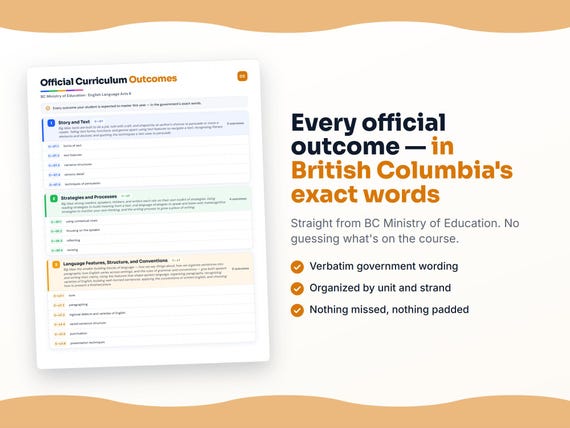
British Columbia defines English Language Arts 6 by strands and outcomes. MapleMind teaches the same curriculum reorganized for one-skill-at-a-time tutoring — the table shows exactly where every official strand lands, and the ministry's own wording is quoted under each unit below.
Official source BC's official English language arts curriculumRead it on the government site — curriculum.gov.bc.ca ↗| Official strand | Outcomes | Where MapleMind teaches it |
|---|---|---|
| Content — Story and Text | 10 | Story and Text |
| Content — Strategies and Processes | 22 | Strategies and Processes |
| Content — Language Features, Structure, and Conventions | 19 | Language Features, Structure, and Conventions |
Every skill below, taught one on one.
 Try the first session free
How MapleMind teaches English Language Arts 6 — every unit, lesson, and skill
Every skill below runs as a short session: a plain-words lesson, a worked example, solving it together, then a five-question skill check that earns up to three stars. Guided Mode keeps it teaching instead of answer-handing — turning it off needs a parent's password.
Unit 1Story and TextOfficial strand · Content — Story and Text
Big Idea: texts are built to do a job, told with craft, and shaped by an author's choices to persuade or move a reader. Telling text forms, functions, and genres apart; using text features to navigate a text; recognizing literary elements and devices; and spotting the techniques a text uses to persuade.
Forms, Functions, and Genres of Text
- Forms of text6.FFG.1 — Identify the form a text takes — a news article, a graphic novel, a blog post, a poem — and notice how form shapes the way a text looks and reads.
- Functions of text6.FFG.2 — Identify the function a text is built to do — inform, persuade, entertain, or instruct — by looking at what it is trying to make the reader think, feel, or do.
- Genres of text6.FFG.3 — Name a text's genre — such as mystery, biography, fantasy, or persuasive writing — from the features and patterns it shows, not just its topic.
Text Features
- Using text features6.TF.1 — Use text features — headings, captions, sidebars, tables of contents, bold words — to locate information quickly and understand how a text is organized.
Literary Elements
- Narrative structures6.LE.1 — Recognize how a story is put together — a beginning that sets up the problem, a middle where it builds, and an ending that resolves it — and how that structure carries the story's meaning.
- Characterization6.LE.2 — Identify how an author builds a character — through what they say, do, think, and how others react to them — and use those clues to describe the character.
- Setting6.LE.3 — Identify a story's setting — the time and place it happens in — and explain how it shapes the mood, events, or choices characters make.
Literary Devices
- Sensory detail6.LD.1 — Notice sensory details — words that let a reader see, hear, smell, taste, or feel a scene — and explain how they make writing more vivid.
- Figurative language6.LD.2 — Recognize figurative language — simile, metaphor, personification — in a text and explain the effect it creates instead of taking it literally.
Techniques of Persuasion
- Techniques of persuasion6.TP.1 — Recognize techniques of persuasion — repetition, appeals to emotion, bandwagon claims, loaded language — used in ads, speeches, and opinion pieces, and name the effect each one has on a reader.
The official wording — 10 outcomes in this unit
- 6.FFG.1
forms of text
- 6.FFG.2
functions of text
- 6.FFG.3
genres of text
- 6.TF.1
text features
- 6.LE.1
narrative structures
- 6.LE.2
characterization
- 6.LE.3
setting
- 6.LD.1
sensory detail
- 6.LD.2
figurative language
- 6.TP.1
techniques of persuasion
Unit 2Strategies and ProcessesOfficial strand · Content — Strategies and Processes
Big Idea: strong readers, speakers, thinkers, and writers each rely on their own toolkit of strategies. Using reading strategies to build meaning from a text, oral language strategies to speak and listen well, metacognitive strategies to monitor your own thinking, and the writing process to grow a piece of writing.
Reading Strategies
- Using contextual clues6.RS.1 — Use the words and sentences around an unfamiliar word to figure out what it probably means.
- Using phonics and word structure6.RS.2 — Break an unfamiliar word into sounds and parts — prefixes, roots, suffixes — to help read and understand it.
- Visualizing6.RS.3 — Build a picture in your mind of what is happening in a text, using the details the author gives, to understand it more deeply.
- Questioning (reading)6.RS.4 — Ask questions before, during, and after reading to guide your thinking and check your understanding of a text.
- Predicting6.RS.5 — Use clues from the title, cover, or story so far to make a reasonable guess about what happens next.
- Previewing text6.RS.6 — Skim a text's title, headings, and pictures before reading closely to get a sense of what it will be about.
- Summarizing6.RS.7 — Shrink a text down to its main idea and most important points in your own words, leaving out minor details.
- Making inferences6.RS.8 — Combine clues from the text with what you already know to figure out something the author doesn't say directly.
Oral Language Strategies
- Focusing on the speaker6.OL.1 — Give full attention to whoever is speaking — eyes on them, mind on their ideas — instead of thinking about something else or planning what to say next.
- Asking questions to clarify6.OL.2 — Ask a question when something a speaker said is unclear, so you understand their meaning instead of guessing.
- Listening for specifics6.OL.3 — Listen for particular details or information you need — like a date, a name, or an instruction — rather than only catching the general idea.
- Expressing opinions6.OL.4 — Share your own opinion clearly in a discussion or debate, along with a reason that explains why you think that way.
- Speaking with expression6.OL.5 — Use your voice — tone, emphasis, feeling — to bring your spoken words to life instead of speaking in a flat monotone.
- Staying on topic6.OL.6 — Keep your contributions in a discussion or debate connected to what is actually being talked about, instead of drifting to something unrelated.
- Taking turns6.OL.7 — Wait for your turn to speak in a conversation or discussion, and let others finish their thought before you add yours.
Metacognitive Strategies
- Reflecting6.MC.1 — Look back on your own learning or work and think about what you did, what worked, and what you noticed about yourself as a learner.
- Questioning your own thinking6.MC.2 — Ask yourself questions like "does this make sense?" or "what am I confused about?" while you learn, to monitor your own understanding.
- Goal setting6.MC.3 — Set a clear, specific goal for your own learning or writing, and use it to guide what you work on next.
- Self-evaluating6.MC.4 — Judge your own work honestly against a goal or standard, noticing what you did well and what still needs work.
Writing Processes
- Revising6.WP.1 — Improve the ideas, details, and flow of a draft — adding, removing, or reordering parts — before worrying about spelling and grammar.
- Editing6.WP.2 — Fix the spelling, grammar, and punctuation in a draft so it is correct and easy to read.
- Considering audience6.WP.3 — Think about who will read a piece of writing — a classmate, a teacher, a younger student — and adjust word choice, tone, and detail so it fits that reader.
The official wording — 22 outcomes in this unit
- 6.RS.1
using contextual clues
- 6.RS.2
using phonics and word structure
- 6.RS.3
visualizing
- 6.RS.4
questioning
- 6.RS.5
predicting
- 6.RS.6
previewing text
- 6.RS.7
summarizing
- 6.RS.8
making inferences
- 6.OL.1
focusing on the speaker
- 6.OL.2
asking questions to clarify
- 6.OL.3
listening for specifics
- 6.OL.4
expressing opinions
- 6.OL.5
speaking with expression
- 6.OL.6
staying on topic
- 6.OL.7
taking turns
- 6.MC.1
reflecting
- 6.MC.2
questioning
- 6.MC.3
goal setting
- 6.MC.4
self-evaluating
- 6.WP.1
revising
- 6.WP.2
editing
- 6.WP.3
considering audience
Unit 3Language Features, Structure, and ConventionsOfficial strand · Content — Language Features, Structure, and Conventions
Big Idea: the smaller building blocks of language — how we say things aloud, how we organize sentences into paragraphs, how English varies across settings, and the rules of grammar and conventions — give both speech and writing their clarity. Using the features that shape spoken language, organizing paragraphs, recognizing varieties of English, building well-formed sentences, applying the conventions of written English, and choosing how to present a finished piece.
Features of Oral Language
- Tone6.FOL.1 — Notice how the tone of a speaker's voice — cheerful, serious, sarcastic — changes how their words should be understood.
- Volume6.FOL.2 — Notice how loud or soft a speaker is, and how volume affects whether a message feels urgent, calm, or important.
- Inflection6.FOL.3 — Notice how a speaker's pitch rises and falls — like at the end of a question — and how that inflection changes meaning.
- Pace6.FOL.4 — Notice how fast or slow a speaker talks, and how pace can show excitement, calm, or give a listener time to think.
- Gestures6.FOL.5 — Notice the hand movements, facial expressions, and body language a speaker uses to support and add meaning to their words.
Paragraphing
- Paragraphing6.PG.1 — Organize writing into paragraphs, each built around one main idea with supporting details, and start a new paragraph when the idea shifts.
Language Varieties
- Regional dialects and varieties of English6.LV.1 — Recognize that English sounds and looks different depending on where it's spoken, with its own regional words, accents, and expressions.
- Standard Canadian English versus American English6.LV.2 — Notice differences between standard Canadian English and American English — spelling, vocabulary, some pronunciations — and identify which is being used.
- Formal versus informal registers6.LV.3 — Tell apart formal language (used in an essay or a speech) from informal language (used with friends or in texting), and explain when each fits.
- Situational varieties6.LV.4 — Recognize that the way you speak or write changes depending on the situation — talking to a teacher, a friend, or a younger sibling calls for different language.
Sentence Structure and Grammar
- Varied sentence structure6.GR.1 — Combine and vary sentences — short and long, simple and compound — so writing doesn't sound choppy or repetitive.
- Pronoun use6.GR.2 — Use pronouns (he, she, they, it) correctly so it's always clear which noun each pronoun is replacing.
- Subject-verb agreement6.GR.3 — Match a verb correctly to its subject — singular subjects take singular verbs, plural subjects take plural verbs — even when other words come between them.
- Use of transitional words6.GR.4 — Use transitional words — first, however, therefore, meanwhile — to connect ideas and show how sentences relate to each other.
- Awareness of run-ons and fragments6.GR.5 — Recognize a run-on sentence (two sentences jammed together) or a sentence fragment (an incomplete thought) and fix it into a correct sentence.
Conventions
- Punctuation6.CV.1 — Use punctuation — periods, commas, quotation marks, question marks — correctly so a piece of writing is clear and easy to read.
- Capitalization6.CV.2 — Capitalize the start of sentences and proper nouns — names, places, titles — correctly and consistently.
- Canadian spelling6.CV.3 — Spell words using Canadian conventions (like "colour" and "centre") accurately in your own writing.
Presentation Techniques
- Presentation techniques6.PT.1 — Choose presentation techniques — visuals, layout, headings, spoken delivery, or digital tools — that suit the purpose and audience of a finished piece of work.
The official wording — 19 outcomes in this unit
- 6.FOL.1
tone
- 6.FOL.2
volume
- 6.FOL.3
inflection
- 6.FOL.4
pace
- 6.FOL.5
gestures
- 6.PG.1
paragraphing
- 6.LV.1
regional dialects and varieties of English
- 6.LV.2
standard Canadian English versus American English
- 6.LV.3
formal versus informal registers
- 6.LV.4
situational varieties
- 6.GR.1
varied sentence structure
- 6.GR.2
pronoun use
- 6.GR.3
subject-verb agreement
- 6.GR.4
use of transitional words
- 6.GR.5
awareness of run-on sentences and sentence fragments
- 6.CV.1
punctuation
- 6.CV.2
capitalization
- 6.CV.3
Canadian spelling
- 6.PT.1
presentation techniques
Printable workbook · A keepsake of the year
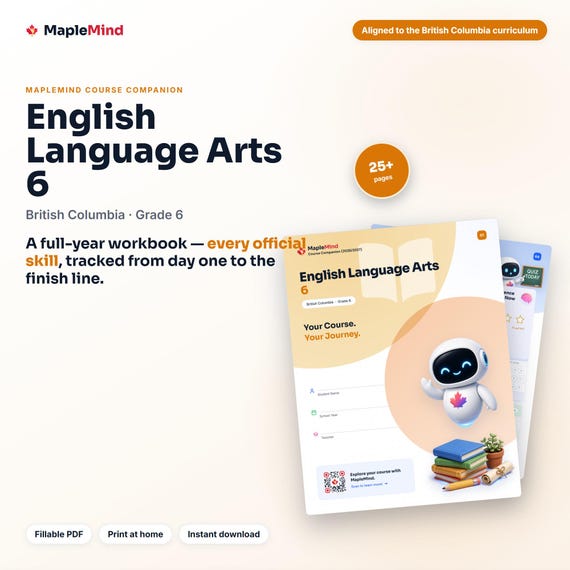
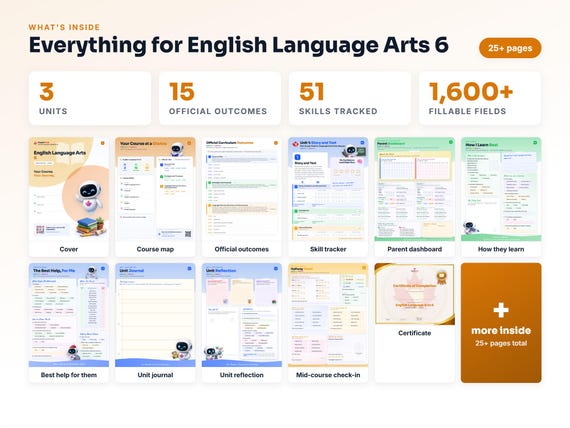
A English Language Arts 6 workbook worth keeping
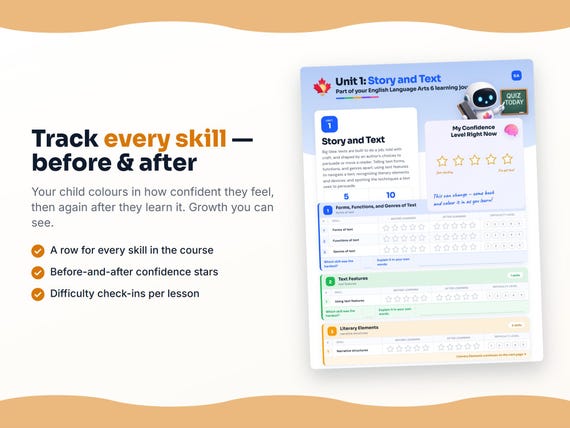
Built from the same official curriculum as this page. Before and after each skill above, your student colours in how sure they feel — so the two of you can see, on one page, what's clicking and what needs another look. It's a quiet way to follow how the year is really going.
By June it's full of their own handwriting: units worked through, confidence grown, a mid-year check-in, notes from parent-teacher night, and a certificate at the end. Less a worksheet, more a record of the year worth keeping on the shelf.
Instant download · see every page, reviews and the full description · five or more workbooks are $2.99 each
What it looks like in the app
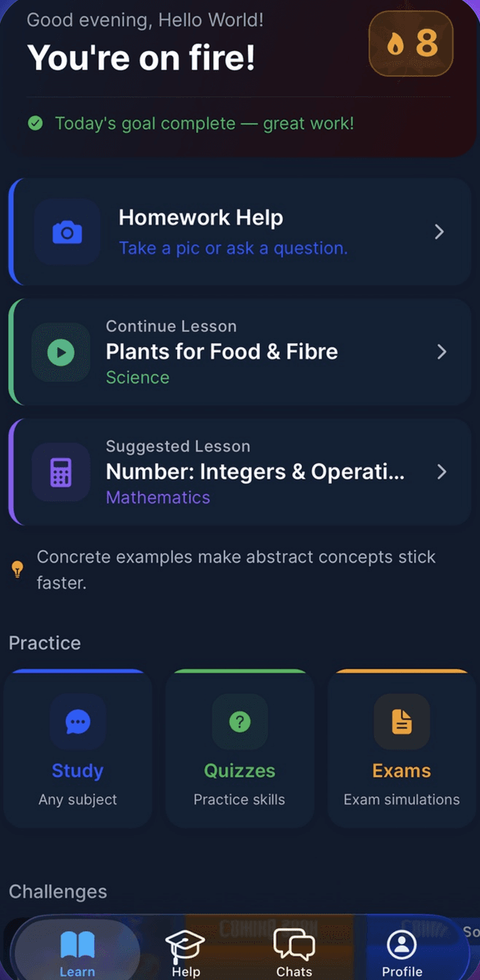
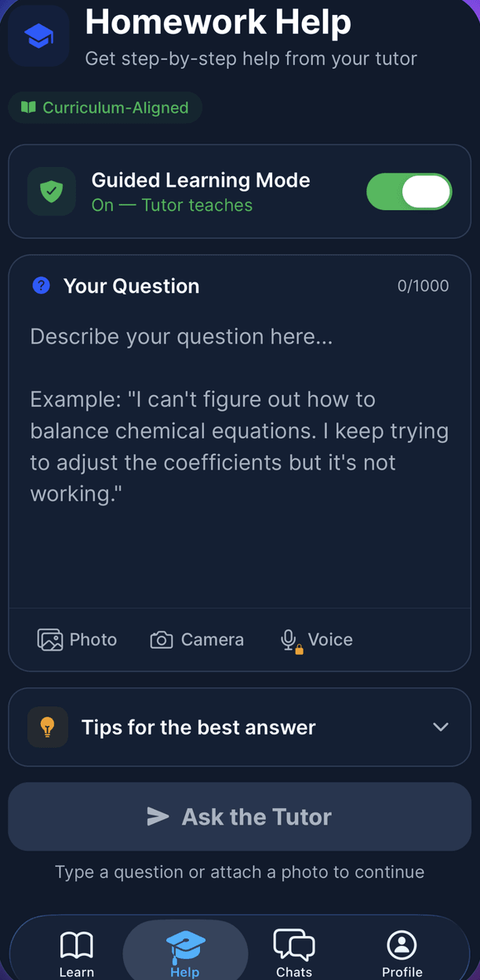
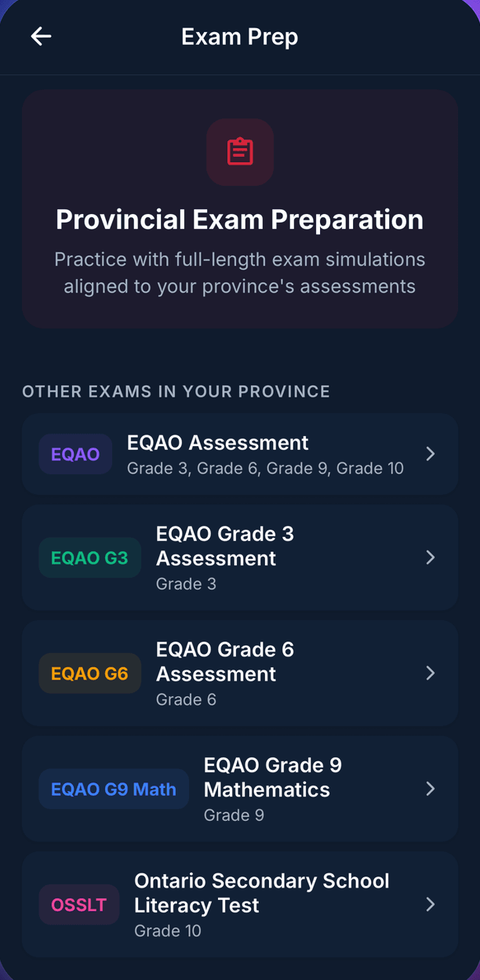
Common questions
Can MapleMind help my child with English Language Arts 6?
Yes. MapleMind's AI tutor covers all 51 skills in British Columbia's English Language Arts 6 — your child picks the exact skill, and the tutor teaches it step by step: a short lesson, a worked example, solving together, then a skill check to show it stuck.
Is MapleMind aligned to British Columbia's official curriculum?
Yes. Every skill in this course maps to an official outcome code from British Columbia's Grade 6 English Language Arts curriculum, and the ministry's own wording is quoted under each unit on this page — with the official government source linked so you can check it yourself.
What does MapleMind cost?
It's free to start — 5 tutoring chats and a practice quiz every day, no credit card. A Pro subscription ($9.99/month or $49.99/year CAD, 7-day free trial) unlocks unlimited tutoring, practice, and exam simulations.
What if my child is stuck on just one topic?
That's the point of skill-level tutoring: open English Language Arts 6 in the app, tap the exact skill from the list on this page, and the tutor teaches just that — no wading through lessons your child doesn't need.
Does MapleMind work in French or other languages?
Yes — 14 languages, including French. Both the app and the tutor's explanations switch to the language your child chooses.
Where can I see the official British Columbia curriculum for English Language Arts 6?
The official source is linked on this page — BC's official English language arts curriculum. The outline here follows it: every MapleMind skill carries its official outcome code, and the ministry's own wording is quoted under each unit.
Keep exploring
Ready when you are
Pick a skill from this page and see it taught properly — free, in the browser, in under a minute.