Get help with Mathematics 5
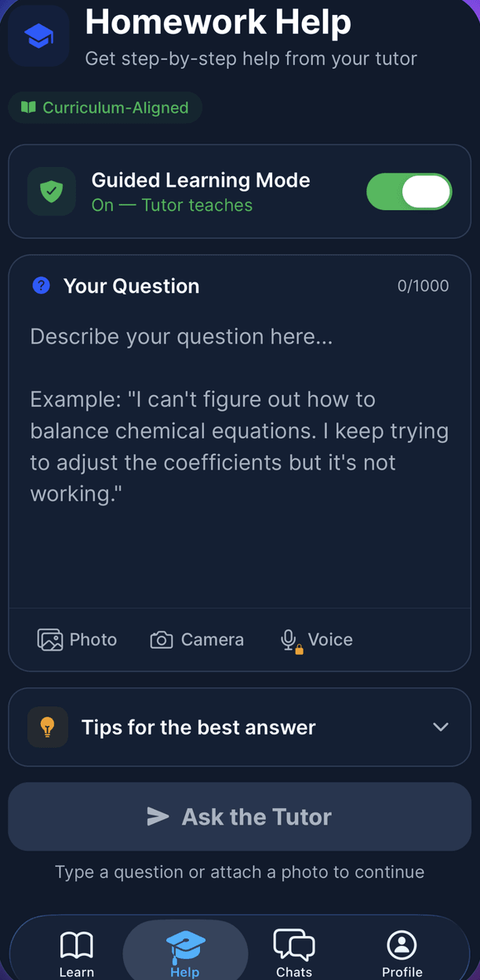
Most tutoring makes your child sit through material your child already knows. MapleMind flips that: pick the exact skill that's causing trouble — any of the 27 below — and the tutor teaches just that one, step by step, as many times as it takes. Ask questions in plain words, any time of day, in English, French, or 12 other languages.
The official Alberta Mathematics 5 curriculum
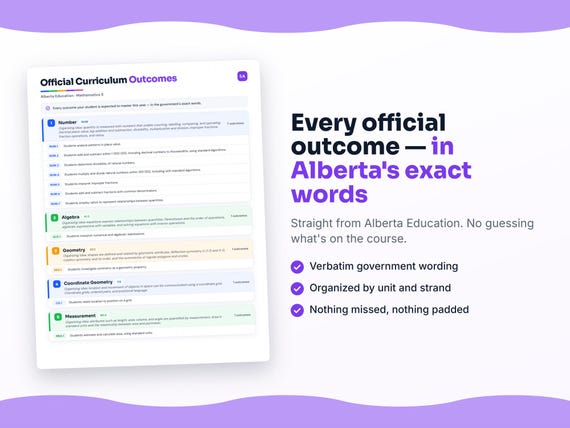
Alberta defines Mathematics 5 by strands and outcomes. MapleMind teaches the same curriculum reorganized for one-skill-at-a-time tutoring — the table shows exactly where every official strand lands, and the ministry's own wording is quoted under each unit below.
Official source Alberta's official programs of studyRead it on the government site — alberta.ca ↗| Official strand | Outcomes | Where MapleMind teaches it |
|---|---|---|
| Number | 7 | Number |
| Algebra | 1 | Algebra |
| Geometry | 1 | Geometry |
| Coordinate Geometry | 1 | Coordinate Geometry |
| Measurement | 1 | Measurement |
| Patterns | 1 | Patterns |
| Statistics | 1 | Statistics |
Every skill below, taught one on one.
 Try the first session free
How MapleMind teaches Mathematics 5 — every unit, lesson, and skill
Every skill below runs as a short session: a plain-words lesson, a worked example, solving it together, then a five-question skill check that earns up to three stars. Guided Mode keeps it teaching instead of answer-handing — turning it off needs a parent's password.
Unit 1NumberOfficial strand · Number
Organizing idea: quantity is measured with numbers that enable counting, labelling, comparing, and operating. Decimal place value, big addition and subtraction, divisibility, multiplication and division, improper fractions, fraction operations, and ratios.
Decimal Place Value Patterns
- Precision and trailing zeros5.N.1 — Understand that more decimal places means more precision, and that a zero in the rightmost place of a decimal does not change its value.
- Decimals between decimals5.N.1 — Discover that there are infinitely many decimal numbers between any two decimal numbers.
Adding and Subtracting Big Numbers and Decimals
- Standard algorithms to 1 000 0005.N.2 — Add and subtract natural numbers within 1 000 000 using the standard algorithms.
- Adding and subtracting decimals to thousandths5.N.2 — Add and subtract decimal numbers to thousandths by aligning place values in the standard algorithms.
Divisibility
- Divisibility tests for 2, 3 and 55.N.3 — Investigate divisibility by natural numbers from 0 to 10 and generalize the divisibility tests for 2, 3 and 5.
- Finding factors (and why zero can never divide)5.N.3 — Use divisibility tests to determine factors of natural numbers, and understand that division by zero is not possible.
Multiplying and Dividing Big Numbers
- The multiplication algorithm5.N.4 — Multiply natural numbers within 100 000 using the standard algorithm.
- The division algorithm5.N.4 — Divide natural numbers within 100 000 using the standard algorithm, interpreting remainders in context.
Improper Fractions and Mixed Numbers
- Fractions bigger than one5.N.5 — Interpret improper fractions as quantities greater than one (numerator greater than denominator), including natural numbers as fractions with denominator 1.
- Mixed numbers and improper fractions5.N.5 — Represent the same quantity as a mixed number (wholes plus a fractional part) and as an improper fraction, converting between the two.
Adding and Subtracting Fractions
- Adding and subtracting with common denominators5.N.6 — Add and subtract fractions with common denominators by composing and decomposing unit fractions.
- Adding and subtracting past one whole5.N.6 — Add and subtract fractions greater than one, working as mixed numbers or improper fractions.
Ratios
- Part-part and part-whole ratios5.N.7 — Express part-part and part-whole relationships between quantities as ratios, using fraction or colon notation.
- Percent as a ratio to 1005.N.7 — Interpret a percentage as a part-whole ratio that compares a quantity to 100.
The official wording — 7 outcomes in this unit
- 5.N.1
Students analyze patterns in place value.
- 5.N.2
Students add and subtract within 1 000 000, including decimal numbers to thousandths, using standard algorithms.
- 5.N.3
Students determine divisibility of natural numbers.
- 5.N.4
Students multiply and divide natural numbers within 100 000, including with standard algorithms.
- 5.N.5
Students interpret improper fractions.
- 5.N.6
Students add and subtract fractions with common denominators.
- 5.N.7
Students employ ratios to represent relationships between quantities.
Unit 2AlgebraOfficial strand · Algebra
Organizing idea: equations express relationships between quantities. Parentheses and the order of operations, algebraic expressions with variables, and solving equations with inverse operations.
Expressions and Equations
- Parentheses and order of operations5.A.1 — Evaluate numerical expressions with multiple operations, performing operations in parentheses first.
- Meet algebraic expressions5.A.1 — Interpret algebraic expressions: variables as unknown values written with letters, coefficients, constant terms, products without the × sign, quotients as fractions, and evaluating by substitution.
- Solving equations with inverse operations5.A.1 — Solve equations by applying inverse operations, and recognize the resulting value of the variable as the solution.
The official wording — 1 outcome in this unit
- 5.A.1
Students interpret numerical and algebraic expressions.
Unit 3GeometryOfficial strand · Geometry
Organizing idea: shapes are defined and related by geometric attributes. Reflection symmetry in 2-D and 3-D, rotation symmetry and its order, and the symmetries of regular polygons and circles.
Symmetry
- Reflection symmetry5.G.1 — Identify reflection symmetry: a line over which a 2-D shape reflects onto itself (or a plane, for a 3-D shape) with the two halves matching exactly.
- Rotation symmetry and its order5.G.1 — Identify rotation symmetry and its order, including that a regular polygon has as many symmetries as sides and a circle has infinitely many.
The official wording — 1 outcome in this unit
- 5.G.1
Students investigate symmetry as a geometric property.
Unit 4Coordinate GeometryOfficial strand · Coordinate Geometry
Organizing idea: location and movement of objects in space can be communicated using a coordinate grid. Coordinate grids, ordered pairs, and positional language.
Grids and Location
- Reading and plotting grid coordinates5.CG.1 — Locate and plot points on a coordinate grid using ordered pairs — first number is the distance from the vertical axis, second is the distance from the horizontal axis.
- Describing position and movement5.CG.1 — Describe locations and movements on a grid using coordinates and positional language (left, right, up, down).
The official wording — 1 outcome in this unit
- 5.CG.1
Students relate location to position on a grid.
Unit 5MeasurementOfficial strand · Measurement
Organizing idea: attributes such as length, area, volume, and angle are quantified by measurement. Area in standard units and the relationship between area and perimeter.
Area
- Area in standard units5.M.1 — Estimate and calculate area using standard units derived from length: square centimetres, square metres and square kilometres.
- Area and perimeter relationships5.M.1 — Explore rectangles with the same area but different perimeters — among them, the square has the least perimeter.
The official wording — 1 outcome in this unit
- 5.M.1
Students estimate and calculate area, using standard units.
Unit 6PatternsOfficial strand · Patterns
Organizing idea: awareness of patterns supports problem solving in various situations. Arithmetic sequences, their tables, their graphs, and the expressions that describe them.
Arithmetic Sequences
- Sequences and their tables5.P.1 — Relate terms to their positions in an arithmetic sequence using a table of values (position first, term second).
- Sequences on grids and in expressions5.P.1 — Plot an arithmetic sequence on a coordinate grid (the points fit on a straight line) and describe the position-term relationship with an algebraic expression.
The official wording — 1 outcome in this unit
- 5.P.1
Students relate terms to position within an arithmetic sequence.
Unit 7StatisticsOfficial strand · Statistics
Organizing idea: the science of collecting, analyzing, visualizing, and interpreting data can inform understanding and decision making. Frequency in categorical data, the mode, and collecting and representing data.
Frequency and Data
- Frequency and the mode5.ST.1 — Compare frequency across categories to answer statistical questions, identifying the mode as the category with the highest frequency.
- Collecting and representing data5.ST.1 — Collect data with closed-list and open-ended questions, and represent frequency with bar graphs, dot plots and stem-and-leaf plots.
The official wording — 1 outcome in this unit
- 5.ST.1
Students analyze frequency in categorical data.

Printable workbook · A keepsake of the year
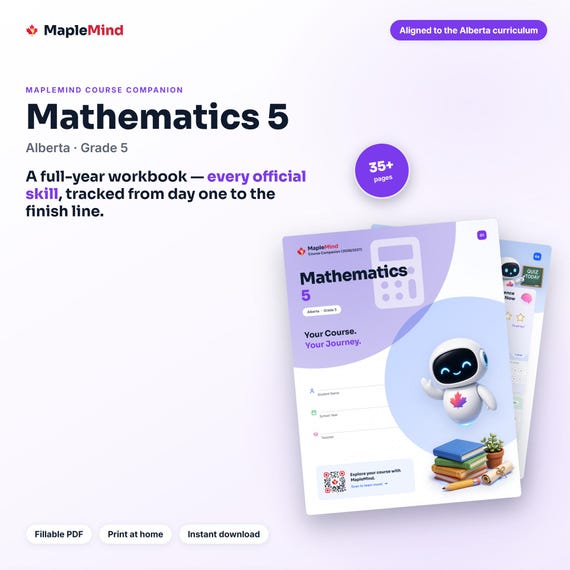
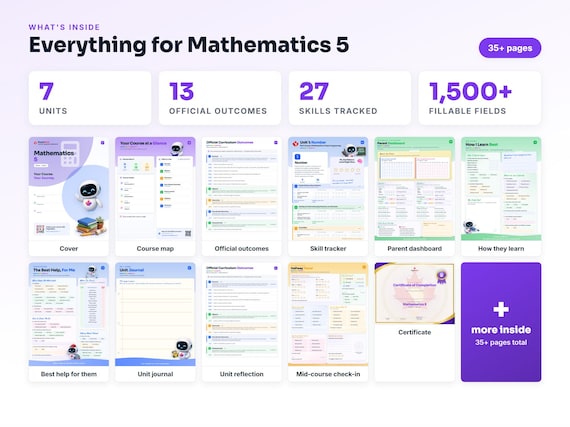
A Mathematics 5 workbook worth keeping
Built from the same official curriculum as this page. Before and after each skill above, your student colours in how sure they feel — so the two of you can see, on one page, what's clicking and what needs another look. It's a quiet way to follow how the year is really going.
By June it's full of their own handwriting: units worked through, confidence grown, a mid-year check-in, notes from parent-teacher night, and a certificate at the end. Less a worksheet, more a record of the year worth keeping on the shelf.
Instant download · see every page, reviews and the full description · five or more workbooks are $2.99 each
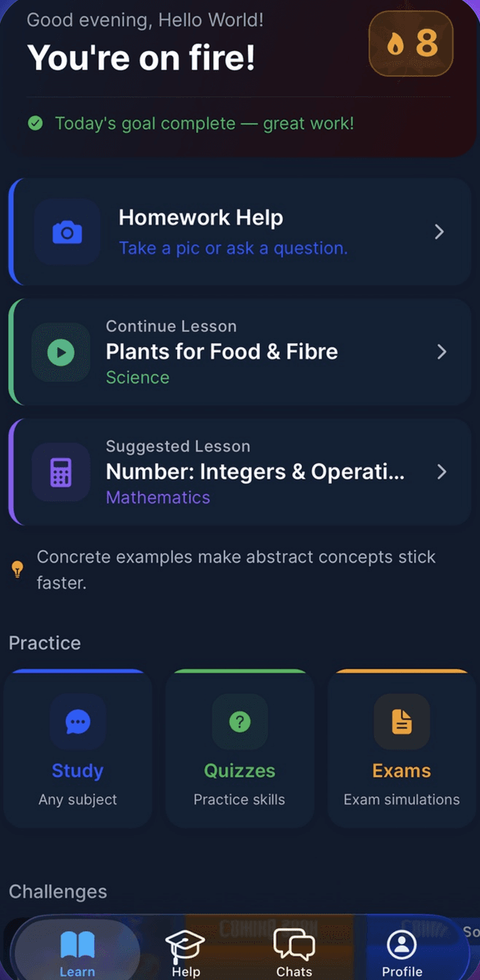
What it looks like in the app
Common questions
Can MapleMind help my child with Mathematics 5?
Yes. MapleMind's AI tutor covers all 27 skills in Alberta's Mathematics 5 — your child picks the exact skill, and the tutor teaches it step by step: a short lesson, a worked example, solving together, then a skill check to show it stuck.
Is MapleMind aligned to Alberta's official curriculum?
Yes. Every skill in this course maps to an official outcome code from Alberta's Grade 5 Mathematics curriculum, and the ministry's own wording is quoted under each unit on this page — with the official government source linked so you can check it yourself.
What does MapleMind cost?
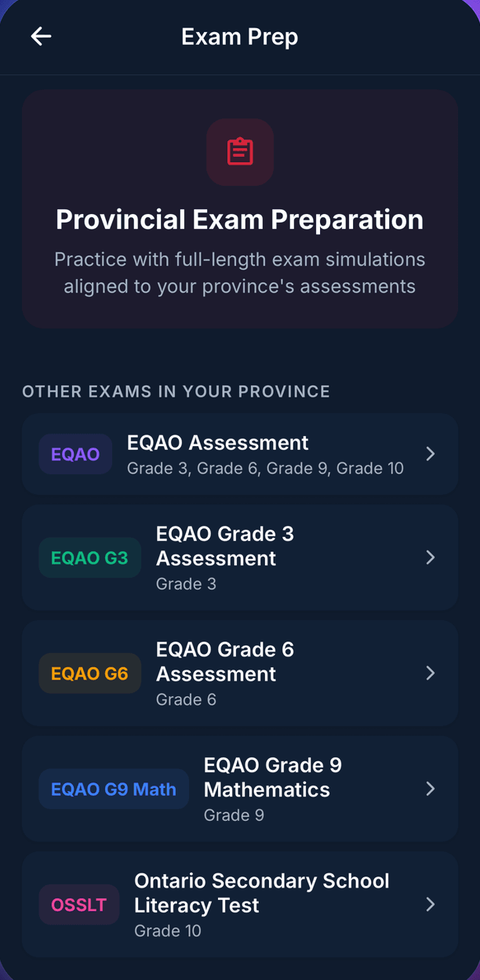
It's free to start — 5 tutoring chats and a practice quiz every day, no credit card. A Pro subscription ($9.99/month or $49.99/year CAD, 7-day free trial) unlocks unlimited tutoring, practice, and exam simulations.
What if my child is stuck on just one topic?
That's the point of skill-level tutoring: open Mathematics 5 in the app, tap the exact skill from the list on this page, and the tutor teaches just that — no wading through lessons your child doesn't need.
Does MapleMind work in French or other languages?
Yes — 14 languages, including French. Both the app and the tutor's explanations switch to the language your child chooses.
Where can I see the official Alberta curriculum for Mathematics 5?
The official source is linked on this page — Alberta's official programs of study. The outline here follows it: every MapleMind skill carries its official outcome code, and the ministry's own wording is quoted under each unit.
Keep exploring
Ready when you are
Pick a skill from this page and see it taught properly — free, in the browser, in under a minute.