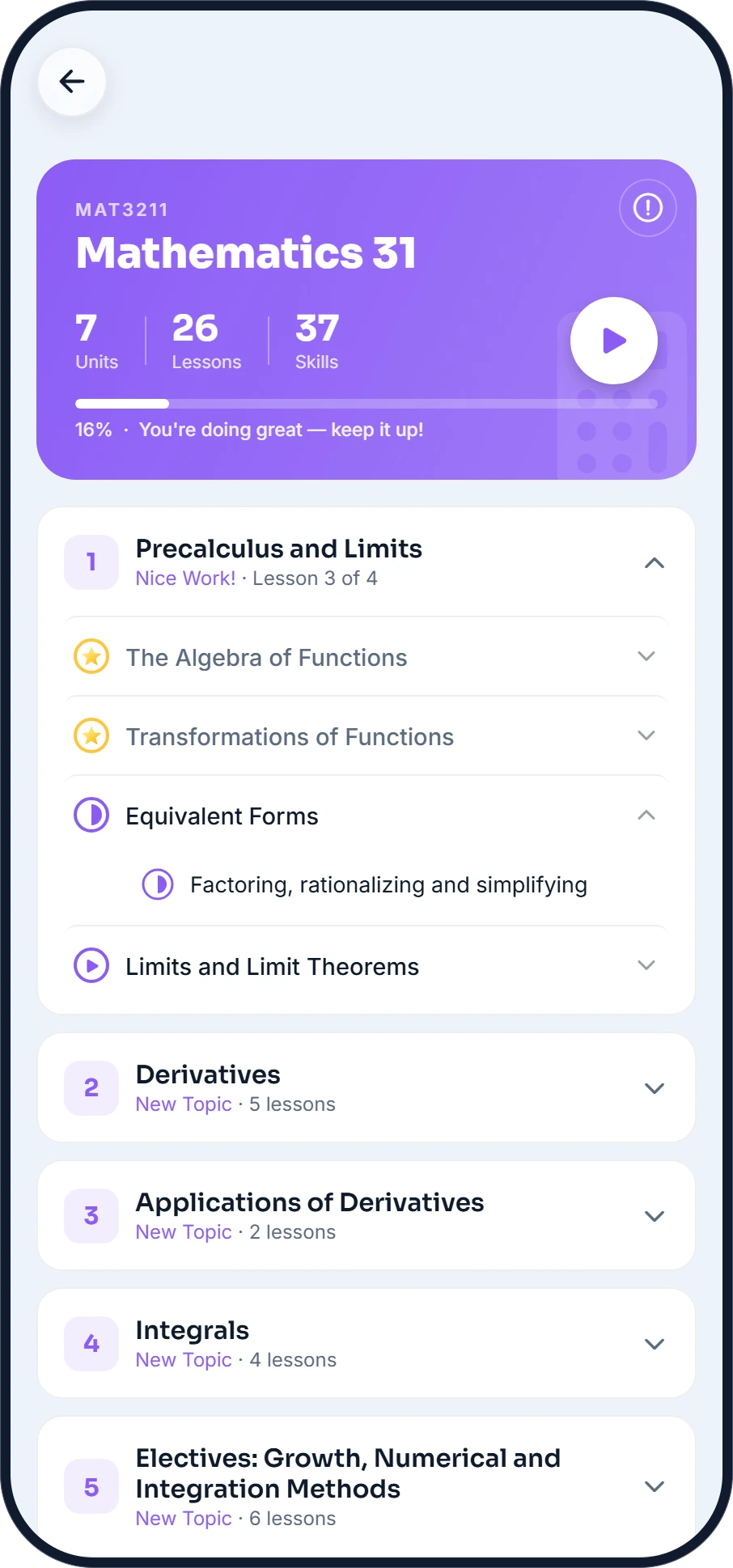
Mathematics 5
Unit 1
Number
More decimal places means more PRECISION — 12.403 pins the time down more exactly than 12.4.
- Precision and trailing zeros
- Decimals between decimals
- Standard algorithms to 1 000 000
11 more skills
- Adding and subtracting decimals to thousandths
- Divisibility tests for 2, 3 and 5
- Finding factors (and why zero can never divide)
- The multiplication algorithm
- The division algorithm
- Fractions bigger than one
- Mixed numbers and improper fractions
- Adding and subtracting with common denominators
- Adding and subtracting past one whole
- Part-part and part-whole ratios
- Percent as a ratio to 100
Unit 2
Algebra
Parentheses group numbers and operations — whatever is inside gets done FIRST.
- Parentheses and order of operations
- Meet algebraic expressions
- Solving equations with inverse operations
Unit 3
Geometry
A 2-D shape has reflection symmetry if a straight line splits it into two halves that match exactly when folded.
- Reflection symmetry
- Rotation symmetry and its order
Unit 4
Coordinate Geometry
An ordered pair gives two distances: FIRST from the vertical axis (how far over), THEN from the horizontal axis (how far up).
- Reading and plotting grid coordinates
- Describing position and movement
Unit 5
Measurement
Area counts unit squares: a cm² is a 1 cm by 1 cm square, an m² is a 1 m square, a km² is a 1 km square — pick the unit that fits the object.
- Area in standard units
- Area and perimeter relationships
Unit 6
Patterns
An arithmetic sequence grows by the same amount each step; a table of values pairs each POSITION (1st, 2nd, 3rd…) with its TERM (5, 10, 15…).
- Sequences and their tables
- Sequences on grids and in expressions
Unit 7
Statistics
Frequency is the count for each category; comparing frequencies answers statistical questions ('which topping is most popular?').
- Frequency and the mode
- Collecting and representing data