Alberta · For parents

What your child learns in Grade 2 in Alberta

Every subject, unit by unit, from Alberta’s curriculum: 156 skills in plain words.

Subjects
4
Skills
156
Provincial exams
None
Official curriculum
alberta.ca

Math in Grade 2

Mathematics 2

6 units · 39 skills

  1. Unit 1

    Number

    The counting order goes on past 100 in the same way, with a new hundred after each ninety-nine: 198, 199, 200, 201, and much later 998, 999, 1000.

    • Counting and naming numbers to 1000
    • Hundreds, tens and ones
    • Numbers on a number line
    15 more skills
    • Comparing and ordering numbers
    • The signs < and >, and the balance
    • Estimating with benchmarks
    • Skip counting by 2s, 10s, 20s, 25s and 50s
    • Counting coins and bills
    • Leftovers, even and odd numbers
    • Facts you know and many ways to make a sum
    • Adding two-digit numbers with strategies
    • Subtracting two-digit numbers with strategies
    • Checking answers and finding missing numbers
    • Problems with things and lengths
    • Splitting a whole into equal parts
    • Naming unit fractions
    • Comparing unit fractions
    • Building the whole from one part
  2. Unit 2

    Geometry

    A side of a flat shape is a straight line segment, and a vertex is a point where two sides meet: a triangle has 3 sides and 3 vertices, and a square has 4 of each.

    • Sides and vertices of flat shapes
    • Faces, surfaces and vertices of solids
    • Sorting shapes by two attributes
    2 more skills
    • Slides, turns and flips
    • Shapes and their moves in art
  3. Unit 3

    Measurement

    Length is measured with units that have length themselves, all the same size: a book is 9 paper clips long when 9 same-size clips reach from one end to the other.

    • Measuring with non-standard units
    • Comparing measurements and choosing units
    • Measuring in centimetres
    2 more skills
    • Referents and estimating length
    • Length on the land
  4. Unit 4

    Patterns

    A hundreds chart has ten numbers in each row across and ten in each column down, so one step right adds 1 and one step down adds 10: from 23, right is 24 and down is 33.

    • Patterns in a hundreds chart
    • Increasing and decreasing patterns
    • Repeating patterns that change two ways
    1 more skill
    • Patterns in art, buildings, designs and nature
  5. Unit 5

    Time

    Duration is how long something lasts, from its beginning to its end, which is a different question from when it starts: a song lasts just as long whether it is sung in the morning or at night.

    • Comparing how long things take
    • Measuring time with things you count
    • Calendar dates, days, weeks, months and years
    1 more skill
    • Winter counts
  6. Unit 6

    Statistics

    A survey question for an investigation offers a few clear choices and every person picks one: 'Which recess game do you like best: tag, soccer or skipping?' gives answers that can be counted.

    • Asking questions and recording data
    • Pictographs and the parts of a graph
    • Bar graphs and dot plots

Science in Grade 2

Science 2

6 units · 39 skills

  1. Unit 1

    Materials and Their Properties

    Objects are made from materials: a spoon is an object, and the metal or wood it is made of is its material.

    • Materials make objects
    • Natural and processed materials
    • Testing materials
    4 more skills
    • Measuring materials
    • The right material for the job
    • Making something for a purpose
    • First Nations, Métis and Inuit materials
  2. Unit 2

    Light and Sound

    A source of light makes its own light: the Sun, a lamp, a campfire and a firefly are all light sources.

    • Where light comes from
    • Light travels in straight lines
    • Light bounces off mirrors
    7 more skills
    • Light bends and splits into colours
    • Sunlight, trees, water and mountains
    • Sound comes from vibrations
    • Where sounds come from
    • Volume, pitch and how long a sound lasts
    • How sound travels
    • Building a sound device
  3. Unit 3

    Earth, Water and the Sun

    Earth has four parts that work together: land, water, air, and living things, which are plants, humans and other animals.

    • Earth, the planet that supports life
    • Landforms
    • Alberta's World Heritage Sites
    5 more skills
    • Bodies of water
    • Water flows downhill
    • Fresh water and salt water
    • Day and night
    • A year around the Sun
  4. Unit 4

    Growing Plants and Animals

    A life cycle shows the different stages of life that a plant or an animal goes through, in order.

    • A plant's life cycle
    • Animal life cycles
    • Offspring and their parents
    3 more skills
    • Showing and comparing life cycles
    • How people affect plants and animals
    • Caring for land, plants and animals
  5. Unit 5

    Giving Clear Instructions

    Creativity is the ability to make something original, such as a new idea, a new technology, a new tool or a new product.

    • Creativity and instructions
    • Precise instructions
    • Testing and debugging instructions
    2 more skills
    • Repeating steps
    • Reliable and efficient instructions
  6. Unit 6

    How We Investigate

    Investigations are done for different purposes: answering a question, building knowledge, satisfying curiosity or solving a problem.

    • Why we investigate
    • Procedures of an investigation
    • Repeating and comparing investigations
See the course: Science 2

English in Grade 2

English Language Arts 2

9 units · 68 skills

  1. Unit 1

    Sounds in Words

    Blending and breaking apart go in two directions with two jobs: blending is for reading a word off the page, and breaking a word apart is for writing one down.

    • Break apart and blend sounds
    • Hearing consonant blends
    • Swap sounds to make new words
    1 more skill
    • Changing sounds in blends
  2. Unit 2

    Letters and Sounds

    A digraph is two letters that make one sound: sh in ship, ch in chin, th in thin, and ph in phone, which says /f/.

    • Sound out letter teams and blends
    • Vowel teams and gliding vowels
    • Silent letters and letters with two sounds
    1 more skill
    • Read and spell word families
  3. Unit 3

    Building Word Meaning

    The base is the main part of a word, the part that holds its meaning: jumps, jumped and jumping all have the base jump.

    • Use word endings to find meaning
    • Comparing with -er and -est
    • Word families of meaning
    5 more skills
    • Connect new words to what they mean
    • Collecting words
    • Choosing same and opposite words
    • Words that sound or look the same
    • Words that make sound effects
  4. Unit 4

    Reading Smoothly

    Letter teams are blended as whole pieces: a fluent reader sees oa, sh or igh and says its sound at once, so toast is read as t, oa, s, t.

    • Quick and accurate decoding
    • More words you see all the time
    • Read smoothly in phrases
    3 more skills
    • Punctuation and expression
    • Reading dialogue
    • Notice and fix reading mistakes
  5. Unit 5

    Understanding What You Read

    A retelling starts with who and where: “There was a girl and her grandmother, on a farm by the river” sets up everything that happens next.

    • Retell what happened in order
    • Summarizing a text
    • Ask questions and make predictions
    7 more skills
    • Making connections
    • Asking and answering questions
    • Questions that need thinking
    • Learning from read-alouds
    • Reading on my own
    • Solving long and tricky words
    • Fixing up when meaning is unclear
  6. Unit 6

    Speaking and Listening

    Listening and replying are two jobs that happen one after the other: while a friend explains how her bike broke, your reply waits until she has told you the chain snapped.

    • Listen carefully and respond
    • Taking part with confidence
    • Speak clearly in complete sentences
    4 more skills
    • Emphasis and saying a poem by heart
    • Words and body working together
    • Oral traditions and protocols
    • Sharing circles
  7. Unit 7

    Writing Your Ideas

    A plan can be a quick web or list of what you will say: four ideas about your dog, her name, her looks, her trick and the cake she ate, are four sentences already.

    • Plan an idea, then write a draft
    • Sentences that stay focused
    • Put sentences into a paragraph
    6 more skills
    • Describing words and the senses
    • Creative ideas and feedback
    • Edit, improve and share
    • Ask questions and gather facts
    • Recording and sorting facts
    • Print neatly and type on a keyboard
  8. Unit 8

    Spelling, Grammar, and Punctuation

    A complete sentence needs two parts: who or what it is about, and what they do or are, so “the big dog” is only half a sentence until “barked” is added.

    • Write complete sentences with end marks
    • Capitals for proper nouns and titles
    • Contractions
    8 more skills
    • Pronouns
    • Adjectives and adverbs
    • Subjects and verbs that agree
    • Words that show time and place
    • Spell using patterns, not just sounds
    • Silent letters and tricky words
    • Spelling strategies
    • Checking spelling with helpers
  9. Unit 9

    How Texts Are Put Together

    Creators share messages for different purposes: to entertain, like a joke book; to help us learn, like a book about planets; and to give instructions, like a recipe.

    • Why creators share messages
    • Notice how a text is organized
    • Real and imaginary messages
    6 more skills
    • Use titles, captions and charts
    • How information texts work
    • Beginning, problem, solution and ending
    • Story elements and plot
    • Folk tales, legends and heroes
    • Couplets, acrostics and imaginative words

Social studies in Grade 2

Grade 2 Social Studies

3 units · 10 skills

  1. Unit 1

    Time and Place

    Canada has distinct physical regions — Canadian Shield, Great Lakes, Prairies, Arctic, Appalachians, Mountains — each with its own landforms and bodies of water.

    • Canada's distinct physical regions
    • Maps, globes, and relative location
    • First Nations, Inuit, Métis, and Francophone heritage
    1 more skill
    • Multiculturalism in Canadian communities
  2. Unit 2

    Systems

    Natural resources transform into goods: trees → lumber → furniture; wheat → flour → bread.

    • Natural resources, goods, and trade
    • How trade travels
    • Three levels of government and their leaders
    1 more skill
    • Voting and how government decides
  3. Unit 3

    Citizenship

    Three main methods: voting (majority wins), consensus (talk until agreement), or one person decides.

    • Decision methods and perspectives
    • Facts and opinions

MapleMind

See Grade 2 in MapleMind

Real screens from the app your child would use.

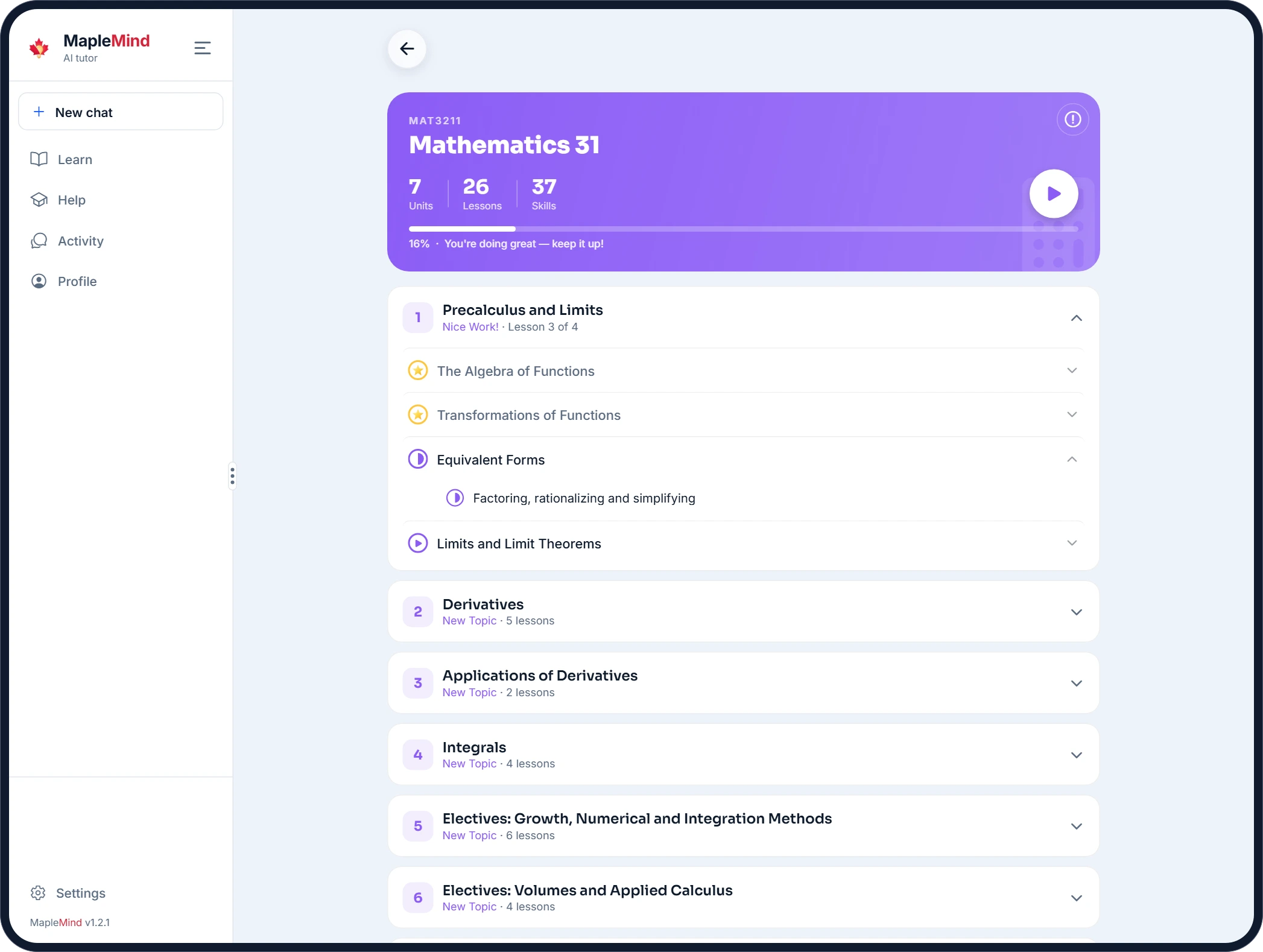
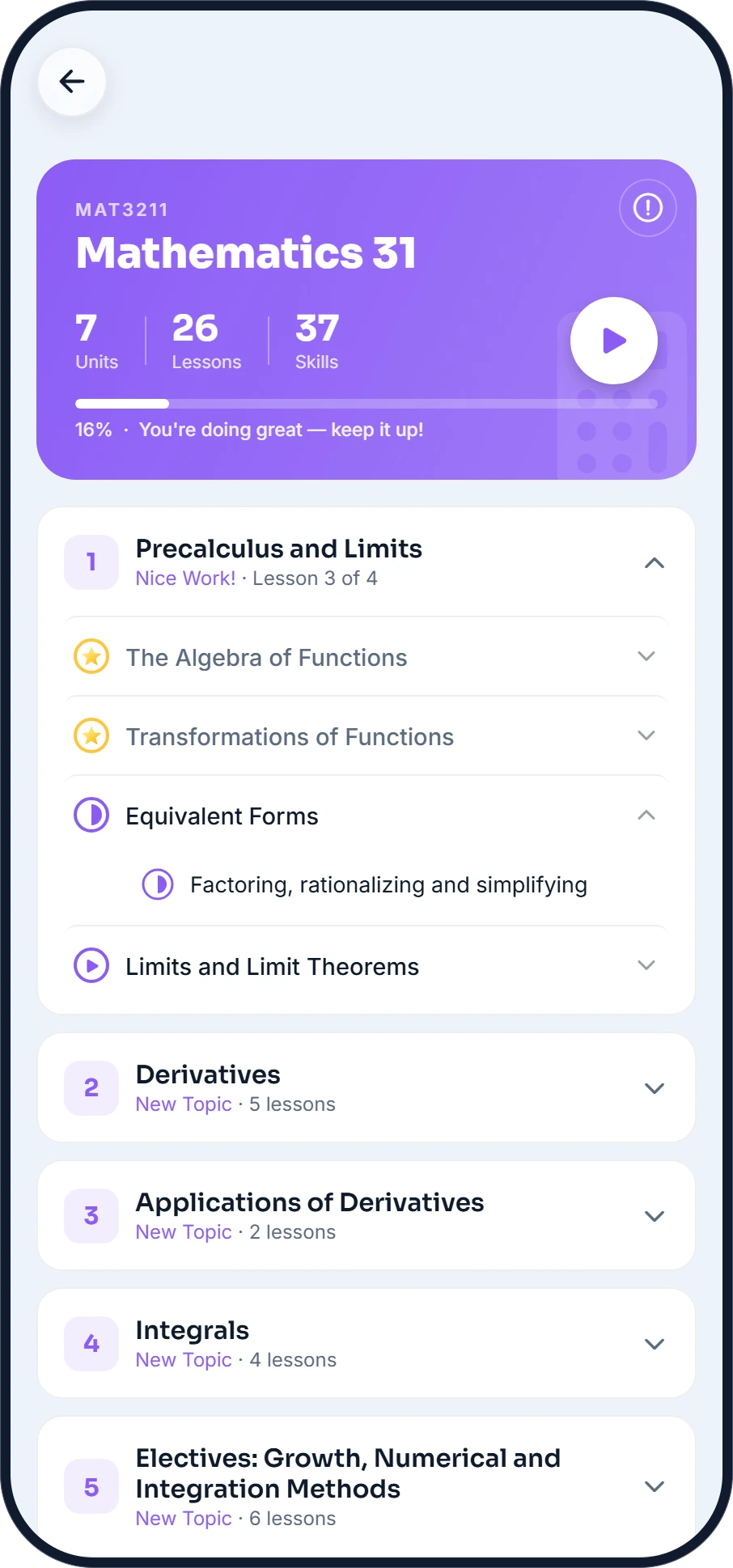
Mathematics 31 in MapleMind on a tablet: its units and lessons in order, a student partway through.Mathematics 31 in MapleMind on a phone: its units and lessons in order, a student partway through.
Their course, unit by unit, the way Alberta teaches it.Shown: Mathematics 31
Homework Help on a tablet: a photo of a worksheet, the tutor’s worked example of a two-step equation, and a question back to the student.Homework Help on a phone: a photo of a worksheet, the tutor’s worked example of a two-step equation, and a question back to the student.
Homework Help: they take a photo of the question, and the tutor works through it with them.
The Parent Dashboard on a tablet: a student’s days studied, streak, lessons, quiz average and recent activity.The Parent Dashboard on a phone: a student’s days studied, streak, lessons, quiz average and recent activity.
The Parent Dashboard: how each child’s week went, in lessons, quizzes and days studied.
A Grade 9 provincial mathematics exam on a tablet: a readiness score, the exam’s time and its next sitting.A Grade 9 provincial mathematics exam on a phone: a readiness score, the exam’s time and its next sitting.
A provincial exam: a practice sitting under the real time, and how ready they are.
The Learn tab on a tablet: a four-day streak, the week’s days, Homework Help, the next lesson and a review.The Learn tab on a phone: a four-day streak, the week’s days, Homework Help, the next lesson and a review.
The Learn tab: their week so far, and the next thing to do.

Help at home

Questions parents ask

What will my child learn in Grade 2 in Alberta?

Math: Mathematics 2. Science: Science 2. English: English Language Arts 2. Social studies: Grade 2 Social Studies. That’s 156 skills in all, from Alberta’s curriculum.

Does my child write a provincial exam in Grade 2?

No. Alberta has no provincial exam in Grade 2.

Where does this list come from?

From Alberta’s official curriculum, the documents its education ministry publishes for each course. Each skill here is one of their expectations, written in plain words.

Can MapleMind help my child in Grade 2?

Yes. Every course on this page is in MapleMind, with lessons, practice and a tutor that works through each step with them. A free account gets 30 messages and 4 activities a day.

Help with Grade 2, one skill at a time.

Every course on this page is in MapleMind, free with daily limits.