Alberta · For parents

What your child learns in Grade 7 in Alberta

Every subject, unit by unit, from Alberta’s curriculum: 243 skills in plain words.

Subjects
5
Skills
243
Provincial exams
None
Official curriculum
alberta.ca

Math in Grade 7

Mathematics 7

4 units · 50 skills

  1. Unit 1

    Number

    Last-digit family — divisible by 2: last digit even; by 5: ends in 0 or 5; by 10: ends in 0. Digit-sum family — by 3: digit sum divisible by 3; by 9: digit sum divisible by 9.

    • Testing for divisibility
    • Why you can never divide by zero
    • Adding and subtracting decimals
    13 more skills
    • Multiplying decimals
    • Dividing decimals
    • Finding a percent of a number
    • Percent problem solving
    • Terminating decimals and fractions
    • Repeating decimals and fractions
    • Adding and subtracting with like denominators
    • Adding and subtracting with unlike denominators
    • Adding and subtracting mixed numbers
    • Adding integers
    • Subtracting integers
    • Comparing and ordering fractions and decimals
    • Using benchmarks to compare
  2. Unit 2

    Patterns and Relations

    A pattern description names the starting value and how it changes each step ('start at 4, add 3 each time').

    • Oral and written patterns
    • From pattern description to relation
    • Building a table of values
    10 more skills
    • Graphing and analyzing the relation
    • Modelling preservation of equality
    • Applying preservation of equality
    • Expression vs. equation
    • Evaluating expressions
    • Modelling one-step equations
    • Solving one-step equations symbolically
    • Solving ax = b
    • Solving x/a = b
    • Solving ax + b = c
  3. Unit 3

    Shape and Space

    The diameter is always twice the radius (d = 2r); both are straight-line measurements through or from the centre.

    • Radius, diameter and circumference
    • Circumference and pi
    • Central angles and constructing circles
    8 more skills
    • Area of triangles
    • Area of parallelograms
    • Area of circles
    • Perpendicular and parallel line segments
    • Perpendicular and angle bisectors
    • Identifying and plotting integer coordinates
    • Translations, rotations and reflections
    • Describing a transformation from coordinates
  4. Unit 4

    Statistics and Probability

    Mean = sum of values ÷ count. Median = the middle value when ordered (average the two middle values if the count is even). Mode = the most frequent value(s).

    • Mean, median and mode
    • Range and choosing the best measure
    • How outliers affect mean, median and mode
    7 more skills
    • Constructing circle graphs
    • Interpreting circle graphs
    • Probability as a ratio, fraction and percent
    • Identifying the sample space
    • Organizing outcomes with tables and tree diagrams
    • Theoretical probability of two independent events
    • Comparing to experimental probability
Science in Grade 7

Science 7

5 units · 100 skills

  1. Unit 1

    Interactions and Ecosystems

    An environment supports life when it meets five needs: nutrients, an energy source, moisture, suitable habitat and the exchange of gases, and a slough meets all five for a muskrat.

    • How an environment supports life
    • Biotic and abiotic parts
    • How species depend on each other
    17 more skills
    • Changing human relationships with the land
    • Human impacts and the needs behind them
    • Environmental decisions and testable questions
    • Producers, consumers and decomposers
    • Energy storage and the energy pyramid
    • Predicting food web changes
    • How decomposers recycle matter
    • The water cycle in an ecosystem
    • The carbon cycle
    • How pollutants move and build up
    • Where living things are found
    • Tracking change in an ecosystem
    • Ecological succession
    • Intended and unintended consequences
    • Investigations that inform decisions
    • Science's limits and Indigenous knowledge
    • Analyzing a local environmental issue
  2. Unit 2

    Plants for Food and Fibre

    Plants are the producers at the base of almost every land food web: every animal in a grassland, from a grasshopper to a coyote, runs on energy that prairie grasses captured from sunlight.

    • Why ecosystems need plants
    • Plants for food and raw materials
    • Medicines, herbs and other plant uses
    17 more skills
    • From natural to managed land
    • Problems in keeping plants productive
    • Seed plant parts and their jobs
    • Diffusion, osmosis and transpiration
    • Photosynthesis and gas exchange
    • Variations in plant structure
    • Plant needs and tolerances
    • The life cycle of a seed plant
    • Growing new plants
    • Changing the environment to raise yields
    • Greenhouses and hydroponics
    • Characteristics of soils
    • Practices that build or degrade soil
    • Breeding new plant varieties
    • Controlling weeds and pests
    • Monocultures and their consequences
    • Farming practices and sustainability
  3. Unit 3

    Heat and Temperature

    People have always used heat for four kinds of jobs: cooking food, keeping warm, making materials such as pottery and metal, and making machines move, and each job led to its own heat technologies.

    • Heat technologies in the past
    • From human needs to heat technologies
    • Devices that make, move and remove heat
    18 more skills
    • Choices in using energy for heat
    • Heat and the motion of particles
    • Telling heat from temperature
    • Changes of state and thermal energy
    • Expansion and contraction of materials
    • Conduction
    • Convection
    • Radiation
    • Conduction, convection or radiation
    • Natural sources of thermal energy
    • Heating with the Sun
    • Designing to control heat transfer
    • Devices that respond to temperature
    • How heaters, furnaces and refrigerators work
    • Problems in controlling thermal energy
    • Sources of heat and their impacts
    • Comparing technologies for heating and cooking
    • Consequences of energy use and conservation
  4. Unit 4

    Structures and Forces

    A structure is anything with a definite shape that holds itself up and supports a load, whether people build it or it is part of nature: a chair, a bridge, a bird's nest and a tree are all structures.

    • Solid, frame and shell structures
    • What structures are made of
    • Structures in nature
    16 more skills
    • Different designs for one job
    • Structures across cultures and times
    • Measuring force and mass
    • Loads on a structure
    • Friction holds structures together
    • Tension, compression, shear and bending
    • How structures fail
    • The right material for each part
    • Stability and foundations
    • Testing strength and flexibility
    • Fixed and flexible joints
    • Comparing natural and synthetic materials
    • Materials in plants and animals
    • Making materials stronger by design
    • Margin of safety
    • Evaluating and improving a design
  5. Unit 5

    Planet Earth

    Earth's surface changes in two ways: suddenly, in seconds to days, as in earthquakes, volcanic eruptions and landslides, and gradually, over thousands to millions of years, as rivers and glaciers wear the land away.

    • Sudden and gradual changes
    • Earth's layers
    • Tools geologists use
    17 more skills
    • Rocks and minerals
    • Describing minerals
    • Mineral hardness and the Mohs scale
    • The three classes of rock
    • The rock cycle
    • Weathering, erosion and sedimentation
    • Alberta's rocks and sediments
    • Evidence that continents move
    • Patterns in plate movement
    • Mountain ranges and their patterns
    • Rock layers in fold and fault mountains
    • Predicting slow changes over time
    • Kinds of fossils and how they form
    • Rebuilding life from fossils
    • The geological time scale
    • Patterns of life in the fossil record
    • How fossil evidence adds up
See the course: Science 7

English in Grade 7

2 courses. Choose the one your child takes.

English as an Additional Language (Grades 7–9)

6 units · 28 skills

  1. Unit 1

    Emerging Literacy (Levels A–B)

    You do not need every word — catching one key word (with a picture or action) is enough to understand.

    • Level A — Listening
    • Level A — Speaking
    • Level A — Reading
    5 more skills
    • Level A — Writing
    • Level B — Listening
    • Level B — Speaking
    • Level B — Reading
    • Level B — Writing
  2. Unit 2

    Level 1 — Beginning

    One-step instructions (open, close, write, look) tell you exactly one thing to do.

    • Level 1 — Listening
    • Level 1 — Speaking
    • Level 1 — Reading
    1 more skill
    • Level 1 — Writing
  3. Unit 3

    Level 2 — Developing

    Listen for the key words that carry the meaning of a short message.

    • Level 2 — Listening
    • Level 2 — Speaking
    • Level 2 — Reading
    1 more skill
    • Level 2 — Writing
  4. Unit 4

    Level 3 — Expanding

    Beyond the main idea, listen for details: who, when, how many.

    • Level 3 — Listening
    • Level 3 — Speaking
    • Level 3 — Reading
    1 more skill
    • Level 3 — Writing
  5. Unit 5

    Level 4 — Bridging

    You can now handle a new situation, not only familiar ones, using context clues.

    • Level 4 — Listening
    • Level 4 — Speaking
    • Level 4 — Reading
    1 more skill
    • Level 4 — Writing
  6. Unit 6

    Level 5 — Extending

    You can now follow new social and subject-area situations with less support.

    • Level 5 — Listening
    • Level 5 — Speaking
    • Level 5 — Reading
    1 more skill
    • Level 5 — Writing

English Language Arts 7

5 units · 20 skills

  1. Unit 1

    Reading and Comprehension

    A summary states the main idea of a text briefly, in your own words, leaving out minor details.

    • Summarizing main ideas
    • Using visual and textual cues
    • Using prior experience to understand
    1 more skill
    • Clarifying and assessing your ideas
  2. Unit 2

    Responding to and Analyzing Texts

    Comparing a character’s behaviour to your own (and to people you know) helps you understand both the character and yourself.

    • Comparing character choices and behaviours
    • Techniques like suspense and foreshadowing
    • Forms and genres
    2 more skills
    • Connecting plot, character and theme
    • Recurring themes across cultures
  3. Unit 3

    Creating Texts

    Idea-generating strategies — brainstorming, listing, mapping, drawing on experience — help you start.

    • Generating and focusing ideas
    • Structuring with point of view and plot
  4. Unit 4

    Research and Information

    Focusing a topic means narrowing it with your audience, purpose, point of view and form in mind.

    • Focusing a topic for audience and purpose
    • Evaluating sources against criteria
    • Organizing into categories
    1 more skill
    • Making notes and referencing sources
  5. Unit 5

    Writing Craft and Conventions

    Coherence means ideas connect and flow in a sensible order, with a clear introduction and conclusion.

    • Revising for coherence
    • Standard English vs. slang
    • Subordinate clauses and agreement
    2 more skills
    • Punctuating direct speech
    • Solving spelling problems

French in Grade 7

French as a Second Language 7 (Nine-Year Program)

6 units · 20 skills

  1. Unit 1

    La boîte à outils — Grade 7 Foundations

    The big four are irregular — memorize them as tunes: j'ai/tu as/il a…, je suis/tu es…, je fais/tu fais…, je vais/tu vas…

    • Avoir, être, faire, aller in the present
    • Regular –er verbs in the present
    • Articles and agreement
    5 more skills
    • Possessive adjectives
    • Saying no: ne … pas
    • Asking questions
    • Expressions with avoir and faire
    • Prepositions of place
  2. Unit 2

    L'école

    Commands come in a small set that repeats daily: Ouvrez vos livres, Écoutez, Levez la main, Asseyez-vous — learn the set, own the classroom.

    • Understanding classroom French
    • Reading school documents
    • Talking about school subjects
    1 more skill
    • Labelling a school floor plan
  3. Unit 3

    Les gens autour de moi

    The family kit: la mère, le père, le frère, la sœur, les grands-parents, l'oncle, la tante.

    • Understanding talk about people
    • Describing people
  4. Unit 4

    La météo

    The conditions kit: il fait beau/mauvais/froid/chaud, il pleut (raining), il neige (snowing), il y a du vent/du soleil.

    • Understanding a weather report
    • Describing the weather
  5. Unit 5

    Fêtes et célébrations

    Invitations answer three questions: quand (le 3 juin), à quelle heure (à 15 h), où (chez Sophie) — scan for them.

    • Reading invitations and celebration texts
    • Writing about holiday traditions
  6. Unit 6

    Le français au Canada et dans le monde

    The Francophone map: in Canada (Québec, parts of New Brunswick, Ontario, Alberta's francophone communities) and worldwide (France, Belgique, Sénégal, Haïti…).

    • Where French is spoken
    • Comparing ways of life

Social studies in Grade 7

Social Studies 7

2 units · 25 skills

  1. Unit 1

    Toward Confederation

    Aboriginal societies (the Iroquois/Haudenosaunee Confederacy, Ojibwa, Mi’kmaq) had their own governments and ways of organizing — many made decisions by consensus.

    • Aboriginal societies and decision-making
    • European imperialism and its impact
    • New France and British colonial societies
    9 more skills
    • Participants in the fur trade
    • The fur trade economy
    • Conflict and the Acadian Deportation
    • The Battle of the Plains of Abraham
    • The 13 Colonies and the Loyalist migration
    • Chief Pontiac and the Royal Proclamation of 1763
    • The Québec Act of 1774
    • Chief Tecumseh and the War of 1812
    • Rebellions, the Act of Union, and the road to Confederation
  2. Unit 2

    Following Confederation: Canadian Expansions

    Louis Riel became the Métis leader because Canada’s expansion threatened Métis land and rights without consultation.

    • Louis Riel and the two resistances
    • Canada’s response and control of the West
    • The creation of Manitoba and the Manitoba Schools Act
    10 more skills
    • Rupert’s Land and the National Policy
    • The railway and the North West Mounted Police
    • Immigration and the settlers of the West
    • New provinces join Confederation
    • The numbered treaties and their impact
    • Newfoundland joins Confederation
    • The changing roles of women
    • Bilingualism, multiculturalism and the Aboriginal population
    • Urbanization and the rise of factories
    • Technology, broadcasting and identity

MapleMind

See Grade 7 in MapleMind

Real screens from the app your child would use.

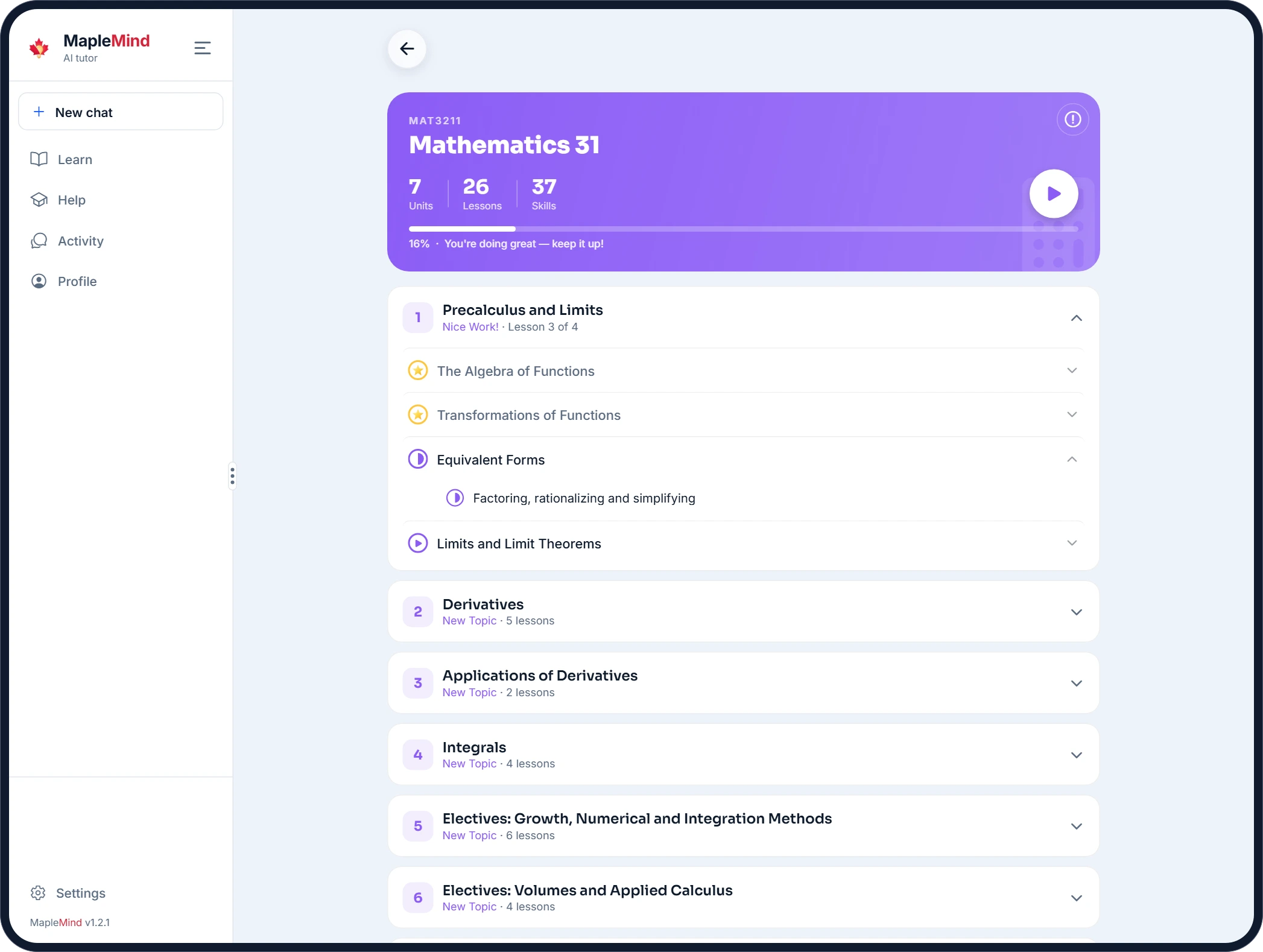
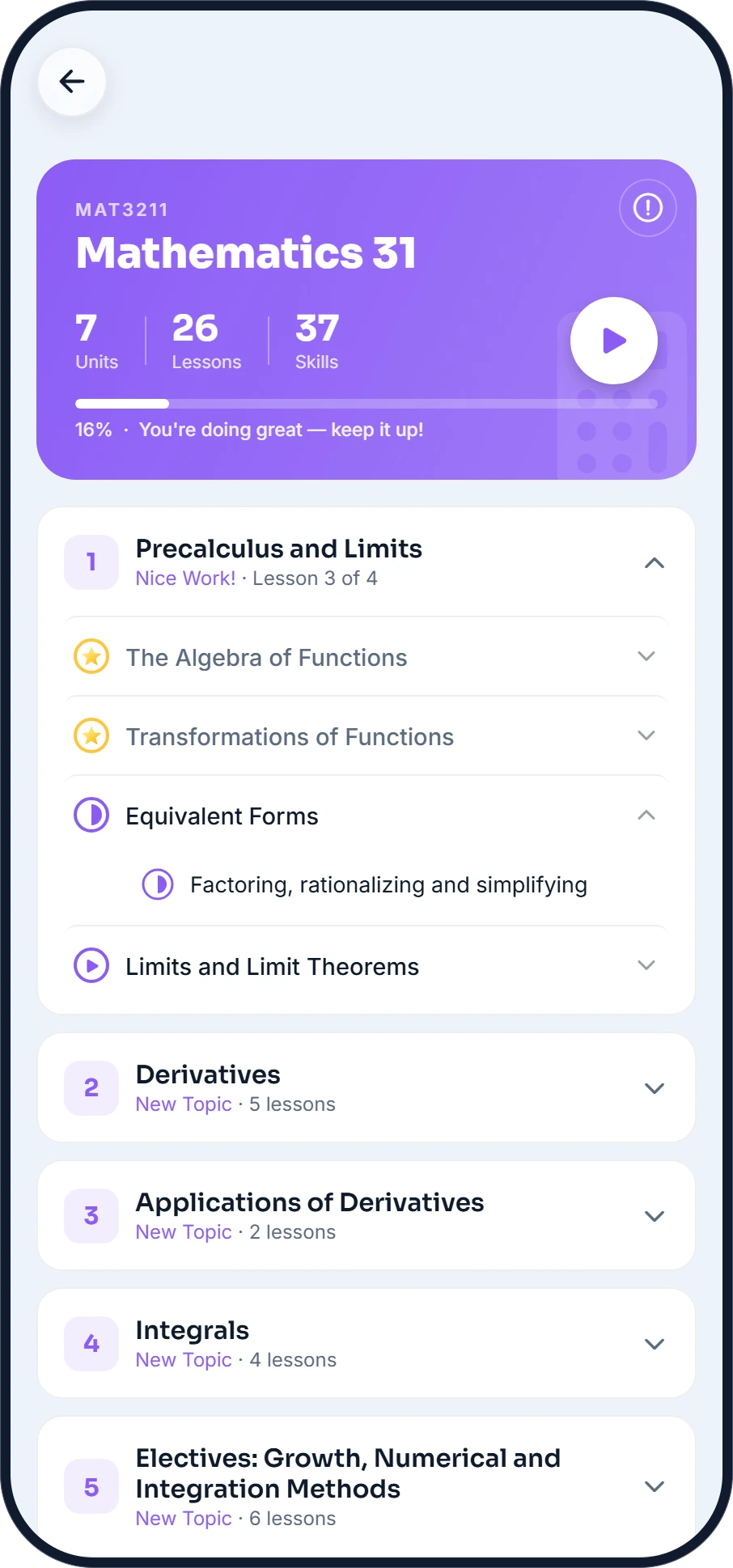
Mathematics 31 in MapleMind on a tablet: its units and lessons in order, a student partway through.Mathematics 31 in MapleMind on a phone: its units and lessons in order, a student partway through.
Their course, unit by unit, the way Alberta teaches it.Shown: Mathematics 31
Homework Help on a tablet: a photo of a worksheet, the tutor’s worked example of a two-step equation, and a question back to the student.Homework Help on a phone: a photo of a worksheet, the tutor’s worked example of a two-step equation, and a question back to the student.
Homework Help: they take a photo of the question, and the tutor works through it with them.
The Parent Dashboard on a tablet: a student’s days studied, streak, lessons, quiz average and recent activity.The Parent Dashboard on a phone: a student’s days studied, streak, lessons, quiz average and recent activity.
The Parent Dashboard: how each child’s week went, in lessons, quizzes and days studied.
A Grade 9 provincial mathematics exam on a tablet: a readiness score, the exam’s time and its next sitting.A Grade 9 provincial mathematics exam on a phone: a readiness score, the exam’s time and its next sitting.
A provincial exam: a practice sitting under the real time, and how ready they are.
The Learn tab on a tablet: a four-day streak, the week’s days, Homework Help, the next lesson and a review.The Learn tab on a phone: a four-day streak, the week’s days, Homework Help, the next lesson and a review.
The Learn tab: their week so far, and the next thing to do.

Help at home

Questions parents ask

What will my child learn in Grade 7 in Alberta?

Math: Mathematics 7. Science: Science 7. English: English as an Additional Language (Grades 7–9) and English Language Arts 7. French: French as a Second Language 7 (Nine-Year Program). Social studies: Social Studies 7. That’s 243 skills in all, from Alberta’s curriculum.

Does my child write a provincial exam in Grade 7?

No. Alberta has no provincial exam in Grade 7.

Where does this list come from?

From Alberta’s official curriculum, the documents its education ministry publishes for each course. Each skill here is one of their expectations, written in plain words.

Can MapleMind help my child in Grade 7?

Yes. Every course on this page is in MapleMind, with lessons, practice and a tutor that works through each step with them. A free account gets 30 messages and 4 activities a day.

Help with Grade 7, one skill at a time.

Every course on this page is in MapleMind, free with daily limits.