Get help with Social Studies 7
Most tutoring makes you sit through material you already know. MapleMind flips that: pick the exact skill that's causing trouble — any of the 25 below — and the tutor teaches just that one, step by step, as many times as it takes. Ask questions in plain words, any time of day, in English, French, or 12 other languages.
The official Alberta Social Studies 7 curriculum
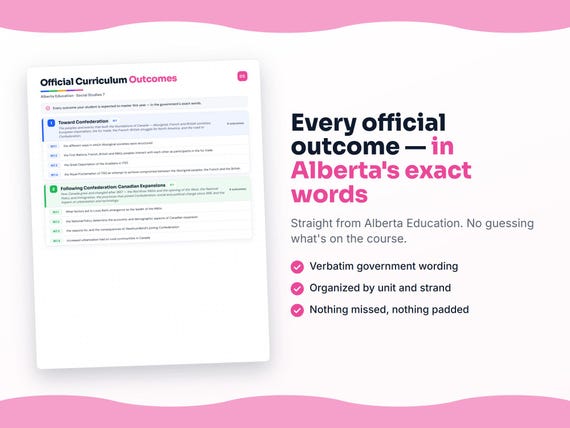
Alberta defines Social Studies 7 by strands and outcomes. MapleMind teaches the same curriculum reorganized for one-skill-at-a-time tutoring — the table shows exactly where every official strand lands, and the ministry's own wording is quoted under each unit below.
Official source Alberta's official programs of studyRead it on the government site — alberta.ca ↗| Official strand | Outcomes | Where MapleMind teaches it |
|---|---|---|
| Related Issue 7.1 | 12 | Toward Confederation |
| Related Issue 7.2 | 13 | Following Confederation: Canadian Expansions |
Every skill below, taught one on one.
 Try the first session free
How MapleMind teaches Social Studies 7 — every unit, lesson, and skill
Every skill below runs as a short session: a plain-words lesson, a worked example, solving it together, then a five-question skill check that earns up to three stars. Guided Mode keeps it teaching instead of answer-handing — turning it off needs a parent's password.
Unit 1Toward ConfederationOfficial strand · Related Issue 7.1
The peoples and events that built the foundations of Canada — Aboriginal, French and British societies, European imperialism, the fur trade, the French-British struggle for North America, and the road to Confederation.
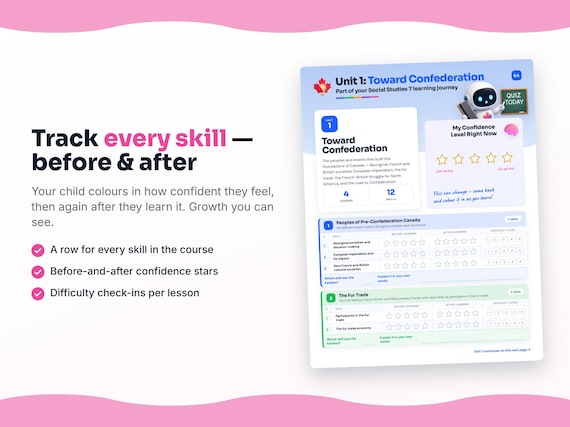
Peoples of Pre-Confederation Canada
- Aboriginal societies and decision-making7.1.3a — Compare how Aboriginal societies (the Iroquois/Haudenosaunee Confederacy, Ojibwa, Mi’kmaq) were structured, and how structure shaped who made decisions — including consensus building and the role and status of women.
- European imperialism and its impact7.1.3b — Explain the social and economic factors of European imperialism, and assess how imperialism affected the social and economic structures of Aboriginal societies and drove the development of Acadia, New France and British settlements.
- New France and British colonial societies7.1.3c — Compare the social structure of New France (the role of the Royal Government and the Catholic Church — governor, intendant, Jesuits) with British exploration and settlement of North America.
The Fur Trade
- Participants in the fur trade7.1.4a — Assess how First Nations, French, British and Métis peoples interacted as participants in the fur trade, and how the Métis emerged as a distinct people.
- The fur trade economy7.1.4b — Explain how the fur trade laid the foundations of the North American economy, how Britain’s interest differed from that of New France, and the role of mercantilism before and after the 1763 Treaty of Paris.
The French-British Struggle for North America
- Conflict and the Acadian Deportation7.1.5a — Assess how conflicts between the French and the British in Europe reached North America, including how they became factors in the Great Deportation of the Acadians in 1755.
- The Battle of the Plains of Abraham7.1.5b — Evaluate the extent to which the Battle of the Plains of Abraham was the key event in achieving British control over North America.
- The 13 Colonies and the Loyalist migration7.1.5c — Assess how British North America was impacted by rebellion in the 13 colonies and by the subsequent Loyalist migration.
The Foundations of Canada
- Chief Pontiac and the Royal Proclamation of 17637.1.6a — Explain the role and intent of Chief Pontiac in controlling British forts, and assess how the Royal Proclamation of 1763 sought compromise between the Aboriginal peoples, the French and the British.
- The Québec Act of 17747.1.6b — Assess how the Québec Act of 1774 contributed to the foundations of Canada as an officially bilingual country by protecting French language, Catholic religion and French civil law.
- Chief Tecumseh and the War of 18127.1.6c — Explain the role of Chief Tecumseh in the War of 1812 and how the War of 1812 contributed to British identity in Canada and to defining Canada’s political boundaries.
- Rebellions, the Act of Union, and the road to Confederation7.1.6d — Assess how the Great Migration and the Act of Union of 1840 responded to the 1837 and 1838 Rebellions, and how Confederation sought to give Québec, Ontario and the Maritimes more control over their own affairs.
The official wording — 12 outcomes in this unit
- 7.1.3a
the different ways in which Aboriginal societies were structured
- 7.1.3b
the social and economic factors of European imperialism
- 7.1.3c
the Royal Government and the Catholic Church play in the social structure of New France
- 7.1.4a
the First Nations, French, British and Métis peoples interact with each other as participants in the fur trade
- 7.1.4b
the fur trade contribute to the foundations of the economy in North America
- 7.1.5a
the Great Deportation of the Acadians in 1755
- 7.1.5b
the Battle of the Plains of Abraham the key event in achieving British control over North America
- 7.1.5c
British North America impacted by rebellion in the 13 colonies and by the subsequent Loyalist migration
- 7.1.6a
the Royal Proclamation of 1763 an attempt to achieve compromise between the Aboriginal peoples, the French and the British
- 7.1.6b
the Québec Act of 1774 contribute to the foundations of Canada as an officially bilingual country
- 7.1.6c
the role of Chief Tecumseh in the War of 1812
- 7.1.6d
the Act of Union of 1840 an attempt to resolve the issues raised by the 1837 and 1838 Rebellions
Unit 2Following Confederation: Canadian ExpansionsOfficial strand · Related Issue 7.2
How Canada grew and changed after 1867 — the Red River Métis and the opening of the West, the National Policy and immigration, the provinces that joined Confederation, social and political change since 1918, and the impact of urbanization and technology.
The Métis and the North-West
- Louis Riel and the two resistances7.2.4a — Assess the factors behind Louis Riel’s emergence as Métis leader, and compare the similarities and differences between the causes of the 1869 Red River Resistance and the causes of the 1885 uprising.
- Canada’s response and control of the West7.2.4b — Assess how the Government of Canada’s response to the Red River Resistance and the 1885 uprising solidified Canada’s control of the West, and the extent to which the resistances were a means to counter assimilation.
- The creation of Manitoba and the Manitoba Schools Act7.2.4c — Assess how the creation of Manitoba sought compromise among the Métis, First Nations, French and British peoples, and how the Manitoba Schools Act and NWT education legislation attempted to impose a British identity.
Building the West
- Rupert’s Land and the National Policy7.2.5a — Evaluate the factors behind the 1869 purchase of Rupert’s Land, and how the National Policy (tariffs, railway, immigration) determined the economic and demographic aspects of Canadian expansion.
- The railway and the North West Mounted Police7.2.5b — Evaluate how the building of the Canadian Pacific Railway affected the growth of Canada (including the role of Chinese railway workers) and the role of the North West Mounted Police in the development of the West.
- Immigration and the settlers of the West7.2.5c — Evaluate the government, religious and missionary strategies used to encourage immigration, and how Francophone, Asian and eastern European settlers changed the collective identity of western communities.
- New provinces join Confederation7.2.5d — Evaluate the factors that led British Columbia and Prince Edward Island to join Confederation, and how the needs of varied populations were considered in creating Alberta and Saskatchewan.
- The numbered treaties and their impact7.2.5e — Evaluate the underlying reasons for negotiating the numbered treaties and the impact that immigration and expansion had on Aboriginal peoples and communities in Canada.
A Changing Canada Since 1918
- Newfoundland joins Confederation7.2.6a — Assess the reasons for, and the consequences of, Newfoundland’s joining Confederation in 1949, and how joining impacted the citizens of Newfoundland.
- The changing roles of women7.2.6b — Assess the social and economic effects of the changing roles and images of women in Canadian society, including the right to vote, working conditions and changing family structures.
- Bilingualism, multiculturalism and the Aboriginal population7.2.6c — Assess how the Official Languages Act contributed to bilingualism, how immigration policies contributed to diversity and multiculturalism, and the challenges and opportunities of a growing Aboriginal population in western Canada.
Urbanization and Technology
- Urbanization and the rise of factories7.2.7a — Assess the impact of increased urbanization on rural communities, and how the emergence of large factories contributed to the development of Canada’s economy.
- Technology, broadcasting and identity7.2.7b — Assess how technological advances (aviation, farming equipment, radio, electronics, multimedia) developed Canada, and the effects of the CBC and La Société Radio-Canada (SRC) on Canadian identity.
The official wording — 13 outcomes in this unit
- 7.2.4a
What factors led to Louis Riel’s emergence as the leader of the Métis
- 7.2.4b
the Government of Canada’s response to the Red River Resistance and the second Métis uprising solidify Canada’s control of the West
- 7.2.4c
the creation of Manitoba an attempt to achieve compromise between the Métis, First Nations, French and British peoples
- 7.2.5a
the National Policy determine the economic and demographic aspects of Canadian expansion
- 7.2.5b
the building of the Canadian Pacific Railway affect the growth of Canada
- 7.2.5c
strategies were used by the government to encourage immigration from Europe
- 7.2.5d
What factors led to British Columbia’s joining Confederation
- 7.2.5e
the underlying reasons for the negotiation of the numbered treaties
- 7.2.6a
the reasons for, and the consequences of, Newfoundland’s joining Confederation
- 7.2.6b
the changing roles and images of women in Canadian society
- 7.2.6c
Canadian immigration policies contributed to increased diversity and multiculturalism
- 7.2.7a
increased urbanization had on rural communities in Canada
- 7.2.7b
technological advances contribute to the development of Canada
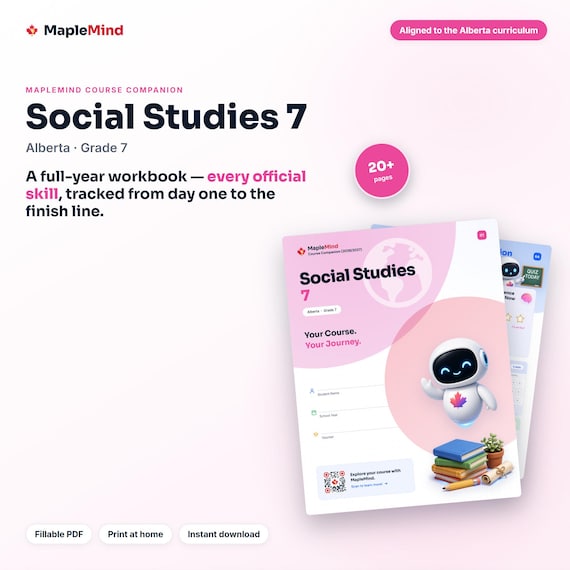
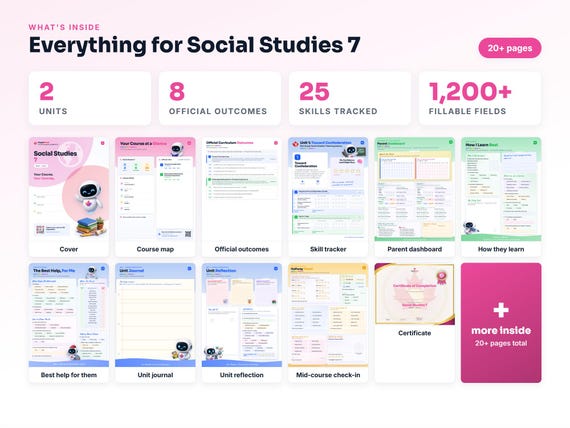
Printable workbook · A keepsake of the year
A Social Studies 7 workbook worth keeping
Built from the same official curriculum as this page. Before and after each skill above, your student colours in how sure they feel — so the two of you can see, on one page, what's clicking and what needs another look. It's a quiet way to follow how the year is really going.
By June it's full of their own handwriting: units worked through, confidence grown, a mid-year check-in, notes from parent-teacher night, and a certificate at the end. Less a worksheet, more a record of the year worth keeping on the shelf.
Instant download · see every page, reviews and the full description · five or more workbooks are $2.99 each
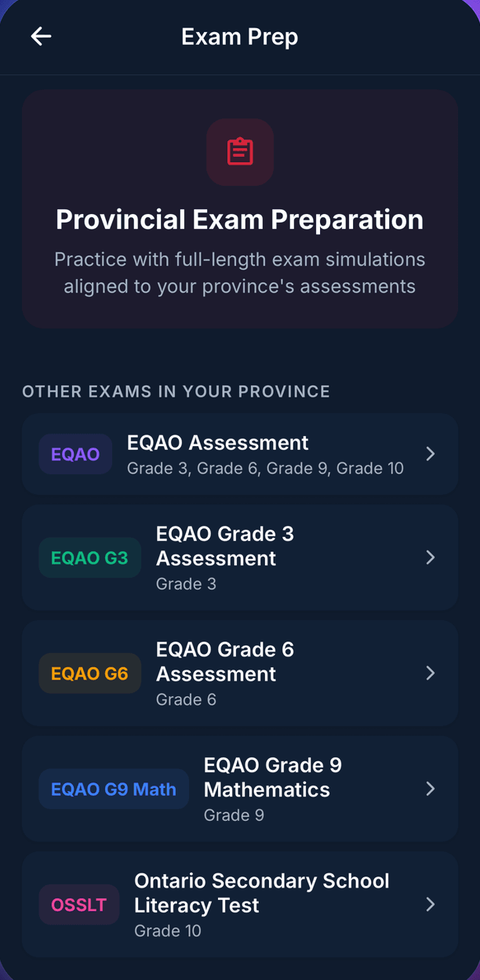
What it looks like in the app


Common questions
Can MapleMind help me with Social Studies 7?
Yes. MapleMind's AI tutor covers all 25 skills in Alberta's Social Studies 7 — you pick the exact skill, and the tutor teaches it step by step: a short lesson, a worked example, solving together, then a skill check to show it stuck.
Is MapleMind aligned to Alberta's official curriculum?
Yes. Every skill in this course maps to an official outcome code from Alberta's Grade 7 Social Studies curriculum, and the ministry's own wording is quoted under each unit on this page — with the official government source linked so you can check it yourself.
What does MapleMind cost?
It's free to start — 5 tutoring chats and a practice quiz every day, no credit card. A Pro subscription ($9.99/month or $49.99/year CAD, 7-day free trial) unlocks unlimited tutoring, practice, and exam simulations.
What if I'm stuck on just one topic?
That's the point of skill-level tutoring: open Social Studies 7 in the app, tap the exact skill from the list on this page, and the tutor teaches just that — no wading through lessons you don't need.
Does MapleMind work in French or other languages?
Yes — 14 languages, including French. Both the app and the tutor's explanations switch to the language you choose.
Where can I see the official Alberta curriculum for Social Studies 7?
The official source is linked on this page — Alberta's official programs of study. The outline here follows it: every MapleMind skill carries its official outcome code, and the ministry's own wording is quoted under each unit.
Keep exploring
Ready when you are
Pick a skill from this page and see it taught properly — free, in the browser, in under a minute.