Get help with Grade 6 Social Studies
Most tutoring makes your child sit through material your child already knows. MapleMind flips that: pick the exact skill that's causing trouble — any of the 10 below — and the tutor teaches just that one, step by step, as many times as it takes. Ask questions in plain words, any time of day, in English, French, or 12 other languages.
The official Alberta Grade 6 Social Studies curriculum
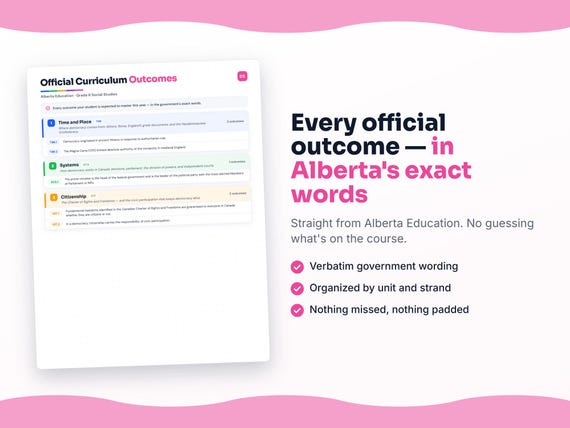
Alberta defines Grade 6 Social Studies by strands and outcomes. MapleMind teaches the same curriculum reorganized for one-skill-at-a-time tutoring — the table shows exactly where every official strand lands, and the ministry's own wording is quoted under each unit below.
Official source Alberta's official programs of studyRead it on the government site — alberta.ca ↗| Official strand | Outcomes | Where MapleMind teaches it |
|---|---|---|
| Strand TP | 1 | Time and Place |
| Strand S | 1 | Systems |
| Strand C | 2 | Citizenship |
Every skill below, taught one on one.
 Try the first session free
How MapleMind teaches Grade 6 Social Studies — every unit, lesson, and skill
Every skill below runs as a short session: a plain-words lesson, a worked example, solving it together, then a five-question skill check that earns up to three stars. Guided Mode keeps it teaching instead of answer-handing — turning it off needs a parent's password.
Unit 1Time and PlaceOfficial strand · Strand TP
Where democracy comes from: Athens, Rome, England's great documents, and the Haudenosaunee Confederacy.
Athens: Democracy Is Born
- Direct democracy in ancient Athenssss6.6.TP.1 — Investigate how democracy originated in ancient Athens in response to authoritarian rule — its fundamental principles, its three social classes, and the features of direct democracy from majority rule to secret ballots.
- The Roman Republic: representative democracysss6.6.TP.1 — Compare the Roman Republic's representative democracy — elected magistrates, a senate and assemblies, three branches under a Constitution — with Athens, and why both systems were limited.
Limiting Kings & Governing by Consensus
- Magna Carta to the Bill of Rightssss6.6.TP.1 — Discuss how the Magna Carta (1215) limited absolute monarchy, the Habeas Corpus Act (1679) established individual legal rights, and the Bill of Rights (1689) gave parliament authority and formalized civil rights.
- The Haudenosaunee Confederacysss6.6.TP.1 — Explain how First Nations of the Haudenosaunee Confederacy govern through consensus — the Grand Council where Chiefs represent each Nation, the influence of Clan Mothers, and the Great Law of Peace.
The official wording — 1 outcome in this unit
- sss6.6.TP.1
Democracy originated in ancient Athens in response to authoritarian rule.
Unit 2SystemsOfficial strand · Strand S
How democracy works in Canada: elections, parliament, the division of powers, and independent courts.
Democracy in Canada
- Canada's parliamentary systemsss6.6.S.1 — Relate Canada's democracy to the British parliamentary system: the Governor General and lieutenant-governors, elections at every level, how the prime minister and premiers lead, and the accountability role of the Official Opposition.
- Division of powers and the independent courtssss6.6.S.1 — Differentiate federal from provincial decision-making authority under the Constitution Act, justify the independence of the judicial system, and connect Canada's democratic practices to earlier systems of government.
The official wording — 1 outcome in this unit
- sss6.6.S.1
The prime minister is the head of the federal government and is the leader of the political party with the most elected Members of Parliament or MPs.
Unit 3CitizenshipOfficial strand · Strand C
The Charter of Rights and Freedoms — and the civic participation that keeps democracy alive.
The Charter of Rights and Freedoms
- Fundamental freedoms and individual rightssss6.6.C.1 — Examine how the Charter (1982) was entrenched in the Constitution, guarantees fundamental freedoms to everyone in Canada — citizen or not — protects individual rights, and allows reasonable limits to protect others.
- Collective rights in the Chartersss6.6.C.1 — Examine the Charter's collective rights: Section 25 affirming Aboriginal and treaty rights, French and English as official languages with Section 23 minority language education rights, and Section 29 religious school rights.
- The Charter in action against injusticesss6.6.C.1 — Examine how the Charter protects all Canadians, applies to all levels of government, and can challenge unjust policies — while diverse communities continue to face discrimination, including antisemitism and Islamophobia.
Civic Participation
- Civic participation and project planningsss6.6.C.2 — Justify civic participation as a democratic responsibility, distinguish formal from informal actions, and plan a civic project: identify the issue, research, set goals, weigh costs, act, and reflect.
The official wording — 2 outcomes in this unit
- sss6.6.C.1
Fundamental freedoms identified in the Canadian Charter of Rights and Freedoms are guaranteed to everyone in Canada whether they are citizens or not.
- sss6.6.C.2
In a democracy, citizenship carries the responsibility of civic participation.
Printable workbook · A keepsake of the year
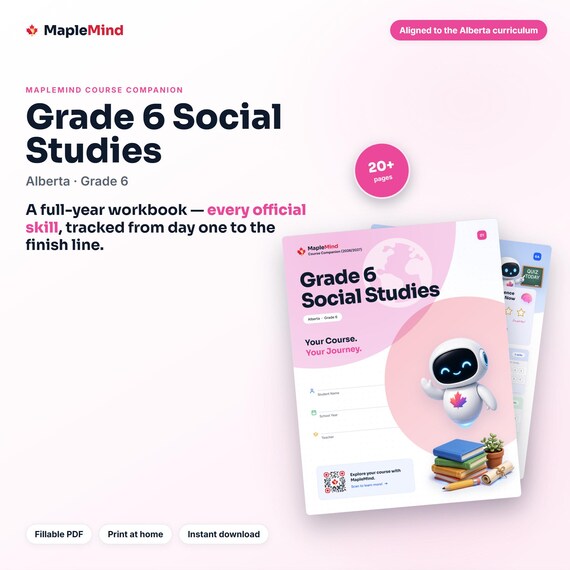
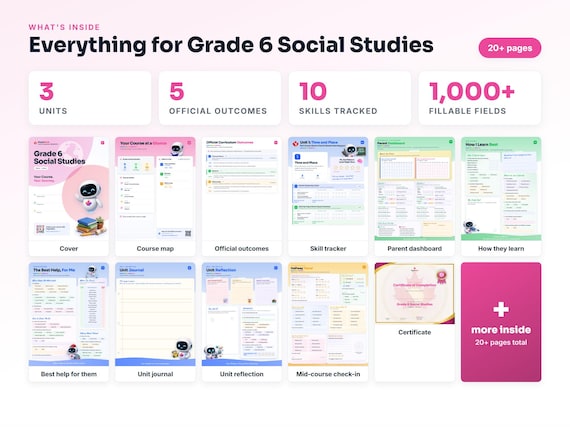
A Grade 6 Social Studies workbook worth keeping
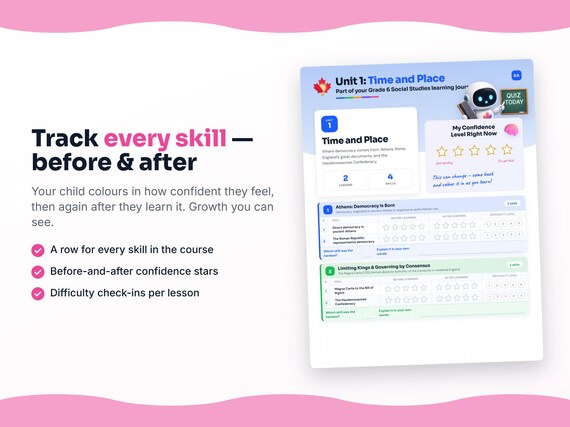
Built from the same official curriculum as this page. Before and after each skill above, your student colours in how sure they feel — so the two of you can see, on one page, what's clicking and what needs another look. It's a quiet way to follow how the year is really going.
By June it's full of their own handwriting: units worked through, confidence grown, a mid-year check-in, notes from parent-teacher night, and a certificate at the end. Less a worksheet, more a record of the year worth keeping on the shelf.
Instant download · see every page, reviews and the full description · five or more workbooks are $2.99 each
What it looks like in the app



Preparing for the Grade 6 Provincial Achievement Test (PAT)?
Alberta students write a Provincial Achievement Test in Grade 6. MapleMind's exam mode simulates it from this course's skills, then shows exactly which ones to shore up.
Common questions
Can MapleMind help my child with Grade 6 Social Studies?
Yes. MapleMind's AI tutor covers all 10 skills in Alberta's Grade 6 Social Studies — your child picks the exact skill, and the tutor teaches it step by step: a short lesson, a worked example, solving together, then a skill check to show it stuck.
Is MapleMind aligned to Alberta's official curriculum?
Yes. Every skill in this course maps to an official outcome code from Alberta's Grade 6 Social Studies curriculum, and the ministry's own wording is quoted under each unit on this page — with the official government source linked so you can check it yourself.
What does MapleMind cost?
It's free to start — 5 tutoring chats and a practice quiz every day, no credit card. A Pro subscription ($9.99/month or $49.99/year CAD, 7-day free trial) unlocks unlimited tutoring, practice, and exam simulations.
What if my child is stuck on just one topic?
That's the point of skill-level tutoring: open Grade 6 Social Studies in the app, tap the exact skill from the list on this page, and the tutor teaches just that — no wading through lessons your child doesn't need.
Does MapleMind work in French or other languages?
Yes — 14 languages, including French. Both the app and the tutor's explanations switch to the language your child chooses.
Where can I see the official Alberta curriculum for Grade 6 Social Studies?
The official source is linked on this page — Alberta's official programs of study. The outline here follows it: every MapleMind skill carries its official outcome code, and the ministry's own wording is quoted under each unit.
Does MapleMind help with the Grade 6 Provincial Achievement Test (PAT)?
Yes. Alberta students write a Provincial Achievement Test in Grade 6. MapleMind's exam mode simulates it from this course's skills, then shows exactly which ones to shore up.
Keep exploring
Ready when you are
Pick a skill from this page and see it taught properly — free, in the browser, in under a minute.