Get help with Science 2
Most tutoring makes your child sit through material your child already knows. MapleMind flips that: pick the exact skill that's causing trouble — any of the 22 below — and the tutor teaches just that one, step by step, as many times as it takes. Ask questions in plain words, any time of day, in English, French, or 12 other languages.
The official Alberta Science 2 curriculum
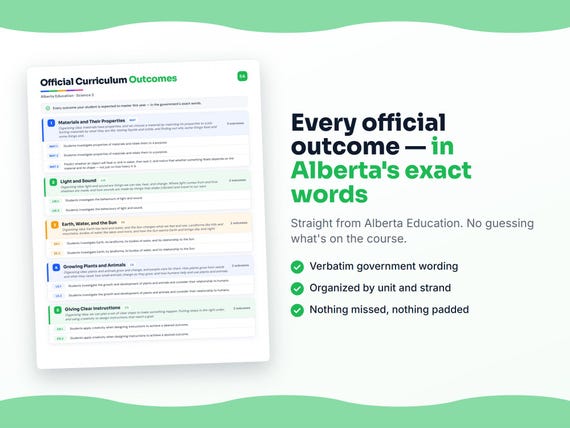
Alberta defines Science 2 by strands and outcomes. MapleMind teaches the same curriculum reorganized for one-skill-at-a-time tutoring — the table shows exactly where every official strand lands, and the ministry's own wording is quoted under each unit below.
Official source Alberta's official programs of studyRead it on the government site — alberta.ca ↗| Official strand | Outcomes | Where MapleMind teaches it |
|---|---|---|
| Materials | 1 | Materials and Their Properties |
| Energy | 1 | Light and Sound |
| Earth Systems | 1 | Earth, Water, and the Sun |
| Living Systems | 1 | Growing Plants and Animals |
| Computer Science | 1 | Giving Clear Instructions |
| Scientific Methods | 1 | How We Investigate |
Every skill below, taught one on one.
 Try the first session free
How MapleMind teaches Science 2 — every unit, lesson, and skill
Every skill below runs as a short session: a plain-words lesson, a worked example, solving it together, then a five-question skill check that earns up to three stars. Guided Mode keeps it teaching instead of answer-handing — turning it off needs a parent's password.
Unit 1Materials and Their PropertiesOfficial strand · Materials
Organizing idea: materials have properties, and we choose a material by matching its properties to a job. Sorting materials by what they are like, testing liquids and solids, and finding out why some things float and some things sink.
What Materials Are Like
- Observing and sorting by properties2.M.1 — Observe a material and describe its properties — hard or soft, rough or smooth, bendy or stiff, shiny or dull — and sort objects into groups by a property they share.
- How liquids and solids behave2.M.1 — Test how a liquid pours and takes the shape of its container while a solid keeps its own shape, and describe the different way each one behaves.
Choosing the Right Material for a Job
- Matching a property to a purpose2.M.1 — Explain why an object is made from a certain material by linking one of its properties to its job — a raincoat is waterproof, a window is see-through, a pot handle does not get too hot.
Float or Sink
- Predicting and testing what floats2.M.1 — Predict whether an object will float or sink in water, then test it, and notice that whether something floats depends on the material and its shape — not just on how heavy it is.
- Shaping a boat that floats2.M.1 — Change the shape of a material (like foil) into a boat that traps air and floats, and explain how the same material can sink as a ball but float as a boat.
The official wording — 1 outcome in this unit
- 2.M.1
Students investigate properties of materials and relate them to a purpose.
Unit 2Light and SoundOfficial strand · Energy
Organizing idea: light and sound are things we can see, hear, and change. Where light comes from and how shadows are made, and how sounds are made by things that shake (vibrate) and travel to our ears.
Light and Shadows
- Where light comes from2.E.1 — Observe that light comes from sources like the Sun, a lamp, or a flashlight, and that we can only see things when light reaches them.
- Making shadows by blocking light2.E.1 — Explore how a shadow is made when an object blocks light, and test how moving the object closer to or farther from the light changes the shadow’s size.
Making and Hearing Sound
- Sound comes from things that shake2.E.1 — Investigate that sound is made when something vibrates (shakes quickly) — a plucked elastic band, a drum skin, or your throat when you hum — and that the shaking stops when the sound stops.
- Loud and soft, high and low2.E.1 — Change a sound to make it louder or softer and higher or lower, and describe what you did to change it (hit harder, use a shorter or tighter string).
The official wording — 1 outcome in this unit
- 2.E.1
Students investigate the behaviours of light and sound.
Unit 3Earth, Water, and the SunOfficial strand · Earth Systems
Organizing idea: Earth has land and water, and the Sun changes what we feel and see. Landforms like hills and mountains, bodies of water like lakes and rivers, and how the Sun warms Earth and brings day and night.
Land and Water on Earth
- Naming landforms2.ES.1 — Observe and name landforms — hills, mountains, valleys, and flat plains — and describe what makes each one different from the others.
- Naming bodies of water2.ES.1 — Identify bodies of water — lakes, rivers, ponds, and oceans — and describe how they are different (a river flows, a lake stays in one place).
How the Sun Changes Earth
- The Sun warms the Earth2.ES.1 — Observe that the Sun gives Earth light and warmth, and notice that a sunny spot feels warmer than a shady spot.
- Day, night, and warm or cold2.ES.1 — Describe how it is lighter and warmer when the Sun is up (day) and darker and cooler when it is not (night), and connect the Sun’s position in the sky to how warm it feels.
The official wording — 1 outcome in this unit
- 2.ES.1
Students investigate Earth, its landforms, its bodies of water, and its relationship to the Sun.
Unit 4Growing Plants and AnimalsOfficial strand · Living Systems
Organizing idea: plants and animals grow and change, and people care for them. How plants grow from seeds and what they need, how small animals change as they grow, and how humans help and use plants and animals.
How Plants Grow
- From seed to plant2.LS.1 — Observe the stages a plant goes through as it grows from a seed — seed, sprout, small plant, grown plant — and put the stages in the right order.
- What plants need to grow2.LS.1 — Identify what a plant needs to grow and stay healthy — water, light, air, and space — and predict what happens to a plant that is missing one of them.
How Animals Grow and Change
- Animals change as they grow2.LS.1 — Observe how small animals grow and change — a caterpillar becomes a butterfly, a tadpole becomes a frog, a chick grows into a hen — and describe the change.
- How people help and use plants and animals2.LS.1 — Describe how humans care for and use plants and animals — growing food in a garden, keeping pets, or planting trees — and how we help living things meet their needs.
The official wording — 1 outcome in this unit
- 2.LS.1
Students investigate the growth and development of plants and animals and consider their relationship to humans.
Unit 5Giving Clear InstructionsOfficial strand · Computer Science
Organizing idea: we can plan a set of clear steps to make something happen. Putting steps in the right order, and using creativity to design instructions that reach a goal.
Steps in the Right Order
- Putting steps in order2.CS.1 — Put a set of steps in the right order to finish a task (like washing hands or making a sandwich), and explain why order matters — some steps must come before others.
Designing Instructions That Work
- Writing clear, one-at-a-time directions2.CS.1 — Design a short set of clear instructions to move a friend or a toy to a spot (forward, turn, stop), giving one small step at a time so the goal is reached.
- Testing and fixing your instructions2.CS.1 — Try out your instructions, notice where they did not work, and change a step to fix them so the desired outcome is achieved.
The official wording — 1 outcome in this unit
- 2.CS.1
Students apply creativity when designing instructions to achieve a desired outcome.
Unit 6How We InvestigateOfficial strand · Scientific Methods
Organizing idea: how we investigate depends on what we want to find out. Watching and asking questions, and choosing a way to investigate that fits the purpose.
Looking Closely and Asking Questions
- Observing with your senses2.SM.1 — Use your senses to observe something closely and describe what you notice, then turn a wondering into a question you could investigate.
Choosing How to Find Out
- Picking a way that fits the question2.SM.1 — Explain that the way we investigate depends on our purpose — you might watch to find out how something changes, sort to find out how things are alike, or test to find out what happens.
The official wording — 1 outcome in this unit
- 2.SM.1
Students examine investigation and explain how it is influenced by purpose.
Printable workbook · A keepsake of the year
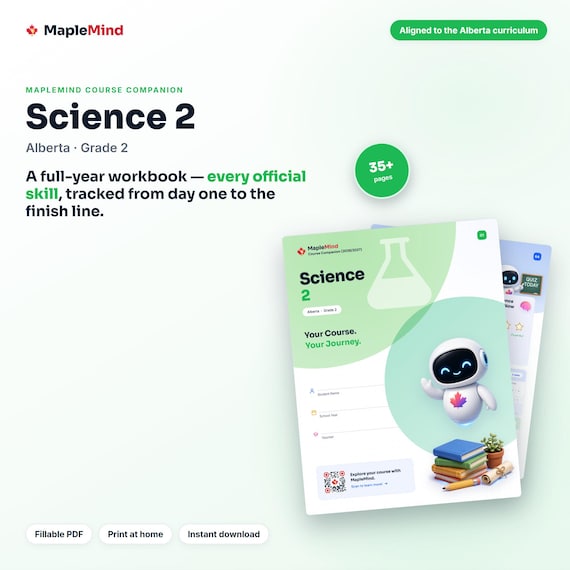
A Science 2 workbook worth keeping
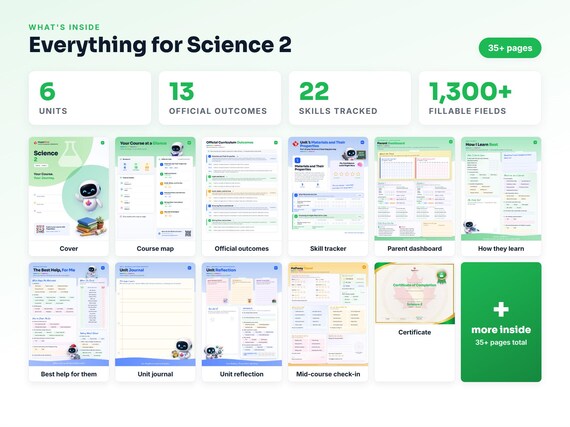
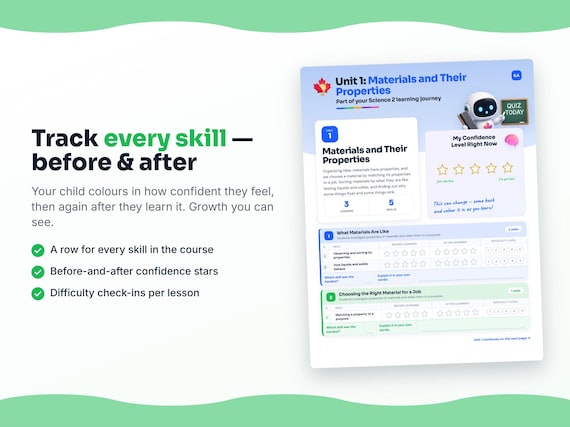
Built from the same official curriculum as this page. Before and after each skill above, your student colours in how sure they feel — so the two of you can see, on one page, what's clicking and what needs another look. It's a quiet way to follow how the year is really going.
By June it's full of their own handwriting: units worked through, confidence grown, a mid-year check-in, notes from parent-teacher night, and a certificate at the end. Less a worksheet, more a record of the year worth keeping on the shelf.
Instant download · see every page, reviews and the full description · five or more workbooks are $2.99 each
What it looks like in the app
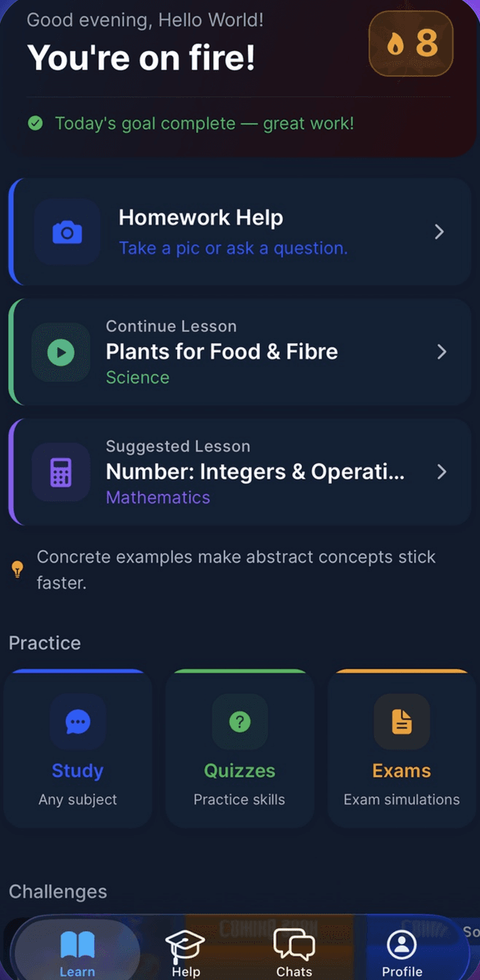
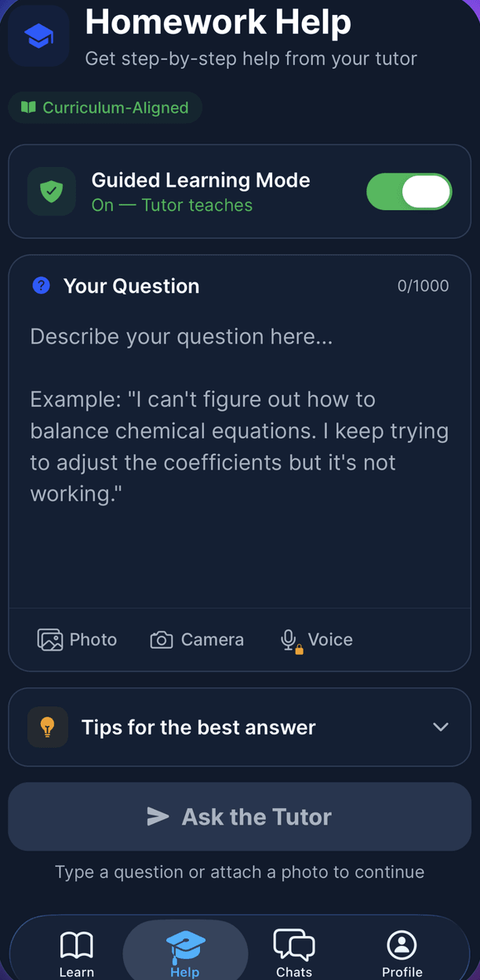
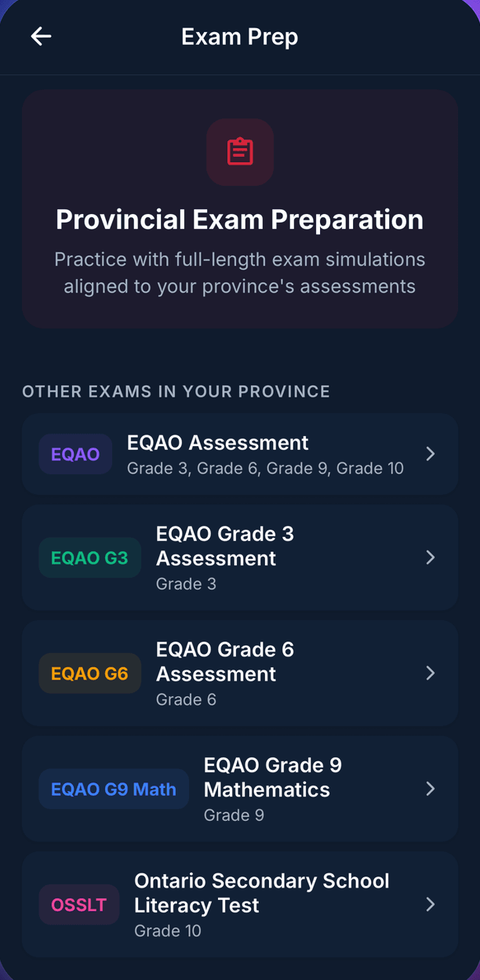
Common questions
Can MapleMind help my child with Science 2?
Yes. MapleMind's AI tutor covers all 22 skills in Alberta's Science 2 — your child picks the exact skill, and the tutor teaches it step by step: a short lesson, a worked example, solving together, then a skill check to show it stuck.
Is MapleMind aligned to Alberta's official curriculum?
Yes. Every skill in this course maps to an official outcome code from Alberta's Grade 2 Science curriculum, and the ministry's own wording is quoted under each unit on this page — with the official government source linked so you can check it yourself.
What does MapleMind cost?
It's free to start — 5 tutoring chats and a practice quiz every day, no credit card. A Pro subscription ($9.99/month or $49.99/year CAD, 7-day free trial) unlocks unlimited tutoring, practice, and exam simulations.
What if my child is stuck on just one topic?
That's the point of skill-level tutoring: open Science 2 in the app, tap the exact skill from the list on this page, and the tutor teaches just that — no wading through lessons your child doesn't need.
Does MapleMind work in French or other languages?
Yes — 14 languages, including French. Both the app and the tutor's explanations switch to the language your child chooses.
Where can I see the official Alberta curriculum for Science 2?
The official source is linked on this page — Alberta's official programs of study. The outline here follows it: every MapleMind skill carries its official outcome code, and the ministry's own wording is quoted under each unit.
Keep exploring
Ready when you are
Pick a skill from this page and see it taught properly — free, in the browser, in under a minute.