Get help with Science 3
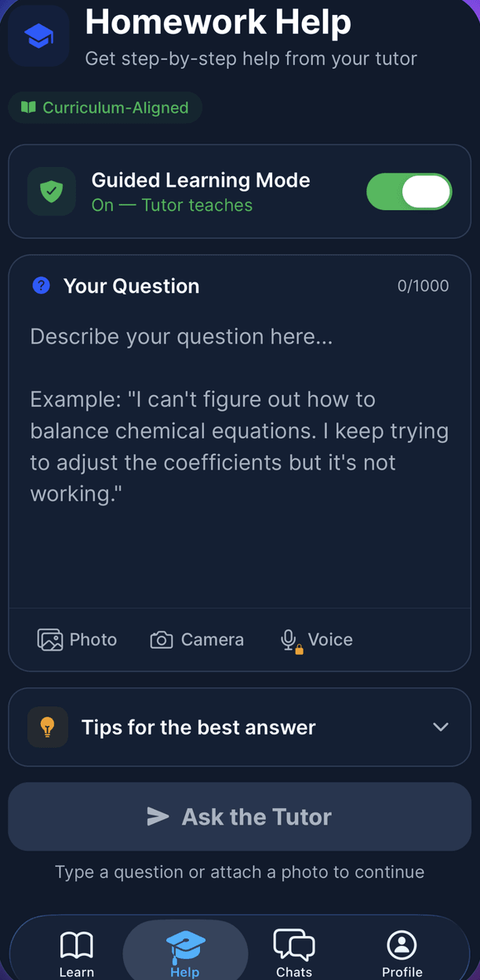
Most tutoring makes your child sit through material your child already knows. MapleMind flips that: pick the exact skill that's causing trouble — any of the 15 below — and the tutor teaches just that one, step by step, as many times as it takes. Ask questions in plain words, any time of day, in English, French, or 12 other languages.
The official Alberta Science 3 curriculum
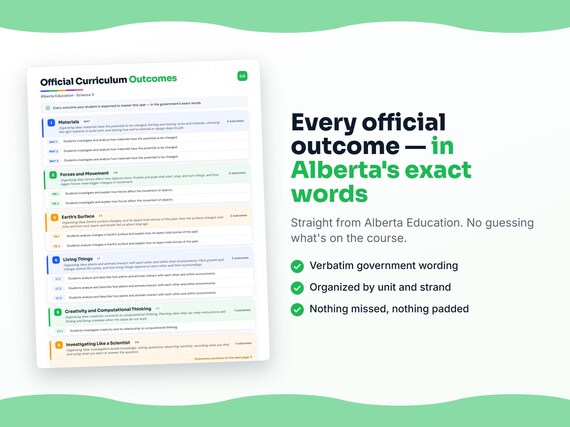
Alberta defines Science 3 by strands and outcomes. MapleMind teaches the same curriculum reorganized for one-skill-at-a-time tutoring — the table shows exactly where every official strand lands, and the ministry's own wording is quoted under each unit below.
Official source Alberta's official programs of studyRead it on the government site — alberta.ca ↗| Official strand | Outcomes | Where MapleMind teaches it |
|---|---|---|
| Materials | 1 | Materials |
| Forces and Movement | 1 | Forces and Movement |
| Earth's Surface | 1 | Earth's Surface |
| Living Things | 1 | Living Things |
| Computational Thinking | 1 | Creativity and Computational Thinking |
| Scientific Methods | 1 | Investigating Like a Scientist |
Every skill below, taught one on one.
 Try the first session free
How MapleMind teaches Science 3 — every unit, lesson, and skill
Every skill below runs as a short session: a plain-words lesson, a worked example, solving it together, then a five-question skill check that earns up to three stars. Guided Mode keeps it teaching instead of answer-handing — turning it off needs a parent's password.
Unit 1MaterialsOfficial strand · Materials
Organizing idea: materials have the potential to be changed. Sorting and testing rocks and minerals, choosing the right material to build with, and testing how well a material or design does its job.
Rocks and Minerals
- Sorting rocks by their properties3.M.1 — Observe and sort rocks and minerals by properties you can test — colour, hardness, shininess, and whether they feel rough or smooth — and describe how they are alike and different.
- How rocks and materials can change3.M.1 — Explore ways a rock or material can be changed — by scratching, wearing down (weathering), heating, or breaking it — and tell what changed and what stayed the same.
Building with the Right Material
- Matching a material to the job3.M.1 — Choose a good material for a building job by testing what each one is like — strong, bendy, waterproof, or see-through — and explain why it fits the job (glass for a window, wood for a frame).
Testing Materials and Designs
- Testing a material or design fairly3.M.1 — Build and test a simple design (a paper bridge, a tower, a boat) to see how well it works, change one thing at a time to make it better, and say what the test showed.
The official wording — 1 outcome in this unit
- 3.M.1
Students investigate and analyze how materials have the potential to be changed.
Unit 2Forces and MovementOfficial strand · Forces and Movement
Organizing idea: forces affect how objects move. Pushes and pulls that start, stop, and turn things, and how bigger forces make bigger changes in movement.
Pushes and Pulls
- Forces start, stop, and turn things3.E.1 — Investigate how a push or a pull is a force that can start an object moving, stop it, speed it up, slow it down, or make it change direction.
Bigger Force, Bigger Move
- How the size of a force changes the movement3.E.1 — Test and explain how a bigger push or pull makes an object move farther or faster, and how the same object is harder to move when it is heavier.
The official wording — 1 outcome in this unit
- 3.E.1
Students investigate and explain how forces affect the movement of objects.
Unit 3Earth's SurfaceOfficial strand · Earth's Surface
Organizing idea: Earth's surface changes, and its layers hold stories of the past. How the surface changes over time and how rock layers and fossils tell us about long ago.
Earth's Changing Surface
- How Earth's surface changes3.ES.1 — Observe and describe how water, wind, and ice slowly wear away and reshape Earth's surface, building up rock, sand, and soil in new places over a very long time.
Layers and Fossils
- Layers hold stories of the past3.ES.1 — Explain how rock builds up in layers, with older layers usually near the bottom, and how fossils in those layers give us clues about plants and animals from long ago.
The official wording — 1 outcome in this unit
- 3.ES.1
Students analyze changes in Earth’s surface and explain how its layers hold stories of the past.
Unit 4Living ThingsOfficial strand · Living Things
Organizing idea: plants and animals interact with each other and within their environments. Plant growth and change, animal life cycles, and how living things depend on each other and their surroundings.
Plant Growth and Changes
- What plants need to grow and change3.LS.1 — Investigate what a plant needs to grow — light, water, air, and space — and describe how a plant changes as it grows from a seed into a full plant with roots, stem, leaves, and flowers.
Animal Life Cycles
- Stages of an animal life cycle3.LS.1 — Describe the life cycle of an animal such as a butterfly or a frog, ordering the stages from egg to adult and comparing how different animals change as they grow.
Living Things Depend on Each Other
- How plants, animals, and places connect3.LS.1 — Describe how plants and animals interact — animals eat plants, spread seeds, and shelter in them — and how each living thing depends on its environment for food, water, and a home.
The official wording — 1 outcome in this unit
- 3.LS.1
Students analyze and describe how plants and animals interact with each other and within environments.
Unit 5Creativity and Computational ThinkingOfficial strand · Computational Thinking
Organizing idea: creativity connects to computational thinking. Planning clear step-by-step instructions and finding and fixing mistakes when the steps do not work.
Step-by-Step Instructions
- Planning clear step-by-step instructions3.CS.1 — Break a task into clear, ordered steps (an algorithm) — like directions to draw a shape or move a friend across the room — and test whether following the steps exactly reaches the goal.
- Finding and fixing mistakes in the steps3.CS.1 — Spot the step that went wrong when instructions do not work (debugging), then fix or reorder the steps, using creativity to find a better way to reach the goal.
The official wording — 1 outcome in this unit
- 3.CS.1
Students investigate creativity and its relationship to computational thinking.
Unit 6Investigating Like a ScientistOfficial strand · Scientific Methods
Organizing idea: investigation builds knowledge. Asking questions, observing carefully, recording what you find, and using what you learn to answer the question.
Ask, Observe, Record
- Asking a question and observing carefully3.SM.1 — Turn a wonder into a testable question, then observe carefully — using your senses and simple tools — and record what you notice with words, tallies, or pictures.
- Using findings to build what you know3.SM.1 — Look back at what you recorded to answer your question, decide what you learned, and explain how doing the investigation added to what you know.
The official wording — 1 outcome in this unit
- 3.SM.1
Students relate investigation to building knowledge.
Printable workbook · A keepsake of the year
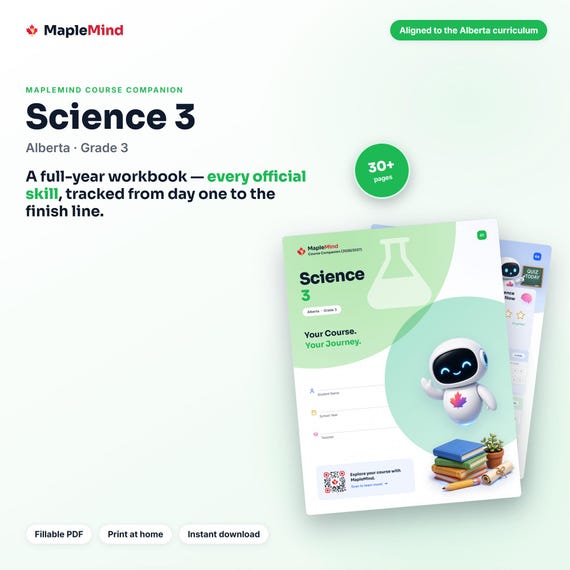
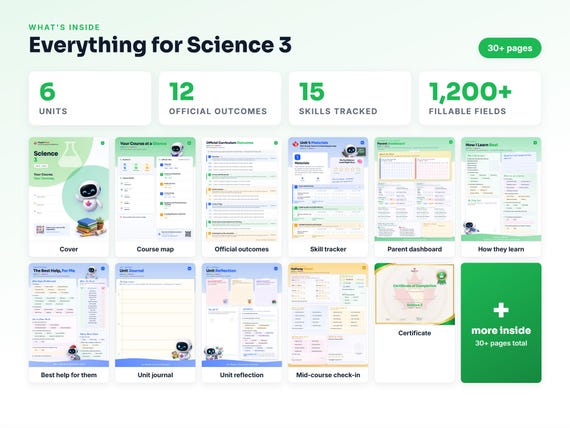
A Science 3 workbook worth keeping
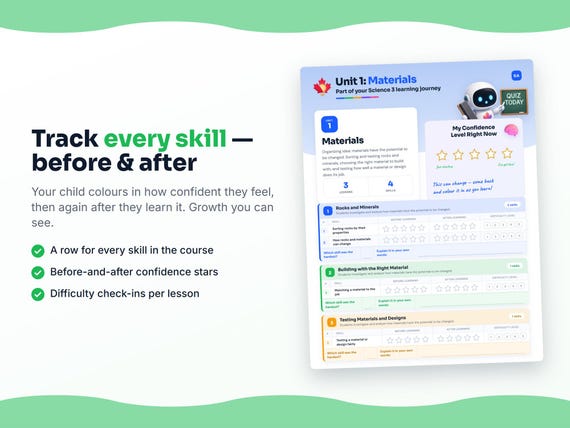
Built from the same official curriculum as this page. Before and after each skill above, your student colours in how sure they feel — so the two of you can see, on one page, what's clicking and what needs another look. It's a quiet way to follow how the year is really going.
By June it's full of their own handwriting: units worked through, confidence grown, a mid-year check-in, notes from parent-teacher night, and a certificate at the end. Less a worksheet, more a record of the year worth keeping on the shelf.
Instant download · see every page, reviews and the full description · five or more workbooks are $2.99 each
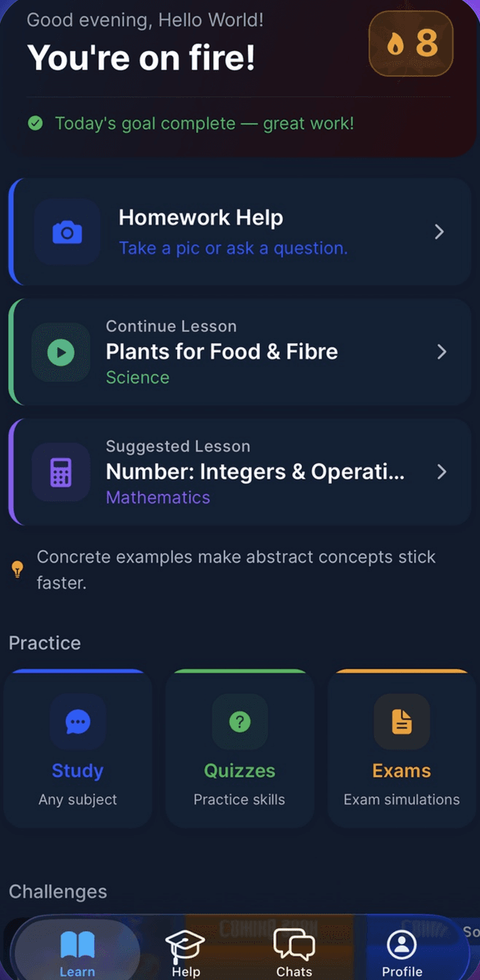
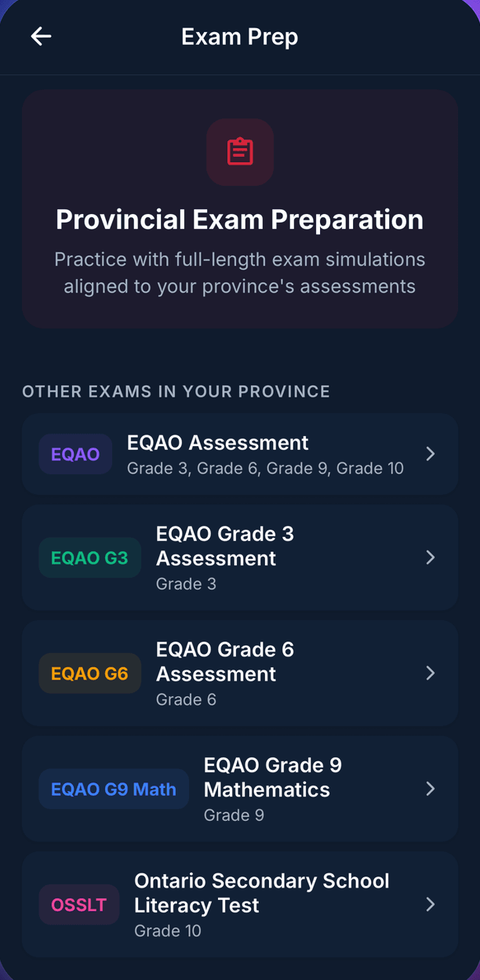
What it looks like in the app
Common questions
Can MapleMind help my child with Science 3?
Yes. MapleMind's AI tutor covers all 15 skills in Alberta's Science 3 — your child picks the exact skill, and the tutor teaches it step by step: a short lesson, a worked example, solving together, then a skill check to show it stuck.
Is MapleMind aligned to Alberta's official curriculum?
Yes. Every skill in this course maps to an official outcome code from Alberta's Grade 3 Science curriculum, and the ministry's own wording is quoted under each unit on this page — with the official government source linked so you can check it yourself.
What does MapleMind cost?
It's free to start — 5 tutoring chats and a practice quiz every day, no credit card. A Pro subscription ($9.99/month or $49.99/year CAD, 7-day free trial) unlocks unlimited tutoring, practice, and exam simulations.
What if my child is stuck on just one topic?
That's the point of skill-level tutoring: open Science 3 in the app, tap the exact skill from the list on this page, and the tutor teaches just that — no wading through lessons your child doesn't need.
Does MapleMind work in French or other languages?
Yes — 14 languages, including French. Both the app and the tutor's explanations switch to the language your child chooses.
Where can I see the official Alberta curriculum for Science 3?
The official source is linked on this page — Alberta's official programs of study. The outline here follows it: every MapleMind skill carries its official outcome code, and the ministry's own wording is quoted under each unit.
Keep exploring
Ready when you are
Pick a skill from this page and see it taught properly — free, in the browser, in under a minute.