Get help with Science 4
Most tutoring makes your child sit through material your child already knows. MapleMind flips that: pick the exact skill that's causing trouble — any of the 17 below — and the tutor teaches just that one, step by step, as many times as it takes. Ask questions in plain words, any time of day, in English, French, or 12 other languages.
The official Alberta Science 4 curriculum
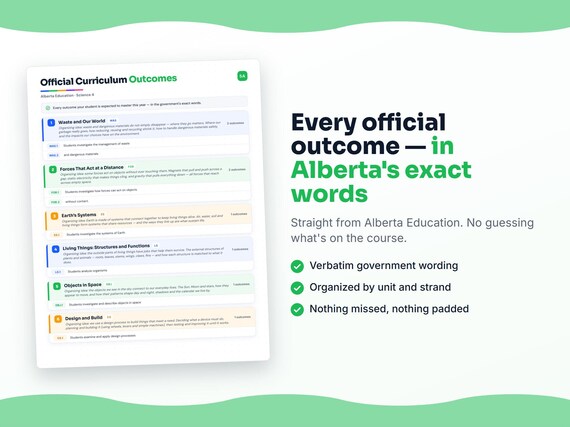
Alberta defines Science 4 by strands and outcomes. MapleMind teaches the same curriculum reorganized for one-skill-at-a-time tutoring — the table shows exactly where every official strand lands, and the ministry's own wording is quoted under each unit below.
Official source Alberta's official programs of studyRead it on the government site — alberta.ca ↗| Official strand | Outcomes | Where MapleMind teaches it |
|---|---|---|
| Matter | 1 | Waste and Our World |
| Energy | 1 | Forces That Act at a Distance |
| Earth Systems | 1 | Earth’s Systems |
| Living Systems | 1 | Living Things: Structures and Functions |
| Space | 1 | Objects in Space |
| Computer Science | 1 | Design and Build |
| Scientific Methods | 1 | Evidence in Science |
Every skill below, taught one on one.
 Try the first session free
How MapleMind teaches Science 4 — every unit, lesson, and skill
Every skill below runs as a short session: a plain-words lesson, a worked example, solving it together, then a five-question skill check that earns up to three stars. Guided Mode keeps it teaching instead of answer-handing — turning it off needs a parent's password.
Unit 1Waste and Our WorldOfficial strand · Matter
Organizing idea: waste and dangerous materials do not simply disappear — where they go matters. Where our garbage really goes, how reducing, reusing and recycling shrink it, how to handle dangerous materials safely, and the impacts our choices have on the environment.
Where Our Waste Really Goes
- Tracking waste after the bin4.M.1 — Follow what happens to waste after it leaves the bin — landfills, recycling and composting — and see that throwing something "away" just moves it somewhere else.
- Reduce, reuse and recycle4.M.1 — Sort everyday items into reduce, reuse, recycle and compost, and explain how each choice makes less waste to manage.
Dangerous Materials and Their Impacts
- Handling dangerous materials safely4.M.1 — Recognize dangerous materials at home (batteries, cleaners, paint) by their warning symbols and describe why they need special disposal, not the regular garbage.
- Impacts on the environment4.M.1 — Describe how waste and dangerous materials can harm land, water and living things, and how good management reduces that harm.
The official wording — 1 outcome in this unit
- 4.M.1
Students investigate the management of waste
Unit 2Forces That Act at a DistanceOfficial strand · Energy
Organizing idea: some forces act on objects without ever touching them. Magnets that pull and push across a gap, static electricity that makes things cling, and gravity that pulls everything down — all forces that reach across empty space.
Magnets and Static Electricity
- Magnets pulling across a gap4.E.1 — Investigate how a magnet attracts or repels certain objects across a gap, and test what materials block or let the force through.
- Static electricity4.E.1 — Observe how a charged object (a rubbed balloon or comb) pulls hair or paper toward it without touching, showing another force that acts at a distance.
Gravity and Non-Contact Forces
- Gravity pulls without touching4.E.1 — Explain that gravity pulls objects toward the ground even though nothing is touching them, and connect it to why dropped things always fall down.
The official wording — 1 outcome in this unit
- 4.E.1
Students investigate how forces can act on objects
Unit 3Earth’s SystemsOfficial strand · Earth Systems
Organizing idea: Earth is made of systems that connect together to keep living things alive. Air, water, soil and living things form systems that share resources — and the ways they link up are what sustain life.
The Systems That Make Earth Work
- Air, water, soil and living things4.ES.1 — Identify Earth’s main systems — air, water, land/soil and living things — and give examples of what each one provides.
- How the systems connect to sustain life4.ES.1 — Trace how the systems connect (the water cycle, plants making air, soil feeding plants) and reflect on how those interconnections keep living things alive.
The official wording — 1 outcome in this unit
- 4.ES.1
Students investigate the systems of Earth
Unit 4Living Things: Structures and FunctionsOfficial strand · Living Systems
Organizing idea: the outside parts of living things have jobs that help them survive. The external structures of plants and animals — roots, leaves, stems, wings, claws, fins — and how each structure is matched to what it does.
Outside Parts and Their Jobs
- Observing external structures4.LS.1 — Observe and name the external structures of plants and animals (roots, leaves, stems; wings, claws, fins, beaks) as the parts you can see from the outside.
- Matching a structure to its job4.LS.1 — Relate each external structure to its function — roots soak up water, wings lift a bird, claws grip and dig — and explain how the part helps the organism survive.
The official wording — 1 outcome in this unit
- 4.LS.1
Students analyze organisms
Unit 5Objects in SpaceOfficial strand · Space
Organizing idea: the objects we see in the sky connect to our everyday lives. The Sun, Moon and stars, how they appear to move, and how their patterns shape day and night, shadows and the calendar we live by.
The Sun, Moon and Stars
- Objects we see in the sky4.SP.1 — Observe and describe objects in space — the Sun, the Moon and stars — including how they look and how they appear to move across the sky.
- How space connects to our day4.SP.1 — Connect objects in space to daily life — the Sun making day and shadows, the Moon’s changing shape, and how these patterns mark time.
The official wording — 1 outcome in this unit
- 4.SP.1
Students investigate and describe objects in space
Unit 6Design and BuildOfficial strand · Computer Science
Organizing idea: we use a design process to build things that meet a need. Deciding what a device must do, planning and building it (using wheels, levers and simple machines), then testing and improving it until it works.
Designing to Meet a Need
- Finding a need and planning a design4.CS.1 — Identify a real need a device could solve and plan a design for it — sketching the idea and choosing parts like wheels and levers before building.
- Build, test and improve to meet the need4.CS.1 — Build a working device, test whether it meets the need, and improve the design based on what the test shows.
The official wording — 1 outcome in this unit
- 4.CS.1
Students examine and apply design processes
Unit 7Evidence in ScienceOfficial strand · Scientific Methods
Organizing idea: science relies on evidence — what we can observe and measure. Gathering evidence carefully, telling evidence apart from a guess, and reflecting on why evidence is what lets us decide if an idea is right.
Gathering and Using Evidence
- Collecting evidence by observing4.SM.1 — Investigate a question by collecting evidence — observing carefully, measuring, and recording what actually happens rather than what you expect.
- Why evidence matters in science4.SM.1 — Reflect on the role of evidence: it is how scientists tell a good idea from a wrong one, and why "because I think so" is not evidence.
The official wording — 1 outcome in this unit
- 4.SM.1
Students investigate evidence
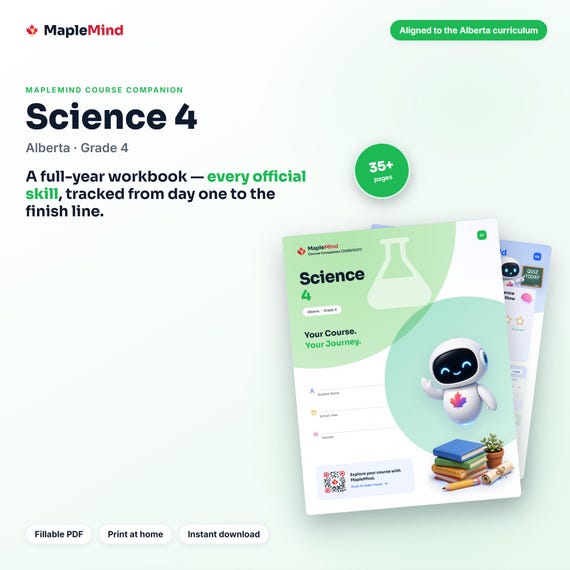
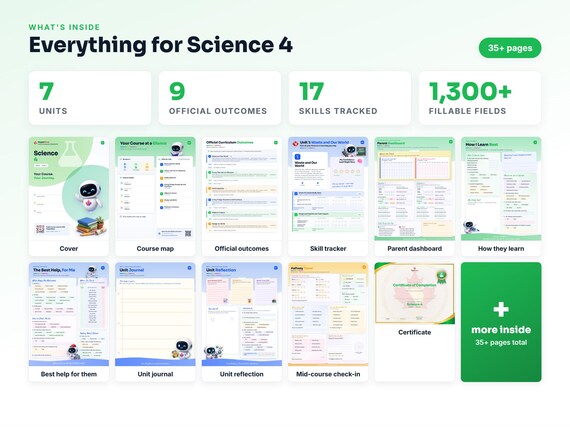
Printable workbook · A keepsake of the year
A Science 4 workbook worth keeping
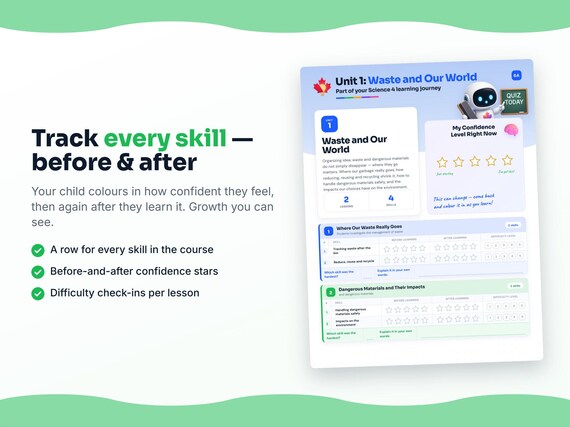
Built from the same official curriculum as this page. Before and after each skill above, your student colours in how sure they feel — so the two of you can see, on one page, what's clicking and what needs another look. It's a quiet way to follow how the year is really going.
By June it's full of their own handwriting: units worked through, confidence grown, a mid-year check-in, notes from parent-teacher night, and a certificate at the end. Less a worksheet, more a record of the year worth keeping on the shelf.
Instant download · see every page, reviews and the full description · five or more workbooks are $2.99 each
What it looks like in the app



Common questions
Can MapleMind help my child with Science 4?
Yes. MapleMind's AI tutor covers all 17 skills in Alberta's Science 4 — your child picks the exact skill, and the tutor teaches it step by step: a short lesson, a worked example, solving together, then a skill check to show it stuck.
Is MapleMind aligned to Alberta's official curriculum?
Yes. Every skill in this course maps to an official outcome code from Alberta's Grade 4 Science curriculum, and the ministry's own wording is quoted under each unit on this page — with the official government source linked so you can check it yourself.
What does MapleMind cost?
It's free to start — 5 tutoring chats and a practice quiz every day, no credit card. A Pro subscription ($9.99/month or $49.99/year CAD, 7-day free trial) unlocks unlimited tutoring, practice, and exam simulations.
What if my child is stuck on just one topic?
That's the point of skill-level tutoring: open Science 4 in the app, tap the exact skill from the list on this page, and the tutor teaches just that — no wading through lessons your child doesn't need.
Does MapleMind work in French or other languages?
Yes — 14 languages, including French. Both the app and the tutor's explanations switch to the language your child chooses.
Where can I see the official Alberta curriculum for Science 4?
The official source is linked on this page — Alberta's official programs of study. The outline here follows it: every MapleMind skill carries its official outcome code, and the ministry's own wording is quoted under each unit.
Keep exploring
Ready when you are
Pick a skill from this page and see it taught properly — free, in the browser, in under a minute.