Get help with Science 5
Most tutoring makes your child sit through material your child already knows. MapleMind flips that: pick the exact skill that's causing trouble — any of the 16 below — and the tutor teaches just that one, step by step, as many times as it takes. Ask questions in plain words, any time of day, in English, French, or 12 other languages.
The official Alberta Science 5 curriculum
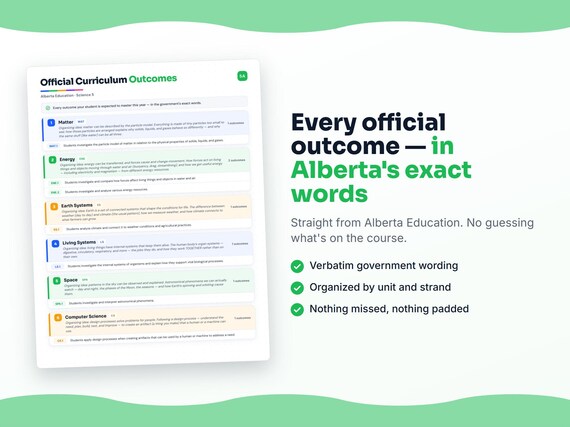
Alberta defines Science 5 by strands and outcomes. MapleMind teaches the same curriculum reorganized for one-skill-at-a-time tutoring — the table shows exactly where every official strand lands, and the ministry's own wording is quoted under each unit below.
Official source Alberta's official programs of studyRead it on the government site — alberta.ca ↗| Official strand | Outcomes | Where MapleMind teaches it |
|---|---|---|
| Matter | 1 | Matter |
| Energy | 2 | Energy |
| Earth Systems | 1 | Earth Systems |
| Living Systems | 1 | Living Systems |
| Space | 1 | Space |
| Computer Science | 1 | Computer Science |
| Scientific Methods | 1 | Scientific Methods |
Every skill below, taught one on one.
 Try the first session free
How MapleMind teaches Science 5 — every unit, lesson, and skill
Every skill below runs as a short session: a plain-words lesson, a worked example, solving it together, then a five-question skill check that earns up to three stars. Guided Mode keeps it teaching instead of answer-handing — turning it off needs a parent's password.
Unit 1MatterOfficial strand · Matter
Organizing idea: matter can be described by the particle model. Everything is made of tiny particles too small to see; how those particles are arranged explains why solids, liquids, and gases behave so differently — and why the same stuff (like water) can be all three.
The Particle Model of Matter
- Everything is made of tiny particles5.M.1 — Understand the particle model: all matter is made of extremely tiny particles, always moving, with empty space between them — even though matter looks solid and continuous.
- Particles in solids, liquids, and gases5.M.1 — Explain the physical properties of solids, liquids, and gases by how their particles are arranged and how freely they move — packed and locked (solid), close but sliding (liquid), or far apart and free (gas).
The official wording — 1 outcome in this unit
- 5.M.1
Students investigate the particle model of matter in relation to the physical properties of solids, liquids, and gases.
Unit 2EnergyOfficial strand · Energy
Organizing idea: energy can be transferred, and forces cause and change movement. How forces act on living things and objects moving through water and air (buoyancy, drag, streamlining), and how we get useful energy — including electricity and magnetism — from different energy resources.
Forces in Water and Air
- Floating, sinking, and buoyancy5.E.1 — Investigate how forces in water affect living things and objects — why some things float and others sink, and how shape and material change what happens.
- Moving through air: drag and streamlining5.E.1 — Compare how forces in air push against moving objects and living things, and how a streamlined shape lets fish, birds, and vehicles move more easily.
Energy Resources, Electricity, and Magnetism
- Where our energy comes from5.E.2 — Investigate and analyze various energy resources — renewable ones like sun, wind, and moving water, and non-renewable ones like coal, oil, and gas — and where the energy for daily life comes from.
- Electricity, magnetism, and simple mechanisms5.E.2 — Build and describe simple electric circuits and explore how electricity and magnetism power mechanisms (a motor, a buzzer, an electromagnet), tracing how one form of energy turns into another.
The official wording — 2 outcomes in this unit
- 5.E.1
Students investigate and compare how forces affect living things and objects in water and air.
- 5.E.2
Students investigate and analyze various energy resources.
Unit 3Earth SystemsOfficial strand · Earth Systems
Organizing idea: Earth is a set of connected systems that shape the conditions for life. The difference between weather (day to day) and climate (the usual pattern), how we measure weather, and how climate connects to what farmers can grow.
Climate, Weather, and Farming
- Weather watch: weather vs. climate5.ES.1 — Analyze climate and connect it to weather conditions — measuring temperature, wind, and precipitation day to day (weather), and describing the long-run pattern of a place (climate).
- Climate and what we can grow5.ES.1 — Connect a region’s climate to its agricultural practices — how growing season, rainfall, and temperature decide which crops farmers can plant and when.
The official wording — 1 outcome in this unit
- 5.ES.1
Students analyze climate and connect it to weather conditions and agricultural practices.
Unit 4Living SystemsOfficial strand · Living Systems
Organizing idea: living things have internal systems that keep them alive. The human body’s organ systems — digestive, circulatory, respiratory, and more — the jobs they do, and how they work TOGETHER rather than on their own.
The Body’s Organ Systems
- Organ systems and the jobs they do5.LS.1 — Investigate the internal systems of organisms and explain how each supports a vital biological process — digestion breaks down food, the circulatory system carries blood, the respiratory system takes in air.
- Systems that work together5.LS.1 — Explain how the internal systems depend on one another to support vital biological processes — the lungs take in oxygen, the blood carries it, and the whole body is kept running by systems cooperating.
The official wording — 1 outcome in this unit
- 5.LS.1
Students investigate the internal systems of organisms and explain how they support vital biological processes.
Unit 5SpaceOfficial strand · Space
Organizing idea: patterns in the sky can be observed and explained. Astronomical phenomena we can actually watch — day and night, the phases of the Moon, the seasons — and how Earth’s spinning and orbiting cause them.
Patterns in the Sky
- Day, night, and the seasons5.SP.1 — Investigate and interpret astronomical phenomena — how Earth spinning on its axis makes day and night, and how Earth’s tilt and orbit around the Sun make the seasons.
- The phases of the Moon5.SP.1 — Interpret the repeating pattern of Moon phases as the changing amount of the sunlit Moon we can see as the Moon orbits Earth.
The official wording — 1 outcome in this unit
- 5.SP.1
Students investigate and interpret astronomical phenomena.
Unit 6Computer ScienceOfficial strand · Computer Science
Organizing idea: design processes solve problems for people. Following a design process — understand the need, plan, build, test, and improve — to create an artifact (a thing you make) that a human or a machine can use.
Designing to Meet a Need
- Following a design process5.CS.1 — Apply design processes when creating artifacts — start from a real need, plan a solution, build it, test how well it works, and improve it.
- Artifacts a human or machine can use5.CS.1 — Create an artifact that can be used by a human or machine to address a need, and explain who uses it and how it meets the need.
The official wording — 1 outcome in this unit
- 5.CS.1
Students apply design processes when creating artifacts that can be used by a human or machine to address a need.
Unit 7Scientific MethodsOfficial strand · Scientific Methods
Organizing idea: science builds knowledge from evidence, gathered fairly. How scientists collect evidence through careful, repeatable investigations — and why ethics (honesty, fairness, and care) matters in every step of doing science.
Gathering Evidence, Doing It Right
- How evidence is gathered5.SM.1 — Investigate how evidence is gathered — making careful observations and measurements, keeping a fair test, and repeating it so the results can be trusted.
- Why ethics matters in science5.SM.1 — Explain the importance of ethics in science — recording results honestly, treating living things with care, giving credit, and never changing data to get the answer you wanted.
The official wording — 1 outcome in this unit
- 5.SM.1
Students investigate how evidence is gathered and explain the importance of ethics in science.
Printable workbook · A keepsake of the year
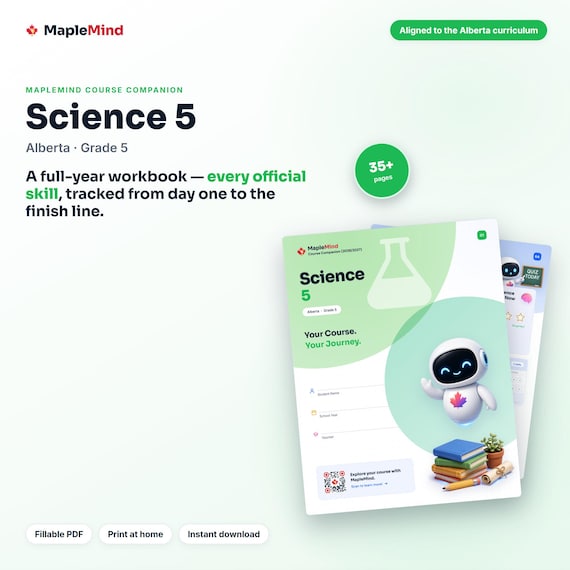
A Science 5 workbook worth keeping
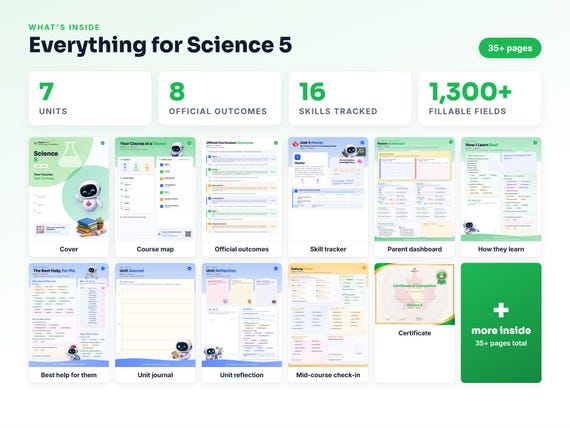
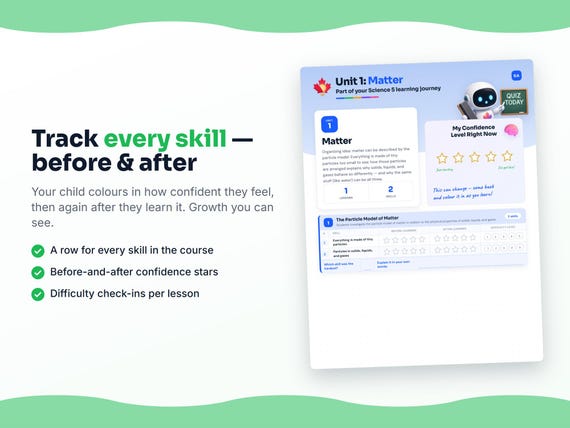
Built from the same official curriculum as this page. Before and after each skill above, your student colours in how sure they feel — so the two of you can see, on one page, what's clicking and what needs another look. It's a quiet way to follow how the year is really going.
By June it's full of their own handwriting: units worked through, confidence grown, a mid-year check-in, notes from parent-teacher night, and a certificate at the end. Less a worksheet, more a record of the year worth keeping on the shelf.
Instant download · see every page, reviews and the full description · five or more workbooks are $2.99 each
What it looks like in the app



Common questions
Can MapleMind help my child with Science 5?
Yes. MapleMind's AI tutor covers all 16 skills in Alberta's Science 5 — your child picks the exact skill, and the tutor teaches it step by step: a short lesson, a worked example, solving together, then a skill check to show it stuck.
Is MapleMind aligned to Alberta's official curriculum?
Yes. Every skill in this course maps to an official outcome code from Alberta's Grade 5 Science curriculum, and the ministry's own wording is quoted under each unit on this page — with the official government source linked so you can check it yourself.
What does MapleMind cost?
It's free to start — 5 tutoring chats and a practice quiz every day, no credit card. A Pro subscription ($9.99/month or $49.99/year CAD, 7-day free trial) unlocks unlimited tutoring, practice, and exam simulations.
What if my child is stuck on just one topic?
That's the point of skill-level tutoring: open Science 5 in the app, tap the exact skill from the list on this page, and the tutor teaches just that — no wading through lessons your child doesn't need.
Does MapleMind work in French or other languages?
Yes — 14 languages, including French. Both the app and the tutor's explanations switch to the language your child chooses.
Where can I see the official Alberta curriculum for Science 5?
The official source is linked on this page — Alberta's official programs of study. The outline here follows it: every MapleMind skill carries its official outcome code, and the ministry's own wording is quoted under each unit.
Keep exploring
Ready when you are
Pick a skill from this page and see it taught properly — free, in the browser, in under a minute.