Get help with Core French 5
Most tutoring makes your child sit through material your child already knows. MapleMind flips that: pick the exact skill that's causing trouble — any of the 22 below — and the tutor teaches just that one, step by step, as many times as it takes. Ask questions in plain words, any time of day, in English, French, or 12 other languages.
The official Alberta Core French 5 curriculum
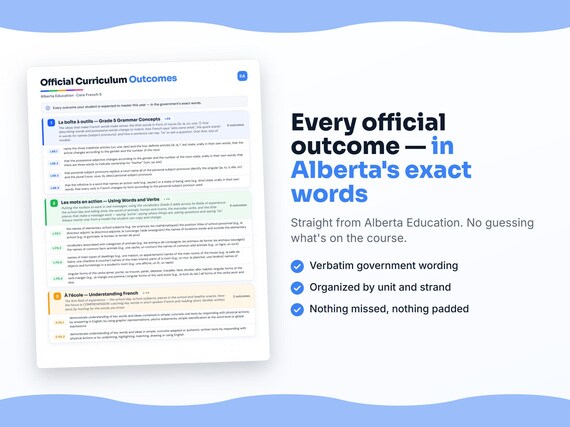
Alberta defines Core French 5 by strands and outcomes. MapleMind teaches the same curriculum reorganized for one-skill-at-a-time tutoring — the table shows exactly where every official strand lands, and the ministry's own wording is quoted under each unit below.
Official source Alberta's official programs of studyRead it on the government site — alberta.ca ↗| Official strand | Outcomes | Where MapleMind teaches it |
|---|---|---|
| Language | 1 | La boîte à outils — Grade 5 Grammar Concepts |
| Language · Fields: School day; Animals; Dwellings | 1 | Les mots en action — Using Words and Verbs |
| Communication · Field: School day, subjects and places | 2 | À l'école — Understanding French |
| Communication · Fields: Animals; Dwellings and rooms | 2 | Les animaux et la maison — Producing French |
| Culture | 1 | La culture francophone — Notice the French around you |
Every skill below, taught one on one.
 Try the first session free
How MapleMind teaches Core French 5 — every unit, lesson, and skill
Every skill below runs as a short session: a plain-words lesson, a worked example, solving it together, then a five-question skill check that earns up to three stars. Guided Mode keeps it teaching instead of answer-handing — turning it off needs a parent's password.
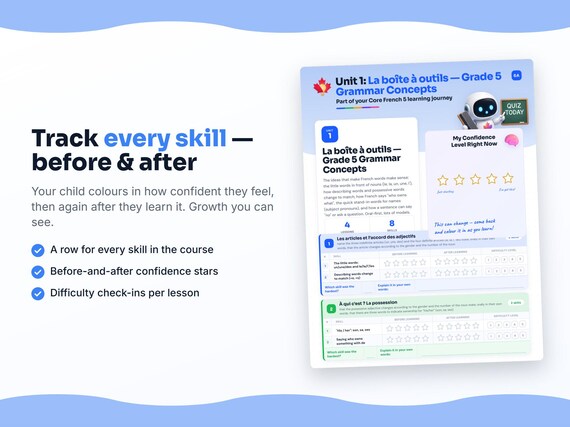
Unit 1La boîte à outils — Grade 5 Grammar ConceptsOfficial strand · Language
The ideas that make French words make sense: the little words in front of nouns (le, la, un, une, l'), how describing words and possessive words change to match, how French says "who owns what", the quick stand-in words for names (subject pronouns), and how a sentence can say "no" or ask a question. Oral-first, lots of models.
Les articles et l'accord des adjectifs
- The little words: un/une/des and le/la/l'/les5.L.1 — Name the three indefinite articles (un, une, des) and the four definite articles (le, la, l', les), and understand that the article changes according to the gender and the number of the noun, and that l' is used with nouns beginning with a vowel.
- Describing words change to match (+e, +s)5.L.1 — Understand that the form of an adjective may change according to the gender and number of the noun described — adding an "e" makes most masculine adjectives feminine (grand → grande), and adding an "s" makes most singular adjectives plural (petit → petits).
À qui c'est ? La possession
- "His / her": son, sa, ses5.L.1 — Understand that the possessive adjective changes according to the gender and number of the noun, and that there are three words to indicate ownership for "his/her" — son, sa, ses — chosen to match the thing owned, not the owner.
- Saying who owns something with de5.L.1 — Understand that the preposition de can be used to indicate possession — C'est le crayon de John (It's John's pencil) — a simple way to say who something belongs to.
Les pronoms personnels
- The quick stand-in words: je, tu, il… nous, vous, ils5.L.1 — Understand that personal subject pronouns replace a noun; name all of them; and sort the singular (je, tu, il, elle, on) from the plural (nous, vous, ils, elles).
- Picking il / elle / ils / elles — and vous for grown-ups5.L.1 — Choose the right pronoun to replace a name or noun — a masculine one → il, a feminine one → elle, two or more → ils or elles (any masculine in the group → ils) — and understand that the vous form is used when addressing an adult or two or more people.
Les verbes, les questions et la négation
- What an infinitive is, and how verbs change5.L.1 — Understand that the infinitive is the word that names a verb — an action verb (sauter = to jump) or a state-of-being verb (être = to be) — and that every verb in French changes its form according to the personal subject pronoun used.
- Questions, commands and saying "no"5.L.1 — Identify the words used to formulate a question (qui, quand, comment…) and how to formulate a question using them; tell a command from a statement; and tell an affirmative sentence apart from a negative one.
The official wording — 1 outcome in this unit
- 5.L.1
name the three indefinite articles (un, une, des) and the four definite articles (le, la, l’, les) state, orally in their own words, that the article changes according to the gender and the number of the noun
Unit 2Les mots en action — Using Words and VerbsOfficial strand · Language · Fields: School day; Animals; Dwellings
Putting the toolbox to work in real messages, using the vocabulary Grade 5 adds across its fields of experience: the school day and telling time, the world of animals, homes and rooms, the everyday verbs, and the little pieces that make a message work — saying "some", saying where things are, asking questions and saying "no". Always mainly oral, from a model the student can copy and change.
À l'école : les matières et l'heure
- School subjects, people and places5.L.2 — Use, mainly orally, the names of elementary school subjects (les sciences, les mathématiques), the position titles of school personnel (le directeur adjoint, le concierge) and the names of locations in and around the school (le gymnase, le bureau, le terrain de jeux).
- Telling time and parts of the day5.L.2 — Use vocabulary for time of day (matin, après-midi, soir, pendant la récréation) and for telling time on the 12-hour clock (Il est huit heures trente = It is eight thirty).
Le monde des animaux
- Kinds of animals: farm, wild and pets5.L.2 — Use vocabulary for categories of animals (les animaux de compagnie, les animaux de ferme, les animaux sauvages) and the names of common farm and wild animals (une vache = a cow, un cochon = a pig, un tigre = a tiger, un ours = a bear).
- Describing animals: bodies, size, colour, habitat5.L.2 — Use vocabulary for animal anatomy (le bec = the beak, la queue = the tail, les pattes = the paws/legs), adjectives for size and colour (gros, petit, roux) and the names of common wild-animal habitats (la forêt, la prairie, les montagnes, le désert).
La maison et ma chambre
- Homes, rooms and what's in a room5.L.2 — Use the names of main types of dwellings (une maison, un appartement), the main rooms of the house (la salle de bains, une chambre à coucher), the parts of a room (un mur = a wall, une fenêtre = a window) and the furnishings in a student's room (une affiche, un lit, un tapis).
- Saying where things are and whose they are5.L.2 — Use the possessive adjectives son, sa, ses and de + noun to say who owns something (C'est la chambre de Kristi), plus prepositional phrases of location to say where something is (Le salon est à côté de la cuisine = The living room is next to the kitchen).
Les verbes du quotidien et les questions
- Everyday verbs and eating/drinking5.L.2 — Use the singular forms of common verbs (aimer, porter, parler, travailler, aller, habiter), of manger (Je mange une pomme = I eat an apple) and boire (Je bois du lait = I drink some milk), and all the forms of avoir and être.
- Asking questions and saying "no" in a message5.L.2 — Use common question words in real messages (Combien de…? Qu'est-ce que…? Où se trouve…? Quelle heure est-il?) and the negative structure ne… pas to say what you don't do or don't have.
The official wording — 1 outcome in this unit
- 5.L.2
the names of elementary school subjects (e.g., les sciences, les mathématiques) the position titles of school personnel (e.g., le directeur adjoint, la directrice adjointe, le concierge, l’aide enseignant) the names of locations inside and outside the elementary school (e.g., le gymnase, le bureau, le terrain de jeux)
Unit 3À l'école — Understanding FrenchOfficial strand · Communication · Field: School day, subjects and places
The first field of experience — the school day, school subjects, places in the school and healthy snacks. Here the focus is COMPREHENSION: catching key words in short spoken French and reading short, familiar written texts by hunting for the words you know.
J'écoute — Listening for key words
- Listening for key words and ideas5.C.1 — Show understanding of key words and ideas in short, simple spoken French — by responding with physical actions, answering in English, a yes/no statement, or simple identification at the word level.
Je lis — Reading short texts
- Reading short familiar texts5.C.2 — Show understanding of key words and ideas in short, simple written French (a note, a label, a timetable) by underlining, highlighting, matching, drawing, or answering in English.
The official wording — 2 outcomes in this unit
- 5.C.1
demonstrate understanding of key words and ideas contained in simple, concrete oral texts by responding with physical actions; by answering in English; by using graphic representations, yes/no statements, simple identification at the word level or global expressions
- 5.C.2
demonstrate understanding of key words and ideas in simple, concrete adapted or authentic written texts by responding with physical actions or by underlining, highlighting, matching, drawing or using English
Unit 4Les animaux et la maison — Producing FrenchOfficial strand · Communication · Fields: Animals; Dwellings and rooms
Two more fields of experience — animals (farm, wild, pets, their bodies and homes) and dwellings (types of homes, rooms, furniture). Now the focus is PRODUCTION: saying short messages out loud and writing short messages, always from a model the student can copy and change.
Je parle — Saying short messages
- Expressing simple oral messages5.C.3 — Express simple spoken messages about a familiar topic (a pet, an animal, your room) using gestures, single words, memorized expressions or short sentences copied from a model.
J'écris — Writing short messages
- Expressing simple written messages5.C.4 — Write simple messages about a familiar topic (label a room, describe an animal or a pet) by copying, labelling, swapping words, or writing short sentences based on a model.
The official wording — 2 outcomes in this unit
- 5.C.3
express simple oral messages by using gestures, one word utterances, memorized global expressions or simple, concrete sentences based on available models
- 5.C.4
express simple written messages by copying, labelling, substituting words or using simple concrete sentences based on available models.
Unit 5La culture francophone — Notice the French around youOfficial strand · Culture
Where French shows up in real life — French posters and books at school, ways to meet francophone people, the accents on a French keyboard, and small French conventions (no a.m./p.m., the "h" for the hour, spacing in big numbers). Awareness, not memorizing.
Le français autour de nous
- Francophone things at school and how to reach francophones5.CU.1 — Recognize elements of Francophone cultures in the school (French posters, a French section in the library), identify ways to enhance contact with Francophone people (penpals, e-pals, radio, television), and seek out information about Francophones from authentic sources.
Les conventions du français
- French accents on the keyboard and time/number conventions5.CU.1 — Recognize that French accents are accessible on a French keyboard, that a.m./p.m. are not used in French, and notice French conventions — spacing of four-digit numbers (1 000), the abbreviation "h" for the hour, and abbreviations like M. and Mme.
The official wording — 1 outcome in this unit
- 5.CU.1
recognize elements of Francophone cultures in the school (e.g., French posters, a French section in the school library) identify a variety of ways for enhancing contact, directly or indirectly, with people of Francophone origin (e.g., penpals, e-pals, radio, television) seek out information about Francophones from authentic sources
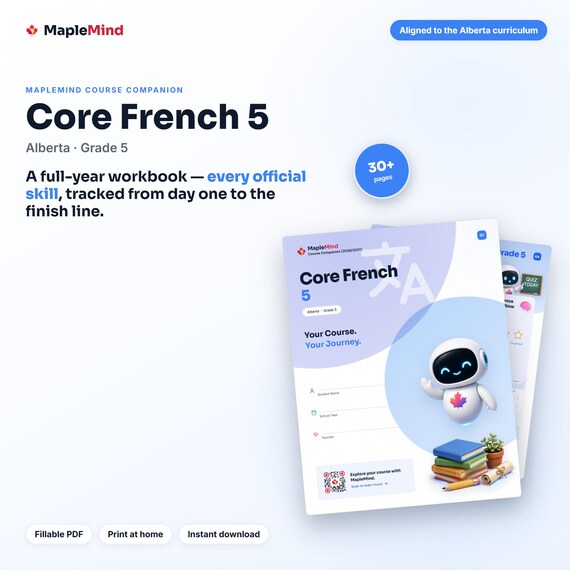
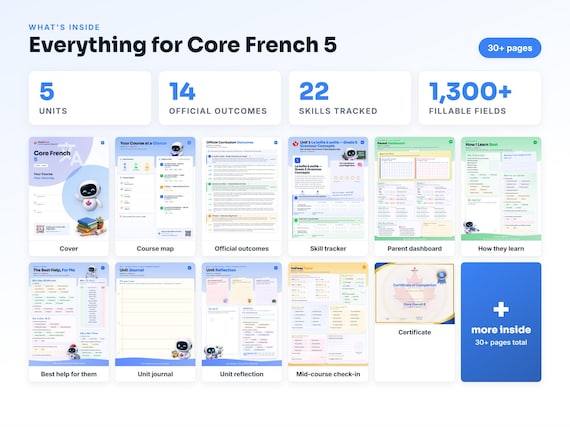
Printable workbook · A keepsake of the year
A Core French 5 workbook worth keeping
Built from the same official curriculum as this page. Before and after each skill above, your student colours in how sure they feel — so the two of you can see, on one page, what's clicking and what needs another look. It's a quiet way to follow how the year is really going.
By June it's full of their own handwriting: units worked through, confidence grown, a mid-year check-in, notes from parent-teacher night, and a certificate at the end. Less a worksheet, more a record of the year worth keeping on the shelf.
Instant download · see every page, reviews and the full description · five or more workbooks are $2.99 each
What it looks like in the app



Common questions
Can MapleMind help my child with Core French 5?
Yes. MapleMind's AI tutor covers all 22 skills in Alberta's Core French 5 — your child picks the exact skill, and the tutor teaches it step by step: a short lesson, a worked example, solving together, then a skill check to show it stuck.
Is MapleMind aligned to Alberta's official curriculum?
Yes. Every skill in this course maps to an official outcome code from Alberta's Grade 5 French curriculum, and the ministry's own wording is quoted under each unit on this page — with the official government source linked so you can check it yourself.
What does MapleMind cost?
It's free to start — 5 tutoring chats and a practice quiz every day, no credit card. A Pro subscription ($9.99/month or $49.99/year CAD, 7-day free trial) unlocks unlimited tutoring, practice, and exam simulations.
What if my child is stuck on just one topic?
That's the point of skill-level tutoring: open Core French 5 in the app, tap the exact skill from the list on this page, and the tutor teaches just that — no wading through lessons your child doesn't need.
Does MapleMind work in French or other languages?
Yes — 14 languages, including French. Both the app and the tutor's explanations switch to the language your child chooses.
Where can I see the official Alberta curriculum for Core French 5?
The official source is linked on this page — Alberta's official programs of study. The outline here follows it: every MapleMind skill carries its official outcome code, and the ministry's own wording is quoted under each unit.
Keep exploring
Ready when you are
Pick a skill from this page and see it taught properly — free, in the browser, in under a minute.