Get help with Core French 4
Most tutoring makes your child sit through material your child already knows. MapleMind flips that: pick the exact skill that's causing trouble — any of the 20 below — and the tutor teaches just that one, step by step, as many times as it takes. Ask questions in plain words, any time of day, in English, French, or 12 other languages.
The official Alberta Core French 4 curriculum
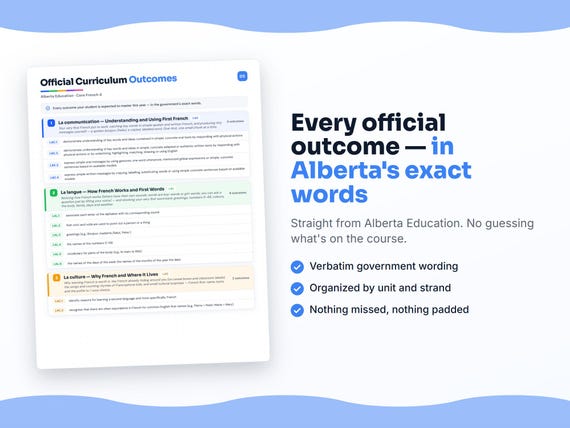
Alberta defines Core French 4 by strands and outcomes. MapleMind teaches the same curriculum reorganized for one-skill-at-a-time tutoring — the table shows exactly where every official strand lands, and the ministry's own wording is quoted under each unit below.
Official source Alberta's official programs of studyRead it on the government site — alberta.ca ↗| Official strand | Outcomes | Where MapleMind teaches it |
|---|---|---|
| Communication | 4 | La communication — Understanding and Using First French |
| Language | 2 | La langue — How French Works and First Words |
| Culture | 1 | La culture — Why French and Where It Lives |
Every skill below, taught one on one.
 Try the first session free
How MapleMind teaches Core French 4 — every unit, lesson, and skill
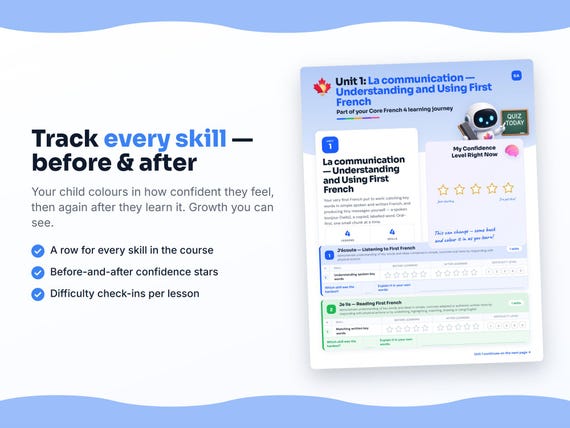
Every skill below runs as a short session: a plain-words lesson, a worked example, solving it together, then a five-question skill check that earns up to three stars. Guided Mode keeps it teaching instead of answer-handing — turning it off needs a parent's password.
Unit 1La communication — Understanding and Using First FrenchOfficial strand · Communication
Your very first French put to work: catching key words in simple spoken and written French, and producing tiny messages yourself — a spoken bonjour (hello), a copied, labelled word. Oral-first, one small chunk at a time.
J'écoute — Listening to First French
- Understanding spoken key words4.C.1 — Show you understand key words and ideas in simple, concrete spoken French by responding with a physical action, answering in English, pointing to a picture, or a yes/no — e.g. hear rouge and touch something red.
Je lis — Reading First French
- Matching written key words4.C.2 — Show you understand key words in simple written French by matching, highlighting, drawing, or answering in English — e.g. match the word chat to a picture of a cat.
Je parle — Saying First French
- Saying simple spoken messages4.C.3 — Express a simple spoken message with a gesture, one word, or a memorized expression based on a model — e.g. wave and say bonjour (hello) or merci (thank you).
J'écris — Writing First French
- Copying and labelling in French4.C.4 — Express a simple written message by copying, labelling, or swapping one word in a model — e.g. copy bleu (blue) under a blue crayon or label la main (the hand) on a picture.
The official wording — 4 outcomes in this unit
- 4.C.1
demonstrate understanding of key words and ideas contained in simple, concrete oral texts by responding with physical actions
- 4.C.2
demonstrate understanding of key words and ideas in simple, concrete adapted or authentic written texts by responding with physical actions or by underlining, highlighting, matching, drawing or using English
- 4.C.3
express simple oral messages by using gestures, one word utterances, memorized global expressions or simple, concrete sentences based on available models
- 4.C.4
express simple written messages by copying, labelling, substituting words or using simple concrete sentences based on available models
Unit 2La langue — How French Works and First WordsOfficial strand · Language
Noticing how French works (letters have their own sounds; words are boy-words or girl-words; you can ask a question just by lifting your voice) — and stocking your very first word bank: greetings, numbers 0–69, colours, the body, family, days and weather.
Les sons et les mots — Sounds, Nouns and Genders
- Letters and their French sounds4.L.1 — Notice that each letter of the French alphabet has its own sound, and that a noun is a word that names a person, place or thing — the two first ideas about how French is built.
- Boy-words, girl-words and the little words un / une / le / la4.L.1 — Notice that nouns in French are either masculine or feminine, and that there are two groups of articles — definite (le, la, les) and indefinite (un, une, des) — so every thing comes with its own little word.
Montrer et demander — Voici, Voilà and Asking
- Pointing things out: voici and voilà4.L.1 — Notice that voici and voilà are used to point out a person or a thing — Voici mon ami (here is my friend), Voilà la porte (there is the door).
- Turning a statement into a question4.L.1 — Notice how to make a question from a statement — by lifting your voice at the end (Ça va ?) or by adding Est-ce que in front — and tell a statement apart from a question.
Bonjour et merci — Greetings and Politeness
- Greetings, introductions and leave-taking4.L.2 — Use, mostly out loud, the first social French: greetings (Bonjour, madame; Salut), introductions (Comment t'appelles-tu? Je m'appelle…) and leave-taking (Au revoir; À demain).
- Politeness and "how are you?"4.L.2 — Use expressions of politeness (Merci; S'il vous plaît; Excusez-moi) and ask/answer about how someone is (Comment ça va? Ça va bien; Pas mal).
Les nombres et les couleurs — Numbers and Colours
- The numbers 0–694.L.2 — Say the names of the numbers 0–69 in French — the counting backbone for age (J'ai neuf ans = I am nine), classroom objects and simple arithmetic.
- The basic colours4.L.2 — Use the basic colours — le rouge (red), le bleu (blue), l'orange (orange), le vert (green) — to name and describe things around the classroom.
Le corps et la famille — Body and Family
- Parts of the body4.L.2 — Use French words for parts of the body — la main (the hand), la tête (the head) — great for songs, games and simple listen-and-point activities.
- Family members and pets4.L.2 — Use words for family members (mon père = my dad, ma sœur = my sister) and common family pets (un poisson rouge = a goldfish, une chienne = a dog).
Les jours et le temps — Days, Months and Weather
- Days, months and the date4.L.2 — Use the names of the days of the week, the months of the year and the date — the everyday calendar French of the classroom.
- Weather expressions4.L.2 — Use common weather expressions — Il pleut (it's raining), Il fait du soleil (it's sunny) — to answer Quel temps fait-il? (what's the weather like?).
The official wording — 2 outcomes in this unit
- 4.L.1
associate each letter of the alphabet with its corresponding sound
- 4.L.2
greetings (e.g., Bonjour, madame./Salut, Peter.)
Unit 3La culture — Why French and Where It LivesOfficial strand · Culture
Why learning French is worth it, the French already hiding around you (on cereal boxes and classroom labels), the songs and counting rhymes of Francophone kids, and small cultural surprises — French first-name twins and the polite tu / vous choice.
Pourquoi le français ? — Why Learn French
- Reasons to learn French and French around us4.CU.1 — Identify reasons for learning a second language — and more specifically French — and spot examples of French in your immediate environment (bilingual labels, bilingual dictionaries).
- French songs and counting rhymes4.CU.1 — Identify French songs, nursery rhymes or counting rhymes (Savez-vous planter les choux?) and notice that even "Happy Birthday" changes from culture to culture (Bonne fête in Canada).
Les prénoms et tu / vous — Names and Politeness
- French versions of English first names4.CU.1 — Recognize that many common English first names have a French equivalent — Pierre = Peter, Marie = Mary — a friendly first window into the language.
- Talking to friends vs. grown-ups: tu and vous4.CU.1 — Notice that tu and vous are used to address people in specific social situations — Comment t'appelles-tu? to a friend, Comment vous appelez-vous? to an adult.
The official wording — 1 outcome in this unit
- 4.CU.1
identify reasons for learning a second language and more specifically, French
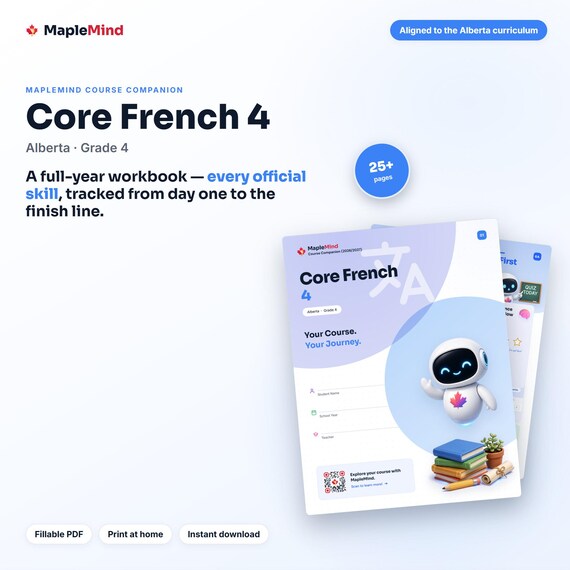
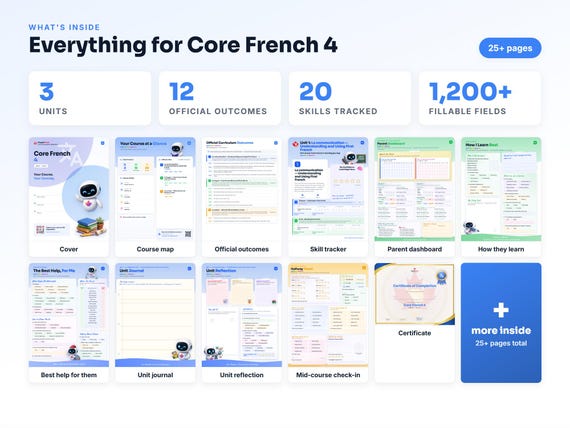
Printable workbook · A keepsake of the year
A Core French 4 workbook worth keeping
Built from the same official curriculum as this page. Before and after each skill above, your student colours in how sure they feel — so the two of you can see, on one page, what's clicking and what needs another look. It's a quiet way to follow how the year is really going.
By June it's full of their own handwriting: units worked through, confidence grown, a mid-year check-in, notes from parent-teacher night, and a certificate at the end. Less a worksheet, more a record of the year worth keeping on the shelf.
Instant download · see every page, reviews and the full description · five or more workbooks are $2.99 each
What it looks like in the app



Common questions
Can MapleMind help my child with Core French 4?
Yes. MapleMind's AI tutor covers all 20 skills in Alberta's Core French 4 — your child picks the exact skill, and the tutor teaches it step by step: a short lesson, a worked example, solving together, then a skill check to show it stuck.
Is MapleMind aligned to Alberta's official curriculum?
Yes. Every skill in this course maps to an official outcome code from Alberta's Grade 4 French curriculum, and the ministry's own wording is quoted under each unit on this page — with the official government source linked so you can check it yourself.
What does MapleMind cost?
It's free to start — 5 tutoring chats and a practice quiz every day, no credit card. A Pro subscription ($9.99/month or $49.99/year CAD, 7-day free trial) unlocks unlimited tutoring, practice, and exam simulations.
What if my child is stuck on just one topic?
That's the point of skill-level tutoring: open Core French 4 in the app, tap the exact skill from the list on this page, and the tutor teaches just that — no wading through lessons your child doesn't need.
Does MapleMind work in French or other languages?
Yes — 14 languages, including French. Both the app and the tutor's explanations switch to the language your child chooses.
Where can I see the official Alberta curriculum for Core French 4?
The official source is linked on this page — Alberta's official programs of study. The outline here follows it: every MapleMind skill carries its official outcome code, and the ministry's own wording is quoted under each unit.
Keep exploring
Ready when you are
Pick a skill from this page and see it taught properly — free, in the browser, in under a minute.