Get help with Core French 6
Most tutoring makes your child sit through material your child already knows. MapleMind flips that: pick the exact skill that's causing trouble — any of the 20 below — and the tutor teaches just that one, step by step, as many times as it takes. Ask questions in plain words, any time of day, in English, French, or 12 other languages.
The official Alberta Core French 6 curriculum
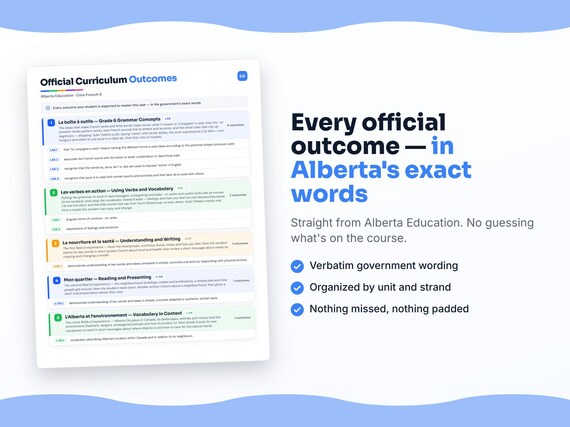
Alberta defines Core French 6 by strands and outcomes. MapleMind teaches the same curriculum reorganized for one-skill-at-a-time tutoring — the table shows exactly where every official strand lands, and the ministry's own wording is quoted under each unit below.
Official source Alberta's official programs of studyRead it on the government site — alberta.ca ↗| Official strand | Outcomes | Where MapleMind teaches it |
|---|---|---|
| Language | 2 | La boîte à outils — Grade 6 Grammar Concepts · Les verbes en action — Using Verbs and Vocabulary |
| Communication · Field: Food, nutrition and health | 2 | La nourriture et la santé — Understanding and Writing |
| Communication · Field: The neighbourhood | 2 | Mon quartier — Reading and Presenting |
| Language · Fields: Alberta; The environment | 1 | L'Alberta et l'environnement — Vocabulary in Context |
| Culture | 1 | La culture francophone — Francophone Alberta and Winter Festivals |
Every skill below, taught one on one.
 Try the first session free
How MapleMind teaches Core French 6 — every unit, lesson, and skill
Every skill below runs as a short session: a plain-words lesson, a worked example, solving it together, then a five-question skill check that earns up to three stars. Guided Mode keeps it teaching instead of answer-handing — turning it off needs a parent's password.
Unit 1La boîte à outils — Grade 6 Grammar ConceptsOfficial strand · Language
The ideas that make French verbs and little words make sense: what it means to "conjugate" a verb, how the –er present-tense pattern works, how French sounds link to letters and accents, and the small rules that trip up beginners — dropping "a/an" before a job, saying "some" with du/de la/des, the avoir expressions (J'ai faim = I am hungry), and when to use jouer à vs faire de. Oral-first, lots of models.
Qu'est-ce que conjuguer un verbe ?
- What "conjugating a verb" means6.L.1 — Explain in their own words that "to conjugate a verb" means naming the different forms a verb takes for each subject pronoun (je, tu, il/elle…), and that a conjugation is simply a verb pattern.
- The –er present-tense pattern6.L.1 — Explain, in their own words, how the –er verb conjugation pattern works in the present tense — the stem stays and the ending changes with each subject pronoun (je parle, tu parles, il parle, nous parlons, vous parlez, ils parlent).
Les sons, les accents et les articles
- Matching French sounds to letters and accents6.L.1 — Associate a French sound with the letter, letter combination or accent that makes it — e.g. é sounds like [e] (café) while è sounds like [ε] (père), and eau sounds like [o] (beau).
- No "a/an" before a job6.L.1 — Recognize that in French the indefinite article (un/une) is dropped when you say someone's profession — M. Brown est dentiste (Mr. Brown is a dentist), not "un dentiste".
Dire « du, de la, des » et les expressions avec avoir
- Saying "some": du, de la, de l', des6.L.1 — Recognize that du, de la, de l' and des are how French says "some" — Je mange du brocoli (I eat some broccoli), Je bois de l'eau (I drink some water).
- Expressions with avoir (J'ai faim)6.L.1 — Recognize that French uses the verb avoir (to have) where English uses "to be" — J'ai faim (I am hungry), J'ai soif (I am thirsty), J'ai chaud/froid (I am hot/cold).
Jouer à / faire de et les moyens de transport
- jouer à vs faire de for sports and activities6.L.1 — Recognize that some sports and activities use jouer à (Je joue au soccer = I play soccer) while others use faire de (Je fais du ski = I ski / I go skiing).
- The right word with each means of transport6.L.1 — Recognize that the little word before a means of transport changes with the type of transport — à bicyclette (by bicycle), en autobus (by bus).
The official wording — 1 outcome in this unit
- 6.L.1
that “to conjugate a verb” means naming the different forms a verb takes according to the personal subject pronoun used
Unit 2Les verbes en action — Using Verbs and VocabularyOfficial strand · Language
Putting the grammar to work in real messages: conjugating everyday –er verbs and useful verbs like se trouver (to be located), and using the vocabulary Grade 6 adds — feelings and how you feel (Je suis heureux/heureuse; J'ai mal à la tête), and the little words that say how much (beaucoup, un peu, assez, trop). Always mainly oral, from a model the student can copy and change.
Conjuguer les verbes du quotidien
- Singular forms of common –er verbs6.L.2 — Use the singular forms (je, tu, il/elle) of common –er verbs — jouer, danser, regarder, travailler, manger — to say short messages about what you and others do.
- Saying where things are with se trouver6.L.2 — Use selected forms of the verb se trouver (to be located) to say where a place is — L'Alberta se trouve entre la Colombie-Britannique et la Saskatchewan.
Exprimer ses sentiments et ses préférences
- Feelings, emotions and how you feel6.L.2 — Use expressions of feelings and emotions to say how you feel — Je suis triste (I am sad), Je suis heureux/heureuse (I am happy), J'ai mal à la tête (My head hurts).
- Saying how much: beaucoup, un peu, assez, trop6.L.2 — Use the adverbs of quantity and intensity — beaucoup (a lot), bien (well), peu (little), assez (enough), trop (too much) — to add "how much" to a message: Je mange trop de chocolat.
The official wording — 1 outcome in this unit
- 6.L.2
singular forms of common –er verbs
Unit 3La nourriture et la santé — Understanding and WritingOfficial strand · Communication · Field: Food, nutrition and health
The first field of experience — food, the food groups, nutritious foods, meals and how you feel. Here the student listens for key words in short spoken French about food and health, then writes a short message about meals by copying and changing a model.
À table ! — Listening and writing about food
- Listening for key words about food and health6.C.1 — Show understanding of key words and ideas in short, simple spoken French about food and health — by pointing or acting it out, giving a yes/no, matching a word to a picture, or answering in English.
- Writing a short message about meals6.C.4 — Write a short message about meals and nutritious foods — a menu, a food-group chart or a couple of sentences — by copying, labelling, swapping words, or writing short sentences from a model.
The official wording — 2 outcomes in this unit
- 6.C.1
demonstrate understanding of key words and ideas contained in simple, concrete oral texts by responding with physical actions
- 6.C.4
express simple written messages by copying, labelling, substituting words or using simple concrete sentences based on available models
Unit 4Mon quartier — Reading and PresentingOfficial strand · Communication · Field: The neighbourhood
The second field of experience — the neighbourhood: buildings, trades and professions, a simple plan and how people get around. Here the student reads short, familiar written French about a neighbourhood, then gives a short oral presentation about their own.
Dans mon quartier — Reading and speaking
- Reading short texts about a neighbourhood6.C.2 — Show understanding of key words and ideas in short, simple written French about a neighbourhood (a simple map, a sign, a short description) by matching, highlighting, underlining, drawing, or answering in English.
- A short oral presentation about my neighbourhood6.C.3 — Give a short oral presentation about your neighbourhood using single words, memorized expressions or short sentences copied from a model — naming buildings, a job, and how you get around (Je vais à l'école en autobus).
The official wording — 2 outcomes in this unit
- 6.C.2
demonstrate understanding of key words and ideas in simple, concrete adapted or authentic written texts
- 6.C.3
express simple oral messages by using one word utterances, memorized global expressions or simple, concrete sentences based on available models
Unit 5L'Alberta et l'environnement — Vocabulary in ContextOfficial strand · Language · Fields: Alberta; The environment
Two more fields of experience — Alberta (its place in Canada, its landscapes, animals and riches) and the environment (habitats, dangers, endangered animals and how to protect it). Here Grade 6 puts its new vocabulary to work in short messages about where Alberta is and how to care for the natural world.
Où est l'Alberta ? Comment protéger la nature ?
- Talking about where Alberta is6.L.2 — Use vocabulary that describes Alberta's location within Canada and next to its neighbours — dans l'ouest du Canada (in western Canada), au nord des États-Unis (north of the United States) — with cardinal points (le nord, le sud, le nord-est).
- Talking about protecting the environment6.L.2 — Use vocabulary related to protecting the environment — le recyclage (recycling), réutiliser les plastiques (reuse plastics) — often with il faut + infinitive (Il faut recycler = We must recycle).
The official wording — 1 outcome in this unit
- 6.L.2
vocabulary describing Alberta’s location within Canada and in relation to its neighbours
Unit 6La culture francophone — Francophone Alberta and Winter FestivalsOfficial strand · Culture
The French-speaking world close to home and across Canada: two Francophone communities in Alberta and where they are, two winter Francophone celebrations (le Carnaval de Québec, le Festival du Voyageur à Saint-Boniface), and the fact that Canada has two official languages — French and English. Awareness and pride, not memorizing.
L'Alberta francophone et les fêtes d'hiver
- Francophone communities in Alberta6.CU.1 — Identify two predominantly Francophone communities in Alberta and roughly where they are — Beaumont est au sud d'Edmonton (Beaumont is south of Edmonton); Saint-Isidore est dans le nord de l'Alberta.
- Winter celebrations and Canada's two languages6.CU.1 — Name two winter Francophone celebrations in Canada (le Carnaval de Québec au Québec; le Festival du Voyageur à Saint-Boniface au Manitoba) and state, in French, that Canada has two official languages — French and English.
The official wording — 1 outcome in this unit
- 6.CU.1
two predominantly Francophone communities in Alberta and their locations
Printable workbook · A keepsake of the year
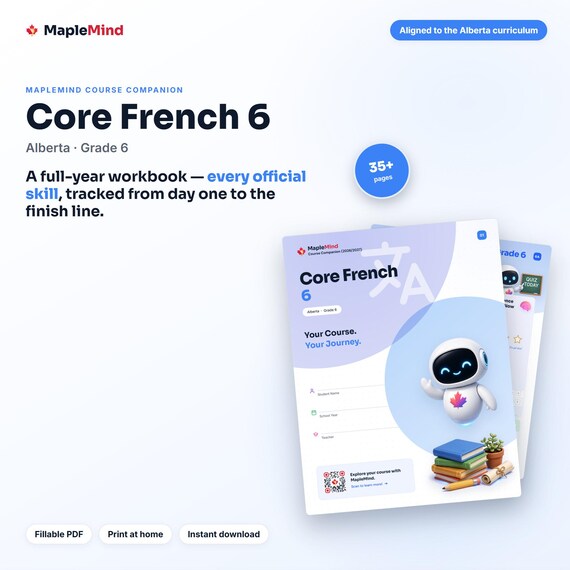
A Core French 6 workbook worth keeping
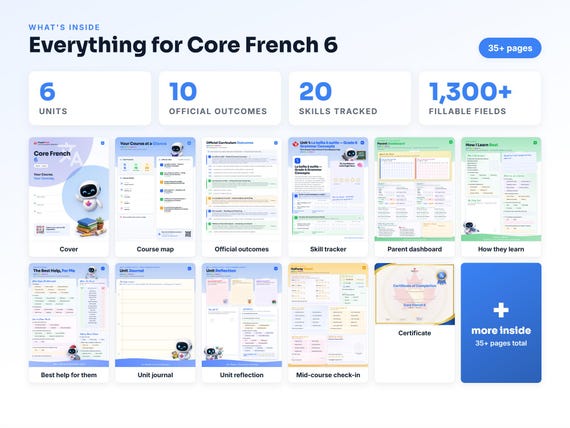
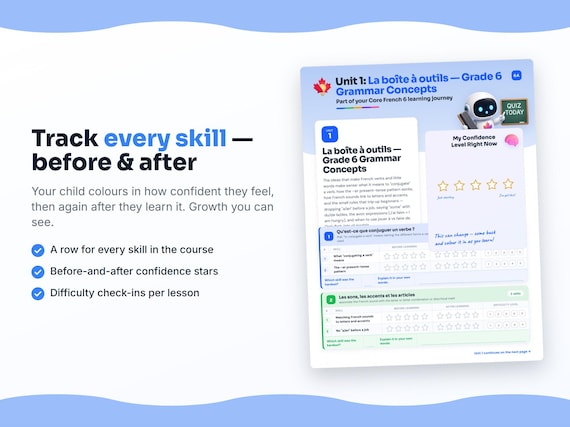
Built from the same official curriculum as this page. Before and after each skill above, your student colours in how sure they feel — so the two of you can see, on one page, what's clicking and what needs another look. It's a quiet way to follow how the year is really going.
By June it's full of their own handwriting: units worked through, confidence grown, a mid-year check-in, notes from parent-teacher night, and a certificate at the end. Less a worksheet, more a record of the year worth keeping on the shelf.
Instant download · see every page, reviews and the full description · five or more workbooks are $2.99 each
What it looks like in the app



Common questions
Can MapleMind help my child with Core French 6?
Yes. MapleMind's AI tutor covers all 20 skills in Alberta's Core French 6 — your child picks the exact skill, and the tutor teaches it step by step: a short lesson, a worked example, solving together, then a skill check to show it stuck.
Is MapleMind aligned to Alberta's official curriculum?
Yes. Every skill in this course maps to an official outcome code from Alberta's Grade 6 French curriculum, and the ministry's own wording is quoted under each unit on this page — with the official government source linked so you can check it yourself.
What does MapleMind cost?
It's free to start — 5 tutoring chats and a practice quiz every day, no credit card. A Pro subscription ($9.99/month or $49.99/year CAD, 7-day free trial) unlocks unlimited tutoring, practice, and exam simulations.
What if my child is stuck on just one topic?
That's the point of skill-level tutoring: open Core French 6 in the app, tap the exact skill from the list on this page, and the tutor teaches just that — no wading through lessons your child doesn't need.
Does MapleMind work in French or other languages?
Yes — 14 languages, including French. Both the app and the tutor's explanations switch to the language your child chooses.
Where can I see the official Alberta curriculum for Core French 6?
The official source is linked on this page — Alberta's official programs of study. The outline here follows it: every MapleMind skill carries its official outcome code, and the ministry's own wording is quoted under each unit.
Keep exploring
Ready when you are
Pick a skill from this page and see it taught properly — free, in the browser, in under a minute.