Get help with Mathematics 4
Most tutoring makes your child sit through material your child already knows. MapleMind flips that: pick the exact skill that's causing trouble — any of the 26 below — and the tutor teaches just that one, step by step, as many times as it takes. Ask questions in plain words, any time of day, in English, French, or 12 other languages.
The official Alberta Mathematics 4 curriculum
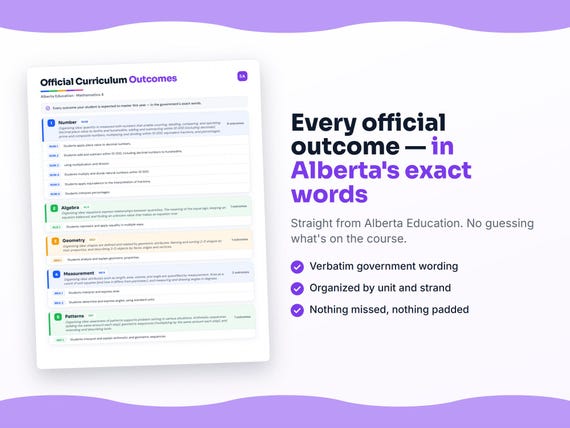
Alberta defines Mathematics 4 by strands and outcomes. MapleMind teaches the same curriculum reorganized for one-skill-at-a-time tutoring — the table shows exactly where every official strand lands, and the ministry's own wording is quoted under each unit below.
Official source Alberta's official programs of studyRead it on the government site — alberta.ca ↗| Official strand | Outcomes | Where MapleMind teaches it |
|---|---|---|
| Number | 6 | Number |
| Algebra | 1 | Algebra |
| Geometry | 1 | Geometry |
| Measurement | 2 | Measurement |
| Patterns | 1 | Patterns |
| Time | 1 | Time |
| Statistics | 1 | Statistics |
Every skill below, taught one on one.
 Try the first session free
How MapleMind teaches Mathematics 4 — every unit, lesson, and skill
Every skill below runs as a short session: a plain-words lesson, a worked example, solving it together, then a five-question skill check that earns up to three stars. Guided Mode keeps it teaching instead of answer-handing — turning it off needs a parent's password.
Unit 1NumberOfficial strand · Number
Organizing idea: quantity is measured with numbers that enable counting, labelling, comparing, and operating. Decimal place value to tenths and hundredths, adding and subtracting within 10 000 (including decimals), prime and composite numbers, multiplying and dividing within 10 000, equivalent fractions, and percentages.
Decimals and Place Value
- Reading and writing decimals4.N.1 — Read, write and say decimal numbers to tenths and hundredths, connecting each digit to its place value (tenths and hundredths as fractions of one whole).
- Comparing and ordering decimals4.N.1 — Compare and order decimals to hundredths by lining up place values, so that a number with more digits is not mistaken for a larger number.
Adding and Subtracting to 10 000
- Adding and subtracting whole numbers4.N.2 — Add and subtract natural numbers within 10 000 using the standard algorithms, regrouping (carrying and borrowing) between place-value columns.
- Adding and subtracting decimals to hundredths4.N.2 — Add and subtract decimal numbers to hundredths by lining up the decimal points so the place values line up (money is a familiar example).
Prime and Composite Numbers
- Factors and multiples4.N.3 — Find the factors of a number by testing which whole numbers divide it evenly, using multiplication and division to build factor pairs.
- Telling primes from composites4.N.3 — Classify a whole number as prime (exactly two factors: 1 and itself) or composite (more than two factors), and explain why 1 is neither.
Multiplying and Dividing
- Multiplying within 10 0004.N.4 — Multiply natural numbers within 10 000, recalling multiplication facts and using strategies such as partial products (breaking a factor apart by place value).
- Dividing and interpreting remainders4.N.4 — Divide natural numbers within 10 000, connecting division to multiplication, and interpret a remainder in the context of a story problem.
Equivalent Fractions
- Fractions that name the same amount4.N.5 — Recognize that different fractions can name the same amount (1/2 = 2/4 = 3/6) by splitting the same whole into more, smaller equal pieces.
- Making and comparing equivalent fractions4.N.5 — Generate equivalent fractions by multiplying or dividing the numerator and denominator by the same number, and use equivalence to compare two fractions.
Percentages
- Percent means out of 1004.N.6 — Interpret a percentage as a number of parts out of 100, and read everyday percentages such as a fully charged battery at 100% or a half-full tank at 50%.
- Percents, fractions and hundredths4.N.6 — Connect a percentage to its fraction over 100 and its decimal in hundredths (50% = 50/100 = 0.50) using a hundredths grid.
The official wording — 6 outcomes in this unit
- 4.N.1
Students apply place value to decimal numbers.
- 4.N.2
Students add and subtract within 10 000, including decimal numbers to hundredths.
- 4.N.3
using multiplication and division
- 4.N.4
Students multiply and divide natural numbers within 10 000.
- 4.N.5
Students apply equivalence to the interpretation of fractions.
- 4.N.6
Students interpret percentages.
Unit 2AlgebraOfficial strand · Algebra
Organizing idea: equations express relationships between quantities. The meaning of the equal sign, keeping an equation balanced, and finding an unknown value that makes an equation true.
Equality and Balance
- The equal sign means "same as"4.A.1 — Understand that the equal sign means both sides have the same value (a balance), not "the answer comes next" — so 7 + 5 = 3 + 9 is a true statement.
- Finding the unknown that keeps it balanced4.A.1 — Find the unknown value in an equation such as 8 + ? = 15 by reasoning about what keeps both sides equal, and represent equality in more than one way.
The official wording — 1 outcome in this unit
- 4.A.1
Students represent and apply equality in multiple ways.
Unit 3GeometryOfficial strand · Geometry
Organizing idea: shapes are defined and related by geometric attributes. Naming and sorting 2-D shapes by their properties, and describing 3-D objects by faces, edges and vertices.
Geometric Properties
- Sorting 2-D shapes by their properties4.G.1 — Analyze and sort 2-D shapes using geometric properties such as number of sides, side lengths, and whether sides are parallel (for example, sorting quadrilaterals).
- Describing 3-D objects4.G.1 — Explain the properties of 3-D objects by counting and describing their faces, edges and vertices, and connecting a solid to the 2-D shapes of its faces.
The official wording — 1 outcome in this unit
- 4.G.1
Students analyze and explain geometric properties.
Unit 4MeasurementOfficial strand · Measurement
Organizing idea: attributes such as length, area, volume, and angle are quantified by measurement. Area as a count of unit squares (and how it differs from perimeter), and measuring and drawing angles in degrees.
Area
- Area as unit squares4.M.1 — Interpret area as the number of unit squares that cover a flat shape, and express area in square units such as square centimetres.
- Area is not the same as perimeter4.M.1 — Find the area of a rectangle as rows × columns of unit squares, and tell area apart from perimeter (the distance around) — they measure different things.
Angles
- Angles, turns and degrees4.M.2 — Understand an angle as an amount of turn, measured in degrees, where a full turn is 360°, a straight line is 180°, and a right angle (square corner) is 90°.
- Measuring and drawing angles4.M.2 — Determine the size of an angle with a protractor and draw an angle of a given size, and classify angles as acute, right or obtuse.
The official wording — 2 outcomes in this unit
- 4.M.1
Students interpret and express area.
- 4.M.2
Students determine and express angles, using standard units.
Unit 5PatternsOfficial strand · Patterns
Organizing idea: awareness of patterns supports problem solving in various situations. Arithmetic sequences (adding the same amount each step), geometric sequences (multiplying by the same amount each step), and extending and describing both.
Growing and Shrinking Sequences
- Arithmetic sequences4.P.1 — Interpret an arithmetic sequence as one where the same amount is added (or subtracted) each step, find the constant step, and extend the sequence.
- Geometric sequences4.P.1 — Interpret a geometric sequence as one where each term is multiplied by the same amount (like doubling: 2, 4, 8, 16), and tell it apart from an arithmetic sequence.
The official wording — 1 outcome in this unit
- 4.P.1
Students interpret and explain arithmetic and geometric sequences.
Unit 6TimeOfficial strand · Time
Organizing idea: duration is described and quantified by time. Standard units of time and how they relate, and finding how long something lasts (elapsed time) using clocks and calendars.
Measuring Duration
- Units of time and how they relate4.T.1 — Communicate duration using standard units of time (seconds, minutes, hours, days, weeks) and convert between related units, such as 60 minutes in an hour.
- Finding elapsed time4.T.1 — Determine how much time has passed between a start and an end time using a clock or a number line of hours and minutes.
The official wording — 1 outcome in this unit
- 4.T.1
Students communicate duration with standard units of time.
Unit 7StatisticsOfficial strand · Statistics
Organizing idea: the science of collecting, analyzing, visualizing, and interpreting data can inform understanding and decision making. How the scale of a graph is chosen and how it changes the way data looks and is read.
Scale in Graphs
- Reading a graph with a scale4.ST.1 — Read values from a bar graph or pictograph whose scale counts by more than one (each square or picture stands for several items), using the scale/key.
- Judging the scale of a graph4.ST.1 — Evaluate whether the scale chosen for a graph is a good fit for the data and how a different scale can make the same data look bigger or smaller.
The official wording — 1 outcome in this unit
- 4.ST.1
Students evaluate the use of scale in graphical representations of data.
Printable workbook · A keepsake of the year
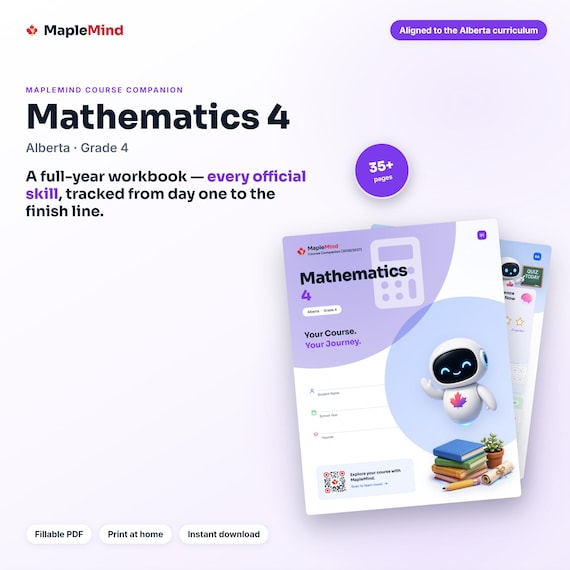
A Mathematics 4 workbook worth keeping
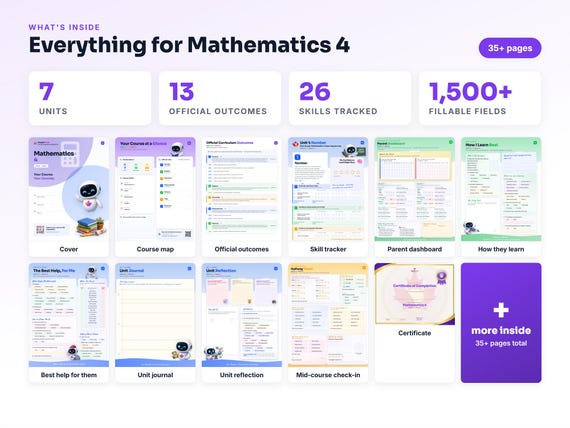
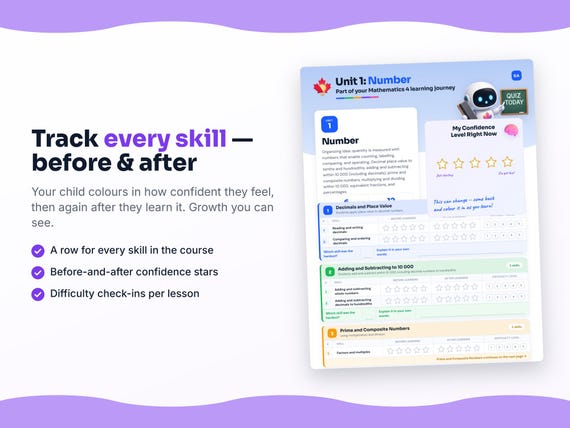
Built from the same official curriculum as this page. Before and after each skill above, your student colours in how sure they feel — so the two of you can see, on one page, what's clicking and what needs another look. It's a quiet way to follow how the year is really going.
By June it's full of their own handwriting: units worked through, confidence grown, a mid-year check-in, notes from parent-teacher night, and a certificate at the end. Less a worksheet, more a record of the year worth keeping on the shelf.
Instant download · see every page, reviews and the full description · five or more workbooks are $2.99 each
What it looks like in the app



Common questions
Can MapleMind help my child with Mathematics 4?
Yes. MapleMind's AI tutor covers all 26 skills in Alberta's Mathematics 4 — your child picks the exact skill, and the tutor teaches it step by step: a short lesson, a worked example, solving together, then a skill check to show it stuck.
Is MapleMind aligned to Alberta's official curriculum?
Yes. Every skill in this course maps to an official outcome code from Alberta's Grade 4 Mathematics curriculum, and the ministry's own wording is quoted under each unit on this page — with the official government source linked so you can check it yourself.
What does MapleMind cost?
It's free to start — 5 tutoring chats and a practice quiz every day, no credit card. A Pro subscription ($9.99/month or $49.99/year CAD, 7-day free trial) unlocks unlimited tutoring, practice, and exam simulations.
What if my child is stuck on just one topic?
That's the point of skill-level tutoring: open Mathematics 4 in the app, tap the exact skill from the list on this page, and the tutor teaches just that — no wading through lessons your child doesn't need.
Does MapleMind work in French or other languages?
Yes — 14 languages, including French. Both the app and the tutor's explanations switch to the language your child chooses.
Where can I see the official Alberta curriculum for Mathematics 4?
The official source is linked on this page — Alberta's official programs of study. The outline here follows it: every MapleMind skill carries its official outcome code, and the ministry's own wording is quoted under each unit.
Keep exploring
Ready when you are
Pick a skill from this page and see it taught properly — free, in the browser, in under a minute.