Get help with Mathematics 3
Most tutoring makes your child sit through material your child already knows. MapleMind flips that: pick the exact skill that's causing trouble — any of the 22 below — and the tutor teaches just that one, step by step, as many times as it takes. Ask questions in plain words, any time of day, in English, French, or 12 other languages.
The official Alberta Mathematics 3 curriculum
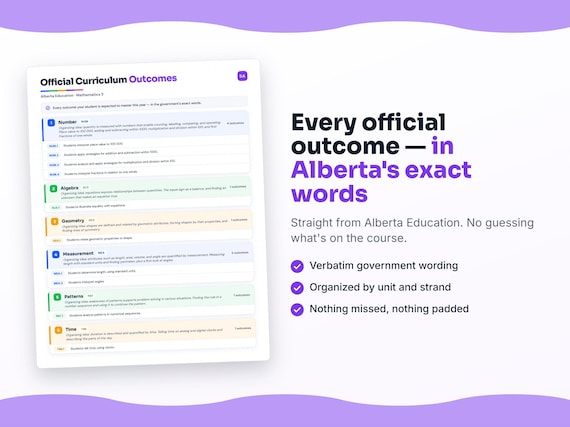
Alberta defines Mathematics 3 by strands and outcomes. MapleMind teaches the same curriculum reorganized for one-skill-at-a-time tutoring — the table shows exactly where every official strand lands, and the ministry's own wording is quoted under each unit below.
Official source Alberta's official programs of studyRead it on the government site — alberta.ca ↗| Official strand | Outcomes | Where MapleMind teaches it |
|---|---|---|
| Number | 4 | Number |
| Algebra | 1 | Algebra |
| Geometry | 1 | Geometry |
| Measurement | 2 | Measurement |
| Patterns | 1 | Patterns |
| Time | 1 | Time |
| Statistics | 1 | Statistics |
Every skill below, taught one on one.
 Try the first session free
How MapleMind teaches Mathematics 3 — every unit, lesson, and skill
Every skill below runs as a short session: a plain-words lesson, a worked example, solving it together, then a five-question skill check that earns up to three stars. Guided Mode keeps it teaching instead of answer-handing — turning it off needs a parent's password.
Unit 1NumberOfficial strand · Number
Organizing idea: quantity is measured with numbers that enable counting, labelling, comparing, and operating. Place value to 100 000, adding and subtracting within 1000, multiplication and division within 100, and first fractions of one whole.
Place Value to 100 000
- Reading and writing big numbers3.N.1 — Read, write, and say numbers up to 100 000, understanding that each place to the left is worth ten times more.
- Comparing and ordering numbers3.N.1 — Compare and order numbers up to 100 000 by looking at the biggest place value first.
Adding and Subtracting to 1000
- Addition strategies3.N.2 — Add two- and three-digit numbers within 1000, regrouping (carrying) when a column makes ten or more.
- Subtraction strategies3.N.2 — Subtract within 1000 by regrouping (borrowing) when a column is too small, and check by adding back.
Multiplication and Division
- Multiplication as equal groups3.N.3 — Understand multiplication as making equal groups and count them with repeated addition or an array — for facts up to 5 × 5.
- Division as fair sharing3.N.3 — Understand division as sharing a total into equal groups (or into groups of a size), and see that it undoes multiplication.
First Fractions
- Naming fractions3.N.4 — Name a fraction of one whole from equal parts: the bottom number (denominator) says how many equal parts, the top number (numerator) says how many are chosen.
- Comparing fractions3.N.4 — Compare simple fractions of the same whole and see that more equal parts means each part is smaller.
The official wording — 4 outcomes in this unit
- 3.N.1
Students interpret place value to 100 000.
- 3.N.2
Students apply strategies for addition and subtraction within 1000.
- 3.N.3
Students analyze and apply strategies for multiplication and division within 100.
- 3.N.4
Students interpret fractions in relation to one whole.
Unit 2AlgebraOfficial strand · Algebra
Organizing idea: equations express relationships between quantities. The equal sign as a balance, and finding an unknown that makes an equation true.
The Balancing Equal Sign
- The equal sign means balance3.A.1 — Understand the equal sign as "the same as" — both sides must balance, so $4 + 3 = 5 + 2$ is true.
- Finding the missing number3.A.1 — Find the unknown number that keeps an equation balanced, such as $6 + \square = 10$.
The official wording — 1 outcome in this unit
- 3.A.1
Students illustrate equality with equations.
Unit 3GeometryOfficial strand · Geometry
Organizing idea: shapes are defined and related by geometric attributes. Sorting shapes by their properties, and finding lines of symmetry.
Shapes and Symmetry
- Sorting shapes by property3.G.1 — Describe and sort 2-D shapes by properties like number of sides, number of corners (vertices), and equal side lengths.
- Lines of symmetry3.G.1 — Find lines of symmetry by folding a shape so the two halves match exactly.
The official wording — 1 outcome in this unit
- 3.G.1
Students relate geometric properties to shape.
Unit 4MeasurementOfficial strand · Measurement
Organizing idea: attributes such as length, area, volume, and angle are quantified by measurement. Measuring length with standard units and finding perimeter, plus a first look at angles.
Length and Perimeter
- Measuring length3.M.1 — Measure length in standard units (centimetres and metres) by lining a ruler up from the zero mark.
- Perimeter — the distance around3.M.1 — Find the perimeter of a shape by adding up the lengths of all its sides.
Angles
- An angle is an amount of turn3.M.2 — Understand an angle as the amount of opening between two arms that meet at a point — a bigger opening is a bigger angle.
- Comparing angles3.M.2 — Compare angles by their openings, and recognize a right angle (a square corner) as a benchmark.
The official wording — 2 outcomes in this unit
- 3.M.1
Students determine length, using standard units.
- 3.M.2
Students interpret angles.
Unit 5PatternsOfficial strand · Patterns
Organizing idea: awareness of patterns supports problem solving in various situations. Finding the rule in a number sequence and using it to continue the pattern.
Number Patterns
- Finding the pattern rule3.P.1 — Find the rule of a number sequence by seeing how much is added (or subtracted) from one term to the next.
- Extending a sequence3.P.1 — Use the rule to continue a number sequence and predict a term further along.
The official wording — 1 outcome in this unit
- 3.P.1
Students analyze patterns in numerical sequences.
Unit 6TimeOfficial strand · Time
Organizing idea: duration is described and quantified by time. Telling time on analog and digital clocks and describing the parts of the day.
Telling Time
- Reading an analog clock3.T.1 — Tell time to the minute on an analog clock, reading the hour hand and the minute hand together.
- Analog and digital time3.T.1 — Match the same time shown on an analog clock and a digital clock, and say it aloud correctly.
The official wording — 1 outcome in this unit
- 3.T.1
Students tell time, using clocks.
Unit 7StatisticsOfficial strand · Statistics
Organizing idea: the science of collecting, analyzing, visualizing, and interpreting data can inform understanding and decision making. Reading data from graphs and explaining what the picture shows.
Reading Graphs
- Reading a graph3.ST.1 — Read counts from picture graphs and bar graphs, using the labels and the scale.
- Explaining the data3.ST.1 — Explain what a graph tells us — which category has the most or fewest, and answer questions from the picture.
The official wording — 1 outcome in this unit
- 3.ST.1
Students interpret and explain representations of data.
Printable workbook · A keepsake of the year
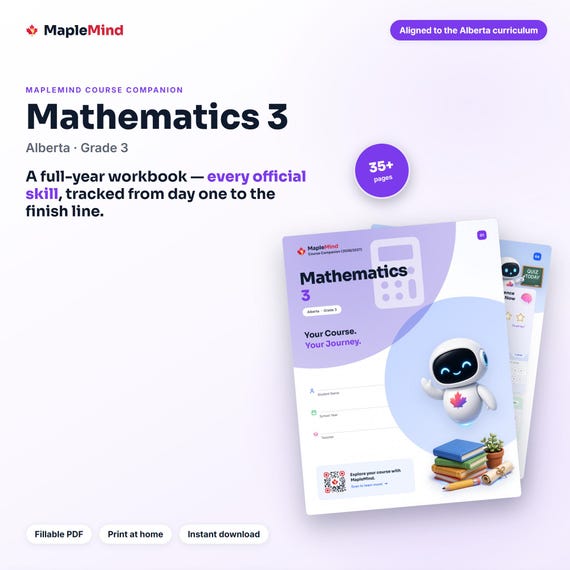
A Mathematics 3 workbook worth keeping
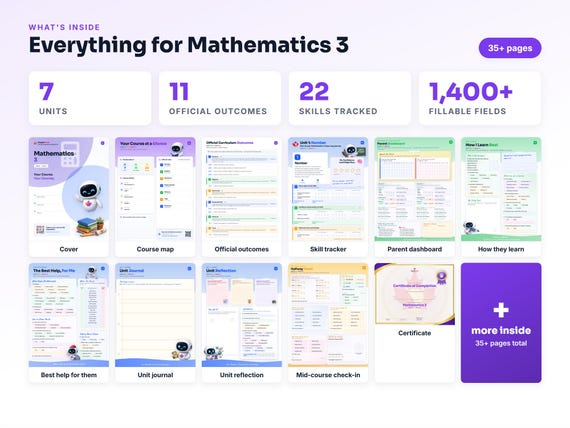
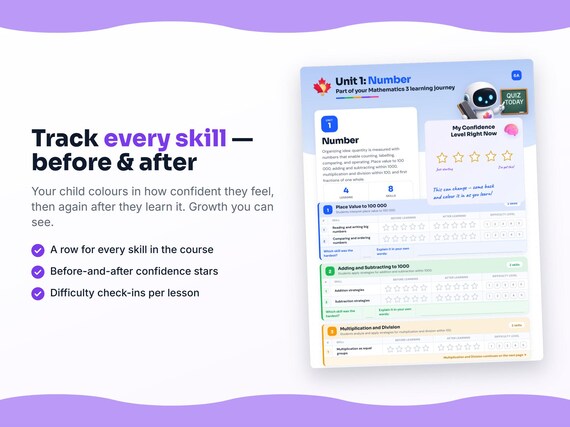
Built from the same official curriculum as this page. Before and after each skill above, your student colours in how sure they feel — so the two of you can see, on one page, what's clicking and what needs another look. It's a quiet way to follow how the year is really going.
By June it's full of their own handwriting: units worked through, confidence grown, a mid-year check-in, notes from parent-teacher night, and a certificate at the end. Less a worksheet, more a record of the year worth keeping on the shelf.
Instant download · see every page, reviews and the full description · five or more workbooks are $2.99 each
What it looks like in the app



Common questions
Can MapleMind help my child with Mathematics 3?
Yes. MapleMind's AI tutor covers all 22 skills in Alberta's Mathematics 3 — your child picks the exact skill, and the tutor teaches it step by step: a short lesson, a worked example, solving together, then a skill check to show it stuck.
Is MapleMind aligned to Alberta's official curriculum?
Yes. Every skill in this course maps to an official outcome code from Alberta's Grade 3 Mathematics curriculum, and the ministry's own wording is quoted under each unit on this page — with the official government source linked so you can check it yourself.
What does MapleMind cost?
It's free to start — 5 tutoring chats and a practice quiz every day, no credit card. A Pro subscription ($9.99/month or $49.99/year CAD, 7-day free trial) unlocks unlimited tutoring, practice, and exam simulations.
What if my child is stuck on just one topic?
That's the point of skill-level tutoring: open Mathematics 3 in the app, tap the exact skill from the list on this page, and the tutor teaches just that — no wading through lessons your child doesn't need.
Does MapleMind work in French or other languages?
Yes — 14 languages, including French. Both the app and the tutor's explanations switch to the language your child chooses.
Where can I see the official Alberta curriculum for Mathematics 3?
The official source is linked on this page — Alberta's official programs of study. The outline here follows it: every MapleMind skill carries its official outcome code, and the ministry's own wording is quoted under each unit.
Keep exploring
Ready when you are
Pick a skill from this page and see it taught properly — free, in the browser, in under a minute.