Get help with Mathematics, Grade 6
Most tutoring makes your child sit through material your child already knows. MapleMind flips that: pick the exact skill that's causing trouble — any of the 51 below — and the tutor teaches just that one, step by step, as many times as it takes. Ask questions in plain words, any time of day, in English, French, or 12 other languages.
The official Ontario Mathematics, Grade 6 curriculum
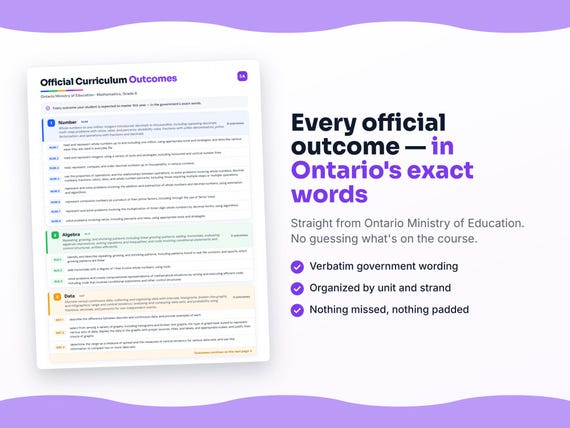
Ontario defines Mathematics, Grade 6 by strands and outcomes. MapleMind teaches the same curriculum reorganized for one-skill-at-a-time tutoring — the table shows exactly where every official strand lands, and the ministry's own wording is quoted under each unit below.
Official source Ontario's official mathematics curriculumRead it on the government site — dcp.edu.gov.on.ca ↗| Official strand | Outcomes | Where MapleMind teaches it |
|---|---|---|
| Strand B | 18 | Number |
| Strand C | 10 | Algebra |
| Strand D | 8 | Data |
| Strand E | 10 | Spatial Sense |
| Strand F | 5 | Financial Literacy |
Ontario also defines Strand A — Social-Emotional Learning Skills — which the ministry teaches through every other strand rather than as its own unit, so it doesn't get a row of its own.
Every skill below, taught one on one.
 Try the first session free
How MapleMind teaches Mathematics, Grade 6 — every unit, lesson, and skill
Every skill below runs as a short session: a plain-words lesson, a worked example, solving it together, then a five-question skill check that earns up to three stars. Guided Mode keeps it teaching instead of answer-handing — turning it off needs a parent's password.
Unit 1NumberOfficial strand · Strand B
Whole numbers to one million; integers introduced; decimals to thousandths, including repeating decimals; multi-step problems with ratios, rates, and percents; divisibility rules; fractions with unlike denominators; prime factorization; and operations with fractions and decimals.
Whole Numbers to One Million
- Reading and representing numbers to one millionB1.1 — Read and represent whole numbers up to one million, using tools and strategies, and describe various ways they are used in everyday life.
Introducing Integers
- Reading and representing integers on number linesB1.2 — Read and represent integers using tools and strategies, including horizontal and vertical number lines.
- Comparing and ordering integers, decimals, and fractionsB1.3 — Compare and order integers, decimal numbers, and fractions, separately and in combination, in various contexts.
Decimals to Thousandths
- Reading, representing, comparing, and ordering decimals to thousandthsB1.4 — Read, represent, compare, and order decimal numbers up to thousandths, in various contexts.
- Rounding terminating and repeating decimalsB1.5 — Round decimal numbers, both terminating and repeating, to the nearest tenth, hundredth, or whole number, as applicable, in various contexts.
- Showing equivalences between fractions and decimals to thousandthsB1.6 — Describe relationships and show equivalences among fractions and decimal numbers up to thousandths, using tools and drawings.
Properties of Operations, Divisibility, and Percents
- Solving multi-step problems with ratios, rates, and percentsB2.1 — Use the properties of operations and the relationships between operations to solve multi-step problems involving whole numbers, decimals, fractions, ratios, rates, and whole number percents.
- Understanding and applying divisibility rulesB2.2 — Understand the divisibility rules and use them to determine whether numbers are divisible by 2, 3, 4, 5, 6, 8, 9, and 10.
- Mental math: calculating percents of whole numbersB2.3 — Use mental math strategies to calculate percents of whole numbers, including 1%, 5%, 10%, 15%, 25%, and 50%, explaining the strategies used.
Adding and Subtracting Whole Numbers, Decimals, and Fractions
- Adding and subtracting whole and decimal numbers with estimation and algorithmsB2.4 — Represent and solve problems involving the addition and subtraction of whole numbers and decimal numbers, using estimation and algorithms.
- Adding and subtracting fractions with like and unlike denominatorsB2.5 — Add and subtract fractions with like and unlike denominators, using appropriate tools, in various contexts.
Prime Factorization
- Representing composite numbers as products of prime factorsB2.6 — Represent composite numbers as a product of their prime factors, including through the use of factor trees.
Multiplying and Dividing with Decimals and Fractions
- Multiplying three-digit whole numbers by decimal tenthsB2.7 — Represent and solve problems involving the multiplication of three-digit whole numbers by decimal tenths, using algorithms.
- Dividing three-digit whole numbers by decimal tenthsB2.8 — Represent and solve problems involving the division of three-digit whole numbers by decimal tenths, using tools, strategies, and algorithms, expressing remainders as appropriate.
- Multiplying whole numbers by proper fractionsB2.9 — Multiply whole numbers by proper fractions, using appropriate tools and strategies.
- Dividing whole numbers by proper fractionsB2.10 — Divide whole numbers by proper fractions, using appropriate tools and strategies.
- Dividing decimals to thousandths by whole numbers up to 10B2.11 — Represent and solve problems involving the division of decimal numbers up to thousandths by whole numbers up to 10, using tools and strategies.
Solving Problems with Ratios, Percents, and Rates
- Solving problems involving ratios, percents, and ratesB2.12 — Solve problems involving ratios, including percents and rates, using appropriate tools and strategies.
The official wording — 18 outcomes in this unit
- B1.1
read and represent whole numbers up to and including one million, using appropriate tools and strategies, and describe various ways they are used in everyday life
- B1.2
read and represent integers, using a variety of tools and strategies, including horizontal and vertical number lines
- B1.3
compare and order integers, decimal numbers, and fractions, separately and in combination, in various contexts
- B1.4
read, represent, compare, and order decimal numbers up to thousandths, in various contexts
- B1.5
round decimal numbers, both terminating and repeating, to the nearest tenth, hundredth, or whole number, as applicable, in various contexts
- B1.6
describe relationships and show equivalences among fractions and decimal numbers up to thousandths, using appropriate tools and drawings, in various contexts
- B2.1
use the properties of operations, and the relationships between operations, to solve problems involving whole numbers, decimal numbers, fractions, ratios, rates, and whole number percents, including those requiring multiple steps or multiple operations
- B2.2
understand the divisibility rules and use them to determine whether numbers are divisible by 2, 3, 4, 5, 6, 8, 9, and 10
- B2.3
use mental math strategies to calculate percents of whole numbers, including 1%, 5%, 10%, 15%, 25%, and 50%, and explain the strategies used
- B2.4
represent and solve problems involving the addition and subtraction of whole numbers and decimal numbers, using estimation and algorithms
- B2.5
add and subtract fractions with like and unlike denominators, using appropriate tools, in various contexts
- B2.6
represent composite numbers as a product of their prime factors, including through the use of factor trees
- B2.7
represent and solve problems involving the multiplication of three-digit whole numbers by decimal tenths, using algorithms
- B2.8
represent and solve problems involving the division of three-digit whole numbers by decimal tenths, using appropriate tools, strategies, and algorithms, and expressing remainders as appropriate
- B2.9
multiply whole numbers by proper fractions, using appropriate tools and strategies
- B2.10
divide whole numbers by proper fractions, using appropriate tools and strategies
- B2.11
represent and solve problems involving the division of decimal numbers up to thousandths by whole numbers up to 10, using appropriate tools and strategies
- B2.12
solve problems involving ratios, including percents and rates, using appropriate tools and strategies
Unit 2AlgebraOfficial strand · Strand C
Repeating, growing, and shrinking patterns including linear growing patterns; adding monomials, evaluating algebraic expressions, solving equations and inequalities; and code involving conditional statements and control structures, written efficiently.
Patterns, Including Linear Growing Patterns
- Identifying patterns and specifying which growing patterns are linearC1.1 — Identify and describe repeating, growing, and shrinking patterns, including patterns found in real-life contexts, and specify which growing patterns are linear.
- Creating and translating patterns, including algebraic expressions for linear growing patternsC1.2 — Create and translate repeating, growing, and shrinking patterns using various representations, including tables of values, graphs, and, for linear growing patterns, algebraic expressions and equations.
- Determining pattern rules and using algebra to solve for unknowns in linear patternsC1.3 — Determine pattern rules and use them to extend patterns, make and justify predictions, and identify missing elements in patterns, and use algebraic representations of the pattern rules to solve for unknown values in linear growing patterns.
- Creating patterns to show relationships among whole and decimal numbersC1.4 — Create and describe patterns to illustrate relationships among whole numbers and decimal numbers.
Monomials, Expressions, Equations, and Inequalities
- Adding monomials with a degree of 1C2.1 — Add monomials with a degree of 1 that involve whole numbers, using tools.
- Evaluating algebraic expressions with whole numbers and decimal tenthsC2.2 — Evaluate algebraic expressions that involve whole numbers and decimal tenths.
- Solving multi-term equations with whole numbersC2.3 — Solve equations that involve multiple terms and whole numbers in various contexts, and verify solutions.
- Solving and graphing two-operation inequalities up to 100C2.4 — Solve inequalities that involve two operations and whole numbers up to 100, and verify and graph the solutions.
Writing Efficient Code
- Writing and running efficient code with conditionals and control structuresC3.1 — Solve problems and create computational representations of mathematical situations by writing and executing efficient code, including code with conditional statements and other control structures.
- Reading and altering code, describing effects on outcomes and efficiencyC3.2 — Read and alter existing code that involves conditional statements and other control structures, and describe how changes to the code affect the outcomes and the efficiency of the code.
The official wording — 10 outcomes in this unit
- C1.1
identify and describe repeating, growing, and shrinking patterns, including patterns found in real-life contexts, and specify which growing patterns are linear
- C1.2
create and translate repeating, growing, and shrinking patterns using various representations, including tables of values, graphs, and, for linear growing patterns, algebraic expressions and equations
- C1.3
determine pattern rules and use them to extend patterns, make and justify predictions, and identify missing elements in repeating, growing, and shrinking patterns, and use algebraic representations of the pattern rules to solve for unknown values in linear growing patterns
- C1.4
create and describe patterns to illustrate relationships among whole numbers and decimal numbers
- C2.1
add monomials with a degree of 1 that involve whole numbers, using tools
- C2.2
evaluate algebraic expressions that involve whole numbers and decimal tenths
- C2.3
solve equations that involve multiple terms and whole numbers in various contexts, and verify solutions
- C2.4
solve inequalities that involve two operations and whole numbers up to 100, and verify and graph the solutions
- C3.1
solve problems and create computational representations of mathematical situations by writing and executing efficient code, including code that involves conditional statements and other control structures
- C3.2
read and alter existing code, including code that involves conditional statements and other control structures, and describe how changes to the code affect the outcomes and the efficiency of the code
Unit 3DataOfficial strand · Strand D
Discrete versus continuous data, collecting and organizing data with intervals; histograms, broken-line graphs, and infographics; range and central tendency; analysing and comparing data sets; and probability using fractions, decimals, and percents for two independent events.
Discrete and Continuous Data
- Describing the difference between discrete and continuous dataD1.1 — Describe the difference between discrete and continuous data, and provide examples of each.
- Collecting qualitative and quantitative data, organizing using intervalsD1.2 — Collect qualitative data and discrete and continuous quantitative data to answer questions of interest about a population, and organize the sets of data as appropriate, including using intervals.
Histograms, Broken-Line Graphs, and Infographics
- Selecting and justifying a graph type, including histograms and broken-line graphsD1.3 — Select from a variety of graphs, including histograms and broken-line graphs, the type best suited to represent data; display data with proper sources, titles, labels, and scales; and justify the choice.
- Creating an infographic using tables, histograms, and broken-line graphsD1.4 — Create an infographic about a data set, representing the data in tables, histograms, and broken-line graphs, and incorporating other relevant information to tell a story about the data.
Range, Central Tendency, and Analysing Data
- Determining range and measures of central tendency to compare data setsD1.5 — Determine the range as a measure of spread and the measures of central tendency for data sets, and use this information to compare two or more data sets.
- Analysing data in histograms, broken-line, and misleading graphsD1.6 — Analyse data sets presented in histograms, broken-line graphs, and misleading graphs by asking and answering questions, challenging preconceived notions, drawing conclusions, and making convincing arguments and informed decisions.
Probability with Fractions, Decimals, and Percents
- Using fractions, decimals, and percents to express probability on a probability lineD2.1 — Use fractions, decimals, and percents to express the probability of events happening, represent this probability on a probability line, and use it to make predictions and informed decisions.
- Determining and comparing probabilities of two independent eventsD2.2 — Determine and compare the theoretical and experimental probabilities of two independent events happening.
The official wording — 8 outcomes in this unit
- D1.1
describe the difference between discrete and continuous data, and provide examples of each
- D1.2
collect qualitative data and discrete and continuous quantitative data to answer questions of interest about a population, and organize the sets of data as appropriate, including using intervals
- D1.3
select from among a variety of graphs, including histograms and broken-line graphs, the type of graph best suited to represent various sets of data; display the data in the graphs with proper sources, titles, and labels, and appropriate scales; and justify their choice of graphs
- D1.4
create an infographic about a data set, representing the data in appropriate ways, including in tables, histograms, and broken-line graphs, and incorporating any other relevant information that helps to tell a story about the data
- D1.5
determine the range as a measure of spread and the measures of central tendency for various data sets, and use this information to compare two or more data sets
- D1.6
analyse different sets of data presented in various ways, including in histograms and broken- line graphs and in misleading graphs, by asking and answering questions about the data, challenging preconceived notions, and drawing conclusions, then make convincing arguments and informed decisions
- D2.1
use fractions, decimals, and percents to express the probability of events happening, represent this probability on a probability line, and use it to make predictions and informed decisions
- D2.2
determine and compare the theoretical and experimental probabilities of two independent events happening
Unit 4Spatial SenseOfficial strand · Strand E
Properties of quadrilaterals; constructing 3D objects from views; the Cartesian plane in all four quadrants; combined transformations up to 360°; metric measurement and unit conversion both directions; protractors to 360°; angle relationship properties; areas of trapezoids, rhombuses, kites, and composite polygons; and surface area of prisms and pyramids.
Properties of Quadrilaterals
- Listing geometric properties of quadrilateralsE1.1 — Create lists of the geometric properties of various types of quadrilaterals, including the properties of the diagonals, rotational symmetry, and line symmetry.
Constructing 3D Objects from Views
- Constructing 3D objects from top, front, and side viewsE1.2 — Construct three-dimensional objects when given their top, front, and side views.
The Cartesian Plane in All Four Quadrants
- Plotting and reading coordinates in all four quadrants and describing translationsE1.3 — Plot and read coordinates in all four quadrants of a Cartesian plane, and describe the translations that move a point from one coordinate to another.
Combined Transformations up to 360°
- Performing and predicting combined translations, reflections, and rotations up to 360°E1.4 — Describe and perform combinations of translations, reflections, and rotations up to 360° on a grid, and predict the results of these transformations.
Metric Measurement and Two-Way Conversion
- Measuring with metric units and converting both waysE2.1 — Measure length, area, mass, and capacity using appropriate metric units, and solve problems that require converting smaller units to larger ones and vice versa.
Protractors to 360° and Angle Relationships
- Using a protractor to measure and construct angles up to 360°E2.2 — Use a protractor to measure and construct angles up to 360°, and state the relationship between angles measured clockwise and those measured counterclockwise.
- Solving for unknown angles using angle relationship propertiesE2.3 — Use the properties of supplementary angles, complementary angles, opposite angles, and interior and exterior angles to solve for unknown angle measures.
Areas of Trapezoids, Rhombuses, Kites, and Composite Polygons
- Determining areas of trapezoids, rhombuses, kites, and composite polygonsE2.4 — Determine the areas of trapezoids, rhombuses, kites, and composite polygons by decomposing them into shapes with known areas.
Surface Area of Prisms and Pyramids
- Creating and using nets to show the relationship between faces and surface areaE2.5 — Create and use nets to demonstrate the relationship between the faces of prisms and pyramids and their surface areas.
- Determining surface areas of prisms and pyramids from their facesE2.6 — Determine the surface areas of prisms and pyramids by calculating the areas of their two-dimensional faces and adding them together.
The official wording — 10 outcomes in this unit
- E1.1
create lists of the geometric properties of various types of quadrilaterals, including the properties of the diagonals, rotational symmetry, and line symmetry
- E1.2
construct three-dimensional objects when given their top, front, and side views
- E1.3
plot and read coordinates in all four quadrants of a Cartesian plane, and describe the translations that move a point from one coordinate to another
- E1.4
describe and perform combinations of translations, reflections, and rotations up to 360° on a grid, and predict the results of these transformations
- E2.1
measure length, area, mass, and capacity using the appropriate metric units, and solve problems that require converting smaller units to larger ones and vice versa
- E2.2
use a protractor to measure and construct angles up to 360°, and state the relationship between angles that are measured clockwise and those that are measured counterclockwise
- E2.3
use the properties of supplementary angles, complementary angles, opposite angles, and interior and exterior angles to solve for unknown angle measures
- E2.4
determine the areas of trapezoids, rhombuses, kites, and composite polygons by decomposing them into shapes with known areas
- E2.5
create and use nets to demonstrate the relationship between the faces of prisms and pyramids and their surface areas
- E2.6
determine the surface areas of prisms and pyramids by calculating the areas of their two- dimensional faces and adding them together
Unit 5Financial LiteracyOfficial strand · Strand F
Advantages and disadvantages of payment methods; setting and pursuing financial goals; factors affecting financial goals; interest rates and fees; and trading, lending, borrowing, and donating.
Methods of Payment
- Describing advantages and disadvantages of payment methodsF1.1 — Describe the advantages and disadvantages of various methods of payment that can be used to purchase goods and services.
Setting and Reaching Financial Goals
- Identifying types of financial goals and key steps to achieve themF1.2 — Identify different types of financial goals, including earning and saving goals, and outline some key steps in achieving them.
- Identifying factors that help or interfere with reaching financial goalsF1.3 — Identify and describe various factors that may help or interfere with reaching financial goals.
Interest Rates, Fees, and Distributing Resources
- Explaining interest rates and fees on accounts and loansF1.4 — Explain the concept of interest rates, and identify types of interest rates and fees associated with different accounts and loans offered by various banks and financial institutions.
- Describing trading, lending, borrowing, and donatingF1.5 — Describe trading, lending, borrowing, and donating as different ways to distribute financial and other resources among individuals and organizations.
The official wording — 5 outcomes in this unit
- F1.1
describe the advantages and disadvantages of various methods of payment that can be used to purchase goods and services
- F1.2
identify different types of financial goals, including earning and saving goals, and outline some key steps in achieving them
- F1.3
identify and describe various factors that may help or interfere with reaching financial goals
- F1.4
explain the concept of interest rates, and identify types of interest rates and fees associated with different accounts and loans offered by various banks and other financial institutions
- F1.5
describe trading, lending, borrowing, and donating as different ways to distribute financial and other resources among individuals and organizations
Printable workbook · A keepsake of the year
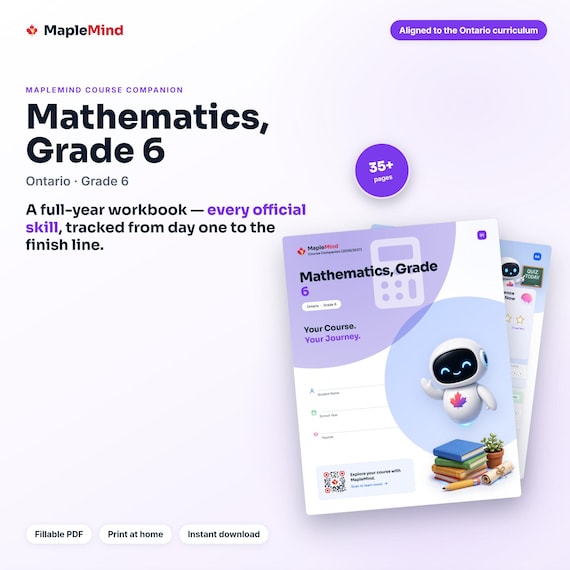
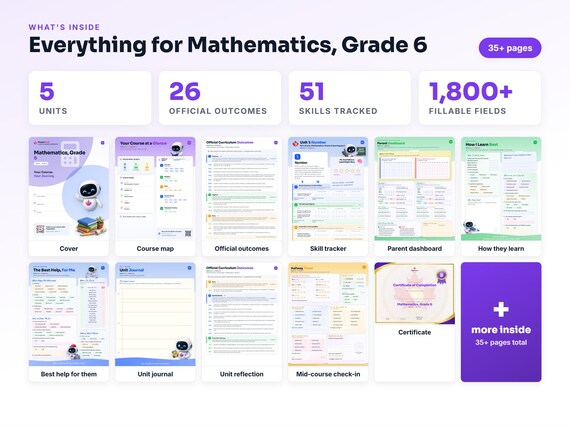
A Mathematics, Grade 6 workbook worth keeping
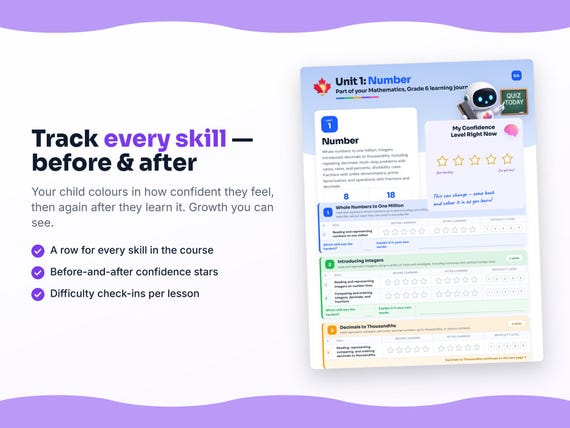
Built from the same official curriculum as this page. Before and after each skill above, your student colours in how sure they feel — so the two of you can see, on one page, what's clicking and what needs another look. It's a quiet way to follow how the year is really going.
By June it's full of their own handwriting: units worked through, confidence grown, a mid-year check-in, notes from parent-teacher night, and a certificate at the end. Less a worksheet, more a record of the year worth keeping on the shelf.
Instant download · see every page, reviews and the full description · five or more workbooks are $2.99 each
What it looks like in the app



Preparing for the EQAO Grade 6 assessment?
Ontario runs EQAO assessments in Grade 6. MapleMind's practice and exam modes build questions from this course so the format feels familiar.
Common questions
Can MapleMind help my child with Mathematics, Grade 6?
Yes. MapleMind's AI tutor covers all 51 skills in Ontario's Mathematics, Grade 6 — your child picks the exact skill, and the tutor teaches it step by step: a short lesson, a worked example, solving together, then a skill check to show it stuck.
Is MapleMind aligned to Ontario's official curriculum?
Yes. Every skill in this course maps to an official outcome code from Ontario's Grade 6 Mathematics curriculum, and the ministry's own wording is quoted under each unit on this page — with the official government source linked so you can check it yourself.
What does MapleMind cost?
It's free to start — 5 tutoring chats and a practice quiz every day, no credit card. A Pro subscription ($9.99/month or $49.99/year CAD, 7-day free trial) unlocks unlimited tutoring, practice, and exam simulations.
What if my child is stuck on just one topic?
That's the point of skill-level tutoring: open Mathematics, Grade 6 in the app, tap the exact skill from the list on this page, and the tutor teaches just that — no wading through lessons your child doesn't need.
Does MapleMind work in French or other languages?
Yes — 14 languages, including French. Both the app and the tutor's explanations switch to the language your child chooses.
Where can I see the official Ontario curriculum for Mathematics, Grade 6?
The official source is linked on this page — Ontario's official mathematics curriculum. The outline here follows it: every MapleMind skill carries its official outcome code, and the ministry's own wording is quoted under each unit.
Does MapleMind help with the EQAO Grade 6 assessment?
Yes. Ontario runs EQAO assessments in Grade 6. MapleMind's practice and exam modes build questions from this course so the format feels familiar.
Keep exploring
Ready when you are
Pick a skill from this page and see it taught properly — free, in the browser, in under a minute.