Get help with Mathematics 9
Most tutoring makes you sit through material you already know. MapleMind flips that: pick the exact skill that's causing trouble — any of the 69 below — and the tutor teaches just that one, step by step, as many times as it takes. Ask questions in plain words, any time of day, in English, French, or 12 other languages.
The official Alberta Mathematics 9 curriculum
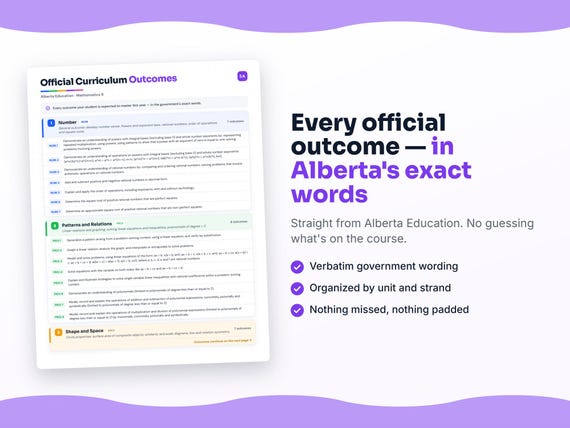
Alberta defines Mathematics 9 by strands and outcomes. MapleMind teaches the same curriculum reorganized for one-skill-at-a-time tutoring — the table shows exactly where every official strand lands, and the ministry's own wording is quoted under each unit below.
Official source Alberta's official programs of studyRead it on the government site — alberta.ca ↗| Official strand | Outcomes | Where MapleMind teaches it |
|---|---|---|
| Number | 6 | Number |
| Patterns and Relations (Patterns; Variables and Equations) | 7 | Patterns and Relations |
| Shape and Space (Measurement; 3-D Objects and 2-D Shapes; Transformations) | 5 | Shape and Space |
| Statistics and Probability (Data Analysis; Chance and Uncertainty) | 4 | Statistics and Probability |
Every skill below, taught one on one.
 Try the first session free
How MapleMind teaches Mathematics 9 — every unit, lesson, and skill
Every skill below runs as a short session: a plain-words lesson, a worked example, solving it together, then a five-question skill check that earns up to three stars. Guided Mode keeps it teaching instead of answer-handing — turning it off needs a parent's password.
Unit 1NumberOfficial strand · Number
General outcome: develop number sense. Powers and exponent laws, rational numbers, order of operations, and square roots.
Understanding Powers
- What a power means9.N.1 — Read and write powers: identify the base and exponent, and represent repeated multiplication as a power (and back).
- Powers with negative bases9.N.1 — Evaluate powers with integral (including negative) bases, and explain the difference between expressions like (−2)⁴ and −2⁴.
- The zero exponent9.N.1 — Use patterns to show why any power with a non-zero base and an exponent of zero equals one.
- Solving problems with powers9.N.1 — Apply powers to solve problems, including area, volume and repeated-growth contexts.
The Exponent Laws
- Product law9.N.2 — Multiply powers with the same base by adding exponents: (aᵐ)(aⁿ) = aᵐ⁺ⁿ.
- Quotient law9.N.2 — Divide powers with the same base by subtracting exponents: aᵐ ÷ aⁿ = aᵐ⁻ⁿ (m > n).
- Power of a power9.N.2 — Raise a power to a power by multiplying exponents: (aᵐ)ⁿ = aᵐⁿ.
- Powers of products and quotients9.N.2 — Apply an exponent across a product or quotient: (ab)ᵐ = aᵐbᵐ and (a/b)ⁿ = aⁿ/bⁿ (b ≠ 0).
- Combining the laws9.N.2 — Choose and combine the exponent laws to simplify multi-step expressions.
The Rational Number System
- What rational numbers are9.N.3 — Identify rational numbers — fractions, decimals, integers and mixed numbers, positive and negative — and place them on a number line.
- Comparing and ordering9.N.3 — Compare and order rational numbers in fraction and decimal form, using benchmarks, place value and equivalent forms.
- Rationals between rationals9.N.3 — Identify a rational number between two given rational numbers.
Operations with Rational Numbers
- Adding and subtracting decimals9.N.3 — Add and subtract positive and negative rational numbers in decimal form.
- Adding and subtracting fractions9.N.3 — Add and subtract positive and negative fractions and mixed numbers, with like and unlike denominators.
- Multiplying and dividing decimals9.N.3 — Multiply and divide positive and negative rational numbers in decimal form.
- Multiplying and dividing fractions9.N.3 — Multiply and divide positive and negative fractions and mixed numbers.
- Problem solving with rationals9.N.3 — Solve multi-step, real-context problems involving arithmetic operations on rational numbers.
Order of Operations
- Order of operations with exponents9.N.4 — Explain and apply the order of operations, including exponents, with and without technology.
- Order of operations with rationals9.N.4 — Apply the order of operations to expressions that combine rational numbers, brackets and exponents.
Square Roots of Perfect Squares
- Perfect squares and their roots9.N.5 — Determine the square root of positive rational numbers that are perfect squares.
- Fraction and decimal perfect squares9.N.5 — Recognize fractions and decimals that are perfect squares (like 4/9 or 0.36) and determine their square roots.
Estimating Square Roots
- Approximating square roots9.N.6 — Estimate the square root of a positive rational number that is not a perfect square, using perfect-square benchmarks.
- Roots between two values9.N.6 — Identify a number whose square root lies between two given numbers, and verify with technology.
The official wording — 6 outcomes in this unit
- 9.N.1
Demonstrate an understanding of powers with integral bases (excluding base 0) and whole number exponents by: representing repeated multiplication, using powers; using patterns to show that a power with an exponent of zero is equal to one; solving problems involving powers.
- 9.N.2
Demonstrate an understanding of operations on powers with integral bases (excluding base 0) and whole number exponents: (a^m)(a^n)=a^(m+n); a^m ÷ a^n = a^(m−n), m>n; (a^m)^n = a^(mn); (ab)^m = a^m b^m; (a/b)^n = a^n/b^n, b≠0.
- 9.N.3
Demonstrate an understanding of rational numbers by: comparing and ordering rational numbers; solving problems that involve arithmetic operations on rational numbers.
- 9.N.4
Explain and apply the order of operations, including exponents, with and without technology.
- 9.N.5
Determine the square root of positive rational numbers that are perfect squares.
- 9.N.6
Determine an approximate square root of positive rational numbers that are non-perfect squares.
Unit 2Patterns and RelationsOfficial strand · Patterns and Relations (Patterns; Variables and Equations)
Linear relations and graphing; solving linear equations and inequalities; polynomials of degree ≤ 2.
Linear Patterns and Equations
- Spotting linear patterns9.PR.1 — Identify and describe linear patterns in tables, pictures and problem contexts.
- From pattern to equation9.PR.1 — Generalize a pattern from a problem-solving context by writing a linear equation for it.
- Verify and predict9.PR.1 — Verify a pattern equation by substitution, then use it to predict later terms.
Graphing Linear Relations
- Graphing a linear relation9.PR.2 — Create a table of values from a linear relation and graph it.
- Reading linear graphs9.PR.2 — Analyze a linear graph and describe the relationship it shows in context.
- Interpolate and extrapolate9.PR.2 — Use a linear graph to estimate values between and beyond the plotted points to solve problems.
Solving Equations I — One and Two Steps
- One-step equations9.PR.3 — Model and solve one-step equations of the form ax = b and x/a = b with rational numbers.
- Two-step equations9.PR.3 — Model and solve two-step equations of the form ax + b = c and x/a + b = c.
- Equations with fractions and decimals9.PR.3 — Solve equations whose coefficients and constants are fractions or decimals.
Solving Equations II — Multi-Step
- Variables on both sides9.PR.3 — Solve equations with the variable on both sides, like ax = b + cx and ax + b = cx + d.
- Equations with brackets9.PR.3 — Expand and solve equations with brackets, like a(x + b) = c and a(bx + c) = d(ex + f).
- Modelling problems with equations9.PR.3 — Translate real problem situations into linear equations (including a/x = b) and solve them.
Linear Inequalities
- What inequalities mean9.PR.4 — Represent an inequality and its solution set in words, symbols and on a number line.
- Solving inequalities9.PR.4 — Solve single-variable linear inequalities with rational coefficients, including reversing the sign when multiplying or dividing by a negative.
- Inequalities in context9.PR.4 — Use inequalities to model and solve problem situations, and verify solution sets.
Introducing Polynomials
- Polynomial vocabulary9.PR.5 — Identify terms, coefficients, constants and the degree of polynomials (degree ≤ 2).
- Modelling polynomials9.PR.5 — Represent polynomials concretely and pictorially (algebra-tile style) and connect the models to symbols.
- Like terms and equivalent expressions9.PR.5 — Identify like terms and recognize equivalent polynomial expressions.
Adding and Subtracting Polynomials
- Adding polynomials9.PR.6 — Add polynomial expressions (degree ≤ 2) concretely, pictorially and symbolically.
- Subtracting polynomials9.PR.6 — Subtract polynomial expressions (degree ≤ 2), explaining the strategy used.
Multiplying and Dividing by Monomials
- Multiplying by a monomial9.PR.7 — Multiply polynomial expressions (degree ≤ 2) by monomials, concretely, pictorially and symbolically.
- Dividing by a monomial9.PR.7 — Divide polynomial expressions (degree ≤ 2) by monomials, explaining each step.
The official wording — 7 outcomes in this unit
- 9.PR.1
Generalize a pattern arising from a problem-solving context, using a linear equation, and verify by substitution.
- 9.PR.2
Graph a linear relation, analyze the graph, and interpolate or extrapolate to solve problems.
- 9.PR.3
Model and solve problems, using linear equations of the form: ax = b; x/a = b, a≠0; ax + b = c; x/a + b = c, a≠0; ax = b + cx; a(x + b) = c; ax + b = cx + d; a(bx + c) = d(ex + f); a/x = b, x≠0; where a, b, c, d, e and f are rational numbers.
- 9.PR.4
Explain and illustrate strategies to solve single variable linear inequalities with rational coefficients within a problem-solving context.
- 9.PR.5
Demonstrate an understanding of polynomials (limited to polynomials of degree less than or equal to 2).
- 9.PR.6
Model, record and explain the operations of addition and subtraction of polynomial expressions, concretely, pictorially and symbolically (limited to polynomials of degree less than or equal to 2).
- 9.PR.7
Model, record and explain the operations of multiplication and division of polynomial expressions (limited to polynomials of degree less than or equal to 2) by monomials, concretely, pictorially and symbolically.
Unit 3Shape and SpaceOfficial strand · Shape and Space (Measurement; 3-D Objects and 2-D Shapes; Transformations)
Circle properties; surface area of composite objects; similarity and scale diagrams; line and rotation symmetry.
Inscribed and Central Angles
- Central and inscribed angles9.SS.1 — Use the property that a central angle is twice the inscribed angle subtended by the same arc to find missing angles.
- Inscribed angles on the same arc9.SS.1 — Use the property that inscribed angles subtended by the same arc are congruent, and justify the reasoning.
Chord Properties
- The perpendicular-to-a-chord property9.SS.1 — Use the property that the perpendicular from the centre of a circle to a chord bisects the chord.
- Solving chord problems9.SS.1 — Combine chord properties with the Pythagorean theorem to find lengths and distances in circles.
Tangent Properties
- Tangents and radii9.SS.1 — Use the property that a tangent to a circle is perpendicular to the radius at the point of tangency.
- Combining circle properties9.SS.1 — Solve multi-step circle problems that combine tangent, chord and angle properties, justifying the strategy.
Surface Area of Composite Objects
- Surface area foundations9.SS.2 — Review surface area of right prisms and cylinders as the building blocks of composite objects.
- Composite objects and overlap9.SS.2 — Determine the surface area of composite 3-D objects, accounting for hidden and overlapping faces.
- Surface-area problem solving9.SS.2 — Solve real-context problems (painting, wrapping, building) involving composite surface area.
Similar Polygons
- What makes polygons similar9.SS.3 — Identify similar polygons using corresponding angles and proportional corresponding sides.
- Solving with similarity9.SS.3 — Use proportions in similar polygons to determine missing side lengths in problems.
Scale Diagrams
- Reading scale diagrams9.SS.4 — Interpret scale diagrams of 2-D shapes and determine scale factors from them.
- Drawing to scale9.SS.4 — Draw enlargements and reductions of 2-D shapes for a given scale factor.
Line and Rotation Symmetry
- Line symmetry9.SS.5 — Identify and draw lines of symmetry in 2-D shapes and designs.
- Rotation symmetry9.SS.5 — Determine the order and angle of rotation symmetry in shapes and designs.
The official wording — 5 outcomes in this unit
- 9.SS.1
Solve problems and justify the solution strategy, using the following circle properties: the perpendicular from the centre of a circle to a chord bisects the chord; the measure of the central angle is equal to twice the measure of the inscribed angle subtended by the same arc; the inscribed angles subtended by the same arc are congruent; a tangent to a circle is perpendicular to the radius at the point of tangency.
- 9.SS.2
Determine the surface area of composite 3-D objects to solve problems.
- 9.SS.3
Demonstrate an understanding of similarity of polygons.
- 9.SS.4
Draw and interpret scale diagrams of 2-D shapes.
- 9.SS.5
Demonstrate an understanding of line and rotation symmetry.
Unit 4Statistics and ProbabilityOfficial strand · Statistics and Probability (Data Analysis; Chance and Uncertainty)
Factors affecting data collection; population vs. sample; a data-analysis project; and the role of probability in society.
Collecting Good Data
- Bias, language and ethics9.SP.1 — Describe how bias, the use of language, and ethics affect what data gets collected and what it means.
- Cost, timing, privacy and culture9.SP.1 — Describe how cost, time and timing, privacy, and cultural sensitivity influence data collection, using real cases.
Population and Sample
- Population vs. sample9.SP.2 — Distinguish a population from a sample and recognize when each is the right way to answer a question.
- Defending your choice9.SP.2 — Select and defend the choice of population or sample for a given question, weighing accuracy, cost and practicality.
Your Data Project
- Planning the investigation9.SP.3 — Formulate a question for investigation and design a collection plan that includes social considerations and a population-or-sample choice.
- Collecting and displaying9.SP.3 — Collect the data and display it in an appropriate, honest format.
- Analyzing and concluding9.SP.3 — Analyze the displayed data and draw conclusions that actually answer the investigation question.
Probability in Society
- Probability in everyday decisions9.SP.4 — Explain how probability is used in society — weather, sports, insurance, games — and interpret what stated probabilities mean.
- Assumptions behind the numbers9.SP.4 — Identify the assumptions behind a stated probability and how probabilities can be misused or misread.
The official wording — 4 outcomes in this unit
- 9.SP.1
Describe the effect of: bias; use of language; ethics; cost; time and timing; privacy; cultural sensitivity; on the collection of data.
- 9.SP.2
Select and defend the choice of using either a population or a sample of a population to answer a question.
- 9.SP.3
Develop and implement a project plan for the collection, display and analysis of data by: formulating a question for investigation; choosing a data collection method that includes social considerations; selecting a population or a sample; collecting the data; displaying the collected data in an appropriate manner; drawing conclusions to answer the question.
- 9.SP.4
Demonstrate an understanding of the role of probability in society.

Printable workbook · A keepsake of the year
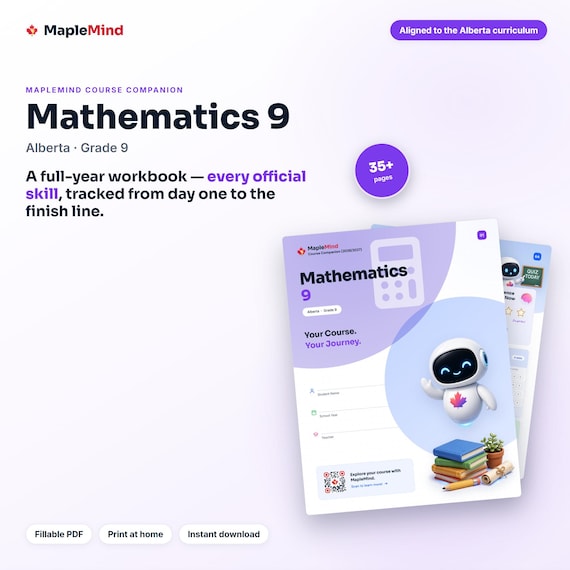
A Mathematics 9 workbook worth keeping
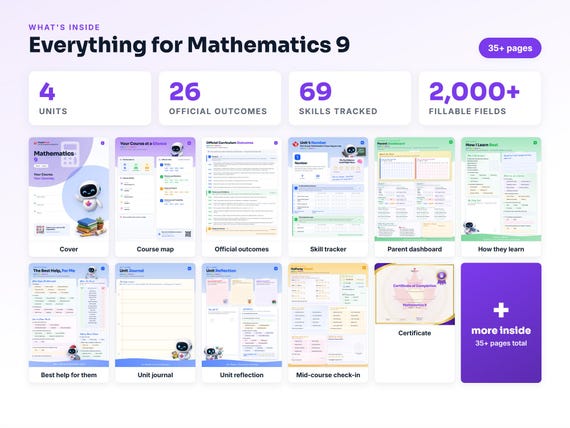
Built from the same official curriculum as this page. Before and after each skill above, your student colours in how sure they feel — so the two of you can see, on one page, what's clicking and what needs another look. It's a quiet way to follow how the year is really going.
By June it's full of their own handwriting: units worked through, confidence grown, a mid-year check-in, notes from parent-teacher night, and a certificate at the end. Less a worksheet, more a record of the year worth keeping on the shelf.
Instant download · see every page, reviews and the full description · five or more workbooks are $2.99 each
What it looks like in the app



Preparing for the Grade 9 Provincial Achievement Test (PAT)?
Alberta students write a Provincial Achievement Test in Grade 9. MapleMind's exam mode simulates it from this course's skills, then shows exactly which ones to shore up.
Common questions
Can MapleMind help me with Mathematics 9?
Yes. MapleMind's AI tutor covers all 69 skills in Alberta's Mathematics 9 — you pick the exact skill, and the tutor teaches it step by step: a short lesson, a worked example, solving together, then a skill check to show it stuck.
Is MapleMind aligned to Alberta's official curriculum?
Yes. Every skill in this course maps to an official outcome code from Alberta's Grade 9 Mathematics curriculum, and the ministry's own wording is quoted under each unit on this page — with the official government source linked so you can check it yourself.
What does MapleMind cost?
It's free to start — 5 tutoring chats and a practice quiz every day, no credit card. A Pro subscription ($9.99/month or $49.99/year CAD, 7-day free trial) unlocks unlimited tutoring, practice, and exam simulations.
What if I'm stuck on just one topic?
That's the point of skill-level tutoring: open Mathematics 9 in the app, tap the exact skill from the list on this page, and the tutor teaches just that — no wading through lessons you don't need.
Does MapleMind work in French or other languages?
Yes — 14 languages, including French. Both the app and the tutor's explanations switch to the language you choose.
Where can I see the official Alberta curriculum for Mathematics 9?
The official source is linked on this page — Alberta's official programs of study. The outline here follows it: every MapleMind skill carries its official outcome code, and the ministry's own wording is quoted under each unit.
Does MapleMind help with the Grade 9 Provincial Achievement Test (PAT)?
Yes. Alberta students write a Provincial Achievement Test in Grade 9. MapleMind's exam mode simulates it from this course's skills, then shows exactly which ones to shore up.
Keep exploring
Ready when you are
Pick a skill from this page and see it taught properly — free, in the browser, in under a minute.