Alberta · For parents

What your child learns in Grade 9 in Alberta

Every subject, unit by unit, from Alberta’s curriculum: 222 skills in plain words.

Subjects
5
Skills
222
Provincial exams
9
Official curriculum
alberta.ca

Math in Grade 9

Mathematics 9

4 units · 69 skills

  1. Unit 1

    Number

    A power is shorthand for repeated multiplication: the base is the number being multiplied; the exponent counts how many times it appears as a factor.

    • What a power means
    • Powers with negative bases
    • The zero exponent
    20 more skills
    • Solving problems with powers
    • Product law
    • Quotient law
    • Power of a power
    • Powers of products and quotients
    • Combining the laws
    • What rational numbers are
    • Comparing and ordering
    • Rationals between rationals
    • Adding and subtracting decimals
    • Adding and subtracting fractions
    • Multiplying and dividing decimals
    • Multiplying and dividing fractions
    • Problem solving with rationals
    • Order of operations with exponents
    • Order of operations with rationals
    • Perfect squares and their roots
    • Fraction and decimal perfect squares
    • Approximating square roots
    • Roots between two values
  2. Unit 2

    Patterns and Relations

    A pattern is linear when it changes by the SAME amount each step — that constant jump is the fingerprint of linearity.

    • Spotting linear patterns
    • From pattern to equation
    • Verify and predict
    19 more skills
    • Graphing a linear relation
    • Reading linear graphs
    • Interpolate and extrapolate
    • One-step equations
    • Two-step equations
    • Equations with fractions and decimals
    • Variables on both sides
    • Equations with brackets
    • Modelling problems with equations
    • What inequalities mean
    • Solving inequalities
    • Inequalities in context
    • Polynomial vocabulary
    • Modelling polynomials
    • Like terms and equivalent expressions
    • Adding polynomials
    • Subtracting polynomials
    • Multiplying by a monomial
    • Dividing by a monomial
  3. Unit 3

    Shape and Space

    A CENTRAL angle has its vertex at the centre; an INSCRIBED angle has its vertex ON the circle — what matters is that both open onto the SAME arc.

    • Central and inscribed angles
    • Inscribed angles on the same arc
    • The perpendicular-to-a-chord property
    12 more skills
    • Solving chord problems
    • Tangents and radii
    • Combining circle properties
    • Surface area foundations
    • Composite objects and overlap
    • Surface-area problem solving
    • What makes polygons similar
    • Solving with similarity
    • Reading scale diagrams
    • Drawing to scale
    • Line symmetry
    • Rotation symmetry
  4. Unit 4

    Statistics and Probability

    Bias skews WHO gets asked (polling only the hockey team about rink funding); language skews WHAT they answer (leading or loaded questions); ethics governs whether the collection should happen at all.

    • Bias, language and ethics
    • Cost, timing, privacy and culture
    • Population vs. sample
    6 more skills
    • Defending your choice
    • Planning the investigation
    • Collecting and displaying
    • Analyzing and concluding
    • Probability in everyday decisions
    • Assumptions behind the numbers

Science in Grade 9

Science 9

5 units · 42 skills

  1. Unit 1

    Biological Diversity

    Diversity has two scales: variation AMONG species (how different a wolf and a trout are) and variation WITHIN a species (how two wolves differ). Both matter.

    • Variation within and among species
    • Niches and symbiotic relationships
    • Sexual vs. asexual reproduction
    7 more skills
    • Heritable traits and variation
    • Dominant and recessive characteristics
    • Chromosomes, genes and DNA
    • Natural and artificial selection
    • Genetic technologies and their issues
    • Extinction and changing diversity
    • Conservation strategies and biotechnology
  2. Unit 2

    Matter and Chemical Change

    A physical property can be observed without changing what the substance is (colour, state, melting point, solubility, conductivity, density); a chemical property describes how it reacts to form new substances (flammability, reactivity with acid).

    • Physical and chemical properties
    • Classifying materials
    • Evidence of chemical change
    8 more skills
    • Reaction rates and energy
    • Conservation of mass
    • Origins of the periodic table
    • Reading atomic structure from the table
    • Ionic vs. molecular compounds
    • Reading and naming chemical formulas
    • Combining ratios and models
    • Word and formula equations
  3. Unit 3

    Environmental Chemistry

    Living things need certain substances (oxygen, water, nutrients); other substances (toxins, excess nutrients, pollutants) can harm them.

    • Helpful and harmful substances
    • Organisms and their chemical needs
    • Measuring quantities of substances
    3 more skills
    • Monitoring air and water quality
    • Transport and bioaccumulation
    • Factors affecting distribution
  4. Unit 4

    Electrical Principles and Technologies

    Energy is not created or used up — it is CONVERTED from one form to another (chemical, mechanical, electrical, light, heat, sound).

    • Energy conversions
    • Static and current electricity
    • Circuits and components
    5 more skills
    • Voltage, current and resistance
    • Energy inputs and outputs
    • Calculating efficiency
    • Generation and the environment
    • Conservation and everyday choices
  5. Unit 5

    Space Exploration

    Our knowledge of space is limited by our tools — new instruments (the telescope, spacecraft) repeatedly overturned old ideas.

    • Changing ideas about Earth and space
    • Reference frames and celestial motion
    • Challenges of space travel
    4 more skills
    • Spin-off technologies
    • Optical and radio telescopes
    • Space probes and remote sensing
    • Opportunities and alternatives
See the course: Science 9

English in Grade 9

2 courses. Choose the one your child takes.

English as an Additional Language (Grades 7–9)

6 units · 28 skills

  1. Unit 1

    Emerging Literacy (Levels A–B)

    You do not need every word — catching one key word (with a picture or action) is enough to understand.

    • Level A — Listening
    • Level A — Speaking
    • Level A — Reading
    5 more skills
    • Level A — Writing
    • Level B — Listening
    • Level B — Speaking
    • Level B — Reading
    • Level B — Writing
  2. Unit 2

    Level 1 — Beginning

    One-step instructions (open, close, write, look) tell you exactly one thing to do.

    • Level 1 — Listening
    • Level 1 — Speaking
    • Level 1 — Reading
    1 more skill
    • Level 1 — Writing
  3. Unit 3

    Level 2 — Developing

    Listen for the key words that carry the meaning of a short message.

    • Level 2 — Listening
    • Level 2 — Speaking
    • Level 2 — Reading
    1 more skill
    • Level 2 — Writing
  4. Unit 4

    Level 3 — Expanding

    Beyond the main idea, listen for details: who, when, how many.

    • Level 3 — Listening
    • Level 3 — Speaking
    • Level 3 — Reading
    1 more skill
    • Level 3 — Writing
  5. Unit 5

    Level 4 — Bridging

    You can now handle a new situation, not only familiar ones, using context clues.

    • Level 4 — Listening
    • Level 4 — Speaking
    • Level 4 — Reading
    1 more skill
    • Level 4 — Writing
  6. Unit 6

    Level 5 — Extending

    You can now follow new social and subject-area situations with less support.

    • Level 5 — Listening
    • Level 5 — Speaking
    • Level 5 — Reading
    1 more skill
    • Level 5 — Writing

English Language Arts 9

5 units · 20 skills

  1. Unit 1

    Reading and Comprehension

    An explicit idea is stated directly in the words; an implicit idea is suggested or implied — you infer it from clues in the text plus what you know.

    • Explicit and implicit meaning
    • Textual cues, skimming and scanning
    • Why readers interpret differently
    1 more skill
    • Weighing multiple points of view
  2. Unit 2

    Responding to and Analyzing Texts

    Characters reveal themselves through what they choose to do and why (their motives), not just what they say about themselves.

    • Character choices and motives
    • Irony, symbolism and other techniques
    • Forms and genres
    2 more skills
    • Comparing character, plot and theme
    • How texts reflect culture
  3. Unit 3

    Creating Texts

    Good writing ideas often come from generalizing a personal experience into a theme others share.

    • Generating ideas from a theme
    • Structuring a narrative
  4. Unit 4

    Research and Information

    A focused research question is specific enough to answer and points you to the information you need.

    • Focusing a research question
    • Evaluating sources for bias
    • Organizing information
    1 more skill
    • Summarizing in your own words
  5. Unit 5

    Writing Craft and Conventions

    Revising is re-seeing the whole piece: does the introduction pull the reader in, is the point of view consistent, do ideas connect with transitions, does the conclusion land?

    • Revising for structure and flow
    • Denotation and connotation
    • Parallel structure
    2 more skills
    • Punctuation and quotation marks
    • Spelling strategies

French in Grade 9

2 courses. Choose the one your child takes.

French as a Second Language 9 (Nine-Year Program)

6 units · 20 skills

  1. Unit 1

    La boîte à outils — Grade 9 Grammar Core

    Three families, three ending sets: –er (je parle, tu parles, il parle, nous parlons, vous parlez, ils parlent), –ir (je finis… nous finissons), –re (j'attends… il attend — no ending in the il form).

    • Conjugating –er, –ir and –re verbs
    • Present tense in affirmative and negative sentences
    • Reflexive verbs in the present
    5 more skills
    • Vouloir, pouvoir, devoir + infinitive
    • The immediate future: aller + infinitive
    • The imperative — commands and advice
    • Expressions with avoir and faire
    • Forming adverbs from adjectives
  2. Unit 2

    Sports et exercice

    Hunt the key words you have been taught — they carry the main idea; you do not need every word (tolerating ambiguity is a strategy, not a weakness).

    • Listening for main ideas and details
    • Reading French texts about sport
    • Explaining a sport orally
    1 more skill
    • Writing a physical activity plan
  3. Unit 3

    Le logement

    Ad French is compressed: maison à deux étages (two-storey house), 8½ pièces (rooms), récemment rénovée, extérieur en briques — learn the pattern, not just the words.

    • Understanding housing texts and ads
    • Describing a home in writing
  4. Unit 4

    La communauté

    Community announcements answer quoi/où/quand (what/where/when) — hunt those three and you have the message.

    • Understanding community messages
    • Giving directions and describing events
  5. Unit 5

    Fêtes et célébrations

    Tradition texts follow a pattern: l'origine (where it began) → les traditions (what people do) → la nourriture (what they eat) — use the pattern as a map.

    • Reading about holidays and traditions
    • Writing about celebrations
  6. Unit 6

    Le monde francophone

    The Francophonie has layers: local (Edmonton's francophone community), provincial (Saint-Paul, Legal), national (Saint-Boniface, Manitoba; Shédiac, Nouveau-Brunswick), international (la Louisiane, Saint-Pierre et Miquelon).

    • Francophone communities and festivals
    • Accents and cultural conventions

French Language Arts (immersion) 9

5 units · 21 skills · Taught in French

  1. Unit 1

    Valorisation du français

    • Valoriser son apprentissage du français
  2. Unit 2

    Compréhension orale

    • Comprendre des discours oraux pour s'informer
    • Comprendre des discours oraux — imaginaire et divertissement
    • L'écoute et les cultures francophones
    2 more skills
    • Planifier son écoute
    • Gérer son écoute
  3. Unit 3

    Compréhension écrite

    • Comprendre des textes écrits pour s'informer
    • Comprendre des textes — imaginaire et esthétique
    • La lecture et les cultures francophones
    2 more skills
    • Planifier sa lecture
    • Gérer sa lecture
  4. Unit 4

    Production orale

    • Parler pour transmettre de l'information
    • Parler pour explorer le langage et divertir
    • Parler clairement et correctement
    2 more skills
    • Planifier sa production orale
    • Gérer sa production orale
  5. Unit 5

    Production écrite

    • Rédiger des textes pour transmettre de l'information
    • Rédiger des textes — imaginaire et vision du monde
    • Écrire correctement
    2 more skills
    • Planifier sa production écrite
    • Gérer sa production écrite

Social studies in Grade 9

Social Studies 9

2 units · 22 skills

  1. Unit 1

    Issues for Canadians: Governance and Rights

    A bill passes through readings in the House of Commons and the Senate, then receives royal assent to become law.

    • How laws are passed and the three branches
    • Choosing and accountability of MPs and Senators
    • Parties, media and lobby groups
    10 more skills
    • How citizens take part in justice
    • The Youth Criminal Justice Act
    • How the Charter protects individual rights
    • The Charter in the workplace
    • Collective rights and language rights
    • The Indian Act and the numbered treaties
    • Métis rights and the Alberta Settlements
    • What shapes immigration policy
    • Provincial and Québec immigration policy
    • Immigration’s impacts and benefits
  2. Unit 2

    Issues for Canadians: Economic Systems

    In a market economy, prices are set by supply and demand, businesses compete, and property is privately owned — decisions are made by individual buyers and sellers, not government.

    • Market economy principles and the consumer
    • Why Canada is a mixed economy
    • Comparing Canada and the United States
    6 more skills
    • Quality of life and consumer behaviour
    • Marketing and consumer power
    • Regional views and social programs
    • Party platforms and philosophy
    • The underground economy and taxes
    • Government decisions on the environment

Provincial exams in Grade 9

MapleMind

See Grade 9 in MapleMind

Real screens from the app your child would use.

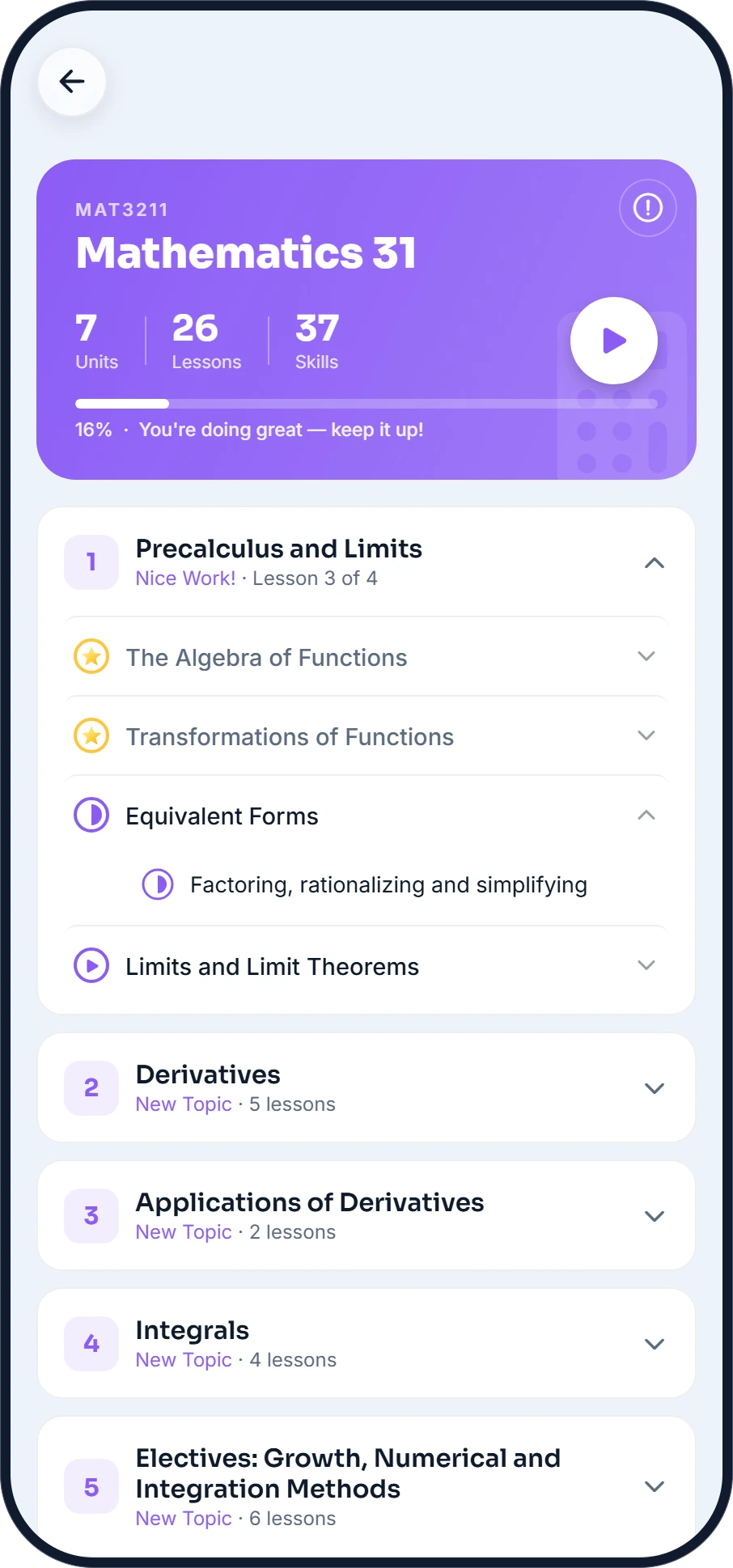
Mathematics 31 in MapleMind on a tablet: its units and lessons in order, a student partway through.Mathematics 31 in MapleMind on a phone: its units and lessons in order, a student partway through.
Their course, unit by unit, the way Alberta teaches it.Shown: Mathematics 31
Homework Help on a tablet: a photo of a worksheet, the tutor’s worked example of a two-step equation, and a question back to the student.Homework Help on a phone: a photo of a worksheet, the tutor’s worked example of a two-step equation, and a question back to the student.
Homework Help: they take a photo of the question, and the tutor works through it with them.
The Parent Dashboard on a tablet: a student’s days studied, streak, lessons, quiz average and recent activity.The Parent Dashboard on a phone: a student’s days studied, streak, lessons, quiz average and recent activity.
The Parent Dashboard: how each child’s week went, in lessons, quizzes and days studied.
A Grade 9 provincial mathematics exam on a tablet: a readiness score, the exam’s time and its next sitting.A Grade 9 provincial mathematics exam on a phone: a readiness score, the exam’s time and its next sitting.
A provincial exam: a practice sitting under the real time, and how ready they are.
The Learn tab on a tablet: a four-day streak, the week’s days, Homework Help, the next lesson and a review.The Learn tab on a phone: a four-day streak, the week’s days, Homework Help, the next lesson and a review.
The Learn tab: their week so far, and the next thing to do.

Help at home

Questions parents ask

What will my child learn in Grade 9 in Alberta?

Math: Mathematics 9. Science: Science 9. English: English as an Additional Language (Grades 7–9) and English Language Arts 9. French: French as a Second Language 9 (Nine-Year Program) and French Language Arts (immersion) 9. Social studies: Social Studies 9. That’s 222 skills in all, from Alberta’s curriculum.

When is the Grade 9 English Language Arts Provincial Achievement Test?

It’s written January 20, 2027, and January 21, 2027, and June 3, 2027, and June 8, 2027.

Where does this list come from?

From Alberta’s official curriculum, the documents its education ministry publishes for each course. Each skill here is one of their expectations, written in plain words.

Can MapleMind help my child in Grade 9?

Yes. Every course on this page is in MapleMind, with lessons, practice and a tutor that works through each step with them. A free account gets 30 messages and 4 activities a day.

Help with Grade 9, one skill at a time.

Every course on this page is in MapleMind, free with daily limits.