Get help with French as a Second Language 9 (Nine-Year Program)
Most tutoring makes you sit through material you already know. MapleMind flips that: pick the exact skill that's causing trouble — any of the 20 below — and the tutor teaches just that one, step by step, as many times as it takes. Ask questions in plain words, any time of day, in English, French, or 12 other languages.
The official Alberta French as a Second Language 9 (Nine-Year Program) curriculum
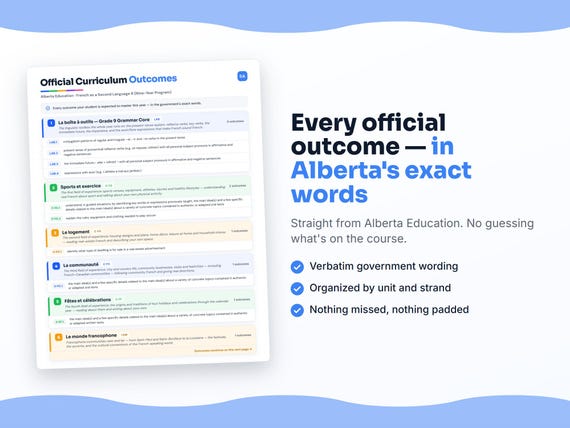
Alberta defines French as a Second Language 9 (Nine-Year Program) by strands and outcomes. MapleMind teaches the same curriculum reorganized for one-skill-at-a-time tutoring — the table shows exactly where every official strand lands, and the ministry's own wording is quoted under each unit below.
Official source Alberta's official programs of studyRead it on the government site — alberta.ca ↗| Official strand | Outcomes | Where MapleMind teaches it |
|---|---|---|
| Language | 2 | La boîte à outils — Grade 9 Grammar Core |
| Communication · Field: Sports and Exercise | 4 | Sports et exercice |
| Communication · Field: Housing | 2 | Le logement |
| Communication · Field: Community | 2 | La communauté |
| Communication · Field: Four Holidays and Celebrations | 2 | Fêtes et célébrations |
| Culture | 1 | Le monde francophone |
Every skill below, taught one on one.
 Try the first session free
How MapleMind teaches French as a Second Language 9 (Nine-Year Program) — every unit, lesson, and skill
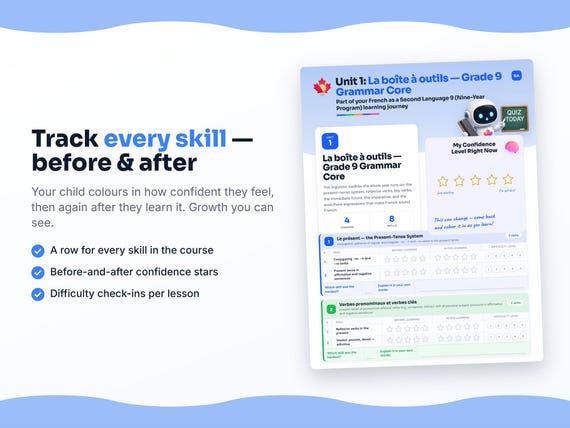
Every skill below runs as a short session: a plain-words lesson, a worked example, solving it together, then a five-question skill check that earns up to three stars. Guided Mode keeps it teaching instead of answer-handing — turning it off needs a parent's password.
Unit 1La boîte à outils — Grade 9 Grammar CoreOfficial strand · Language
The linguistic toolbox the whole year runs on: the present-tense system, reflexive verbs, key verbs, the immediate future, the imperative, and the avoir/faire expressions that make French sound French.
Le présent — the Present-Tense System
- Conjugating –er, –ir and –re verbs9.L.1 — Conjugate regular and irregular –er, –ir and –re verbs in the present tense with all personal subject pronouns.
- Present tense in affirmative and negative sentences9.L.2 — Use the present tense of regular and irregular verbs accurately in affirmative and negative sentences.
Verbes pronominaux et verbes clés
- Reflexive verbs in the present9.L.2 — Use pronominal reflexive verbs (se reposer, s'étirer) in the present tense, affirmative and negative.
- Vouloir, pouvoir, devoir + infinitive9.L.2 — Use vouloir, pouvoir and devoir in the present tense, and the verb + infinitive pattern (aimer, adorer, détester, vouloir, pouvoir, devoir + infinitif).
Le futur proche et l'impératif
- The immediate future: aller + infinitive9.L.2 — Express what is going to happen using the immediate future — aller + infinitif — with all subject pronouns, affirmative and negative.
- The imperative — commands and advice9.L.2 — Give commands and advice with the imperative, affirmative and negative, including reflexive verbs (Repose-toi sur le sol).
Expressions avec avoir et faire + les adverbes
- Expressions with avoir and faire9.L.2 — Use idiomatic expressions with avoir (L'athlète a mal aux jambes) and faire (Je fais du yoga; Mon père fait le ménage).
- Forming adverbs from adjectives9.L.2 — Form and use adverbs derived from adjectives (lente → lentement) to add precision to sentences.
The official wording — 2 outcomes in this unit
- 9.L.1
conjugation patterns of regular and irregular –er, –ir and –re verbs in the present tense
- 9.L.2
present tense of regular and irregular –er, –ir, –re verbs with all personal subject pronouns in affirmative and negative sentences
Unit 2Sports et exerciceOfficial strand · Communication · Field: Sports and Exercise
The first field of experience: sports venues, equipment, athletes, injuries and healthy lifestyles — understanding real French about sport and talking about your own physical activity.
Comprendre le monde du sport
- Listening for main ideas and details9.C.1 — Understand the main idea(s) and a few specific details in oral French about concrete topics like sports, using previously taught key words (identify le hockey sur glace and pull out rules of the game).
- Reading French texts about sport9.C.2 — Understand the main idea(s) and specific details in written French texts about sports and exercise.
Parler sport
- Explaining a sport orally9.C.3 — Describe and explain orally, with some detail in a structured, modelled fashion — e.g. explain the rules, equipment and clothing needed to play soccer.
- Writing a physical activity plan9.C.4 — Produce a structured written message in the present tense (and sometimes immediate future) — e.g. design a physical activity plan.
The official wording — 4 outcomes in this unit
- 9.C.1
understand, in guided situations, by identifying key words or expressions previously taught, the main idea(s) and a few specific details related to the main idea(s) about a variety of concrete topics contained in authentic or adapted oral texts
- 9.C.2
understand, in guided situations, by identifying key words or expressions previously taught, the main idea(s) and a few specific details related to the main idea(s) about a variety of concrete topics contained in authentic or adapted written texts
- 9.C.3
explain the rules, equipment and clothing needed to play soccer
- 9.C.4
design a physical activity plan
Unit 3Le logementOfficial strand · Communication · Field: Housing
The second field of experience: housing designs and plans, home décor, leisure at home and household chores — reading real-estate French and describing your own space.
Chez moi
- Understanding housing texts and ads9.C.2 — Pull the main idea and specific features from written housing texts — e.g. identify what type of dwelling is for sale in a real estate advertisement (maison à deux étages) and its features (8½ pièces, récemment rénovées).
- Describing a home in writing9.C.4 — Describe a home and explain choices in structured written French — e.g. explain the choice of colours and furniture for one's new room.
The official wording — 2 outcomes in this unit
- 9.C.2
identify what type of dwelling is for sale in a real estate advertisement
- 9.C.4
explain the choice of colours and furniture for one's new room
Unit 4La communautéOfficial strand · Communication · Field: Community
The third field of experience: city and country life, community businesses, clubs and festivities — including French-Canadian communities — following community French and giving real directions.
Ma communauté
- Understanding community messages9.C.1 — Understand main ideas and details in oral French about community life — announcements, events, services.
- Giving directions and describing events9.C.3 — Give directions and describe community happenings orally — e.g. give someone directions to the neighbourhood video store; describe a community event.
The official wording — 2 outcomes in this unit
- 9.C.1
the main idea(s) and a few specific details related to the main idea(s) about a variety of concrete topics contained in authentic or adapted oral texts
- 9.C.3
give someone directions to the neighbourhood video store
Unit 5Fêtes et célébrationsOfficial strand · Communication · Field: Four Holidays and Celebrations
The fourth field of experience: the origins and traditions of four holidays and celebrations through the calendar year — reading about them and writing about your own.
Les fêtes
- Reading about holidays and traditions9.C.2 — Understand written French about the origins and traditions of holidays and celebrations (the fourth field of experience).
- Writing about celebrations9.C.4 — Describe traditions and express preferences about celebrations in structured written French — e.g. describe a community event in an e-mail message.
The official wording — 2 outcomes in this unit
- 9.C.2
the main idea(s) and a few specific details related to the main idea(s) about a variety of concrete topics contained in authentic or adapted written texts
- 9.C.4
describe a community event in an e-mail message
Unit 6Le monde francophoneOfficial strand · Culture
Francophone communities near and far — from Saint-Paul and Saint-Boniface to la Louisiane — the festivals, the accents, and the cultural conventions of the French-speaking world.
La francophonie
- Francophone communities and festivals9.CU.1 — Identify Francophone communities at the local (Edmonton), provincial (Saint-Paul, Legal), national (Saint-Boniface; Shédiac) and international (la Louisiane; Saint-Pierre et Miquelon) levels, and festivals one could join (le Festival du Homard, le Carnaval de Nice).
- Accents and cultural conventions9.CU.1 — Recognize that accents vary within and among Francophone cultures (Acadian, Québécois, Parisian French) and use French sociolinguistic conventions (naming of streets, monuments, number spacing).
The official wording — 1 outcome in this unit
- 9.CU.1
identify Francophone communities at the local (e.g., Edmonton), provincial (e.g., Saint-Paul, Legal), national (e.g., Saint-Boniface, Manitoba; Shédiac, Nouveau-Brunswick) and international (e.g., la Louisiane; Saint-Pierre et Miquelon) levels

Printable workbook · A keepsake of the year
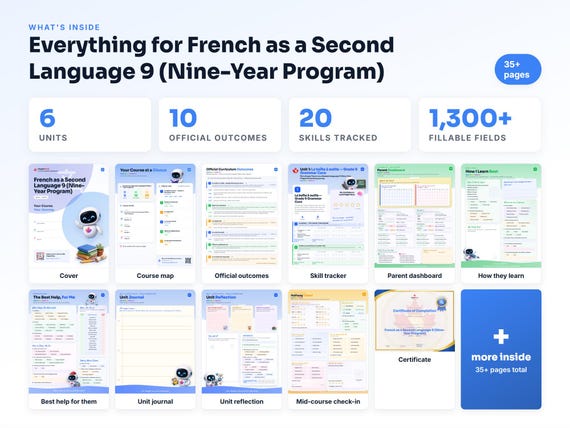
A French as a Second Language 9 (Nine-Year Program) workbook worth keeping
Built from the same official curriculum as this page. Before and after each skill above, your student colours in how sure they feel — so the two of you can see, on one page, what's clicking and what needs another look. It's a quiet way to follow how the year is really going.
By June it's full of their own handwriting: units worked through, confidence grown, a mid-year check-in, notes from parent-teacher night, and a certificate at the end. Less a worksheet, more a record of the year worth keeping on the shelf.
Instant download · see every page, reviews and the full description · five or more workbooks are $2.99 each
What it looks like in the app



Common questions
Can MapleMind help me with French as a Second Language 9 (Nine-Year Program)?
Yes. MapleMind's AI tutor covers all 20 skills in Alberta's French as a Second Language 9 (Nine-Year Program) — you pick the exact skill, and the tutor teaches it step by step: a short lesson, a worked example, solving together, then a skill check to show it stuck.
Is MapleMind aligned to Alberta's official curriculum?
Yes. Every skill in this course maps to an official outcome code from Alberta's Grade 9 French curriculum, and the ministry's own wording is quoted under each unit on this page — with the official government source linked so you can check it yourself.
What does MapleMind cost?
It's free to start — 5 tutoring chats and a practice quiz every day, no credit card. A Pro subscription ($9.99/month or $49.99/year CAD, 7-day free trial) unlocks unlimited tutoring, practice, and exam simulations.
What if I'm stuck on just one topic?
That's the point of skill-level tutoring: open French as a Second Language 9 (Nine-Year Program) in the app, tap the exact skill from the list on this page, and the tutor teaches just that — no wading through lessons you don't need.
Does MapleMind work in French or other languages?
Yes — 14 languages, including French. Both the app and the tutor's explanations switch to the language you choose.
Where can I see the official Alberta curriculum for French as a Second Language 9 (Nine-Year Program)?
The official source is linked on this page — Alberta's official programs of study. The outline here follows it: every MapleMind skill carries its official outcome code, and the ministry's own wording is quoted under each unit.
Keep exploring
Ready when you are
Pick a skill from this page and see it taught properly — free, in the browser, in under a minute.