Get help with Social Studies 9
Most tutoring makes you sit through material you already know. MapleMind flips that: pick the exact skill that's causing trouble — any of the 22 below — and the tutor teaches just that one, step by step, as many times as it takes. Ask questions in plain words, any time of day, in English, French, or 12 other languages.
The official Alberta Social Studies 9 curriculum
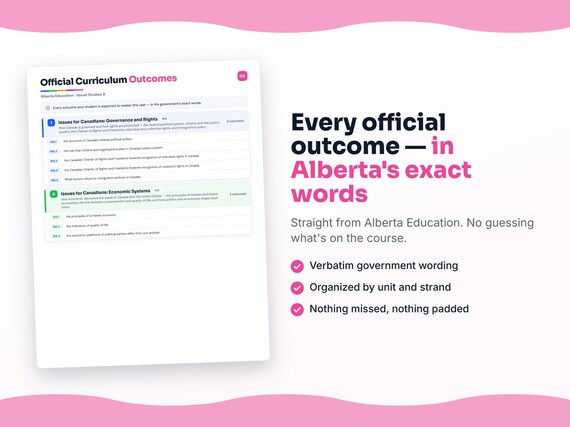
Alberta defines Social Studies 9 by strands and outcomes. MapleMind teaches the same curriculum reorganized for one-skill-at-a-time tutoring — the table shows exactly where every official strand lands, and the ministry's own wording is quoted under each unit below.
Official source Alberta's official programs of studyRead it on the government site — alberta.ca ↗| Official strand | Outcomes | Where MapleMind teaches it |
|---|---|---|
| Related Issue 9.1 | 13 | Issues for Canadians: Governance and Rights |
| Related Issue 9.2 | 9 | Issues for Canadians: Economic Systems |
Every skill below, taught one on one.
 Try the first session free
How MapleMind teaches Social Studies 9 — every unit, lesson, and skill
Every skill below runs as a short session: a plain-words lesson, a worked example, solving it together, then a five-question skill check that earns up to three stars. Guided Mode keeps it teaching instead of answer-handing — turning it off needs a parent's password.
Unit 1Issues for Canadians: Governance and RightsOfficial strand · Related Issue 9.1
How Canada is governed and how rights are protected — the federal political system, citizens and the justice system, the Charter of Rights and Freedoms, individual and collective rights, and immigration policy.
Canada’s Federal Political System
- How laws are passed and the three branches9.1.4a — Examine how a bill becomes law in Canada’s federal system and the relationship among the executive, legislative and judicial branches.
- Choosing and accountability of MPs and Senators9.1.4b — Describe the processes used to determine Members of Parliament and Senators, and to whom they are accountable.
- Parties, media and lobby groups9.1.4c — Explain the role of political parties, the media and lobby groups in the political system, and how well political and legislative processes meet the needs of all Canadians.
Citizens and the Justice System
- How citizens take part in justice9.1.5a — Analyze how citizens and organizations participate in Canada’s justice system (jury duty, knowing the law, advocacy, the John Howard and Elizabeth Fry Societies), and citizens’ legal roles and responsibilities.
- The Youth Criminal Justice Act9.1.5b — Explain the intention of the Youth Criminal Justice Act and how it shapes the way the justice system treats young people.
The Charter and Individual Rights
- How the Charter protects individual rights9.1.6a — Assess how the Charter of Rights and Freedoms fosters recognition of individual rights, supports individuals in exercising them, and how rights relate to the responsibilities of Canadian citizens.
- The Charter in the workplace9.1.6b — Assess how the Charter has affected conditions in the workplace on issues of gender, age, race and religion.
Collective Rights
- Collective rights and language rights9.1.7a — Assess how the Charter fosters recognition of collective rights and meets the needs of Francophones in minority settings and in Québec, and how governments support official-language minorities.
- The Indian Act and the numbered treaties9.1.7b — Assess how the Indian Act and Treaties 6, 7 and 8 recognize the status and identity of Aboriginal peoples.
- Métis rights and the Alberta Settlements9.1.7c — Assess how governments recognize Métis cultures and rights through legislation — treaties, governance, land claims, and the Métis Settlements in Alberta.
Immigration and Policy
- What shapes immigration policy9.1.8a — Assess the economic, political, health and security factors that influence immigration policy, and how changes to immigration and refugee policy reflect world issues.
- Provincial and Québec immigration policy9.1.8b — Explain how provincial governments influence and implement immigration policies, and how Québec uses immigration to strengthen the French language in North America.
- Immigration’s impacts and benefits9.1.8c — Assess the impact of increasing immigration on Aboriginal peoples and communities, its relationship to Charter rights, and the extent to which Canada benefits from immigration.
The official wording — 13 outcomes in this unit
- 9.1.4a
the structure of Canada's federal political system
- 9.1.4b
What processes are used to determine Members of Parliament (MPs) and Senators
- 9.1.4c
the role of political parties within Canada’s federal political system
- 9.1.5a
the role that citizens and organizations play in Canada's justice system
- 9.1.5b
the intention of the Youth Criminal Justice Act
- 9.1.6a
the Canadian Charter of Rights and Freedoms fostered recognition of individual rights in Canada
- 9.1.6b
the Canadian Charter of Rights and Freedoms affected conditions in the workplace
- 9.1.7a
the Canadian Charter of Rights and Freedoms fostered recognition of collective rights in Canada
- 9.1.7b
the Indian Act recognize the status and identity of Aboriginal peoples
- 9.1.7c
governments recognize Métis cultures and rights through legislation
- 9.1.8a
What factors influence immigration policies in Canada
- 9.1.8b
provincial governments able to influence and implement immigration policies
- 9.1.8c
What impact does increasing immigration have on Aboriginal peoples and communities
Unit 2Issues for Canadians: Economic SystemsOfficial strand · Related Issue 9.2
How economic decisions are made in Canada and the United States — the principles of market and mixed economies, the link between consumerism and quality of life, and how politics and economics shape each other.
Market and Mixed Economies
- Market economy principles and the consumer9.2.4a — Compare the principles of a market economy — supply, demand, competition and private ownership — and the role of the consumer, including how consumer actions reflect individual and collective identity.
- Why Canada is a mixed economy9.2.4b — Explain why governments intervene in a market economy, why Canada is viewed as a mixed economy, and how the emergence of labour unions has affected market and mixed economies.
- Comparing Canada and the United States9.2.4c — Compare the similarities and differences in how the governments of Canada and the United States intervene in their economies and answer the basic economic question of scarcity.
Consumerism and Quality of Life
- Quality of life and consumer behaviour9.2.5a — Assess indicators of quality of life and how individual consumer behaviour (including environmental effects) impacts it.
- Marketing and consumer power9.2.5b — Explain how marketing impacts consumerism, how consumerism creates opportunities and limitations for quality of life, and how consumerism is used as a power of a collective (e.g., boycotts).
Politics and the Economy
- Party platforms and philosophy9.2.6a — Compare how the economic platforms of political parties differ (Liberal vs. Conservative; Democrat vs. Republican) and how a party’s philosophy is reflected in its platform (social programs, taxes, taxation model).
- The underground economy and taxes9.2.6b — Assess how the underground economy (tax evasion, the black market) impacts the federal and provincial tax base and social programs.
- Government decisions on the environment9.2.6c — Assess how government decisions on environmental issues — the preservation, exploitation and trade of natural resources — impact quality of life.
The official wording — 9 outcomes in this unit
- 9.2.4a
the principles of a market economy
- 9.2.4b
Why is Canada viewed as having a mixed economy
- 9.2.4c
similarities and differences in the way governments in Canada and the United States intervene in the market economies
- 9.2.5a
the indicators of quality of life
- 9.2.5b
How does marketing impact consumerism
- 9.2.5c
What societal values underlie social programs in Canada and the United States
- 9.2.6a
the economic platforms of political parties differ from one another
- 9.2.6b
the underground economy impact the federal and provincial tax base and social programs
- 9.2.6c
government decisions on environmental issues impact quality of life
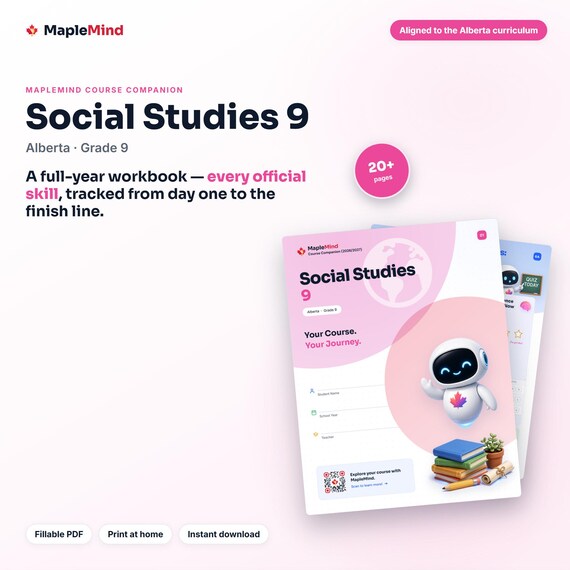
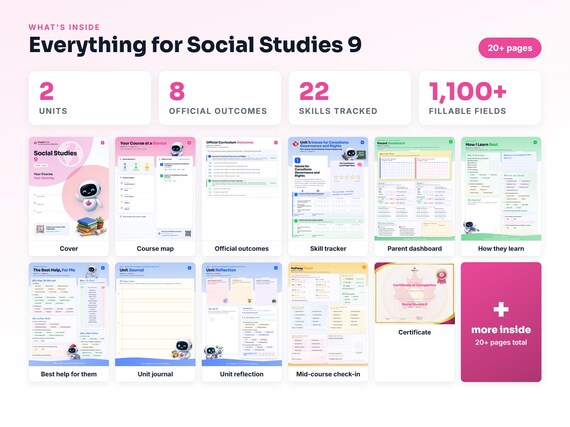
Printable workbook · A keepsake of the year
A Social Studies 9 workbook worth keeping
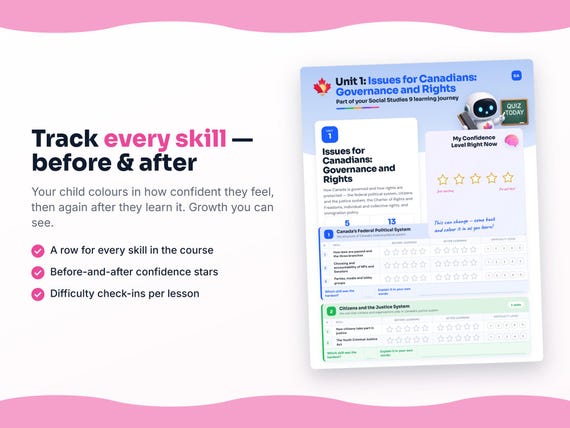
Built from the same official curriculum as this page. Before and after each skill above, your student colours in how sure they feel — so the two of you can see, on one page, what's clicking and what needs another look. It's a quiet way to follow how the year is really going.
By June it's full of their own handwriting: units worked through, confidence grown, a mid-year check-in, notes from parent-teacher night, and a certificate at the end. Less a worksheet, more a record of the year worth keeping on the shelf.
Instant download · see every page, reviews and the full description · five or more workbooks are $2.99 each
What it looks like in the app



Preparing for the Grade 9 Provincial Achievement Test (PAT)?
Alberta students write a Provincial Achievement Test in Grade 9. MapleMind's exam mode simulates it from this course's skills, then shows exactly which ones to shore up.
Common questions
Can MapleMind help me with Social Studies 9?
Yes. MapleMind's AI tutor covers all 22 skills in Alberta's Social Studies 9 — you pick the exact skill, and the tutor teaches it step by step: a short lesson, a worked example, solving together, then a skill check to show it stuck.
Is MapleMind aligned to Alberta's official curriculum?
Yes. Every skill in this course maps to an official outcome code from Alberta's Grade 9 Social Studies curriculum, and the ministry's own wording is quoted under each unit on this page — with the official government source linked so you can check it yourself.
What does MapleMind cost?
It's free to start — 5 tutoring chats and a practice quiz every day, no credit card. A Pro subscription ($9.99/month or $49.99/year CAD, 7-day free trial) unlocks unlimited tutoring, practice, and exam simulations.
What if I'm stuck on just one topic?
That's the point of skill-level tutoring: open Social Studies 9 in the app, tap the exact skill from the list on this page, and the tutor teaches just that — no wading through lessons you don't need.
Does MapleMind work in French or other languages?
Yes — 14 languages, including French. Both the app and the tutor's explanations switch to the language you choose.
Where can I see the official Alberta curriculum for Social Studies 9?
The official source is linked on this page — Alberta's official programs of study. The outline here follows it: every MapleMind skill carries its official outcome code, and the ministry's own wording is quoted under each unit.
Does MapleMind help with the Grade 9 Provincial Achievement Test (PAT)?
Yes. Alberta students write a Provincial Achievement Test in Grade 9. MapleMind's exam mode simulates it from this course's skills, then shows exactly which ones to shore up.
Keep exploring
Ready when you are
Pick a skill from this page and see it taught properly — free, in the browser, in under a minute.