Get help with Social Studies 10-1
Most tutoring makes you sit through material you already know. MapleMind flips that: pick the exact skill that's causing trouble — any of the 29 below — and the tutor teaches just that one, step by step, as many times as it takes. Ask questions in plain words, any time of day, in English, French, or 12 other languages.
The official Alberta Social Studies 10-1 curriculum
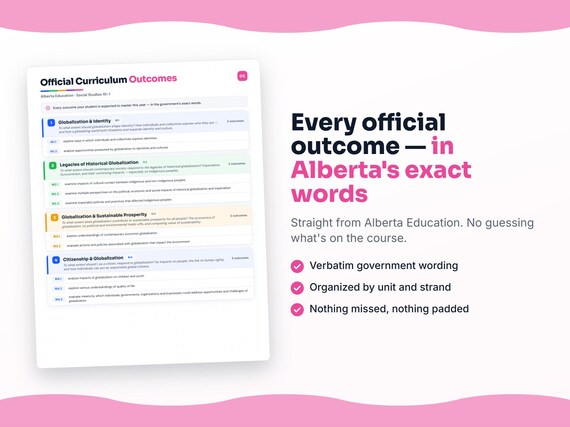
Alberta defines Social Studies 10-1 by strands and outcomes. MapleMind teaches the same curriculum reorganized for one-skill-at-a-time tutoring — the table shows exactly where every official strand lands, and the ministry's own wording is quoted under each unit below.
Official source Alberta's official programs of studyRead it on the government site — alberta.ca ↗| Official strand | Outcomes | Where MapleMind teaches it |
|---|---|---|
| Related Issue 1 | 6 | Globalization & Identity |
| Related Issue 2 | 8 | Legacies of Historical Globalization |
| Related Issue 3 | 7 | Globalization & Sustainable Prosperity |
| Related Issue 4 | 8 | Citizenship & Globalization |
Every skill below, taught one on one.
 Try the first session free
How MapleMind teaches Social Studies 10-1 — every unit, lesson, and skill
Every skill below runs as a short session: a plain-words lesson, a worked example, solving it together, then a five-question skill check that earns up to three stars. Guided Mode keeps it teaching instead of answer-handing — turning it off needs a parent's password.
Unit 1Globalization & IdentityOfficial strand · Related Issue 1
To what extent should globalization shape identity? How individuals and collectives express who they are — and how a globalizing world both threatens and expands identity and culture.
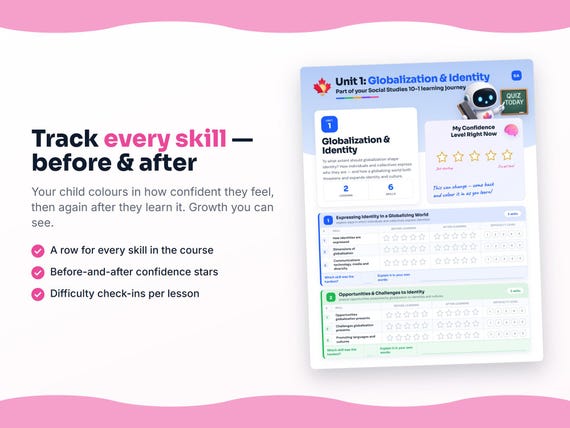
Expressing Identity in a Globalizing World
- How identities are expressed1.4 — Explore the ways individuals and collectives express identity — traditions, language, religion, the arts, attire, relationship to land, ideological beliefs.
- Dimensions of globalization1.5 — Explore understandings and dimensions of globalization — political, economic, social and other contemporary examples.
- Communications technology, media and diversity1.6 — Examine the impact of communications technology and media on diversity — the universalization of pop culture, hybridization and diversification.
Opportunities & Challenges to Identity
- Opportunities globalization presents1.7 — Analyze opportunities globalization presents to identities and cultures — acculturation, cultural revitalization, affirmation of identity, integration.
- Challenges globalization presents1.8 — Analyze challenges globalization presents — assimilation, marginalization, accommodation, homogenization.
- Promoting languages and cultures1.9 — Evaluate efforts to promote languages and cultures in a globalizing world — language laws, linguistic rights, cultural content legislation, revitalization.
The official wording — 6 outcomes in this unit
- 1.4
explore ways in which individuals and collectives express identities
- 1.5
explore understandings and dimensions of globalization
- 1.6
examine the impact of communications technology and media on diversity
- 1.7
analyze opportunities presented by globalization to identities and cultures
- 1.8
analyze challenges presented by globalization to identities and cultures
- 1.9
evaluate efforts to promote languages and cultures in a globalizing world
Unit 2Legacies of Historical GlobalizationOfficial strand · Related Issue 2
To what extent should contemporary society respond to the legacies of historical globalization? Imperialism, Eurocentrism, and their continuing impacts — especially on Indigenous peoples.
Foundations of Historical Globalization
- Impacts of cultural contact2.6 — Examine the impacts of cultural contact between Indigenous and non-Indigenous peoples — exchange of goods and technologies, depopulation, influences on institutions.
- Foundations: capitalism, imperialism, Eurocentrism2.7 — Explore the foundations of historical globalization — the rise of capitalism, industrialization, imperialism and Eurocentrism.
- Historical globalization and imperialism2.8 — Explore the relationship between historical globalization and imperialism — how the drive to connect and trade was bound up with the drive to dominate.
Legacies & Responses
- Multiple perspectives on impacts2.9 — Examine multiple perspectives on the political, economic and social impacts of historical globalization and imperialism.
- Contemporary legacies (residential schools)2.11 — Analyze contemporary global issues rooted in post-colonial policies — the consequences of residential schools and their social impact on Indigenous peoples.
- Addressing the consequences2.12 — Evaluate various attempts to address the consequences of imperialist policies and practices on Indigenous peoples in Canada and elsewhere.
Imperialist Policies & Enduring Legacies
- Imperialist policies affecting Indigenous peoples2.10 — Examine imperialist policies and practices that affected Indigenous peoples — British rule in India, British and French rule in Canada, and post-colonial governments in Canada.
- Legacies that still influence globalization2.13 — Examine legacies of historical globalization and imperialism that continue to influence globalization today — the structures, borders and inequalities inherited from the past.
The official wording — 8 outcomes in this unit
- 2.6
examine impacts of cultural contact between Indigenous and non-Indigenous peoples
- 2.7
explore the foundations of historical globalization
- 2.8
explore the relationship between historical globalization and imperialism
- 2.9
examine multiple perspectives on the political, economic and social impacts of historical globalization and imperialism
- 2.11
analyze contemporary global issues that have origins in policies and practices of post-colonial governments
- 2.12
evaluate various attempts to address consequences of imperialist policies and practices on Indigenous peoples
- 2.10
examine imperialist policies and practices that affected Indigenous peoples
- 2.13
examine legacies of historical globalization and imperialism that continue to influence globalization
Unit 3Globalization & Sustainable ProsperityOfficial strand · Related Issue 3
To what extent does globalization contribute to sustainable prosperity for all people? The economics of globalization, its political and environmental trade-offs, and competing views of sustainability.
The Economics of Globalization
- Understanding economic globalization3.3 — Explore understandings of contemporary economic globalization.
- Foundations of contemporary globalization3.4 — Examine the foundations of contemporary globalization — the ideas and institutions behind it, including F. A. Hayek, the Bretton Woods Conference and Milton Friedman.
- Factors expanding globalization3.5 — Analyze factors that expanded globalization since the Second World War — international agreements and organizations, transnational corporations, media and transportation technologies.
- Challenges and opportunities3.6 — Analyze the political and economic challenges and opportunities of globalization — trade liberalization, foreign investment, privatization, outsourcing, the knowledge economy.
Environment & Sustainability
- Globalization and the environment3.8 — Evaluate actions and policies associated with globalization that impact the environment — land and resource use, resource development agreements, environmental legislation.
- People, the land and globalization3.7 — Explore multiple perspectives regarding the relationship among people, the land and globalization — spirituality, stewardship, sustainability and resource development.
- Perspectives on sustainability3.9 — Analyze multiple perspectives on sustainability and prosperity in a globalizing world.
The official wording — 7 outcomes in this unit
- 3.3
explore understandings of contemporary economic globalization
- 3.4
examine the foundations of contemporary globalization
- 3.5
analyze factors contributing to the expansion of globalization since the Second World War
- 3.6
analyze political and economic challenges and opportunities of globalization
- 3.8
evaluate actions and policies associated with globalization that impact the environment
- 3.7
explore multiple perspectives regarding the relationship among people, the land and globalization
- 3.9
analyze multiple perspectives on sustainability and prosperity in a globalizing world
Unit 4Citizenship & GlobalizationOfficial strand · Related Issue 4
To what extent should I, as a citizen, respond to globalization? Its impacts on people, the link to human rights, and how individuals can act as responsible global citizens.
Globalization’s Impacts on People
- Impacts on children and youth4.5 — Analyze the impacts of globalization on children and youth — awareness of global issues, employment issues, identity.
- Globalization, democratization and human rights4.7 — Evaluate the relationships between globalization, democratization and human rights.
- Effects on individuals and communities4.8 — Analyze how globalization affects individuals and communities — migration, technology, agricultural issues, pandemics, resource issues.
Quality of Life & Impacts on Women
- Understandings of quality of life4.4 — Explore various understandings of quality of life — how different people and societies define what a good life is, beyond income alone.
- Impacts of globalization on women4.6 — Analyze the impacts of globalization on women — gender issues, labour issues and opportunities for entrepreneurship.
Acting as a Global Citizen
- Means to address globalization4.10 — Evaluate the means by which individuals, governments, organizations and businesses could address the opportunities and challenges of globalization — activism, legislation, agreements, consumer activism.
- Perspectives on civic responsibilities4.9 — Explore multiple perspectives regarding the civic responsibilities that individuals, governments, organizations and businesses may have in addressing the opportunities and challenges presented by globalization.
- Active, responsible global citizenship4.11 — Develop strategies to demonstrate active, responsible global citizenship.
The official wording — 8 outcomes in this unit
- 4.5
analyze impacts of globalization on children and youth
- 4.7
evaluate relationships between globalization and democratization and human rights
- 4.8
analyze how globalization affects individuals and communities
- 4.4
explore various understandings of quality of life
- 4.6
analyze impacts of globalization on women
- 4.10
evaluate means by which individuals, governments, organizations and businesses could address opportunities and challenges of globalization
- 4.9
explore multiple perspectives regarding the civic responsibilities that individuals, governments, organizations and businesses may have in addressing opportunities and challenges presented by globalization
- 4.11
develop strategies to demonstrate active, responsible global citizenship
Printable workbook · A keepsake of the year
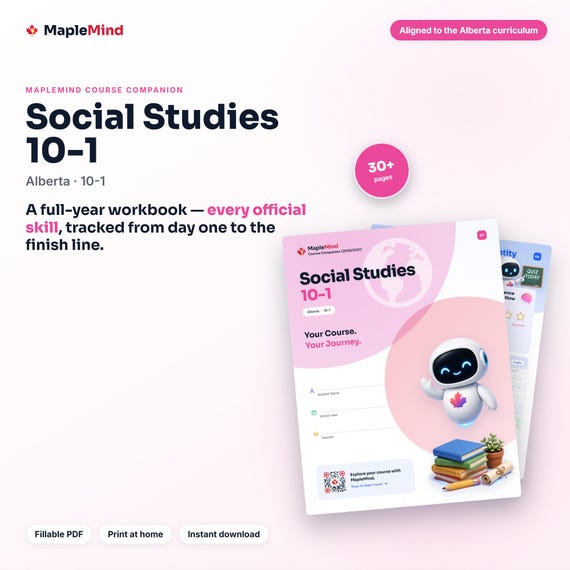
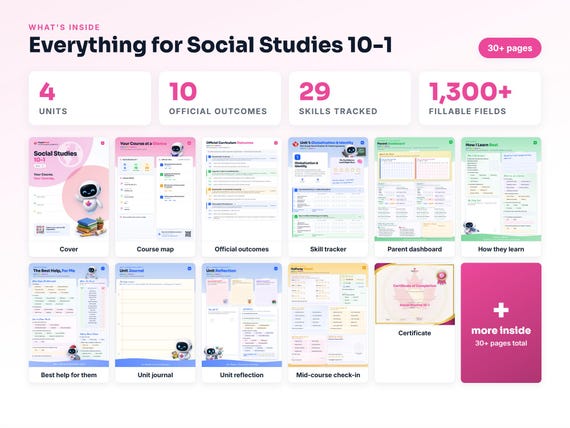
A Social Studies 10-1 workbook worth keeping
Built from the same official curriculum as this page. Before and after each skill above, your student colours in how sure they feel — so the two of you can see, on one page, what's clicking and what needs another look. It's a quiet way to follow how the year is really going.
By June it's full of their own handwriting: units worked through, confidence grown, a mid-year check-in, notes from parent-teacher night, and a certificate at the end. Less a worksheet, more a record of the year worth keeping on the shelf.
Instant download · see every page, reviews and the full description · five or more workbooks are $2.99 each
What it looks like in the app
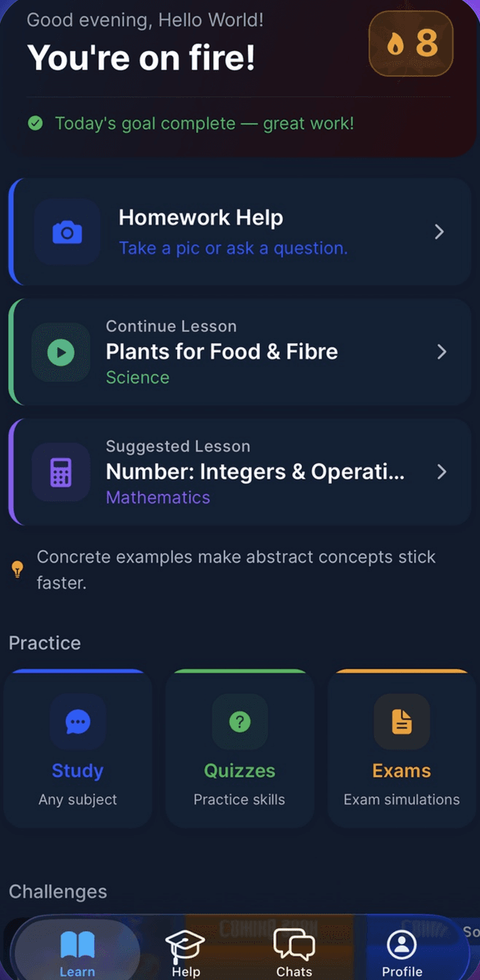

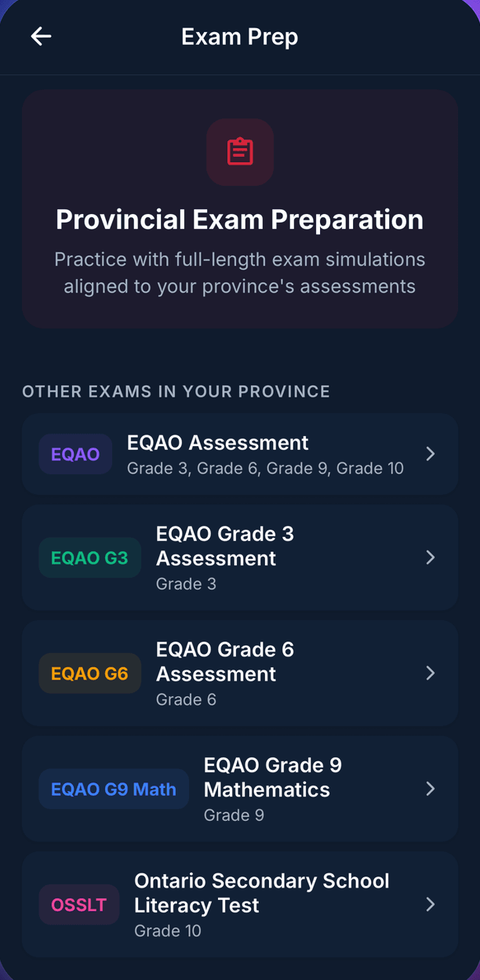
Common questions
Can MapleMind help me with Social Studies 10-1?
Yes. MapleMind's AI tutor covers all 29 skills in Alberta's Social Studies 10-1 — you pick the exact skill, and the tutor teaches it step by step: a short lesson, a worked example, solving together, then a skill check to show it stuck.
Is MapleMind aligned to Alberta's official curriculum?
Yes. Every skill in this course maps to an official outcome code from Alberta's Grade 10 Social Studies curriculum, and the ministry's own wording is quoted under each unit on this page — with the official government source linked so you can check it yourself.
What does MapleMind cost?
It's free to start — 5 tutoring chats and a practice quiz every day, no credit card. A Pro subscription ($9.99/month or $49.99/year CAD, 7-day free trial) unlocks unlimited tutoring, practice, and exam simulations.
What if I'm stuck on just one topic?
That's the point of skill-level tutoring: open Social Studies 10-1 in the app, tap the exact skill from the list on this page, and the tutor teaches just that — no wading through lessons you don't need.
Does MapleMind work in French or other languages?
Yes — 14 languages, including French. Both the app and the tutor's explanations switch to the language you choose.
Where can I see the official Alberta curriculum for Social Studies 10-1?
The official source is linked on this page — Alberta's official programs of study. The outline here follows it: every MapleMind skill carries its official outcome code, and the ministry's own wording is quoted under each unit.
Keep exploring
Ready when you are
Pick a skill from this page and see it taught properly — free, in the browser, in under a minute.