Get help with Social Studies 20-1
Most tutoring makes you sit through material you already know. MapleMind flips that: pick the exact skill that's causing trouble — any of the 25 below — and the tutor teaches just that one, step by step, as many times as it takes. Ask questions in plain words, any time of day, in English, French, or 12 other languages.
The official Alberta Social Studies 20-1 curriculum
Alberta defines Social Studies 20-1 by strands and outcomes. MapleMind teaches the same curriculum reorganized for one-skill-at-a-time tutoring — the table shows exactly where every official strand lands, and the ministry's own wording is quoted under each unit below.
Official source Alberta's official programs of studyRead it on the government site — alberta.ca ↗| Official strand | Outcomes | Where MapleMind teaches it |
|---|---|---|
| Related Issue 1 | 7 | Nation, Nationalism & Identity |
| Related Issue 2 | 6 | The Pursuit of National Interest |
| Related Issue 3 | 6 | Nationalism & Internationalism |
| Related Issue 4 | 6 | Contemporary & Future Canadian Identity |
Every skill below, taught one on one.
 Try the first session free
How MapleMind teaches Social Studies 20-1 — every unit, lesson, and skill
Every skill below runs as a short session: a plain-words lesson, a worked example, solving it together, then a five-question skill check that earns up to three stars. Guided Mode keeps it teaching instead of answer-handing — turning it off needs a parent's password.
Unit 1Nation, Nationalism & IdentityOfficial strand · Related Issue 1
To what extent should nation be the foundation of identity? What nation and nationalism mean, how nationalism takes shape, and how contending national loyalties are reconciled.
Understanding Nation & Nationalism
- Expressions of nationalism1.5 — Explore a range of expressions of nationalism — how national feeling shows up in symbols, language, art, celebration and public life.
- Understandings of nation and nationalism1.6 — Develop understandings of nation and nationalism — relationship to land, geographic, collective, civic, ethnic, cultural, linguistic, political, spiritual, religious and patriotic bases.
- Nation and nation-state1.7 — Analyze the relationship between nation and nation-state — how the two align, overlap or conflict.
- How nationalism develops1.8 — Analyze how the development of nationalism is shaped by historical, geographic, political, economic and social factors — the French Revolution and Napoleonic era, and contemporary examples.
Nationalism, Identity & Contending Loyalties
- Nationalism as identity1.9 — Analyze nationalism as an identity, internalized feeling and/or collective consciousness shared by a people — Canadian, Québecois, American, First Nations and Métis nationalism, Inuit perspectives.
- Reconciling contending nationalist loyalties1.10 — Evaluate the importance of reconciling contending nationalist loyalties — Canadian nationalism, First Nations and Métis nationalism, ethnic and civic nationalism in Canada, Québecois nationalism, Inuit perspectives.
- Reconciling non-nationalist loyalties1.11 — Evaluate the importance of reconciling nationalism with contending non-nationalist loyalties — religion, region, culture, race, ideology, class and other contending loyalties.
The official wording — 7 outcomes in this unit
- 1.5
explore a range of expressions of nationalism
- 1.6
develop understandings of nation and nationalism
- 1.7
analyze the relationship between nation and nation-state
- 1.8
analyze how the development of nationalism is shaped by historical, geographic, political, economic and social factors
- 1.9
analyze nationalism as an identity, internalized feeling and/or collective consciousness shared by a people
- 1.10
evaluate the importance of reconciling contending nationalist loyalties
- 1.11
evaluate the importance of reconciling nationalism with contending non-nationalist loyalties
Unit 2The Pursuit of National InterestOfficial strand · Related Issue 2
To what extent should national interest be pursued? How national interest shapes foreign policy, how nationalism can become ultranationalism, and the extremes ultranationalism can reach.
National Interest & Ultranationalism
- Nationalism and the pursuit of national interest2.4 — Explore the relationship between nationalism and the pursuit of national interest — how a nation's sense of itself drives what it defines as its interests.
- National interest and foreign policy2.5 — Analyze how the pursuit of national interest shapes foreign policy — the First World War peace settlements and the interwar period.
- Nationalism and ultranationalism2.6 — Analyze the relationship between nationalism and ultranationalism — where healthy national feeling crosses into an extreme, exclusionary form.
Conflict, Genocide & Self-Determination
- Ultranationalism in times of conflict2.7 — Analyze nationalism and ultranationalism during times of conflict — causes and examples from the First and Second World Wars, ultranationalism in Japan, internments in Canada, conscription crises.
- Ultranationalism and genocide2.8 — Analyze ultranationalism as a cause of genocide — the Holocaust, the 1932–1933 famine in Ukraine, and contemporary examples.
- National self-determination2.9 — Analyze impacts of the pursuit of national self-determination — successor states, decolonization, the Québecois sovereignty movement, First Nations, Métis and Inuit self-government.
The official wording — 6 outcomes in this unit
- 2.4
explore the relationship between nationalism and the pursuit of national interest
- 2.5
analyze how the pursuit of national interest shapes foreign policy
- 2.6
analyze the relationship between nationalism and ultranationalism
- 2.7
analyze nationalism and ultranationalism during times of conflict
- 2.8
analyze ultranationalism as a cause of genocide
- 2.9
analyze impacts of the pursuit of national self-determination
Unit 3Nationalism & InternationalismOfficial strand · Related Issue 3
To what extent should internationalism be pursued? The motives behind involvement in world affairs, what internationalism means, how it is promoted, and whether it must come at the cost of nationalism.
Motives & Understandings of Internationalism
- Motives for involvement in world affairs3.4 — Analyze the motives of nation and state involvement or noninvolvement in international affairs — economic stability, self-determination, peace, security and humanitarianism.
- Understandings of internationalism3.5 — Explore understandings of internationalism — cooperation among nations toward shared goals.
- Promoting internationalism through foreign policy3.6 — Analyze how internationalism can be promoted through foreign policy — multilateralism, supranationalism, peacekeeping, foreign aid, international law and agreements.
International Organizations & the Nationalism Tension
- Organizations that promote internationalism3.7 — Evaluate the extent to which selected organizations promote internationalism — the United Nations, World Council of Indigenous Peoples, European Union, Arctic Council and others.
- Impacts of pursuing internationalism3.8 — Analyze the impacts of the pursuit of internationalism in addressing contemporary global issues — conflict, poverty, debt, disease, environment and human rights.
- Nationalism versus internationalism3.9 — Evaluate the extent to which nationalism must be sacrificed in the interest of internationalism — the core trade-off between loyalty to nation and cooperation with the world.
The official wording — 6 outcomes in this unit
- 3.4
analyze the motives of nation and state involvement or noninvolvement in international affairs
- 3.5
explore understandings of internationalism
- 3.6
analyze how internationalism can be promoted through foreign policy
- 3.7
evaluate the extent to which selected organizations promote internationalism
- 3.8
analyze impacts of the pursuit of internationalism in addressing contemporary global issues
- 3.9
evaluate the extent to which nationalism must be sacrificed in the interest of internationalism
Unit 4Contemporary & Future Canadian IdentityOfficial strand · Related Issue 4
To what extent should individuals and groups in Canada embrace a national identity? Multiple perspectives on Canadian identity, how it is promoted, its history, and the challenges of national unity and future visions.
Perspectives on & Promotion of Canadian Identity
- Perspectives on national identity in Canada4.4 — Explore multiple perspectives on national identity in Canada — the many, sometimes competing, views of what makes Canada a nation.
- Promoting a national identity4.5 — Analyze methods used by individuals, groups and governments in Canada to promote a national identity — symbolism, mythology, institutions, government programs and initiatives.
- Historical perspectives of Canada as a nation4.6 — Examine historical perspectives of Canada as a nation — LaFontaine and Baldwin, the Fathers of Confederation, treaties and the Indian Act, Riel, French-Canadian nationalism, and more.
National Unity & Future Visions of Canada
- Challenges and opportunities of national unity4.7 — Evaluate the challenges and opportunities associated with the promotion of Canadian national unity — Québec sovereignty, federal-provincial-territorial relations, Aboriginal self-determination and land claims, bilingualism, multiculturalism.
- Personal and collective visions of national identity4.9 — Develop personal and collective visions of national identity — what the student and their communities believe a Canadian national identity should be.
- Future visions of Canada4.8 — Evaluate various perspectives of future visions of Canada — pluralism, the multination model, separatism, Aboriginal self-determination, global leadership, North American integration.
The official wording — 6 outcomes in this unit
- 4.4
explore multiple perspectives on national identity in Canada
- 4.5
analyze methods used by individuals, groups and governments in Canada to promote a national identity
- 4.6
examine historical perspectives of Canada as a nation
- 4.7
evaluate the challenges and opportunities associated with the promotion of Canadian national unity
- 4.9
develop personal and collective visions of national identity
- 4.8
evaluate various perspectives of future visions of Canada

Printable workbook · A keepsake of the year
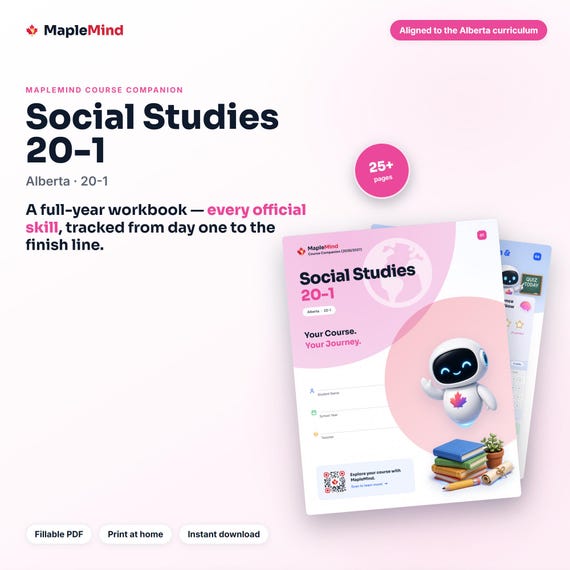
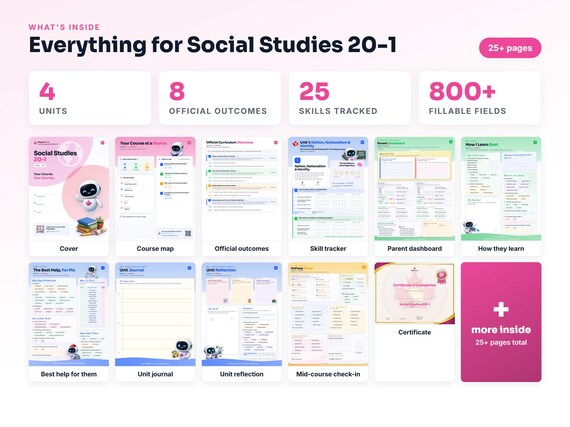
A Social Studies 20-1 workbook worth keeping
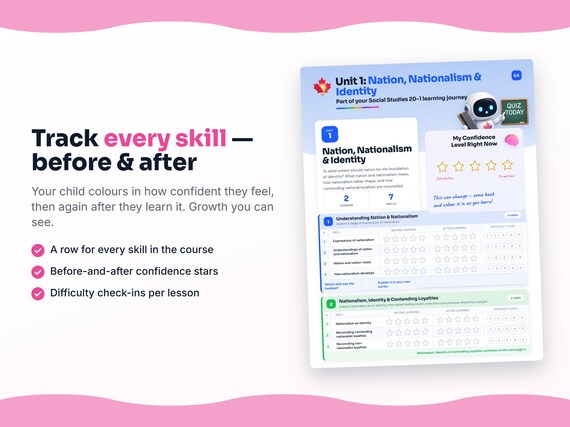
Built from the same official curriculum as this page. Before and after each skill above, your student colours in how sure they feel — so the two of you can see, on one page, what's clicking and what needs another look. It's a quiet way to follow how the year is really going.
By June it's full of their own handwriting: units worked through, confidence grown, a mid-year check-in, notes from parent-teacher night, and a certificate at the end. Less a worksheet, more a record of the year worth keeping on the shelf.
Instant download · see every page, reviews and the full description · five or more workbooks are $2.99 each
What it looks like in the app



Common questions
Can MapleMind help me with Social Studies 20-1?
Yes. MapleMind's AI tutor covers all 25 skills in Alberta's Social Studies 20-1 — you pick the exact skill, and the tutor teaches it step by step: a short lesson, a worked example, solving together, then a skill check to show it stuck.
Is MapleMind aligned to Alberta's official curriculum?
Yes. Every skill in this course maps to an official outcome code from Alberta's Grade 11 Social Studies curriculum, and the ministry's own wording is quoted under each unit on this page — with the official government source linked so you can check it yourself.
What does MapleMind cost?
It's free to start — 5 tutoring chats and a practice quiz every day, no credit card. A Pro subscription ($9.99/month or $49.99/year CAD, 7-day free trial) unlocks unlimited tutoring, practice, and exam simulations.
What if I'm stuck on just one topic?
That's the point of skill-level tutoring: open Social Studies 20-1 in the app, tap the exact skill from the list on this page, and the tutor teaches just that — no wading through lessons you don't need.
Does MapleMind work in French or other languages?
Yes — 14 languages, including French. Both the app and the tutor's explanations switch to the language you choose.
Where can I see the official Alberta curriculum for Social Studies 20-1?
The official source is linked on this page — Alberta's official programs of study. The outline here follows it: every MapleMind skill carries its official outcome code, and the ministry's own wording is quoted under each unit.
Keep exploring
Ready when you are
Pick a skill from this page and see it taught properly — free, in the browser, in under a minute.