Get help with Social Studies 30-2
Most tutoring makes you sit through material you already know. MapleMind flips that: pick the exact skill that's causing trouble — any of the 30 below — and the tutor teaches just that one, step by step, as many times as it takes. Ask questions in plain words, any time of day, in English, French, or 12 other languages.
The official Alberta Social Studies 30-2 curriculum
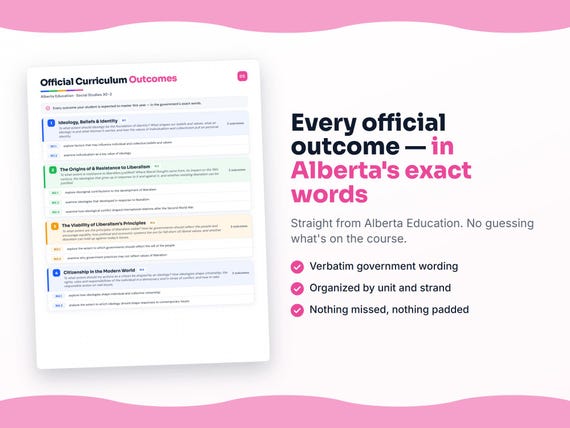
Alberta defines Social Studies 30-2 by strands and outcomes. MapleMind teaches the same curriculum reorganized for one-skill-at-a-time tutoring — the table shows exactly where every official strand lands, and the ministry's own wording is quoted under each unit below.
Official source Alberta's official programs of studyRead it on the government site — alberta.ca ↗| Official strand | Outcomes | Where MapleMind teaches it |
|---|---|---|
| Related Issue 1 | 8 | Ideology, Beliefs & Identity |
| Related Issue 2 | 10 | The Origins of & Resistance to Liberalism |
| Related Issue 3 | 6 | The Viability of Liberalism’s Principles |
| Related Issue 4 | 6 | Citizenship in the Modern World |
Every skill below, taught one on one.
 Try the first session free
How MapleMind teaches Social Studies 30-2 — every unit, lesson, and skill
Every skill below runs as a short session: a plain-words lesson, a worked example, solving it together, then a five-question skill check that earns up to three stars. Guided Mode keeps it teaching instead of answer-handing — turning it off needs a parent's password.
Unit 1Ideology, Beliefs & IdentityOfficial strand · Related Issue 1
To what extent should ideology be the foundation of identity? What shapes our beliefs and values, what an ideology is and what themes it carries, and how the values of individualism and collectivism pull on personal identity.
Beliefs, Values & What an Ideology Is
- Factors that shape beliefs and values1.3 — Explore factors that may influence individual and collective beliefs and values — culture, language, media, relationship to land, environment, gender, religion, spirituality and ideology.
- Expressions of individualism and collectivism1.4 — Identify historic and contemporary expressions of individualism and collectivism — how a focus on the individual or the group has shown up across time and today.
- Characteristics of an ideology1.5 — Examine the characteristics of ideology — interpretations of history, beliefs about human nature, beliefs about the structure of society, and visions for the future.
- Themes of ideologies1.6 — Identify themes of ideologies — nation, class, relationship to land, environment and religion — the big topics different ideologies argue about.
Individualism, Collectivism & Identity
- Individualism as a value of ideology1.7 — Examine individualism as a key value of ideology — the values of liberalism: individual rights and freedoms, self-interest, competition, economic freedom, rule of law and private property.
- Collectivism as a foundation of ideology1.8 — Examine collectivism as a foundation of ideology — the values of collectivism: collective responsibility, collective interest, cooperation, economic equality, adherence to collective norms and public property.
- Individualism and the common good1.9 — Examine the relationship between individualism and common good in contemporary societies — how societies balance individual freedom against what benefits everyone.
- How far ideology should shape identity1.10 — Analyze the extent to which personal identity should be shaped by ideologies — how much of who you are should come from the beliefs you hold about individual and collective life.
The official wording — 8 outcomes in this unit
- 1.3
explore factors that may influence individual and collective beliefs and values
- 1.4
identify historic and contemporary expressions of individualism and collectivism
- 1.5
examine the characteristics of ideology
- 1.6
identify themes of ideologies
- 1.7
examine individualism as a key value of ideology
- 1.8
examine collectivism as a foundation of ideology
- 1.9
examine the relationship between individualism and common good in contemporary societies
- 1.10
analyze the extent to which personal identity should be shaped by ideologies
Unit 2The Origins of & Resistance to LiberalismOfficial strand · Related Issue 2
To what extent is resistance to liberalism justified? Where liberal thought came from, its impact on the 19th century, the ideologies that grew up in response to it and against it, and whether resisting liberalism can be justified.
Where Liberalism Came From
- Aboriginal contributions to liberalism2.4 — Explore Aboriginal contributions to the development of liberalism — how Indigenous ideas and governance influenced liberal thought.
- The origins of liberal thought2.5 — Explore the relationship between the values of liberalism and the origins of liberal thought — the ideas of Adam Smith and John Stuart Mill.
- Liberal thought in the 19th century2.6 — Examine the impacts of liberal thought on 19th century society — laissez-faire capitalism, industrialization, the class system and limited government.
Responses to & Rejection of Liberalism
- Ideologies that responded to liberalism2.7 — Examine ideologies that developed in response to liberalism — socialism and Marxism, which grew up to challenge liberalism's effects.
- The growth of liberalism2.8 — Examine the growth of liberalism — labour standards and unions, voting rights, the welfare state, protection of human rights and feminism.
- Systems that rejected liberalism2.9 — Analyze ideological systems that rejected liberalism — Communism in the Soviet Union and fascism in Nazi Germany.
The Cold War & Challenges to Liberalism
- Ideological conflict after WWII2.10 — Examine how ideological conflict shaped international relations after the Second World War — expansionism, containment, deterrence, brinkmanship, détente and liberation movements.
- Perspectives on imposing liberalism2.11 — Examine perspectives on the imposition of liberalism — Aboriginal experiences and contemporary events where liberalism was imposed rather than chosen.
- Modern liberalism challenged by alternative thought2.12 — Examine the extent to which modern liberalism is challenged by alternative thought — Aboriginal collective thought, environmentalism, religious perspectives and extremism.
- Whether resistance to liberalism is justified2.13 — Evaluate the extent to which resistance to liberalism is justified — weighing when pushing back against liberal values has good reasons behind it.
The official wording — 10 outcomes in this unit
- 2.4
explore Aboriginal contributions to the development of liberalism
- 2.5
explore the relationship between the values of liberalism and the origins of liberal thought
- 2.6
examine the impacts of liberal thought on 19 th century society
- 2.7
examine ideologies that developed in response to liberalism
- 2.8
examine the growth of liberalism
- 2.9
analyze ideological systems that rejected liberalism
- 2.10
examine how ideological conflict shaped international relations after the Second World War
- 2.11
examine perspectives on the imposition of liberalism
- 2.12
examine the extent to which modern liberalism is challenged by alternative thought
- 2.13
evaluate the extent to which resistance to liberalism is justified
Unit 3The Viability of Liberalism’s PrinciplesOfficial strand · Related Issue 3
To what extent are the principles of liberalism viable? How far governments should reflect the people and encourage equality, how political and economic systems live out (or fall short of) liberal values, and whether liberalism can hold up against today’s issues.
The Will of the People, Equality & Systems
- Governments reflecting the will of the people3.3 — Explore the extent to which governments should reflect the will of the people — how far a government should simply do what the majority wants.
- Governments encouraging economic equality3.4 — Explore the extent to which governments should encourage economic equality — how much a government should act to close the gap between rich and poor.
- How systems reflect the values of liberalism3.5 — Examine the extent to which the practices of political and economic systems reflect the values of liberalism — consensus decision making, direct and representative democracies, authoritarian systems, free market, command and mixed economies.
Practice Gaps, Rights & Viability
- When practice falls short of liberal values3.6 — Examine why government practices may not reflect values of liberalism — using Canada and contemporary examples where actions do not match liberal ideals.
- Governments promoting individual and collective rights3.7 — Explore the extent to which governments should promote individual and collective rights — the Canadian Charter, the Québec Charter, First Nations, Métis and Inuit rights, and emergencies and security legislation.
- Whether liberalism is viable today3.8 — Evaluate the extent to which the values of liberalism are viable in the context of contemporary issues — environment concerns, resource use, debt and poverty, racism, pandemics, terrorism and censorship.
The official wording — 6 outcomes in this unit
- 3.3
explore the extent to which governments should reflect the will of the people
- 3.4
explore the extent to which governments should encourage economic equality
- 3.5
examine the extent to which the practices of political and economic systems reflect the values of liberalism
- 3.6
examine why government practices may not reflect values of liberalism
- 3.7
explore the extent to which governments should promote individual and collective rights
- 3.8
evaluate the extent to which the values of liberalism are viable in the context of contemporary issues
Unit 4Citizenship in the Modern WorldOfficial strand · Related Issue 4
To what extent should my actions as a citizen be shaped by an ideology? How ideologies shape citizenship, the rights, roles and responsibilities of the individual in a democracy and in times of conflict, and how to take responsible action on real issues.
Ideology, Citizenship, Rights & Roles
- How ideologies shape citizenship4.4 — Explore how ideologies shape individual and collective citizenship — how what people believe changes what it means to be a good citizen.
- The individual in a democratic society4.5 — Examine perspectives on the rights, roles and responsibilities of the individual in a democratic society — respect for law and order, protest, civil disobedience and political participation.
- The individual during times of conflict4.6 — Examine perspectives on the rights, roles and responsibilities of the individual during times of conflict — humanitarian crises, antiwar movements, pro-democracy movements and contemporary examples.
Ideology & Taking Responsible Action
- How far ideology should shape responses to issues4.7 — Analyze the extent to which ideology should shape responses to contemporary issues — how much your beliefs should decide how you react to the problems of the day.
- Strategies that show leadership on issues4.8 — Develop strategies to address local, national and global issues that demonstrate individual and collective leadership — practical plans for making a difference.
- Active and responsible citizenship4.9 — Explore opportunities to demonstrate active and responsible citizenship through individual and collective action — real ways to get involved and act on what you believe.
The official wording — 6 outcomes in this unit
- 4.4
explore how ideologies shape individual and collective citizenship
- 4.5
examine perspectives on the rights, roles and responsibilities of the individual in a democratic society
- 4.6
examine perspectives on the rights, roles and responsibilities of the individual during times of conflict
- 4.7
analyze the extent to which ideology should shape responses to contemporary issues
- 4.8
develop strategies to address local, national and global issues that demonstrate individual and collective leadership
- 4.9
explore opportunities to demonstrate active and responsible citizenship through individual and collective action
Printable workbook · A keepsake of the year
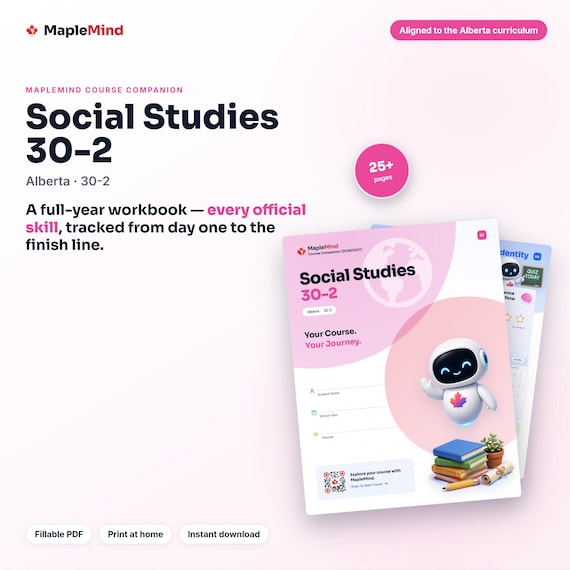
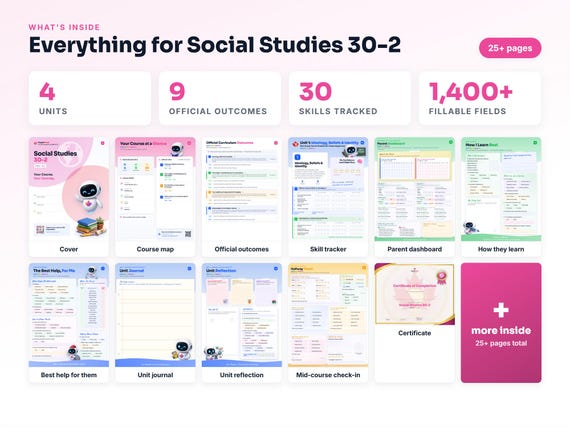
A Social Studies 30-2 workbook worth keeping
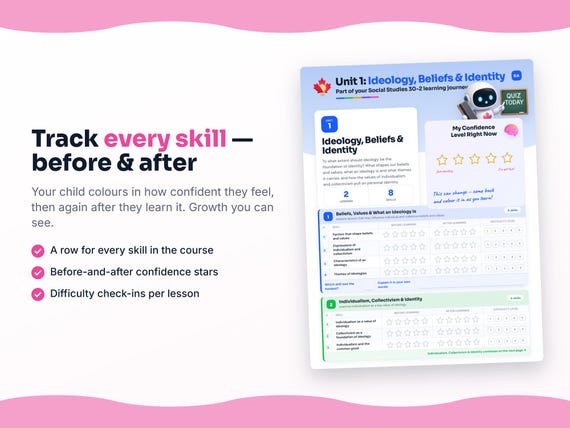
Built from the same official curriculum as this page. Before and after each skill above, your student colours in how sure they feel — so the two of you can see, on one page, what's clicking and what needs another look. It's a quiet way to follow how the year is really going.
By June it's full of their own handwriting: units worked through, confidence grown, a mid-year check-in, notes from parent-teacher night, and a certificate at the end. Less a worksheet, more a record of the year worth keeping on the shelf.
Instant download · see every page, reviews and the full description · five or more workbooks are $2.99 each
What it looks like in the app
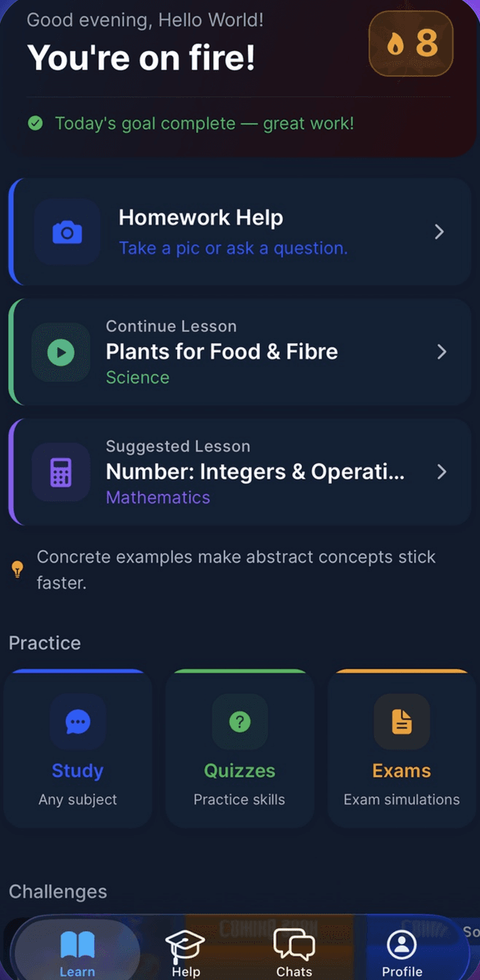
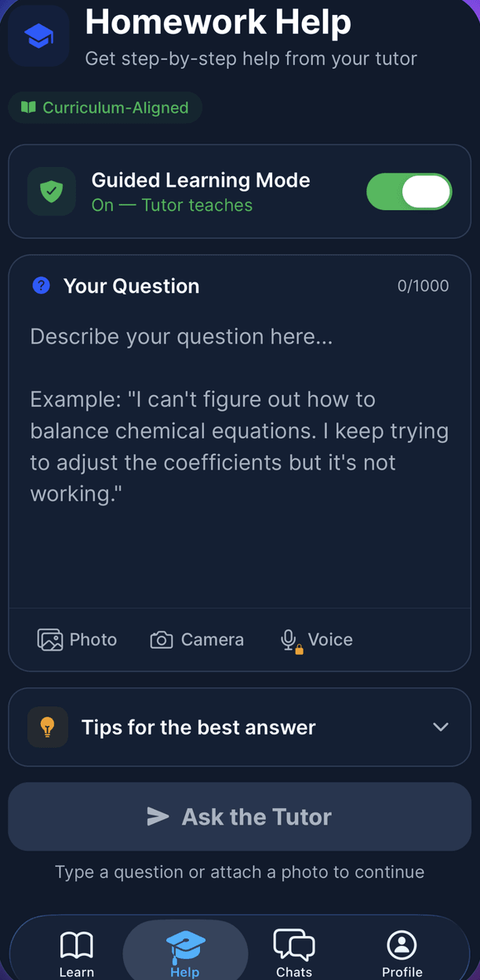
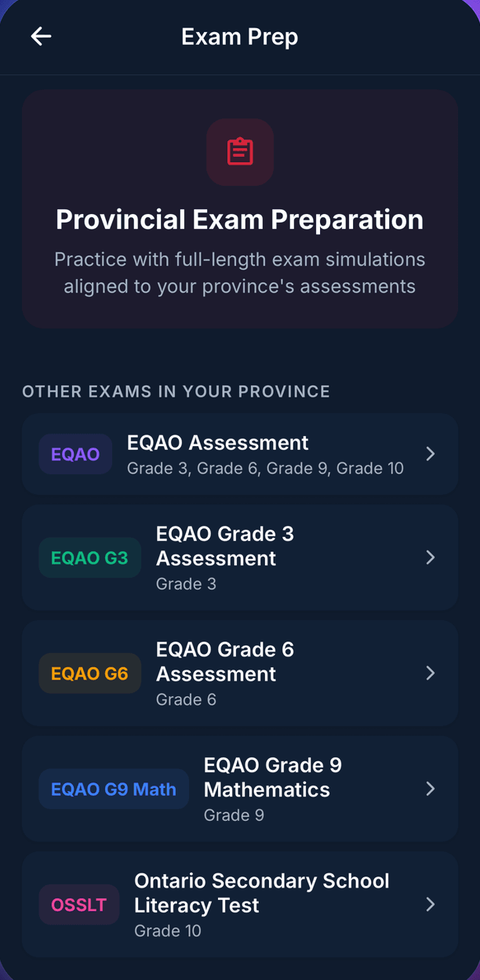
Preparing for the Social Studies 30-2 Diploma Exam?
Social Studies 30-2 ends in a provincial Diploma Exam worth a big part of the final mark. MapleMind's exam mode builds a full simulation from the course — timed sections, written responses, and a graded result that shows which skills to review. Our Diploma Exam prep guide has a full study plan.
Common questions
Can MapleMind help me with Social Studies 30-2?
Yes. MapleMind's AI tutor covers all 30 skills in Alberta's Social Studies 30-2 — you pick the exact skill, and the tutor teaches it step by step: a short lesson, a worked example, solving together, then a skill check to show it stuck.
Is MapleMind aligned to Alberta's official curriculum?
Yes. Every skill in this course maps to an official outcome code from Alberta's Grade 12 Social Studies curriculum, and the ministry's own wording is quoted under each unit on this page — with the official government source linked so you can check it yourself.
What does MapleMind cost?
It's free to start — 5 tutoring chats and a practice quiz every day, no credit card. A Pro subscription ($9.99/month or $49.99/year CAD, 7-day free trial) unlocks unlimited tutoring, practice, and exam simulations.
What if I'm stuck on just one topic?
That's the point of skill-level tutoring: open Social Studies 30-2 in the app, tap the exact skill from the list on this page, and the tutor teaches just that — no wading through lessons you don't need.
Does MapleMind work in French or other languages?
Yes — 14 languages, including French. Both the app and the tutor's explanations switch to the language you choose.
Where can I see the official Alberta curriculum for Social Studies 30-2?
The official source is linked on this page — Alberta's official programs of study. The outline here follows it: every MapleMind skill carries its official outcome code, and the ministry's own wording is quoted under each unit.
Does MapleMind help with the Social Studies 30-2 Diploma Exam?
Yes. Social Studies 30-2 ends in a provincial Diploma Exam worth a big part of the final mark. MapleMind's exam mode builds a full simulation from the course — timed sections, written responses, and a graded result that shows which skills to review.
Keep exploring
Ready when you are
Pick a skill from this page and see it taught properly — free, in the browser, in under a minute.