Get help with Core French, Grade 8
Most tutoring makes you sit through material you already know. MapleMind flips that: pick the exact skill that's causing trouble — any of the 33 below — and the tutor teaches just that one, step by step, as many times as it takes. Ask questions in plain words, any time of day, in English, French, or 12 other languages.
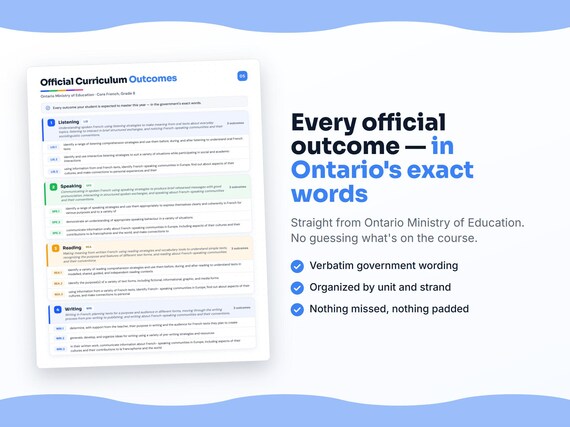
The official Ontario Core French, Grade 8 curriculum
Ontario defines Core French, Grade 8 by strands and outcomes. MapleMind teaches the same curriculum reorganized for one-skill-at-a-time tutoring — the table shows exactly where every official strand lands, and the ministry's own wording is quoted under each unit below.
Official source Ontario's official curriculumRead it on the government site — dcp.edu.gov.on.ca ↗Every skill below, taught one on one.
 Try the first session free
How MapleMind teaches Core French, Grade 8 — every unit, lesson, and skill
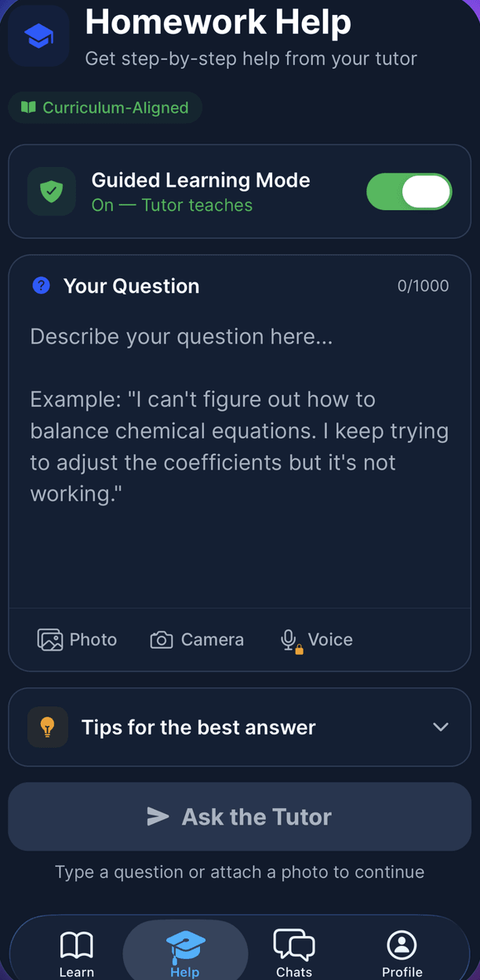
Every skill below runs as a short session: a plain-words lesson, a worked example, solving it together, then a five-question skill check that earns up to three stars. Guided Mode keeps it teaching instead of answer-handing — turning it off needs a parent's password.
Unit 1ListeningOfficial strand · Strand A
Understanding spoken French: using listening strategies to make meaning from oral texts about everyday topics, listening to interact in brief structured exchanges, and noticing French-speaking communities and their sociolinguistic conventions.
Listening to Understand
- Using listening strategiesA1.1 — Choose and use listening strategies before, during, and after listening to understand simple oral French - like spotting familiar words, using visual clues, and asking questions.
- Showing you understoodA1.2 — Show you understand simple spoken French about everyday topics - following directions, matching a description to a picture, or acting out a command - with visual support.
Listening to Interact
- Interactive listening strategiesA2.1 — Use interactive listening strategies in French conversations - knowing when to listen and when to speak, looking at the speaker, and asking for repetition or clarification.
- Responding in short exchangesA2.2 — Respond with understanding in brief, structured French exchanges about yourself, family, friends, and your surroundings, with visual support.
- Reflecting on my listeningA2.3 — Talk about which listening strategies helped you, and name your listening strengths and one step to improve.
Culture and Conventions in Listening
- French-speaking communities in OntarioA3.1 — Using what you hear, identify French-speaking communities in Europe - their culture and contributions to la francophonie, and make connections to your own and other communities.
- Noticing sociolinguistic conventionsA3.2 — From spoken French, notice sociolinguistic conventions used in different situations - like formal vs. informal greetings and expressions of courtesy.
The official wording — 7 outcomes in this unit
- A1.1
identify a range of listening comprehension strategies and use them before, during, and after listening to understand oral French texts
- A1.2
demonstrate an understanding of the purpose and meaning of oral French texts containing increasingly complex messages about everyday matters and matters of personal interest, with contextual
- A2.1
identify and use interactive listening strategies to suit a variety of situations while participating in social and academic interactions
- A2.2
respond with understanding to what others say while participating in interactions of various lengths about everyday matters and matters of personal interest
- A2.3
(a) describe, in conversation with the teacher and their peers, factors that prevent them from listening effectively
- A3.1
using information from oral French texts, identify French-speaking communities in Europe, find out about aspects of their cultures, and make connections to personal experiences and their
- A3.2
using information from oral French texts, identify and demonstrate an understanding of sociolinguistic conventions used in a variety of situations in diverse French-speaking communities*
Unit 2SpeakingOfficial strand · Strand B
Communicating in spoken French: using speaking strategies to produce brief rehearsed messages with good pronunciation, interacting in structured spoken exchanges, and speaking about French-speaking communities and their conventions.
Speaking to Communicate
- Using speaking strategiesB1.1 — Choose and use speaking strategies to express yourself clearly in French - reusing familiar patterns, and using gestures, expression, and voice to support your message.
- Producing short spoken messagesB1.2 — Use familiar words to produce brief, rehearsed spoken French messages about yourself, family, friends, and your surroundings.
- Speaking with fluencyB1.3 — Speak with a smooth pace, appropriate intonation, and accurate pronunciation in brief rehearsed French about familiar topics.
Speaking to Interact
- Speaking-interaction strategiesB2.1 — Show appropriate speaking behaviour in French exchanges - restating others' ideas, using tone and gestures that fit the audience, and asking clarifying questions.
- Taking part in spoken exchangesB2.2 — Engage in brief, structured spoken French interactions using familiar words, with teacher modelling and support.
- Reflecting on my speakingB2.3 — Talk about which speaking strategies helped you, and name your speaking strengths and one step to improve.
Culture and Conventions in Speaking
- Speaking about French-speaking communitiesB3.1 — When you speak, identify French-speaking communities in Europe - their culture and contributions to la francophonie, and make connections to your own and other communities.
- Using sociolinguistic conventionsB3.2 — Identify and use sociolinguistic conventions - greetings, courtesy expressions, and non-verbal cues - appropriately in spoken French.
The official wording — 8 outcomes in this unit
- B1.1
identify a range of speaking strategies and use them appropriately to express themselves clearly and coherently in French for various purposes and to a variety of
- B1.2
produce rehearsed and increasingly spontaneous messages in French to communicate ideas and information about matters of personal interest, with contextual, auditory, and visual support
- B1.3
speak with a smooth pace, appropriate intonation, and accurate pronunciation in rehearsed communications about a range of familiar topics
- B2.1
demonstrate an understanding of appropriate speaking behaviour in a variety of situations
- B2.2
exchange information and ideas with the teacher and their peers in guided, increasingly spontaneous spoken interactions about matters of personal interest, with teacher modelling and support
- B2.3
(a) describe, in conversation with the teacher and their peers, some strategies they found helpful before, during, and after speaking to communicate effectively; (b) identify their
- B3.1
communicate information orally about French-speaking communities in Europe, including aspects of their cultures and their contributions to la francophonie and the world, and make connections to
- B3.2
identify sociolinguistic conventions associated with a variety of social situations in diverse French-speaking communities* and use them appropriately in spoken interactions
Unit 3ReadingOfficial strand · Strand C
Making meaning from written French: using reading strategies and vocabulary tools to understand simple texts, recognizing the purpose and features of different text forms, and reading about French-speaking communities and their conventions.
Reading Comprehension
- Using reading strategiesC1.1 — Use reading strategies before, during, and after reading simple French texts - previewing, predicting, using cognates, and reading pictures.
- Reading for meaningC1.2 — Understand simple French texts with visuals and familiar names, words, and phrases, with teacher support - retelling and responding to what you read.
- Reading with fluencyC1.3 — Read familiar-word French texts at a rate and ease that shows overall understanding, recognizing high-frequency words and reading with punctuation.
- Developing vocabularyC1.4 — Use a few vocabulary strategies before, during, and after reading to work out or confirm the meaning of new French words.
Purpose, Form, and Style
- Purposes of text formsC2.1 — Identify the purpose of familiar French text forms - fictional, informational, graphic, and media - like a poem, a menu, or an advertisement.
- Characteristics of text formsC2.2 — Identify features and stylistic elements of familiar French text forms - like a poem's rhyme, a menu's sections, or an ad's eye-catching graphics.
- Reflecting on my readingC2.3 — Talk about which reading strategies helped you, and name your reading strengths and one step to improve.
Culture and Conventions in Reading
- Reading about French-speaking communitiesC3.1 — Using French texts, identify French-speaking communities in Europe - their culture and contributions to la francophonie, and make connections to your own and other communities.
- Conventions in French textsC3.2 — In age-appropriate French texts, identify sociolinguistic conventions used in different situations - like regional word choices (salut, la fin de semaine).
The official wording — 9 outcomes in this unit
- C1.1
identify a variety of reading comprehension strategies and use them before, during, and after reading to understand texts in modelled, shared, guided, and independent reading contexts
- C1.2
demonstrate an understanding of a variety of French texts containing visuals and familiar names, words, and expressions, with teacher modelling and guidance as appropriate
- C1.3
read a variety of texts containing familiar names, words, and expressions at a sufficient rate and with sufficient ease to demonstrate that they understand the overall
- C1.4
use a variety of vocabulary-acquisition strategies before, during, and after reading to determine or confirm the meaning of new, unfamiliar, or recently learned words
- C2.1
identify the purpose(s) of a variety of text forms, including fictional, informational, graphic, and media forms
- C2.2
identify some characteristics and/or stylistic elements of a variety of text forms, including fictional, informational, graphic, and media forms
- C2.3
(a) describe, in conversation with the teacher and their peers, some strategies they found helpful before, during, and after reading to understand texts; (b) identify their
- C3.1
using information from a variety of French texts, identify French- speaking communities in Europe, find out about aspects of their cultures, and make connections to personal
- C3.2
identify, in age- and grade-appropriate French texts, examples of sociolinguistic conventions associated with a variety of social situations in diverse French-speaking communities*
Unit 4WritingOfficial strand · Strand D
Writing in French: planning texts for a purpose and audience in different forms, moving through the writing process from pre-writing to publishing, and writing about French-speaking communities and their conventions.
Purpose, Audience, and Form
- Identifying purpose and audienceD1.1 — With teacher support, decide your purpose for writing and the audience for the French text you plan to create.
- Writing in different formsD1.2 — Write a variety of simple French texts, using the basic structure and style of each form - a card, a caption, a recipe, a survey, or a list.
- Applying language conventionsD1.3 — Communicate meaning clearly by using parts of speech appropriately and following conventions for correct spelling, word order, and punctuation.
The Writing Process
- Pre-writing: gathering ideasD2.1 — Generate, develop, and organize ideas for French writing using pre-writing strategies - brainstorming, graphic organizers, and drawing.
- Drafting and revisingD2.2 — Plan and produce a French draft following a model, then revise it - rereading, adding, cutting, and reorganizing - with teacher support.
- Producing finished work: conventionsD2.3 — Improve written French using a few conventions - accurate spelling with accents, high-frequency adjectives, correct subject pronouns, and present-tense verbs - and simple presentation elements.
- Reflecting on my writingD2.4 — Talk about which writing strategies helped you, and name your writing strengths and one step to improve.
Culture and Conventions in Writing
- Writing about French-speaking communitiesD3.1 — In your writing, identify French-speaking communities in Europe - their culture and contributions to la francophonie, and make connections to your own and other communities.
- Conventions in my writingD3.2 — Identify and use sociolinguistic conventions - greetings, courtesy expressions, letter formats, and date conventions - appropriately in your French writing.
The official wording — 9 outcomes in this unit
- D1.1
determine, with support from the teacher, their purpose in writing and the audience for French texts they plan to create
- D1.2
write a variety of age- and grade-appropriate French texts, applying their knowledge of the basic structural and stylistic elements of each form
- D1.3
communicate their meaning clearly, using parts of speech appropriately and following conventions for correct spelling, word order, and punctuation
- D2.1
generate, develop, and organize ideas for writing using a variety of pre-writing strategies and resources
- D2.2
plan and produce drafts and revise their writing, using a variety of teacher-directed and independent strategies
- D2.3
make improve- ments to enhance the clarity and readability of their written work, and use a few elements of effective presentation to produce a polished product
- D2.4
(a) describe, in conversation with the teacher and their peers, some strategies they found helpful before, during, and after writing; (b) identify their areas of greater
- D3.1
in their written work, communicate information about French- speaking communities in Europe, including aspects of their cultures and their contributions to la francophonie and the world
- D3.2
identify sociolinguistic conventions associated with a variety of social situations in diverse French-speaking communities* and use them appropriately in their written work

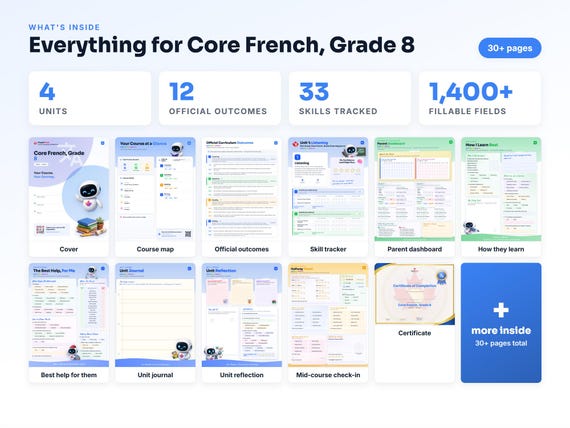

Printable workbook · A keepsake of the year
A Core French, Grade 8 workbook worth keeping
Built from the same official curriculum as this page. Before and after each skill above, your student colours in how sure they feel — so the two of you can see, on one page, what's clicking and what needs another look. It's a quiet way to follow how the year is really going.
By June it's full of their own handwriting: units worked through, confidence grown, a mid-year check-in, notes from parent-teacher night, and a certificate at the end. Less a worksheet, more a record of the year worth keeping on the shelf.
Instant download · see every page, reviews and the full description · five or more workbooks are $2.99 each
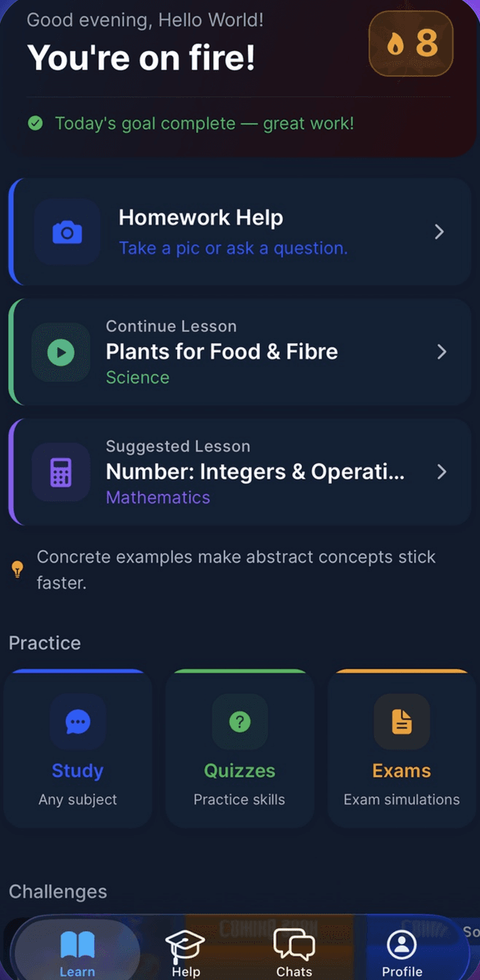
What it looks like in the app
Common questions
Can MapleMind help me with Core French, Grade 8?
Yes. MapleMind's AI tutor covers all 33 skills in Ontario's Core French, Grade 8 — you pick the exact skill, and the tutor teaches it step by step: a short lesson, a worked example, solving together, then a skill check to show it stuck.
Is MapleMind aligned to Ontario's official curriculum?
Yes. Every skill in this course maps to an official outcome code from Ontario's Grade 8 French curriculum, and the ministry's own wording is quoted under each unit on this page — with the official government source linked so you can check it yourself.
What does MapleMind cost?
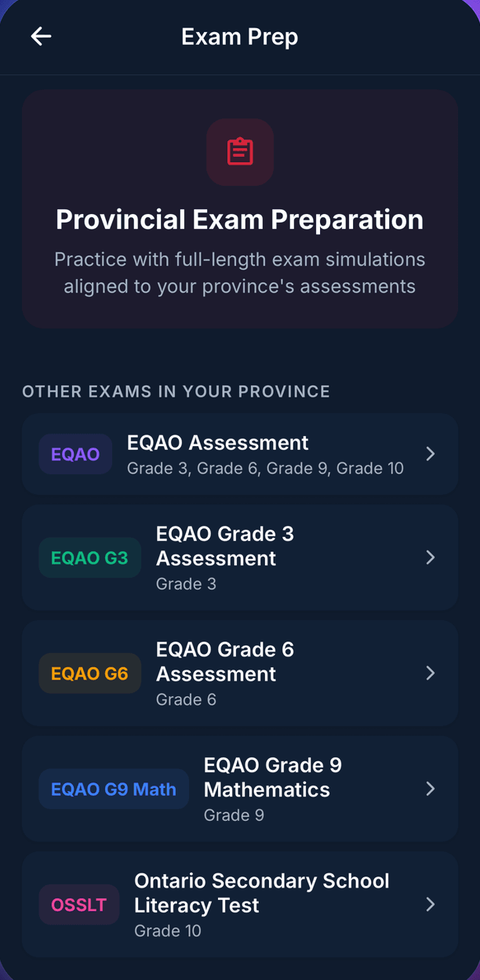
It's free to start — 5 tutoring chats and a practice quiz every day, no credit card. A Pro subscription ($9.99/month or $49.99/year CAD, 7-day free trial) unlocks unlimited tutoring, practice, and exam simulations.
What if I'm stuck on just one topic?
That's the point of skill-level tutoring: open Core French, Grade 8 in the app, tap the exact skill from the list on this page, and the tutor teaches just that — no wading through lessons you don't need.
Does MapleMind work in French or other languages?
Yes — 14 languages, including French. Both the app and the tutor's explanations switch to the language you choose.
Where can I see the official Ontario curriculum for Core French, Grade 8?
The official source is linked on this page — Ontario's official curriculum. The outline here follows it: every MapleMind skill carries its official outcome code, and the ministry's own wording is quoted under each unit.
Keep exploring
Ready when you are
Pick a skill from this page and see it taught properly — free, in the browser, in under a minute.