Get help with Science and Technology, Grade 8
Most tutoring makes you sit through material you already know. MapleMind flips that: pick the exact skill that's causing trouble — any of the 47 below — and the tutor teaches just that one, step by step, as many times as it takes. Ask questions in plain words, any time of day, in English, French, or 12 other languages.
The official Ontario Science and Technology, Grade 8 curriculum
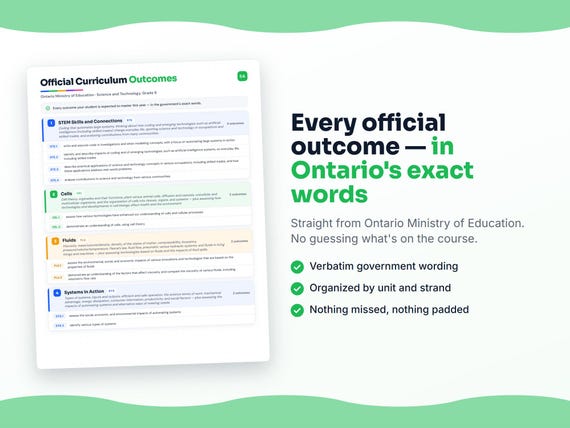
Ontario defines Science and Technology, Grade 8 by strands and outcomes. MapleMind teaches the same curriculum reorganized for one-skill-at-a-time tutoring — the table shows exactly where every official strand lands, and the ministry's own wording is quoted under each unit below.
Official source Ontario's official science curriculumRead it on the government site — dcp.edu.gov.on.ca ↗| Official strand | Outcomes | Where MapleMind teaches it |
|---|---|---|
| Strand A | 4 | STEM Skills and Connections |
| Strand B | 8 | Cells |
| Strand C | 12 | Fluids |
| Strand D | 12 | Systems in Action |
| Strand E | 10 | Water Systems |
Every skill below, taught one on one.
 Try the first session free
How MapleMind teaches Science and Technology, Grade 8 — every unit, lesson, and skill
Every skill below runs as a short session: a plain-words lesson, a worked example, solving it together, then a five-question skill check that earns up to three stars. Guided Mode keeps it teaching instead of answer-handing — turning it off needs a parent's password.
Unit 1STEM Skills and ConnectionsOfficial strand · Strand A
Coding that automates large systems, thinking about how coding and emerging technologies such as artificial intelligence (including skilled trades) change everyday life, spotting science and technology in occupations and skilled trades, and analysing contributions from many communities.
Coding: Automating Large Systems
- Automating large systems with codeA2.1 — Write and run code with a focus on automating large systems in action.
Coding, AI, and Skilled Trades
- How coding and AI affect life and skilled tradesA2.2 — Identify and describe how coding and emerging technologies such as artificial intelligence systems change everyday life, including in the skilled trades.
Science and Technology in Jobs and Trades
- Science and technology in occupations and skilled tradesA3.1 — Describe real uses of science and technology in various occupations, including skilled trades, and how they help solve real-world problems.
People Who Help Science Grow
- Analysing contributions from many communitiesA3.3 — Analyse how people from many different communities have contributed to science and technology.
The official wording — 4 outcomes in this unit
- A2.1
write and execute code in investigations and when modelling concepts, with a focus on automating large systems in action
- A2.2
identify and describe impacts of coding and of emerging technologies, such as artificial intelligence systems, on everyday life, including skilled trades
- A3.1
describe practical applications of science and technology concepts in various occupations, including skilled trades, and how these applications address real-world problems
- A3.3
analyse contributions to science and technology from various communities
Unit 2CellsOfficial strand · Strand B
Cell theory, organelles and their functions, plant versus animal cells, diffusion and osmosis, unicellular and multicellular organisms, and the organization of cells into tissues, organs, and systems — plus assessing how technologies and developments in cell biology affect health and the environment.
Cell Biology, Technology, and Society
- Technologies that reveal cellsB1.1 — Assess how various technologies have enhanced our understanding of cells and cellular processes.
- Effects of developments in cell biologyB1.2 — Analyse the beneficial and harmful effects of developments in cell biology and related technologies on health and the environment, considering different perspectives.
Exploring Cells
- Cell theoryB2.1 — Show an understanding of cells using cell theory.
- Organelles and their functionsB2.2 — Identify organelles and cell components — nucleus, cell membrane, cell wall, chloroplasts, vacuole, mitochondria, and cytoplasm — and explain their basic functions.
- Plant and animal cellsB2.3 — Compare the structure and function of plant and animal cells.
- Diffusion and osmosisB2.4 — Explain the processes of diffusion and osmosis within a cell.
- Unicellular and multicellular organismsB2.5 — Describe unicellular and multicellular organisms, and compare how the two types meet their basic needs.
- From cells to systemsB2.6 — Describe the organization of cells into tissues, organs, and systems.
The official wording — 8 outcomes in this unit
- B1.1
assess how various technologies have enhanced our understanding of cells and cellular processes
- B1.2
analyse beneficial and harmful effects of developments in cell biology and associated emerging technologies on human health and the environment, while taking different perspectives into consideration
- B2.1
demonstrate an understanding of cells, using cell theory
- B2.2
identify organelles and other cell components, including the nucleus, cell membrane, cell wall, chloroplasts, vacuole, mitochondria, and cytoplasm, and explain their basic functions
- B2.3
compare the structure and function of plant and animal cells
- B2.4
explain the processes of diffusion and osmosis within a cell
- B2.5
describe various unicellular and multicellular organisms, and compare ways in which these two types of organisms meet their basic needs
- B2.6
describe the organization of cells into tissues, organs, and systems
Unit 3FluidsOfficial strand · Strand C
Viscosity, mass/volume/density, density of the states of matter, compressibility, buoyancy, pressure/volume/temperature, Pascal's law, fluid flow, pneumatic versus hydraulic systems, and fluids in living things and machines — plus assessing technologies based on fluids and the impacts of fluid spills.
Fluid Technologies and Spills
- Impacts of fluid-based technologiesC1.1 — Assess the environmental, social, and economic impacts of innovations and technologies based on the properties of fluids.
- Impacts of fluid spillsC1.2 — Assess the environmental and social impacts of fluid spills, including impacts on First Nations, Métis, and Inuit communities and the challenges of cleanup.
Exploring Fluids
- ViscosityC2.1 — Show an understanding of the factors that affect viscosity, and compare the viscosity of various fluids, including volumetric flow rate.
- Mass, volume, and densityC2.2 — Show an understanding of the relationship between mass, volume, and density.
- Density of solids, liquids, and gasesC2.3 — Explain the difference in density between solids, liquids, and gases using the particle theory of matter.
- Compressibility of liquids and gasesC2.4 — Explain the difference between liquids and gases in terms of compressibility and how it affects their applications.
- BuoyancyC2.5 — Determine the buoyancy of an object, given its density, in a variety of fluids.
- Pressure, volume, and temperatureC2.6 — Explain in qualitative terms the relationship between pressure, volume, and temperature when a liquid or gas is compressed or heated.
- Pascal's law and force transfer in fluidsC2.7 — Describe how forces are transferred in all directions in fluids, using Pascal's law to quantify the transfer of forces.
- Factors affecting fluid flowC2.8 — Describe factors that affect the flow of fluids.
- Pneumatic and hydraulic systemsC2.9 — Describe the differences between pneumatic and hydraulic systems.
- Fluids in living things and machinesC2.10 — Compare how fluids are used and regulated in living organisms and in mechanical devices or systems.
The official wording — 12 outcomes in this unit
- C1.1
assess the environmental, social, and economic impacts of various innovations and technologies that are based on the properties of fluids
- C1.2
assess the environmental and social impacts of fluid spills, including impacts on First Nations, Métis, and Inuit communities, and including the cost and technical challenges related to cleanup and remediation efforts
- C2.1
demonstrate an understanding of the factors that affect viscosity, and compare the viscosity of various fluids, including volumetric flow rate
- C2.2
demonstrate an understanding of the relationship between mass, volume, and density
- C2.3
explain the difference between solids, liquids, and gases in terms of their density, using the particle theory of matter
- C2.4
explain the difference between liquids and gases in terms of their compressibility and how their compressibility affects their technological applications
- C2.5
determine the buoyancy of an object, given its density, in a variety of fluids
- C2.6
explain in qualitative terms the relationship between pressure, volume, and temperature when a liquid or a gas is compressed or heated
- C2.7
describe how forces are transferred in all directions in fluids, including using Pascal’s law to quantify the transfer of forces in fluids
- C2.8
describe factors that affect the flow of fluids
- C2.9
describe the differences between pneumatic and hydraulic systems
- C2.10
compare how fluids are used and how their flow is regulated in living organisms and in mechanical devices or systems
Unit 4Systems in ActionOfficial strand · Strand D
Types of systems, inputs and outputs, efficient and safe operation, the science terms of work, mechanical advantage, energy dissipation, consumer information, productivity, and social factors — plus assessing the impacts of automating systems and alternative ways of meeting needs.
Automation and Alternatives
- Impacts of automating systemsD1.1 — Assess the social, economic, and environmental impacts of automating systems.
- Alternative ways of meeting needsD1.2 — Assess the impact of alternative ways of meeting needs currently met by existing systems, considering different points of view.
Exploring Systems in Action
- Types of systemsD2.1 — Identify various types of systems.
- Inputs and outputs of systemsD2.2 — Describe the purpose, inputs, and outputs of various systems, including food-processing systems.
- Efficient and safe operationD2.3 — Identify the processes and components of a system that allow it to perform its function efficiently and safely.
- The science terms of workD2.4 — Use the scientific terms displacement, force, work, energy, and efficiency to describe everyday experiences.
- Work, force, and displacementD2.5 — Show an understanding of the relationships between work, force, and displacement in simple systems.
- Input and output forcesD2.6 — Explain the relationship between input and output forces in mechanical systems.
- Calculating mechanical advantageD2.6 — Determine the mechanical advantage of various mechanical systems, including simple machines.
- Energy dissipation and efficiencyD2.7 — Identify ways energy can dissipate from mechanical systems, and describe innovations that make them more efficient.
- Information for safe, efficient useD2.8 — Explain how providing information and support to consumers helps ensure systems run safely and efficiently.
- Innovations and productivityD2.9 — Describe technological innovations involving mechanical systems that have increased productivity in various industries.
The official wording — 12 outcomes in this unit
- D1.1
assess the social, economic, and environmental impacts of automating systems
- D1.2
assess the impact on individuals, society, and the environment of alternative ways of meeting needs that are currently met by existing systems, taking different points of view into consideration
- D2.1
identify various types of systems
- D2.2
describe the purpose, inputs, and outputs of various systems, including systems related to food processing
- D2.3
identify the various processes and components of a system that allow it to perform its function efficiently and safely
- D2.4
use the scientific terms displacement, force, work, energy, and efficiency to describe everyday experiences
- D2.5
demonstrate an understanding of the relationships between work, force, and displacement in simple systems
- D2.6
explain the relationship between input and output forces
- D2.7
identify ways in which energy can dissipate from mechanical systems, and describe technological innovations that make these systems more efficient
- D2.8
explain how providing information and support to consumers helps to ensure that the systems they use run safely and efficiently
- D2.9
describe technological innovations involving mechanical systems that have increased productivity in various industries
- D2.10
identify social factors that influence the evolution of a system
Unit 5Water SystemsOfficial strand · Strand E
The states, distribution, and circulation of water, watersheds, the water table, glaciers and climate change, atmospheric effects of water bodies, water-quality indicators, and municipal water processing — plus assessing the sustainability of fresh water, First Nations, Métis, and Inuit water knowledges, and the impacts of discoveries on water systems.
Water Sustainability and Knowledge
- Fresh-water scarcity and a plan of actionE1.1 — Assess the social and environmental impact of fresh-water scarcity, and propose a plan of action for fresh-water sustainability.
- First Nations, Métis, and Inuit water knowledgesE1.2 — Show an understanding of First Nations, Métis, and Inuit knowledges and values about water and sustainable water management.
- Impact of discoveries on water systemsE1.3 — Assess the impact of scientific discoveries and technological innovations on local and global water systems.
Exploring Water Systems
- States, distribution, and circulation of waterE2.1 — Identify the states of water on Earth's surface, their distribution and circulation, and the conditions under which they exist.
- WatershedsE2.2 — Show an understanding of a watershed and explain its importance to water management and planning.
- The water tableE2.3 — Explain how human activity and natural phenomena cause changes in the water table.
- Glaciers, ice-caps, and climate changeE2.4 — Identify factors, including climate change, contributing to the melting of glaciers and polar ice-caps, and describe the effects on water systems.
- Water bodies and the atmosphereE2.5 — Explain changes in atmospheric conditions caused by the presence of bodies of water.
- Water-quality indicatorsE2.6 — Describe various indicators of water quality, and explain the impact of human activity on those indicators.
- Municipal water processingE2.7 — Explain how municipalities process water and manage water usage.
The official wording — 10 outcomes in this unit
- E1.1
assess the social and environmental impact of the scarcity of fresh water, and propose a plan of action to help address fresh water sustainability issues
- E1.2
demonstrate an understanding of First Nations, Métis, and Inuit knowledges and values about water, connections to water, and ways of managing water resources sustainably
- E1.3
assess the impact of scientific discoveries and technological innovations on local and global water systems
- E2.1
identify the states of water on Earth’s surface, their distribution, relative amounts, and circulation, and the conditions under which they exist
- E2.2
demonstrate an understanding of a watershed, and explain its importance to water management and planning
- E2.3
explain how human activity and natural phenomena cause changes in the water table
- E2.4
identify factors, including climate change, that have contributed to the melting of glaciers and polar ice- caps, and describe the effects of this phenomenon on local and global water systems
- E2.5
explain changes in atmospheric conditions caused by the presence of bodies of water
- E2.6
describe various indicators of water quality, and explain the impact of human activity on those indicators
- E2.7
explain how municipalities process water and manage water usage
Printable workbook · A keepsake of the year
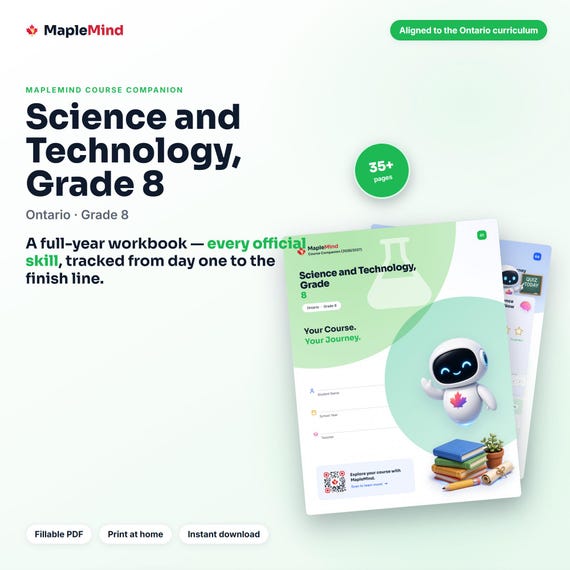
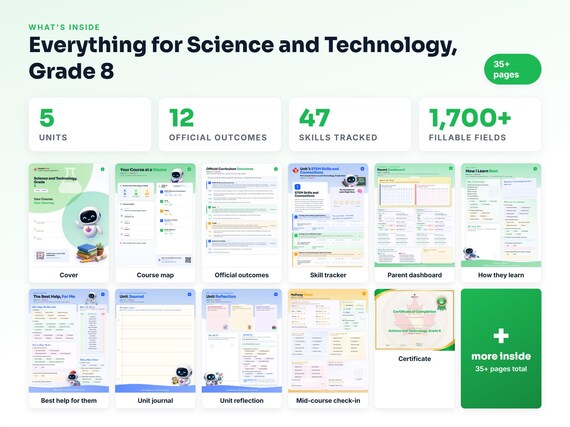
A Science and Technology, Grade 8 workbook worth keeping
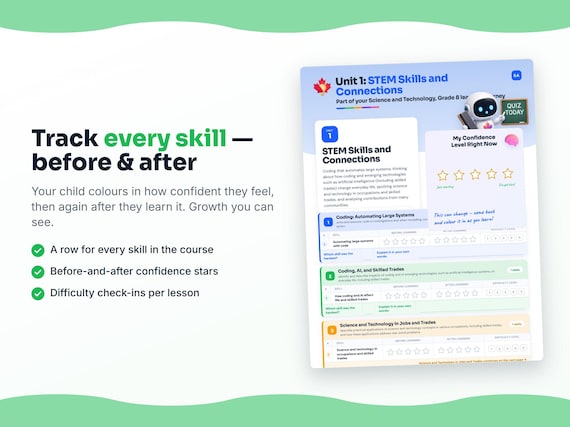
Built from the same official curriculum as this page. Before and after each skill above, your student colours in how sure they feel — so the two of you can see, on one page, what's clicking and what needs another look. It's a quiet way to follow how the year is really going.
By June it's full of their own handwriting: units worked through, confidence grown, a mid-year check-in, notes from parent-teacher night, and a certificate at the end. Less a worksheet, more a record of the year worth keeping on the shelf.
Instant download · see every page, reviews and the full description · five or more workbooks are $2.99 each
What it looks like in the app



Common questions
Can MapleMind help me with Science and Technology, Grade 8?
Yes. MapleMind's AI tutor covers all 47 skills in Ontario's Science and Technology, Grade 8 — you pick the exact skill, and the tutor teaches it step by step: a short lesson, a worked example, solving together, then a skill check to show it stuck.
Is MapleMind aligned to Ontario's official curriculum?
Yes. Every skill in this course maps to an official outcome code from Ontario's Grade 8 Science curriculum, and the ministry's own wording is quoted under each unit on this page — with the official government source linked so you can check it yourself.
What does MapleMind cost?
It's free to start — 5 tutoring chats and a practice quiz every day, no credit card. A Pro subscription ($9.99/month or $49.99/year CAD, 7-day free trial) unlocks unlimited tutoring, practice, and exam simulations.
What if I'm stuck on just one topic?
That's the point of skill-level tutoring: open Science and Technology, Grade 8 in the app, tap the exact skill from the list on this page, and the tutor teaches just that — no wading through lessons you don't need.
Does MapleMind work in French or other languages?
Yes — 14 languages, including French. Both the app and the tutor's explanations switch to the language you choose.
Where can I see the official Ontario curriculum for Science and Technology, Grade 8?
The official source is linked on this page — Ontario's official science curriculum. The outline here follows it: every MapleMind skill carries its official outcome code, and the ministry's own wording is quoted under each unit.
Keep exploring
Ready when you are
Pick a skill from this page and see it taught properly — free, in the browser, in under a minute.