Get help with Science, Grade 9 (De-streamed)
Most tutoring makes you sit through material you already know. MapleMind flips that: pick the exact skill that's causing trouble — any of the 48 below — and the tutor teaches just that one, step by step, as many times as it takes. Ask questions in plain words, any time of day, in English, French, or 12 other languages.
The official Ontario Science, Grade 9 (De-streamed) curriculum
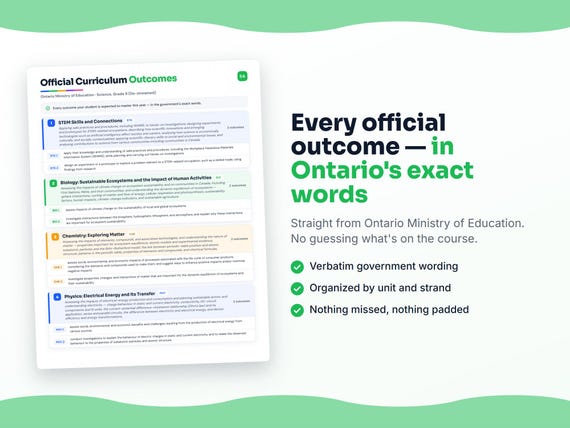
Ontario defines Science, Grade 9 (De-streamed) by strands and outcomes. MapleMind teaches the same curriculum reorganized for one-skill-at-a-time tutoring — the table shows exactly where every official strand lands, and the ministry's own wording is quoted under each unit below.
Official source Ontario's official science curriculumRead it on the government site — dcp.edu.gov.on.ca ↗| Official strand | Outcomes | Where MapleMind teaches it |
|---|---|---|
| Strand A | 6 | STEM Skills and Connections |
| Strand B | 10 | Biology: Sustainable Ecosystems and the Impact of Human Activities |
| Strand C | 9 | Chemistry: Exploring Matter |
| Strand D | 12 | Physics: Electrical Energy and Its Transfer |
| Strand E | 9 | Earth and Space Science: The Solar System and the Universe |
Every skill below, taught one on one.
 Try the first session free
How MapleMind teaches Science, Grade 9 (De-streamed) — every unit, lesson, and skill
Every skill below runs as a short session: a plain-words lesson, a worked example, solving it together, then a five-question skill check that earns up to three stars. Guided Mode keeps it teaching instead of answer-handing — turning it off needs a parent's password.
Unit 1STEM Skills and ConnectionsOfficial strand · Strand A
Applying safe practices and procedures, including WHMIS, to hands-on investigations; designing experiments and prototypes for STEM-related occupations, describing how scientific innovations and emerging technologies such as artificial intelligence affect society and careers, analysing how science is economically, culturally, and socially contextualized, applying scientific-literacy skills to social and environmental issues, and analysing contributions to science from various communities including communities in Canada.
WHMIS and Safe Lab Practices
- WHMIS and safe practices for hands-on investigationssnc1w.A1.5 — Apply knowledge and understanding of safe practices and procedures, including the Workplace Hazardous Materials Information System (WHMIS), while planning and carrying out hands-on investigations.
Designing for STEM Careers and Emerging Technology
- Designing an experiment or prototype for a STEM occupationsnc1w.A2.1 — Design an experiment or prototype to explore a problem relevant to a STEM-related occupation, such as a skilled trade, using research findings.
- How innovations and AI affect society and careerssnc1w.A2.2 — Describe how scientific innovations and emerging technologies, including artificial intelligence systems, impact society and careers.
- Contributions to science from various communitiessnc1w.A2.5 — Analyse contributions to science by people from various communities, including communities in Canada.
The official wording — 6 outcomes in this unit
- snc1w.A1.5
apply their knowledge and understanding of safe practices and procedures, including the Workplace Hazardous Materials Information System (WHMIS), while planning and carrying out hands-on investigations
- snc1w.A2.1
design an experiment or a prototype to explore a problem relevant to a STEM-related occupation, such as a skilled trade, using findings from research
- snc1w.A2.2
describe how scientific innovations and emerging technologies, including artificial intelligence systems, impact society and careers
- snc1w.A2.3
analyse how the development and application of science is economically, culturally, and socially contextualized, by investigating real-world issues
- snc1w.A2.4
apply scientific literacy skills when investigating social and environmental issues that have personal, local, and/or global impacts
- snc1w.A2.5
analyse contributions to science by people from various communities, including communities in Canada
Unit 2Biology: Sustainable Ecosystems and the Impact of Human ActivitiesOfficial strand · Strand B
Assessing the impacts of climate change on ecosystem sustainability and on communities in Canada, including First Nations, Métis, and Inuit communities; and understanding the dynamic equilibrium of ecosystems — sphere interactions, cycling of matter and flow of energy, cellular respiration and photosynthesis, sustainability factors, human impacts, climate-change indicators, and sustainable agriculture.
Climate Change and Sustainability
- Climate-change impacts on ecosystem sustainabilitysnc1w.B1.1 — Assess impacts of climate change on the sustainability of local and global ecosystems.
- Initiatives for combatting climate changesnc1w.B1.1 — Describe local or global initiatives for combatting climate change.
- Personal and community solutions to climate-change impactssnc1w.B1.1 — Identify solutions to address some of the impacts of climate change.
- Climate-change impacts on communities in Canadasnc1w.B1.2 — Assess impacts of climate change on communities in Canada, including First Nations, Métis, and Inuit communities.
- Sustainable practices and dynamic equilibriumsnc1w.B1.3 — Investigate and explain how sustainable practices used by various communities, including First Nations, Métis, and Inuit communities, reflect an understanding of ecosystems' dynamic equilibrium.
The Dynamic Equilibrium of Ecosystems
- Interactions of the biosphere, hydrosphere, lithosphere, and atmospheresnc1w.B2.1 — Investigate interactions between the biosphere, hydrosphere, lithosphere, and atmosphere, and explain why they matter for ecosystem sustainability.
- Cycling of matter and flow of energysnc1w.B2.2 — Explain how naturally occurring phenomena, including the cycling of matter and the flow of energy, contribute to the dynamic equilibrium of ecosystems.
- Cellular respiration and photosynthesissnc1w.B2.3 — Compare and contrast cellular respiration and photosynthesis, and explain how their complementary relationship contributes to ecosystems' dynamic equilibrium.
- Factors and processes in ecosystem sustainabilitysnc1w.B2.4 — Investigate factors and processes — biodiversity, air and water quality, soil health, and succession — and explain how they contribute to ecosystem sustainability.
- Human activities and dynamic equilibriumsnc1w.B2.5 — Explain the effects of various human activities on the dynamic equilibrium of ecosystems.
- Indicators of climate changesnc1w.B2.6 — Identify and use indicators of climate change to describe its impacts on ecosystems, and analyse how human activities contribute to climate change.
- Sustainable practices in agriculturesnc1w.B2.7 — Explain how sustainable practices related to the cycling of matter and the flow of energy can be applied in agricultural innovations.
The official wording — 10 outcomes in this unit
- snc1w.B1.1
assess impacts of climate change on the sustainability of local and global ecosystems
- snc1w.B1.2
assess impacts of climate change on communities in Canada, including First Nations, Métis, and Inuit communities
- snc1w.B1.3
investigate and explain how sustainable practices used by various communities, including First Nations, Métis, and Inuit communities, reflect an understanding of the importance of the dynamic equilibrium of ecosystems
- snc1w.B2.1
investigate interactions between the biosphere, hydrosphere, lithosphere, and atmosphere, and explain why these interactions are important for ecosystem sustainability
- snc1w.B2.2
explain how naturally occurring phenomena, including the cycling of matter and the flow of energy, contribute to the dynamic equilibrium within and between ecosystems
- snc1w.B2.3
compare and contrast the processes of cellular respiration and photosynthesis, and explain how their complementary relationship contributes to the dynamic equilibrium of ecosystems
- snc1w.B2.4
investigate factors and processes, including biodiversity, air and water quality, soil health, and succession, and explain how they contribute to ecosystem sustainability
- snc1w.B2.5
explain the effects of various human activities on the dynamic equilibrium of ecosystems
- snc1w.B2.6
identify and use various indicators of climate change to describe the impacts of climate change on local and global ecosystems, and analyse how human activities contribute to climate change
- snc1w.B2.7
explain how sustainable practices related to the cycling of matter and the flow of energy can be applied in agricultural innovations
Unit 3Chemistry: Exploring MatterOfficial strand · Strand C
Assessing the impacts of elements, compounds, and associated technologies; and understanding the nature of matter — properties important for ecosystem equilibrium, atomic models and experimental evidence, subatomic particles and the Bohr-Rutherford model, the link between periodic-table position and atomic structure, patterns in the periodic table, properties of elements and compounds, and chemical formulas.
Elements, Compounds, and Their Impacts
- Impacts of consumer-product life cyclessnc1w.C1.1 — Assess the social, environmental, and economic impacts of the life cycle of consumer products, considering the elements and compounds used, and suggest ways to improve them.
- Impacts of emerging chemical technologiessnc1w.C1.2 — Analyse impacts of emerging chemical technologies in various fields, including the skilled trades, and assess factors influencing their development.
Atoms, Elements, and the Periodic Table
- Properties of matter and ecosystem equilibriumsnc1w.C2.1 — Investigate properties, changes, and interactions of matter that are important for the dynamic equilibrium and sustainability of ecosystems.
- Atomic models and experimental evidencesnc1w.C2.2 — Research the role of experimental evidence in developing atomic models, and compare and contrast different models of the atom.
- Subatomic particles and the Bohr-Rutherford modelsnc1w.C2.3 — Identify the location, relative mass, and charge of subatomic particles within an atom using the Bohr-Rutherford model.
- Periodic-table position and atomic structuresnc1w.C2.4 — Explain the relationship between an element's position in the periodic table and the structure of its atoms, using models.
- Patterns in the periodic tablesnc1w.C2.5 — Investigate the physical and chemical properties of elements and relate them to the organization of the periodic table, classifying elements and identifying patterns.
- Properties of elements and compoundssnc1w.C2.6 — Investigate and describe physical and chemical properties of elements and compounds, including those in common household products.
- Structure and chemical formulas of compoundssnc1w.C2.7 — Describe the relationship between the structure of simple compounds and their chemical formulas.
The official wording — 9 outcomes in this unit
- snc1w.C1.1
assess social, environmental, and economic impacts of processes associated with the life cycle of consumer products, considering the elements and compounds used to make them, and suggest ways to enhance positive impacts and/or minimize negative impacts
- snc1w.C1.2
analyse impacts of using emerging chemical technologies in various fields, including in the skilled trades, and assess factors that influence the development of these technologies
- snc1w.C2.1
investigate properties, changes, and interactions of matter that are important for the dynamic equilibrium of ecosystems and their sustainability
- snc1w.C2.2
research the role of experimental evidence in the development of various atomic models, and compare and contrast different models of the atom
- snc1w.C2.3
identify the location, relative mass, and charge of subatomic particles within an atom, using the Bohr- Rutherford model
- snc1w.C2.4
explain the relationship between the position of an element in the periodic table and the structure of its atoms, using models
- snc1w.C2.5
investigate the physical and chemical properties of elements, and use their findings to relate these properties to the organization of the periodic table, classify elements, and identify patterns in the periodic table
- snc1w.C2.6
investigate and describe physical and chemical properties of elements and compounds, including those that make up common household products
- snc1w.C2.7
describe the relationship between the structure of simple compounds and their chemical formulas
Unit 4Physics: Electrical Energy and Its TransferOfficial strand · Strand D
Assessing the impacts of electrical-energy production and consumption and planning sustainable action; and understanding electricity — charge behaviour in static and current electricity, conductivity, DC-circuit components and SI units, the current–potential difference–resistance relationship (Ohm's law) and its application, series and parallel circuits, the difference between electricity and electrical energy, and device efficiency and energy transformations.
Producing and Using Electrical Energy Responsibly
- Benefits and challenges of electricity sourcessnc1w.D1.1 — Assess the social, environmental, and economic benefits and challenges of producing electrical energy from various sources.
- Electricity's community impacts and sustainabilitysnc1w.D1.2 — Evaluate how electrical-energy production and consumption impact communities locally or globally, and describe ways to achieve sustainable practices.
- A plan of action for an energy issuesnc1w.D1.3 — Develop a plan of action to address a local or global electrical-energy production or consumption issue, including energy-conservation strategies.
- Impacts of emerging electrical technologiessnc1w.D1.4 — Analyse the social, environmental, and economic impacts of emerging technologies for electrical-energy production, consumption, storage, and conservation.
Charge, Circuits, and Ohm's Law
- Behaviour of electric chargessnc1w.D2.1 — Conduct investigations to explain the behaviour of electric charges in static and current electricity, and relate it to subatomic particles and atomic structure.
- Conductivity of materialssnc1w.D2.2 — Determine the conductivity of various materials by investigating their ability to hold or transfer electric charges.
- DC-circuit components and SI unitssnc1w.D2.3 — Identify the components of a DC circuit and their functions, and identify electrical quantities, their symbols, and their SI units.
- Deriving Ohm's lawsnc1w.D2.4 — Investigate the relationships between electric current, potential difference, and resistance in circuits, and develop a mathematical model to represent them.
- Applying Ohm's lawsnc1w.D2.5 — Apply a mathematical model to calculate electric current, potential difference, and resistance in real-world situations.
- Series and parallel circuitssnc1w.D2.6 — Construct series and parallel circuits to compare electric current, potential difference, and resistance in both types.
- Electricity versus electrical energysnc1w.D2.7 — Explain the difference between electricity and electrical energy.
- Device efficiency and energy transformationssnc1w.D2.8 — Determine the efficiency of electrical devices that consume or produce electrical energy, and identify the energy transformations in each.
The official wording — 12 outcomes in this unit
- snc1w.D1.1
assess social, environmental, and economic benefits and challenges resulting from the production of electrical energy from various sources
- snc1w.D1.2
evaluate how electrical energy production and consumption impact various communities locally or globally, and describe ways to achieve sustainable practices
- snc1w.D1.3
develop a plan of action to address a local or global electrical energy production or consumption issue, including strategies for energy conservation
- snc1w.D1.4
analyse social, environmental, and economic impacts of emerging technologies related to electrical energy production, consumption, storage, and conservation
- snc1w.D2.1
conduct investigations to explain the behaviour of electric charges in static and current electricity, and to relate the observed behaviour to the properties of subatomic particles and atomic structure
- snc1w.D2.2
determine the conductivity of various materials by investigating their ability to hold or transfer electric charges
- snc1w.D2.3
identify the components of a direct current (DC) circuit and explain their functions, and identify electrical quantities, their symbols, and their corresponding International System of Units (SI) units
- snc1w.D2.4
investigate the relationships between electric current, potential difference, and resistance in electrical circuits, and develop a mathematical model to represent the relationships
- snc1w.D2.5
apply a mathematical model to calculate electric current, potential difference, and resistance in real- world situations
- snc1w.D2.6
construct series and parallel circuits to compare electric current, potential difference, and resistance in both types of circuits
- snc1w.D2.7
explain the difference between electricity and electrical energy
- snc1w.D2.8
determine the efficiency of various electrical devices that consume or produce electrical energy, and identify the energy transformations in each device
Unit 5Earth and Space Science: The Solar System and the UniverseOfficial strand · Strand E
Evaluating the impacts of space observation and exploration and their contributions to understanding Earth; and understanding the solar system and universe — the Sun's importance, how the Sun's energy drives natural phenomena and renewable energy, evidence for the origin and evolution of the universe, the components of the solar system and universe, quantifying astronomical distances, and the causes of astronomical phenomena observed from Earth.
Why We Explore Space
- Impacts of space observation and explorationsnc1w.E1.1 — Evaluate the social, environmental, and economic impacts of space observation and exploration.
- Space technology and understanding Earthsnc1w.E1.2 — Evaluate how space observation and exploration technologies contribute to our understanding of climate change, natural disasters, and other phenomena.
- Space innovations applied on Earthsnc1w.E1.3 — Assess ways technological innovations from space observation and exploration are applied in various fields, including contributions to sustainable practices on Earth.
The Solar System and the Universe
- The Sun and its importancesnc1w.E2.1 — Describe the importance of the Sun and its characteristics, including its role in the solar system and in sustaining life on Earth.
- The Sun's energy and natural phenomenasnc1w.E2.2 — Explain how the Sun's energy causes natural phenomena on Earth, and how these contribute to renewable-energy production.
- Evidence for the origin of the universesnc1w.E2.3 — Summarize observational evidence used to support theories about the origin and evolution of the universe and solar system, considering diverse ways of knowing.
- Components of the solar system and universesnc1w.E2.4 — Describe the major components of the solar system and the universe and compare their characteristics.
- Quantifying distances in spacesnc1w.E2.5 — Quantify distances in the solar system and universe by applying an understanding of relative distances and sizes and using appropriate units of measure.
- Causes of astronomical phenomenasnc1w.E2.6 — Conduct investigations to explain the causes of various astronomical phenomena that can be observed from Earth.
The official wording — 9 outcomes in this unit
- snc1w.E1.1
evaluate social, environmental, and economic impacts of space observation and exploration
- snc1w.E1.2
evaluate how space observation and exploration technologies contribute to our understanding of climate change, natural disasters, and other phenomena
- snc1w.E1.3
assess ways in which technological innovations related to space observation and exploration are applied in various fields, including their contributions to sustainable practices on Earth
- snc1w.E2.1
describe the importance of the Sun and its characteristics, including its role in the solar system and in sustaining life on Earth
- snc1w.E2.2
explain how the Sun’s energy causes natural phenomena on Earth, and how these phenomena contribute to renewable energy production
- snc1w.E2.3
summarize observational evidence used to support theories about the origin and evolution of the universe and the solar system, considering diverse ways of knowing
- snc1w.E2.4
describe major components of the solar system and the universe and compare their characteristics
- snc1w.E2.5
quantify distances in the solar system and the universe by applying an understanding of relative distances and sizes and using appropriate units of measure
- snc1w.E2.6
conduct investigations to explain the causes of various astronomical phenomena that can be observed from Earth
Printable workbook · A keepsake of the year
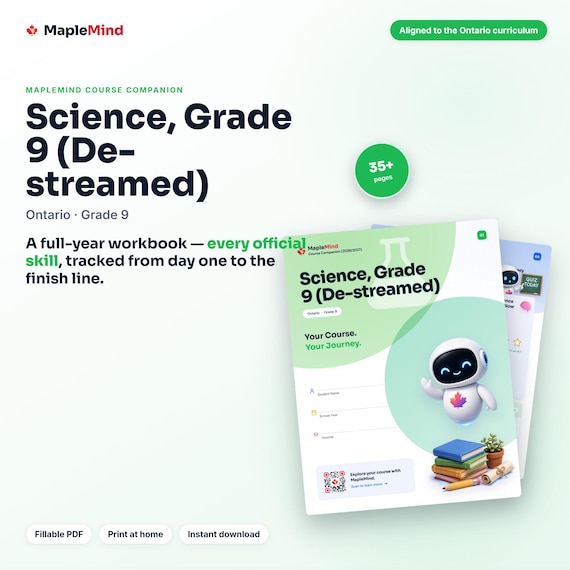
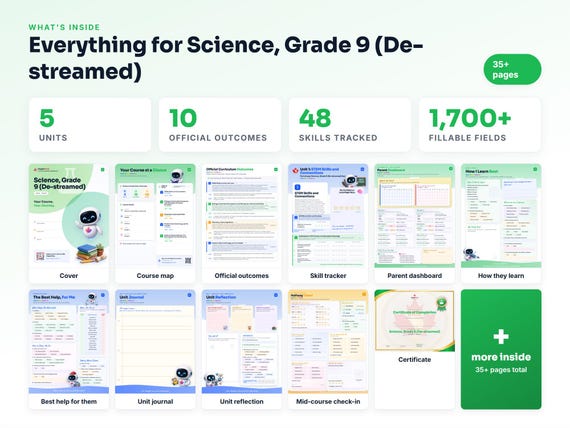
A Science, Grade 9 (De-streamed) workbook worth keeping
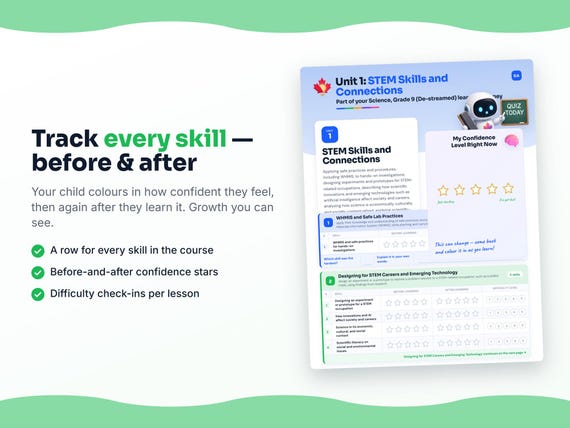
Built from the same official curriculum as this page. Before and after each skill above, your student colours in how sure they feel — so the two of you can see, on one page, what's clicking and what needs another look. It's a quiet way to follow how the year is really going.
By June it's full of their own handwriting: units worked through, confidence grown, a mid-year check-in, notes from parent-teacher night, and a certificate at the end. Less a worksheet, more a record of the year worth keeping on the shelf.
Instant download · see every page, reviews and the full description · five or more workbooks are $2.99 each
What it looks like in the app



Common questions
Can MapleMind help me with Science, Grade 9 (De-streamed)?
Yes. MapleMind's AI tutor covers all 48 skills in Ontario's Science, Grade 9 (De-streamed) — you pick the exact skill, and the tutor teaches it step by step: a short lesson, a worked example, solving together, then a skill check to show it stuck.
Is MapleMind aligned to Ontario's official curriculum?
Yes. Every skill in this course maps to an official outcome code from Ontario's Grade 9 Science curriculum, and the ministry's own wording is quoted under each unit on this page — with the official government source linked so you can check it yourself.
What does MapleMind cost?
It's free to start — 5 tutoring chats and a practice quiz every day, no credit card. A Pro subscription ($9.99/month or $49.99/year CAD, 7-day free trial) unlocks unlimited tutoring, practice, and exam simulations.
What if I'm stuck on just one topic?
That's the point of skill-level tutoring: open Science, Grade 9 (De-streamed) in the app, tap the exact skill from the list on this page, and the tutor teaches just that — no wading through lessons you don't need.
Does MapleMind work in French or other languages?
Yes — 14 languages, including French. Both the app and the tutor's explanations switch to the language you choose.
Where can I see the official Ontario curriculum for Science, Grade 9 (De-streamed)?
The official source is linked on this page — Ontario's official science curriculum. The outline here follows it: every MapleMind skill carries its official outcome code, and the ministry's own wording is quoted under each unit.
Keep exploring
Ready when you are
Pick a skill from this page and see it taught properly — free, in the browser, in under a minute.