Get help with Science, Grade 10, Academic
Most tutoring makes you sit through material you already know. MapleMind flips that: pick the exact skill that's causing trouble — any of the 70 below — and the tutor teaches just that one, step by step, as many times as it takes. Ask questions in plain words, any time of day, in English, French, or 12 other languages.
The official Ontario Science, Grade 10, Academic curriculum
Ontario defines Science, Grade 10, Academic by strands and outcomes. MapleMind teaches the same curriculum reorganized for one-skill-at-a-time tutoring — the table shows exactly where every official strand lands, and the ministry's own wording is quoted under each unit below.
Official source Ontario's official science curriculumRead it on the government site — dcp.edu.gov.on.ca ↗| Official strand | Outcomes | Where MapleMind teaches it |
|---|---|---|
| Strand A | 2 | Investigation Skills and Careers |
| Strand B | 15 | Biology: Tissues, Organs, and Systems of Living Things |
| Strand C | 16 | Chemistry: Chemical Reactions |
| Strand D | 19 | Earth and Space Science: Climate Change |
| Strand E | 16 | Physics: Light and Geometric Optics |
Every skill below, taught one on one.
 Try the first session free
How MapleMind teaches Science, Grade 10, Academic — every unit, lesson, and skill
Every skill below runs as a short session: a plain-words lesson, a worked example, solving it together, then a five-question skill check that earns up to three stars. Guided Mode keeps it teaching instead of answer-handing — turning it off needs a parent's password.
Unit 1Investigation Skills and CareersOfficial strand · Strand A
Careers related to the fields of science under study and the education and training they require, and scientists — including Canadians — who have contributed to those fields. The scientific investigation skills of strand A1 are woven through every lab and inquiry in strands B-E rather than taught here on their own.
Careers in Science
- Careers in the sciencessnc2d.SNC2D.A2.1 — Identify and describe a variety of careers related to the fields of science under study and the education and training necessary for them.
Scientists and Their Contributions
- Scientists who contributed to these fieldssnc2d.SNC2D.A2.2 — Identify scientists, including Canadians, who have contributed to the fields of science under study.
The official wording — 2 outcomes in this unit
- snc2d.SNC2D.A2.1
identify and describe a variety of careers re- lated to the fields of science under study (e.g., meteorologist, medical illustrator, geochemist, optical physicist) and the education and train- ing necessary for these careers
- snc2d.SNC2D.A2.2
identify scientists, including Canadians (e.g., Sheela Basrur, William Richard Peltier, Alice Wilson, Willard Doyle), who have made a contribution to the fields of science under study
Unit 2Biology: Tissues, Organs, and Systems of Living ThingsOfficial strand · Strand B
Cells, cell division and specialization, and the hierarchical organization of cells into tissues, organs, and systems in plants and animals — investigated with the microscope and dissection — plus evaluating medical and other technologies and public-health strategies related to systems biology.
Systems Biology, Technology, and Society
- Ethical issues in systems-biology technologysnc2d.SNC2D.B1.1 — Analyse ethical issues related to a technological development in systems biology, and communicate the findings.
- Medical imaging technologiessnc2d.SNC2D.B1.2 — Assess the importance to human health and society of medical imaging technologies used in Canada to diagnose or treat abnormalities in tissues, organs, and systems.
- Public-health strategies in systems biologysnc2d.SNC2D.B1.3 — Describe public-health strategies related to systems biology, such as cancer screening, vaccines, and health education.
- Impact of public-health strategies on societysnc2d.SNC2D.B1.3 — Assess the impact on society of public-health strategies related to systems biology.
Investigating Cells and Systems
- Cell and system terminologysnc2d.SNC2D.B2.1 — Use appropriate terminology related to cells, tissues, organs, and systems of living things.
- Stages of mitosis under the microscopesnc2d.SNC2D.B2.2 — Examine cells under a microscope to identify the various stages of mitosis in plants and animals.
- Comparing plant and animal cellssnc2d.SNC2D.B2.3 — Examine plant and animal cells under a microscope and draw labelled biological diagrams showing how their organelles differ.
- Investigating specialized cellssnc2d.SNC2D.B2.4 — Investigate specialized cells in the human body or in plants under a microscope, and draw labelled diagrams of their structural differences.
- Rate of cell division in cancerous cellssnc2d.SNC2D.B2.5 — Investigate the rate of cell division in cancerous and non-cancerous cells and predict its impact on an organism.
- Dissecting organ systemssnc2d.SNC2D.B2.6 — Investigate, through dissection, the interrelationships between organ systems of a plant or an animal.
- Researching a disease of tissues or systemssnc2d.SNC2D.B2.7 — Use a research process to investigate a disease or abnormality related to tissues, organs, or systems of humans or plants.
- The cell cycle and mitosissnc2d.SNC2D.B3.1 — Describe the cell cycle in plants and animals, and explain the importance of mitosis for growth and tissue repair.
- Cell division and specializationsnc2d.SNC2D.B3.2 — Explain the importance of cell division and cell specialization in generating new tissues and organs.
- From cells to systemssnc2d.SNC2D.B3.3 — Explain the links between specialized cells, tissues, organs, and systems in plants and animals.
- Functions of animal systemssnc2d.SNC2D.B3.4 — Explain the primary functions of a variety of systems in animals.
- Interaction of systems in an organismsnc2d.SNC2D.B3.5 — Explain the interaction of different systems within an organism and why such interactions are necessary for survival.
The official wording — 15 outcomes in this unit
- snc2d.SNC2D.B1.1
analyse, on the basis of research, ethical issues related to a technological development in the field of systems biology (e.g., cloning, stem- cell research, live organ transplants, transgenic transplants), and communicate their findings [IP, PR, AI, C]
- snc2d.SNC2D.B1.2
assess the importance to human health and/ or society of medical imaging technologies (e.g., ultrasound, X‑rays, computerized axial tomog- raphy [CT or CAT] scan, magnetic resonance imaging [MRI], microscopy, biophotonics) used in Canada in diagnosing or treating abnormal- ities in tissues, organs, and/ or systems [AI, C]
- snc2d.SNC2D.B1.3
describe public health strategies related to systems biology (e.g., cancer screening and pre- vention programs; vaccines against the human papillomavirus [HPV] and measles, mumps, and rubella [MMR]; AIDS education), and as- sess their impact on society [AI, C]
- snc2d.SNC2D.B2.1
use appropriate terminology related to cells, tissues, organs, and systems of living things, in- cluding, but not limited to: absorption, anaphase, capillaries, concentration, differentiation, diffusion, meristematic, mesophyll, phloem, prophase, red blood cells, regeneration, stomate, and xylem [C]
- snc2d.SNC2D.B2.2
examine cells under a microscope or similar instrument to identify the various stages of mi- tosis in plants and animals [PR, AI]
- snc2d.SNC2D.B2.3
examine different plant and animal cells (e.g., cheek cells, onion cells) under a microscope or similar instrument, and draw labelled biologic- al diagrams to show how the cells’ organelles differ [PR, C]
- snc2d.SNC2D.B2.4
investigate, using a microscope or similar in- strument, specialized cells in the human body or in plants, focusing on different types of cells (e.g., bone, muscle, leaf, root cells), and draw labelled biological diagrams to show the cells’ structural differences [PR, C]
- snc2d.SNC2D.B2.5
investigate the rate of cell division in cancer- ous and non‑cancerous cells, using pictures, videos, or images, and predict the impact of this rate of cell division on an organism [PR, AI]
- snc2d.SNC2D.B2.6
investigate, through a laboratory or computer‑ simulated dissection of a plant, worm, fish, or frog, the interrelationships between organ systems of a plant or an animal (e.g., between the root system and leaf system in a plant; between the digestive system and circulatory system in an animal) [PR, AI]
- snc2d.SNC2D.B2.7
use a research process to investigate a disease or abnormality related to tissues, organs, or sys- tems of humans or plants (e.g., heart disease, tobacco mosaic virus, wheat rust) [IP, PR, C]
- snc2d.SNC2D.B3.1
describe the cell cycle in plants and animals, and explain the importance of mitosis for the growth of cells and repair of tissues
- snc2d.SNC2D.B3.2
explain the importance of cell division and cell specialization in generating new tissues and organs (e.g., the division of stem cells into specialized cells such as muscle cells or nerve cells in humans; the division of meristematic cells to expand and differentiate plant tissue)
- snc2d.SNC2D.B3.3
explain the links between specialized cells, tis- sues, organs, and systems in plants and animals (e.g., muscle cells and nerve cells form the tissue found in the heart, which is a component of the circulatory system; granum and thylakoid struc- tures act as solar collectors in the chloroplast to produce carbohydrates for plant growth)
- snc2d.SNC2D.B3.4
explain the primary functions of a variety of systems in animals (e.g., the circulatory system transports materials through the organism; the respiratory system supplies oxygen to and re- moves carbon dioxide from the body)
- snc2d.SNC2D.B3.5
explain the interaction of different systems within an organism (e.g., the respiratory system brings oxygen into the body, and the circulatory system transports the oxygen to cells) and why such interactions are necessary for the organ- ism’s survival
Unit 3Chemistry: Chemical ReactionsOfficial strand · Strand C
Chemical reactions — synthesis, decomposition, displacement, and acid-base neutralization — investigated through inquiry and represented with word and balanced equations, grounded in the law of conservation of mass, chemical formulae, and the pH scale, plus analysing safety and environmental issues of reactions.
Reactions, Safety, and the Environment
- Safety and environmental issues of reactionssnc2d.SNC2D.C1.1 — Analyse various safety and environmental issues associated with chemical reactions and their reactants and products.
- Chemistry solving environmental challengessnc2d.SNC2D.C1.2 — Analyse how understanding the properties of chemical substances and their reactions can be applied to solve environmental challenges.
Investigating Chemical Reactions
- Chemical-reaction terminologysnc2d.SNC2D.C2.1 — Use appropriate terminology related to chemical reactions, including compounds, product, and reactant.
- Molecular models of reactionssnc2d.SNC2D.C2.2 — Construct molecular models to illustrate the structure of molecules in simple chemical reactions and produce diagrams of them.
- Investigating reaction typessnc2d.SNC2D.C2.3 — Investigate simple chemical reactions — synthesis, decomposition, and displacement — and represent them in a variety of formats.
- Conservation of mass inquirysnc2d.SNC2D.C2.4 — Use an inquiry process to investigate the law of conservation of mass in a reaction and account for any discrepancies.
- Evidence of chemical changesnc2d.SNC2D.C2.5 — Plan and conduct an inquiry to identify the evidence of chemical change.
- Classifying acids and basessnc2d.SNC2D.C2.6 — Plan and conduct an inquiry to classify common substances as acidic, basic, or neutral.
- Formulae, composition, and namessnc2d.SNC2D.C3.1 — Describe the relationships between chemical formulae, composition, and names of binary compounds.
- Why we balance equationssnc2d.SNC2D.C3.2 — Explain, using the law of conservation of mass and atomic theory, the rationale for balancing chemical equations.
- Evidence that indicates chemical changesnc2d.SNC2D.C3.3 — Describe the types of evidence that indicate a chemical change.
- Writing balanced equationssnc2d.SNC2D.C3.4 — Write word equations and balanced chemical equations for simple chemical reactions.
- Reactants and products of reaction typessnc2d.SNC2D.C3.5 — Describe, from observation, the reactants and products of synthesis, decomposition, and displacement reactions.
- Acid-base neutralizationsnc2d.SNC2D.C3.6 — Describe the process of acid-base neutralization.
- The pH scalesnc2d.SNC2D.C3.7 — Describe how the pH scale is used to classify solutions as acidic, basic, or neutral.
- Identifying compounds and writing formulaesnc2d.SNC2D.C3.8 — Identify simple ionic, polyatomic-ion, and molecular compounds and acids, and write their formulae using the periodic table.
The official wording — 16 outcomes in this unit
- snc2d.SNC2D.C1.1
analyse, on the basis of research, various safety and environmental issues associated with chemical reactions and their reactants and/ or product(s) (e.g., chemical reactions related to the use of cyanide in gold mining, the corrosion of metal supports on bridges, the use of differ- ent antibacterial agents such as chlorine and bromine in recreational pools) [IP, PR, AI, C]
- snc2d.SNC2D.C1.2
analyse how an understanding of the proper- ties of chemical substances and their reactions can be applied to solve environmental challenges (e.g., renewing the Great Lakes, neutralizing acid spills, scrubbing smokestack emissions) [AI, C]
- snc2d.SNC2D.C2.1
use appropriate terminology related to chemical reactions, including, but not limited to: compounds, product, and reactant [C]
- snc2d.SNC2D.C2.2
construct molecular models to illustrate the structure of molecules in simple chemical reac- tions (e.g., C + O 2 ➞ CO 2 ; 2H 2 + O 2 ➞ 2H 2 O), and produce diagrams of these models [PR, C]
- snc2d.SNC2D.C2.3
investigate simple chemical reactions, including synthesis, decomposition, and dis- placement reactions, and represent them using a variety of formats (e.g., molecular models, word equations, balanced chemical equations) [PR, AI, C]
- snc2d.SNC2D.C2.4
use an inquiry process to investigate the law of conservation of mass in a chemical reaction (e.g., compare the values before and after the reaction), and account for any discrepancies [PR, AI]
- snc2d.SNC2D.C2.5
plan and conduct an inquiry to identify the evidence of chemical change (e.g., the forma- tion of a gas or precipitate, a change in colour or odour, a change in temperature) [IP, PR, AI]
- snc2d.SNC2D.C2.6
plan and conduct an inquiry to classify some common substances as acidic, basic, or neutral (e.g., use acid–base indicators or pH test strips to classify common household substances) [IP, PR, AI]
- snc2d.SNC2D.C3.1
describe the relationships between chemical formulae, composition, and names of binary compounds (e.g., carbon dioxide, CO 2 , has two oxygen atoms and one carbon atom)
- snc2d.SNC2D.C3.2
explain, using the law of conservation of mass and atomic theory, the rationale for bal- ancing chemical equations
- snc2d.SNC2D.C3.3
describe the types of evidence that indicate chemical change (e.g., changes in colour, the production of a gas, the formation of a precipi- tate, the production or absorption of heat, the production of light)
- snc2d.SNC2D.C3.4
write word equations and balanced chemical equations for simple chemical reactions (e.g., 2H 2 + O 2 ➞ 2H 2 O)
- snc2d.SNC2D.C3.5
describe, on the basis of observation, the react- ants in and products of a variety of chemical reactions, including synthesis, decomposition, and displacement reactions (e.g., reactions occur- ring when magnesium burns or in the production of oxygen from hydrogen peroxide; the reaction of iron and copper sulphate; reactions occurring when fossil fuels burn)
- snc2d.SNC2D.C3.6
describe the process of acid–base neutraliza- tion (i.e., an acid reacts with a base to form a salt and often water)
- snc2d.SNC2D.C3.7
describe how the pH scale is used to classify solutions as acidic, basic, or neutral (e.g., a solu- tion with a pH of 1 is highly acidic; a solution with a pH of 7 is neutral)
- snc2d.SNC2D.C3.8
identify simple ionic compounds (e.g., NaCl), simple compounds involving polyatomic ions (e.g., KNO 3 , NaOH), molecular compounds (e.g., CO 2 , H 2 O, NH 3 ), and acids (e.g., HCl(aq), H 2 SO 4 (aq)), using the periodic table and a list of the most com- mon polyatomic ions (e.g., OH–, SO 4 -2), and write the formulae
Unit 4Earth and Space Science: Climate ChangeOfficial strand · Strand D
Earth's climate system and the natural and anthropogenic greenhouse effect — heat transfer, the water cycle and ocean currents, greenhouse-gas sources and sinks, and the causes, indicators, and effects of climate change — plus analysing climate-change effects and assessing initiatives that address it.
Climate Change and Society
- Effects of climate changesnc2d.SNC2D.D1.1 — Analyse the positive and negative effects of climate change on human activity and natural systems.
- Assessing climate initiativessnc2d.SNC2D.D1.2 — Assess the effectiveness of current initiatives that address climate change.
- Proposing a course of actionsnc2d.SNC2D.D1.2 — Propose a further course of action related to a climate-change initiative.
Investigating Earth's Climate System
- Climate-change terminologysnc2d.SNC2D.D2.1 — Use appropriate terminology related to climate change.
- Modelling the greenhouse effectsnc2d.SNC2D.D2.2 — Design and build a model to illustrate the natural greenhouse effect and use it to explain the anthropogenic greenhouse effect.
- Evidence of climate change from datasnc2d.SNC2D.D2.3 — Analyse different sources of scientific data for evidence of natural and human-influenced climate change.
- Testing a climate hypothesissnc2d.SNC2D.D2.4 — Investigate a popular hypothesis on a cause-and-effect relationship in climate change using simulations or time-trend data.
- Heat transfer in the hydrosphere and atmospheresnc2d.SNC2D.D2.5 — Investigate the effects of heat transfer within the hydrosphere and atmosphere.
- Water's states and climatesnc2d.SNC2D.D2.6 — Investigate how water in its various states influences climate patterns.
- Ocean currents and heat transfersnc2d.SNC2D.D2.7 — Investigate the influence of ocean currents on local and global heat transfer and precipitation patterns.
- Classifying local climatesnc2d.SNC2D.D2.8 — Classify the climate of the local region and compare it to other regions.
- Perspectives and bias in climate discussionsnc2d.SNC2D.D2.9 — Compare different perspectives and biases evident in scientific and non-scientific media discussions of climate change.
- Earth's climate systemsnc2d.SNC2D.D3.1 — Describe the principal components of Earth's climate system and how the system works.
- Heat transfer and currentssnc2d.SNC2D.D3.2 — Describe and explain heat transfer in the hydrosphere and atmosphere and its effects on air and water currents.
- Natural vs anthropogenic greenhouse effectsnc2d.SNC2D.D3.3 — Describe the natural greenhouse effect, explain its importance for life, and distinguish it from the anthropogenic greenhouse effect.
- Natural and human factors in climatesnc2d.SNC2D.D3.4 — Identify natural phenomena and human activities that affect climate, and describe their role in Canada's contribution to climate change.
- Greenhouse-gas sources and sinkssnc2d.SNC2D.D3.5 — Describe the principal natural and anthropogenic sources and sinks of greenhouse gases.
- How gases trap heatsnc2d.SNC2D.D3.6 — Describe how different carbon and nitrogen compounds influence the trapping of heat in the atmosphere and hydrosphere.
- Anthropogenic effects and ozonesnc2d.SNC2D.D3.7 — Describe the causes and effects of the anthropogenic greenhouse effect, ozone depletion, and ground-level ozone and smog.
- Indicators of climate changesnc2d.SNC2D.D3.8 — Identify and describe indicators of global climate change.
The official wording — 19 outcomes in this unit
- snc2d.SNC2D.D1.1
analyse current and/ or potential effects, both positive and negative, of climate change on hu- man activity and natural systems (e.g., loss of habitat for Arctic mammals such as polar bears and loss of traditional lifestyles for Inuit as Arctic ice shrinks; famine as arable land is lost to desert- ification; an increase in water-borne disease and human resettlement as coastal lands are flooded; expansion of the growing season in some regions) [AI, C]
- snc2d.SNC2D.D1.2
assess, on the basis of research, the effective- ness of some current individual, regional, national, or international initiatives that address the issue of climate change (e.g., Drive Clean, ENERGY STAR, federal and provincial govern- ment rebates for retrofitting older buildings to be more energy efficient, carbon offset programs, community tree-planting programs, municipal recycling programs, Intergovernmental Panel on Climate Change [IPCC]), and propose a further course of action related to one of these initiatives [PR, AI, C]
- snc2d.SNC2D.D2.1
use appropriate terminology related to climate change, including, but not limited to: albedo, anthropogenic, atmosphere, cycles, heat sinks, and hydrosphere [C]
- snc2d.SNC2D.D2.2
design and build a model to illustrate the natural greenhouse effect, and use the model to explain the anthropogenic greenhouse effect [IP, PR, C]
- snc2d.SNC2D.D2.3
analyse different sources of scientific data (e.g., lake cores, tree rings, fossils and pre- served organisms, ice cores) for evidence of natural climate change and climate change in- fluenced by human activity [PR, AI, C]
- snc2d.SNC2D.D2.4
investigate a popular hypothesis on a cause- and-effect relationship having to do with climate change (e.g., the combustion of fossil fuels is re- sponsible for rising global temperatures; the concentration of atmospheric CO 2 is responsible for rising global temperatures; global temper- atures have been on the increase since the industrial revolution; the severity of cyclones, hurricanes, and tornadoes increases as atmos- pheric temperatures increase), using simulations and/ or time-trend data that model climate pro- files (e.g., data from Statistics Canada and Environment Canada) [PR, AI, C]
- snc2d.SNC2D.D2.5
investigate, through laboratory inquiry or simulations, the effects of heat transfer within the hydrosphere and atmosphere [PR, AI]
- snc2d.SNC2D.D2.6
investigate, through laboratory inquiry or simulations, how water in its various states in- fluences climate patterns (e.g., water bodies moderate climate, water vapour is a green- house gas, ice increases the albedo of Earth’s surface) [PR, AI]
- snc2d.SNC2D.D2.7
investigate, through research or simulations, the influence of ocean currents on local and global heat transfer and precipitation patterns [PR, AI]
- snc2d.SNC2D.D2.8
classify the climate of their local region using various tools or systems (e.g., Ecoregions of Canada, bioclimate profiles), and compare their region to other regions in Ontario, Canada, and the world [AI, C]
- snc2d.SNC2D.D2.9
compare different perspectives and/ or biases evident in discussions of climate change in scien- tific and non‑scientific media (e.g., with reference to knowledge, beliefs, and values) [AI, C]
- snc2d.SNC2D.D3.1
describe the principal components of Earth’s climate system (e.g., the sun, oceans, and atmos- phere; the topography and configuration of land masses) and how the system works
- snc2d.SNC2D.D3.2
describe and explain heat transfer in the hydrosphere and atmosphere and its effects on air and water currents
- snc2d.SNC2D.D3.3
describe the natural greenhouse effect, ex- plain its importance for life, and distinguish it from the anthropogenic greenhouse effect
- snc2d.SNC2D.D3.4
identify natural phenomena (e.g., plate tec- tonics, uplift and weathering, solar radiance, cosmic ray cycles) and human activities (e.g., forest fires, deforestation, the burning of fossil fuels, industrial emissions) known to affect cli- mate, and describe the role of both in Canada’s contribution to climate change
- snc2d.SNC2D.D3.5
describe the principal sources and sinks, both natural and/ or anthropogenic, of greenhouse gases (e.g., carbon dioxide, methane, nitrous oxide, halocarbons, water vapour)
- snc2d.SNC2D.D3.6
describe how different carbon and nitrogen compounds (e.g., carbon dioxide, methane, nitrous oxide) influence the trapping of heat in the atmosphere and hydrosphere
- snc2d.SNC2D.D3.7
describe, in general terms, the causes and effects of the anthropogenic greenhouse effect, the depletion of stratospheric and tropospheric ozone, and the formation of ground-level ozone and smog
- snc2d.SNC2D.D3.8
identify and describe indicators of global cli- mate change (e.g., changes in: glacial and polar ice, sea levels, wind patterns, global carbon budget assessments)
Unit 5Physics: Light and Geometric OpticsOfficial strand · Strand E
The behaviour of light — reflection in plane and curved mirrors and refraction through lenses — investigated with ray diagrams and algebraic equations, plus the electromagnetic spectrum, types of light emission, image formation, and optical phenomena, and evaluating optical technologies.
Optical Technology and Society
- Devices for human perception of lightsnc2d.SNC2D.E1.1 — Analyse a technological device or procedure related to human perception of light and evaluate its effectiveness.
- Devices that use lightsnc2d.SNC2D.E1.2 — Analyse a technological device that uses the properties of light and explain how it has enhanced society.
Investigating Light and Optics
- Light and optics terminologysnc2d.SNC2D.E2.1 — Use appropriate terminology related to light and optics.
- Investigating the laws of reflectionsnc2d.SNC2D.E2.2 — Use an inquiry process to investigate the laws of reflection using plane and curved mirrors, and draw ray diagrams.
- Predicting images in mirrorssnc2d.SNC2D.E2.3 — Predict the qualitative characteristics of images formed by plane and curved mirrors, test the predictions, and summarize findings.
- Investigating refractionsnc2d.SNC2D.E2.4 — Use an inquiry process to investigate refraction through media of different refractive indices and analyse the data for a trend.
- Predicting images with a converging lenssnc2d.SNC2D.E2.5 — Predict, using ray diagrams and algebraic equations, the position and characteristics of an image from a converging lens, and test the predictions.
- Calculating light velocity from refractive indexsnc2d.SNC2D.E2.6 — Calculate the velocity of light in various media using indices of refraction and explain refraction angles from the velocity changes.
- Types of light emissionsnc2d.SNC2D.E3.1 — Describe and explain various types of light emissions.
- The electromagnetic spectrumsnc2d.SNC2D.E3.2 — Identify and label the visible and invisible regions of the electromagnetic spectrum.
- Images in plane and curved mirrorssnc2d.SNC2D.E3.3 — Describe the characteristics and positions of images formed by plane and curved mirrors, with ray diagrams and equations.
- Total internal reflectionsnc2d.SNC2D.E3.4 — Explain the conditions for partial reflection/refraction and total internal reflection, with labelled ray diagrams.
- Images from converging lensessnc2d.SNC2D.E3.5 — Describe the characteristics and positions of images formed by converging lenses, with ray diagrams.
- Mirrors and lenses in instrumentssnc2d.SNC2D.E3.6 — Identify how the properties of mirrors and lenses determine their use in optical instruments.
- Factors affecting refractionsnc2d.SNC2D.E3.7 — Identify the factors, in qualitative and quantitative terms, that affect the refraction of light between media.
- Explaining optical phenomenasnc2d.SNC2D.E3.8 — Describe properties of light and use them to explain naturally occurring optical phenomena.
The official wording — 16 outcomes in this unit
- snc2d.SNC2D.E1.1
analyse a technological device or procedure related to human perception of light (e.g., eye- glasses, contact lenses, infrared or low light vision sensors, laser surgery), and evaluate its effectiveness [AI, C]
- snc2d.SNC2D.E1.2
analyse a technological device that uses the properties of light (e.g., microscope, retro- reflector, solar oven, camera), and explain how it has enhanced society [AI, C]
- snc2d.SNC2D.E2.1
use appropriate terminology related to light and optics, including, but not limited to: angle of incidence, angle of reflection, angle of refraction, focal point, luminescence, magnification, mirage, and virtual image [C]
- snc2d.SNC2D.E2.2
use an inquiry process to investigate the laws of reflection, using plane and curved mirrors, and draw ray diagrams to summarize their find- ings [PR, C]
- snc2d.SNC2D.E2.3
predict the qualitative characteristics of images formed by plane and curved mirrors (e.g., loca- tion, relative distance, orientation, and size in plane mirrors; location, orientation, size, type in curved mirrors), test their predictions through in- quiry, and summarize their findings [PR, AI, C]
- snc2d.SNC2D.E2.4
use an inquiry process to investigate the re- fraction of light as it passes through media of different refractive indices, compile data on their findings, and analyse the data to deter- mine if there is a trend (e.g., the amount by which the angle of refraction changes as the angle of incidence increases varies for media of different refractive indices) [PR, AI, C]
- snc2d.SNC2D.E2.5
predict, using ray diagrams and algebraic equations, the position and characteristics of an image produced by a converging lens, and test their predictions through inquiry [PR, AI, C]
- snc2d.SNC2D.E2.6
calculate, using the indices of refraction, the velocity of light as it passes through a variety of media, and explain the angles of refraction with reference to the variations in velocity [PR, C]
- snc2d.SNC2D.E3.1
describe and explain various types of light emissions (e.g., chemiluminescence, biolumin- escence, incandescence, fluorescence, phosphor- escence, triboluminescence; from an electric discharge or light-emitting diode [LED])
- snc2d.SNC2D.E3.2
identify and label the visible and invisible regions of the electromagnetic spectrum
- snc2d.SNC2D.E3.3
describe, on the basis of observation, the char- acteristics and positions of images formed by plane and curved mirrors (e.g., location, orien- tation, size, type), with the aid of ray diagrams and algebraic equations, where appropriate
- snc2d.SNC2D.E3.4
explain the conditions required for partial reflection/refraction and for total internal reflection in lenses, and describe the reflection/ refraction using labelled ray diagrams
- snc2d.SNC2D.E3.5
describe the characteristics and positions of images formed by converging lenses (e.g., orien- tation, size, type), with the aid of ray diagrams
- snc2d.SNC2D.E3.6
identify ways in which the properties of mirrors and lenses (both converging and diverging) determine their use in optical instruments (e.g., cameras, telescopes, binoculars, microscopes)
- snc2d.SNC2D.E3.7
identify the factors, in qualitative and quan- titative terms, that affect the refraction of light as it passes from one medium to another
- snc2d.SNC2D.E3.8
describe properties of light, and use them to ex- plain naturally occurring optical phenomena (e.g., apparent depth, shimmering, a mirage, a rainbow)

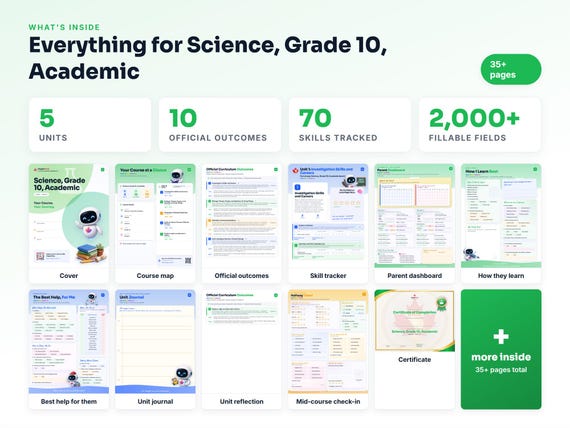


Printable workbook · A keepsake of the year
A Science, Grade 10, Academic workbook worth keeping
Built from the same official curriculum as this page. Before and after each skill above, your student colours in how sure they feel — so the two of you can see, on one page, what's clicking and what needs another look. It's a quiet way to follow how the year is really going.
By June it's full of their own handwriting: units worked through, confidence grown, a mid-year check-in, notes from parent-teacher night, and a certificate at the end. Less a worksheet, more a record of the year worth keeping on the shelf.
Instant download · see every page, reviews and the full description · five or more workbooks are $2.99 each
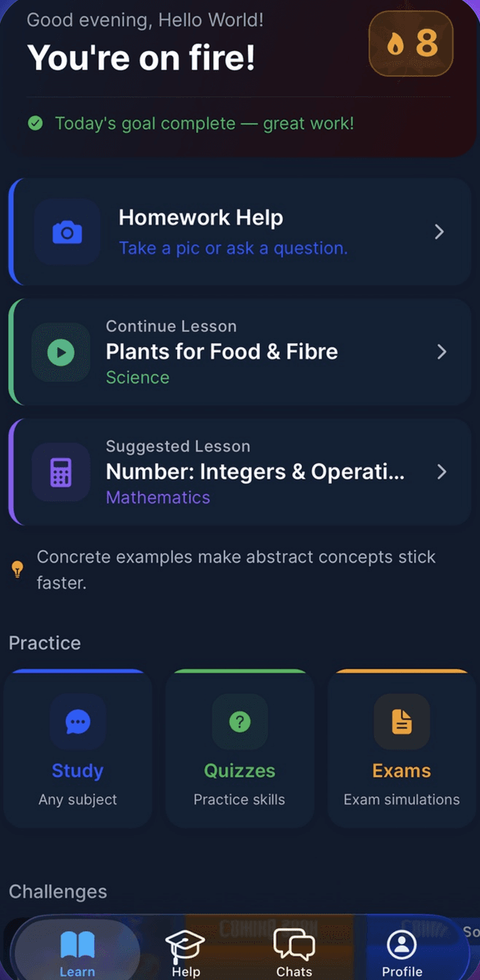
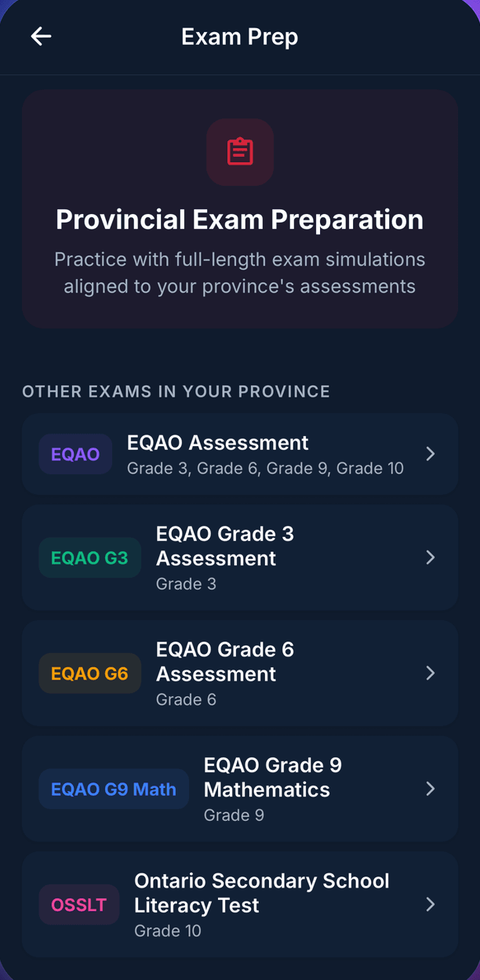
What it looks like in the app

Common questions
Can MapleMind help me with Science, Grade 10, Academic?
Yes. MapleMind's AI tutor covers all 70 skills in Ontario's Science, Grade 10, Academic — you pick the exact skill, and the tutor teaches it step by step: a short lesson, a worked example, solving together, then a skill check to show it stuck.
Is MapleMind aligned to Ontario's official curriculum?
Yes. Every skill in this course maps to an official outcome code from Ontario's Grade 10 Science curriculum, and the ministry's own wording is quoted under each unit on this page — with the official government source linked so you can check it yourself.
What does MapleMind cost?
It's free to start — 5 tutoring chats and a practice quiz every day, no credit card. A Pro subscription ($9.99/month or $49.99/year CAD, 7-day free trial) unlocks unlimited tutoring, practice, and exam simulations.
What if I'm stuck on just one topic?
That's the point of skill-level tutoring: open Science, Grade 10, Academic in the app, tap the exact skill from the list on this page, and the tutor teaches just that — no wading through lessons you don't need.
Does MapleMind work in French or other languages?
Yes — 14 languages, including French. Both the app and the tutor's explanations switch to the language you choose.
Where can I see the official Ontario curriculum for Science, Grade 10, Academic?
The official source is linked on this page — Ontario's official science curriculum. The outline here follows it: every MapleMind skill carries its official outcome code, and the ministry's own wording is quoted under each unit.
Keep exploring
Ready when you are
Pick a skill from this page and see it taught properly — free, in the browser, in under a minute.