Get help with Chemistry, Grade 11, University Preparation
Most tutoring makes you sit through material you already know. MapleMind flips that: pick the exact skill that's causing trouble — any of the 76 below — and the tutor teaches just that one, step by step, as many times as it takes. Ask questions in plain words, any time of day, in English, French, or 12 other languages.
The official Ontario Chemistry, Grade 11, University Preparation curriculum
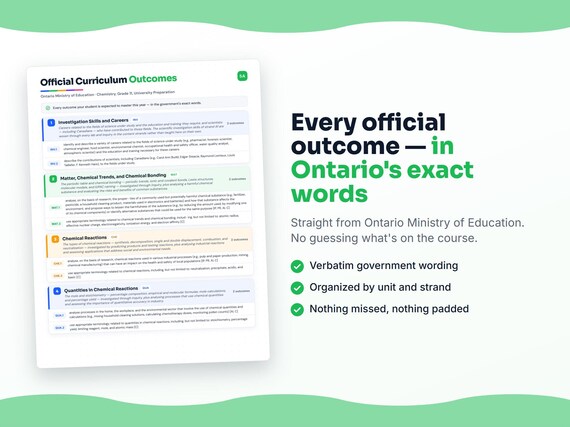
Ontario defines Chemistry, Grade 11, University Preparation by strands and outcomes. MapleMind teaches the same curriculum reorganized for one-skill-at-a-time tutoring — the table shows exactly where every official strand lands, and the ministry's own wording is quoted under each unit below.
Official source Ontario's official science curriculumRead it on the government site — dcp.edu.gov.on.ca ↗| Official strand | Outcomes | Where MapleMind teaches it |
|---|---|---|
| Strand A | 2 | Investigation Skills and Careers |
| Strand B | 14 | Matter, Chemical Trends, and Chemical Bonding |
| Strand C | 15 | Chemical Reactions |
| Strand D | 13 | Quantities in Chemical Reactions |
| Strand E | 16 | Solutions and Solubility |
| Strand F | 13 | Gases and Atmospheric Chemistry |
Every skill below, taught one on one.
 Try the first session free
How MapleMind teaches Chemistry, Grade 11, University Preparation — every unit, lesson, and skill
Every skill below runs as a short session: a plain-words lesson, a worked example, solving it together, then a five-question skill check that earns up to three stars. Guided Mode keeps it teaching instead of answer-handing — turning it off needs a parent's password.
Unit 1Investigation Skills and CareersOfficial strand · Strand A
Careers related to the fields of science under study and the education and training they require, and scientists — including Canadians — who have contributed to those fields. The scientific investigation skills of strand A1 are woven through every lab and inquiry in the content strands rather than taught here on their own.
Careers in Chemistry
- Careers in chemistrysch3u.SCH3U.A2.1 — Identify and describe a variety of careers related to the fields of science under study and the education and training necessary for them.
Scientists and Their Contributions
- Scientists who contributed to chemistrysch3u.SCH3U.A2.2 — Describe the contributions of scientists, including Canadians, to the fields under study.
The official wording — 2 outcomes in this unit
- sch3u.SCH3U.A2.1
identify and describe a variety of careers related to the fields of science under study (e.g., pharmacist, forensic scientist, chemical engineer, food scientist, environmental chemist, occupational health and safety officer, water quality analyst, atmospheric scientist) and the education and training necessary for these careers
- sch3u.SCH3U.A2.2
describe the contributions of scientists, including Canadians (e.g., Carol Ann Budd, Edgar Steacie, Raymond Lemieux, Louis Taillefer, F. Kenneth Hare), to the fields under study
Unit 2Matter, Chemical Trends, and Chemical BondingOfficial strand · Strand B
The periodic table and chemical bonding — periodic trends, ionic and covalent bonds, Lewis structures, molecular models, and IUPAC naming — investigated through inquiry, plus analysing a harmful chemical substance and evaluating the risks and benefits of common substances.
Chemical Substances, Health, and the Environment
- Analysing a harmful chemical substancesch3u.SCH3U.B1.1 — Analyse the properties of a commonly used but potentially harmful chemical substance and how it affects the environment.
- Reducing a substance's harmfulnesssch3u.SCH3U.B1.1 — Propose ways to lessen the harmfulness of a substance, or identify alternative substances for the same purpose.
- Risks and benefits of common substancessch3u.SCH3U.B1.2 — Evaluate the risks and benefits to human health of some commonly used chemical substances.
Investigating Trends and Bonding
- Trends and bonding terminologysch3u.SCH3U.B2.1 — Use appropriate terminology related to chemical trends and chemical bonding.
- Analysing periodic trendssch3u.SCH3U.B2.2 — Analyse data related to the properties of elements within a period to identify general trends.
- Building an activity seriessch3u.SCH3U.B2.3 — Use an inquiry process to investigate the chemical reactions of elements and produce an activity series.
- Drawing Lewis structuressch3u.SCH3U.B2.4 — Draw Lewis structures to represent the bonds in ionic and molecular compounds.
- Predicting bond typesch3u.SCH3U.B2.5 — Predict the nature of a bond using electronegativity values of atoms.
- Building molecular modelssch3u.SCH3U.B2.6 — Build molecular models and write structural formulae for molecular compounds and ionic crystalline structures.
- Naming compounds with IUPACsch3u.SCH3U.B2.7 — Write chemical formulae of binary and polyatomic compounds and name them using IUPAC nomenclature.
- Atomic number, mass number, and isotopessch3u.SCH3U.B3.1 — Explain the relationship between atomic number and mass number and the difference between isotopes and radioisotopes.
- Isotopic abundance and atomic masssch3u.SCH3U.B3.2 — Explain the relationship between isotopic abundance and the relative atomic mass of an element.
- Periodic law and trendssch3u.SCH3U.B3.3 — State the periodic law and explain how electron arrangement and forces produce periodic trends.
- Ionic versus covalent bond formationsch3u.SCH3U.B3.4 — Explain the differences between the formation of ionic bonds and covalent bonds.
- Properties of ionic and molecular compoundssch3u.SCH3U.B3.5 — Compare and contrast the physical properties of ionic and molecular compounds.
The official wording — 14 outcomes in this unit
- sch3u.SCH3U.B1.1
analyse, on the basis of research, the proper- ties of a commonly used but potentially harmful chemical substance (e.g., fertilizer, pesticide, a household cleaning product, materials used in electronics and batteries) and how that substance affects the environment, and propose ways to lessen the harmfulness of the substance (e.g., by reducing the amount used, by modifying one of its chemical components) or identify alternative substances that could be used for the same purpose [IP, PR, AI, C]
- sch3u.SCH3U.B1.2
evaluate the risks and benefits to human health of some commonly used chemical substances (e.g., chemical additives in foods; pharmaceuticals; cosmetics and perfumes; household cleaning products) [AI, C]
- sch3u.SCH3U.B2.1
use appropriate terminology related to chemical trends and chemical bonding, includ- ing, but not limited to: atomic radius, effective nuclear charge, electronegativity, ionization energy, and electron affinity [C]
- sch3u.SCH3U.B2.2
analyse data related to the properties of elements within a period (e.g., ionization energy, atomic radius) to identify general trends in the periodic table [AI]
- sch3u.SCH3U.B2.3
use an inquiry process to investigate the chemical reactions of elements (e.g., metals, non-metals) with other substances (e.g., oxygen, acids, water), and produce an activity series using the resulting data [PR, AI]
- sch3u.SCH3U.B2.4
draw Lewis structures to represent the bonds in ionic and molecular compounds [PR, C]
- sch3u.SCH3U.B2.5
predict the nature of a bond (e.g., non-polar covalent, polar covalent, ionic), using electro- negativity values of atoms [AI]
- sch3u.SCH3U.B2.6
build molecular models, and write structural formulae, for molecular compounds containing single and multiple bonds (e.g., CO 2 , H 2 O, C 2 H 4 ), and for ionic crystalline structures (e.g., NaCl) [PR, AI, C]
- sch3u.SCH3U.B2.7
write chemical formulae of binary and polyatomic compounds, including those with multiple valences, and name the compounds using the International Union of Pure and Applied Chemistry (IUPAC) nomenclature system [AI, C]
- sch3u.SCH3U.B3.1
explain the relationship between the atomic number and the mass number of an element, and the difference between isotopes and radio- isotopes of an element
- sch3u.SCH3U.B3.2
explain the relationship between isotopic abundance of an element’s isotopes and the relative atomic mass of the element
- sch3u.SCH3U.B3.3
state the periodic law, and explain how patterns in the electron arrangement and forces in atoms result in periodic trends (e.g., in atomic radius, ionization energy, electron affinity, electronegativity) in the periodic table
- sch3u.SCH3U.B3.4
explain the differences between the forma- tion of ionic bonds and the formation of covalent bonds
- sch3u.SCH3U.B3.5
compare and contrast the physical properties of ionic and molecular compounds (e.g., NaCl and CH 4 ; NaOH and H 2 O)
Unit 3Chemical ReactionsOfficial strand · Strand C
The types of chemical reactions — synthesis, decomposition, single and double displacement, combustion, and neutralization — investigated by predicting products and testing reactions, plus analysing industrial reactions and assessing applications that address social and environmental needs.
Reactions in Industry and Society
- Industrial chemical reactionssch3u.SCH3U.C1.1 — Analyse chemical reactions used in industrial processes that can affect the health and safety of local populations.
Investigating Chemical Reactions
- Reactions terminologysch3u.SCH3U.C2.1 — Use appropriate terminology related to chemical reactions.
- Balancing chemical equationssch3u.SCH3U.C2.2 — Write balanced chemical equations for synthesis, decomposition, displacement, and combustion reactions using IUPAC nomenclature.
- Investigating reaction typessch3u.SCH3U.C2.3 — Investigate synthesis, decomposition, and displacement reactions by testing their products.
- Predicting synthesis and decomposition productssch3u.SCH3U.C2.4 — Predict the products of different types of synthesis and decomposition reactions.
- Predicting single displacement productssch3u.SCH3U.C2.5 — Predict the products of single displacement reactions using the metal activity series and the halogen series.
- Predicting double displacement productssch3u.SCH3U.C2.6 — Predict the products of double displacement reactions.
- Complete versus incomplete combustionsch3u.SCH3U.C2.7 — Design an inquiry to demonstrate the difference between complete and incomplete combustion.
- Comparing oxide solutionssch3u.SCH3U.C2.8 — Plan and conduct an inquiry to compare the properties of non-metal oxide and metal oxide solutions.
- Investigating neutralizationsch3u.SCH3U.C2.9 — Investigate neutralization reactions.
- Demonstrating single displacementsch3u.SCH3U.C2.10 — Plan and conduct an inquiry to demonstrate a single displacement reaction using the metal activity series.
- Identifying reaction typessch3u.SCH3U.C3.1 — Identify various types of chemical reactions.
- Complete versus incomplete combustion conceptssch3u.SCH3U.C3.2 — Explain the difference between a complete and an incomplete combustion reaction.
- Formation of acids and basessch3u.SCH3U.C3.3 — Explain the chemical reactions that form acids and bases from metal and non-metal oxides.
The official wording — 15 outcomes in this unit
- sch3u.SCH3U.C1.1
analyse, on the basis of research, chemical reactions used in various industrial processes (e.g., pulp and paper production, mining, chemical manufacturing) that can have an impact on the health and safety of local populations [IP, PR, AI, C]
- sch3u.SCH3U.C1.2
assess the effectiveness of some applications of chemical reactions that are used to address social and environmental needs and problems [AI, C]
- sch3u.SCH3U.C2.1
use appropriate terminology related to chemical reactions, including, but not limited to: neutralization, precipitate, acidic, and basic [C]
- sch3u.SCH3U.C2.2
write balanced chemical equations to represent synthesis, decomposition, single displacement, double displacement, and combustion reactions, using the IUPAC nomenclature system [PR, AI, C]
- sch3u.SCH3U.C2.3
investigate synthesis, decomposition, single displacement, and double displacement reac- tions, by testing the products of each reaction (e.g., test for products such as gases, the pres- ence of an acid, or the presence of a base) [PR, AI]
- sch3u.SCH3U.C2.4
predict the products of different types of synthesis and decomposition reactions (e.g., synthesis reactions in which simple compounds are formed; synthesis reactions of metallic or non-metallic oxides with water; decomposition reactions, in which a chemical compound is separated into several compounds) [AI]
- sch3u.SCH3U.C2.5
predict the products of single displacement reactions, using the metal activity series and the halogen series [AI]
- sch3u.SCH3U.C2.6
predict the products of double displacement reactions (e.g., the formation of precipitates or gases; neutralization) [AI]
- sch3u.SCH3U.C2.7
design an inquiry to demonstrate the differ- ence between a complete and an incomplete combustion reaction [IP, C]
- sch3u.SCH3U.C2.8
plan and conduct an inquiry to compare the properties of non-metal oxide solutions and metal oxide solutions (e.g., carbon dioxide reacts with water to make water acidic; magnesium oxide reacts with water to make water basic) [IP, PR, AI]
- sch3u.SCH3U.C2.9
investigate neutralization reactions (e.g., neutralize a dilute solution of sodium hydroxide with a dilute solution of hydrochloric acid, and isolate the sodium chloride produced) [PR]
- sch3u.SCH3U.C2.10
plan and conduct an inquiry to demonstrate a single displacement reaction, using elements from the metal activity series [IP, PR]
- sch3u.SCH3U.C3.1
identify various types of chemical reactions, including synthesis, decomposition, single displacement, double displacement, and combustion
- sch3u.SCH3U.C3.2
explain the difference between a complete combustion reaction and an incomplete combustion reaction (e.g., complete and incomplete combustion of hydrocarbon fuels)
- sch3u.SCH3U.C3.3
explain the chemical reactions that result in the formation of acids and bases from metal oxides and non-metal oxides (e.g., calcium oxide reacts with water to produce a basic solution; carbon dioxide reacts with water to produce an acidic solution)
Unit 4Quantities in Chemical ReactionsOfficial strand · Strand D
The mole and stoichiometry — percentage composition, empirical and molecular formulae, mole calculations, and percentage yield — investigated through inquiry, plus analysing processes that use chemical quantities and assessing the importance of quantitative accuracy in industry.
Chemical Quantities in Everyday Life and Industry
- Processes using chemical quantitiessch3u.SCH3U.D1.1 — Analyse processes in the home, workplace, and environmental sector that use chemical quantities and calculations.
- Accuracy in industrial processessch3u.SCH3U.D1.2 — Assess the importance of quantitative accuracy in industrial chemical processes and the environmental impact of inaccuracy.
Investigating the Mole and Stoichiometry
- Quantities terminologysch3u.SCH3U.D2.1 — Use appropriate terminology related to quantities in chemical reactions.
- Calculating percentage compositionsch3u.SCH3U.D2.2 — Conduct an inquiry to calculate the percentage composition of a compound.
- Mole calculationssch3u.SCH3U.D2.3 — Solve problems involving quantities in moles, number of particles, and atomic mass.
- Empirical and molecular formulaesch3u.SCH3U.D2.4 — Determine the empirical and molecular formulae of compounds given molar masses and composition or mass data.
- Stoichiometric calculationssch3u.SCH3U.D2.5 — Calculate the mass or quantity in moles or molecules for any reactant or product in a balanced equation.
- Percentage yield and limiting reagentssch3u.SCH3U.D2.6 — Solve problems involving percentage yield and limiting reagents.
- Determining yield by inquirysch3u.SCH3U.D2.7 — Conduct an inquiry to determine the actual, theoretical, and percentage yield of a reaction.
- Law of definite proportionssch3u.SCH3U.D3.1 — Explain the law of definite proportions.
- Avogadro's number and molar masssch3u.SCH3U.D3.2 — Describe the relationships between Avogadro's number, the mole concept, and molar mass.
- Empirical and molecular formula relationshipsch3u.SCH3U.D3.3 — Explain the relationship between the empirical formula and the molecular formula of a compound.
- Quantitative relationships in equationssch3u.SCH3U.D3.4 — Explain the quantitative relationships expressed in a balanced chemical equation.
The official wording — 13 outcomes in this unit
- sch3u.SCH3U.D1.1
analyse processes in the home, the workplace, and the environmental sector that involve the use of chemical quantities and calculations (e.g., mixing household cleaning solutions, calculating chemotherapy doses, monitoring pollen counts) [AI, C]
- sch3u.SCH3U.D1.2
assess, on the basis of research, the importance of quantitative accuracy in industrial chemical processes and the potential impact on the environment if quantitative accuracy is not observed [IP, PR, AI, C]
- sch3u.SCH3U.D2.1
use appropriate terminology related to quantities in chemical reactions, including, but not limited to: stoichiometry, percentage yield, limiting reagent, mole, and atomic mass [C]
- sch3u.SCH3U.D2.2
conduct an inquiry to calculate the percentage composition of a compound (e.g., a hydrate) [PR, AI]
- sch3u.SCH3U.D2.3
solve problems related to quantities in chemical reactions by performing calculations involving quantities in moles, number of particles, and atomic mass [AI]
- sch3u.SCH3U.D2.4
determine the empirical formulae and molecular formulae of various chemical com- pounds, given molar masses and percentage composition or mass data [AI]
- sch3u.SCH3U.D2.5
calculate the corresponding mass, or quan- tity in moles or molecules, for any given reactant or product in a balanced chemical equation as well as for any other reactant or product in the chemical reaction [AI]
- sch3u.SCH3U.D2.6
solve problems related to quantities in chemical reactions by performing calculations involving percentage yield and limiting reagents [AI]
- sch3u.SCH3U.D2.7
conduct an inquiry to determine the actual yield, theoretical yield, and percentage yield of the products of a chemical reaction (e.g., a chemical reaction between steel wool and copper(II) sulfate solution), assess the effec- tiveness of the procedure, and suggest sources of experimental error [PR, AI]
- sch3u.SCH3U.D3.1
explain the law of definite proportions
- sch3u.SCH3U.D3.2
describe the relationships between Avogadro’s number, the mole concept, and the molar mass of any given substance
- sch3u.SCH3U.D3.3
explain the relationship between the empir- ical formula and the molecular formula of a chemical compound
- sch3u.SCH3U.D3.4
explain the quantitative relationships ex- pressed in a balanced chemical equation, using appropriate units of measure (e.g., moles, grams, atoms, ions, molecules)
Unit 5Solutions and SolubilityOfficial strand · Strand E
Aqueous solutions — concentration, solubility, precipitation, acids and bases, and titration — investigated through inquiry, plus analysing water pollution and the economic, social, and environmental issues of drinking water.
Water, Pollution, and Solutions
- Water pollutantssch3u.SCH3U.E1.1 — Analyse the origins and cumulative effects of pollutants that enter our water systems and how they affect water quality.
- Drinking water issuessch3u.SCH3U.E1.2 — Analyse economic, social, and environmental issues related to the distribution, purification, or use of drinking water.
Investigating Solutions and Solubility
- Solutions terminologysch3u.SCH3U.E2.1 — Use appropriate terminology related to aqueous solutions and solubility.
- Concentration calculationssch3u.SCH3U.E2.2 — Solve problems related to the concentration of solutions and express results in various units.
- Preparing solutionssch3u.SCH3U.E2.3 — Prepare solutions of a given concentration by dissolving a solute or diluting a concentrated solution.
- Analysing solution propertiessch3u.SCH3U.E2.4 — Conduct an investigation to analyse qualitative and quantitative properties of solutions.
- Net ionic equationssch3u.SCH3U.E2.5 — Write balanced net ionic equations for precipitation and neutralization reactions.
- Stoichiometry with solutionssch3u.SCH3U.E2.6 — Use stoichiometry to solve problems involving solutions and solubility.
- Acid-base titrationsch3u.SCH3U.E2.7 — Determine the concentration of an acid or base using the acid-base titration technique.
- Analysing drinking watersch3u.SCH3U.E2.8 — Conduct an investigation to determine the concentrations of pollutants in drinking water and compare to standards.
- Properties of watersch3u.SCH3U.E3.1 — Describe the properties of water and explain why they make water a good solvent.
- Formation of solutionssch3u.SCH3U.E3.2 — Explain the formation of solutions of ionic, molecular, and non-polar compounds.
- Effects of temperature and pressure on solubilitysch3u.SCH3U.E3.3 — Explain the effects of changes in temperature and pressure on the solubility of solids, liquids, and gases.
- Predicting precipitatessch3u.SCH3U.E3.4 — Identify the formation of precipitates in aqueous solutions using a solubility table.
- Arrhenius theory of acids and basessch3u.SCH3U.E3.5 — Explain the Arrhenius theory of acids and bases.
- Strong and weak acids and basessch3u.SCH3U.E3.6 — Explain the difference between strong and weak acids and bases in terms of degree of ionization.
The official wording — 16 outcomes in this unit
- sch3u.SCH3U.E1.1
analyse the origins and cumulative effects of pollutants that enter our water systems (e.g., landfill leachates, agricultural run-off, industrial effluents, chemical spills), and explain how these pollutants affect water quality [AI, C]
- sch3u.SCH3U.E1.2
analyse economic, social, and environmental issues related to the distribution, purification, or use of drinking water (e.g., the impact on the environment of the use of bottled water) [AI, C]
- sch3u.SCH3U.E2.1
use appropriate terminology related to aqueous solutions and solubility, including, but not limited to: concentration, solubility, precipitate, ionization, dissociation, pH, dilute, solute, and solvent [C]
- sch3u.SCH3U.E2.2
solve problems related to the concentration of solutions by performing calculations involving moles, and express the results in various units (e.g., moles per litre, grams per 100 mL, parts per million or parts per billion, mass, volume per cent) [AI, C]
- sch3u.SCH3U.E2.3
prepare solutions of a given concentration by dissolving a solid solute in a solvent or by diluting a concentrated solution [PR]
- sch3u.SCH3U.E2.4
conduct an investigation to analyse quali- tative and quantitative properties of solutions (e.g., perform a qualitative analysis of ions in a solution) [PR, AI]
- sch3u.SCH3U.E2.5
write balanced net ionic equations to represent precipitation and neutralization reactions [AI, C]
- sch3u.SCH3U.E2.6
use stoichiometry to solve problems involving solutions and solubility [AI]
- sch3u.SCH3U.E2.7
determine the concentration of an acid or a base in a solution (e.g., the concentration of acetic acid in vinegar), using the acid–base titration technique [PR, AI]
- sch3u.SCH3U.E2.8
conduct an investigation to determine the concentrations of pollutants in their local treated drinking water, and compare the results to commonly used guidelines and standards (e.g., provincial and federal standards) [PR, AI]
- sch3u.SCH3U.E3.1
describe the properties of water (e.g., polarity, hydrogen bonding), and explain why these properties make water such a good solvent
- sch3u.SCH3U.E3.2
explain the process of formation for solutions that are produced by dissolving ionic and molecular compounds (e.g., salt, oxygen) in water, and for solutions that are produced by dissolving non-polar solutes in non-polar solvents (e.g., grease in vegetable oil)
- sch3u.SCH3U.E3.3
explain the effects of changes in temperature and pressure on the solubility of solids, liquids, and gases (e.g., explain how a change in tem- perature or atmospheric pressure affects the solubility of oxygen in lake water)
- sch3u.SCH3U.E3.4
identify, using a solubility table, the formation of precipitates in aqueous solutions (e.g., the use of iron or aluminum compounds to precipi- tate and remove phosphorus from wastewater)
- sch3u.SCH3U.E3.5
explain the Arrhenius theory of acids and bases
- sch3u.SCH3U.E3.6
explain the difference between strong and weak acids, and between strong and weak bases, in terms of degree of ionization
Unit 6Gases and Atmospheric ChemistryOfficial strand · Strand F
The behaviour of gases — the gas laws, molar volume, kinetic molecular theory, and the atmosphere — investigated through inquiry and calculation, plus analysing human effects on air quality and reporting on Canadian initiatives to reduce air pollution.
Air Quality and Human Activity
- Effects on air qualitysch3u.SCH3U.F1.1 — Analyse the effects on air quality of some technologies and human activities, including one's own.
- Reducing a personal carbon footprintsch3u.SCH3U.F1.1 — Propose actions to reduce one's personal carbon footprint.
- Assessing air quality with the indexsch3u.SCH3U.F1.2 — Assess air quality conditions for a Canadian location using Environment Canada's Air Quality Health Index.
- Reporting on Canadian air-quality initiativessch3u.SCH3U.F1.2 — Report on Canadian initiatives to improve air quality and reduce greenhouse gases.
Investigating the Gas Laws
- Gases terminologysch3u.SCH3U.F2.1 — Use appropriate terminology related to gases and atmospheric chemistry.
- Investigating gas relationshipssch3u.SCH3U.F2.2 — Determine, through inquiry, the quantitative and graphical relationships between pressure, volume, and temperature of a gas.
- Solving gas law problemssch3u.SCH3U.F2.3 — Solve quantitative problems using the gas laws.
- Gas stoichiometrysch3u.SCH3U.F2.4 — Use stoichiometry to solve problems related to chemical reactions involving gases.
- Determining molar volume or mass of a gassch3u.SCH3U.F2.5 — Determine, through inquiry, the molar volume or molar mass of a gas produced by a reaction.
- Components of the atmospheresch3u.SCH3U.F3.1 — Identify the major and minor chemical components of Earth's atmosphere.
- States of matter and forcessch3u.SCH3U.F3.2 — Describe the states of matter and explain their differences in terms of forces between particles.
- Kinetic molecular theorysch3u.SCH3U.F3.3 — Use the kinetic molecular theory to explain the properties and behaviour of gases.
- Ideal gas relationshipssch3u.SCH3U.F3.4 — Describe, for an ideal gas, the quantitative relationships between pressure, volume, temperature, and amount.
- Explaining the gas lawssch3u.SCH3U.F3.5 — Explain the gas laws: Dalton's law, Boyle's, Charles's, Gay-Lussac's, the combined gas law, and the ideal gas law.
- Avogadro's hypothesissch3u.SCH3U.F3.6 — Explain Avogadro's hypothesis and how his contribution increased our understanding of gas reactions.
The official wording — 13 outcomes in this unit
- sch3u.SCH3U.F1.1
analyse the effects on air quality of some technologies and human activities (e.g., smelting; driving gas-powered vehicles), including their own activities, and propose actions to reduce their personal carbon footprint [AI, C]
- sch3u.SCH3U.F1.2
assess air quality conditions for a given Canadian location, using Environment Canada’s Air Quality Health Index, and report on some Canadian initiatives to improve air quality and reduce greenhouse gases (e.g., Ontario’s Drive Clean program to control vehicle emissions) [AI, C]
- sch3u.SCH3U.F2.1
use appropriate terminology related to gases and atmospheric chemistry, including, but not limited to: standard temperature, standard pressure, molar volume, and ideal gas [C]
- sch3u.SCH3U.F2.2
determine, through inquiry, the quantitative and graphical relationships between the pressure, volume, and temperature of a gas [PR, AI]
- sch3u.SCH3U.F2.3
solve quantitative problems by performing calculations based on Boyle’s law, Charles’s law, Gay-Lussac’s law, the combined gas law, Dalton’s law of partial pressures, and the ideal gas law [AI]
- sch3u.SCH3U.F2.4
use stoichiometry to solve problems related to chemical reactions involving gases (e.g., problems involving moles, number of atoms, number of molecules, mass, and volume) [AI]
- sch3u.SCH3U.F2.5
determine, through inquiry, the molar volume or molar mass of a gas produced by a chemical reaction (e.g., the molar volume of hydrogen gas from the reaction of magnesium with hydrochloric acid) [PR, AI]
- sch3u.SCH3U.F3.1
identify the major and minor chemical components of Earth’s atmosphere
- sch3u.SCH3U.F3.2
describe the different states of matter, and explain their differences in terms of the forces between atoms, molecules, and ions
- sch3u.SCH3U.F3.3
use the kinetic molecular theory to explain the properties and behaviour of gases in terms of types and degrees of molecular motion
- sch3u.SCH3U.F3.4
describe, for an ideal gas, the quantitative relationships that exist between the variables of pressure, volume, temperature, and amount of substance
- sch3u.SCH3U.F3.5
explain Dalton’s law of partial pressures, Boyle’s law, Charles’s law, Gay-Lussac’s law, the combined gas law, and the ideal gas law
- sch3u.SCH3U.F3.6
explain Avogadro’s hypothesis and how his contribution to the gas laws has increased our understanding of the chemical reactions of gases

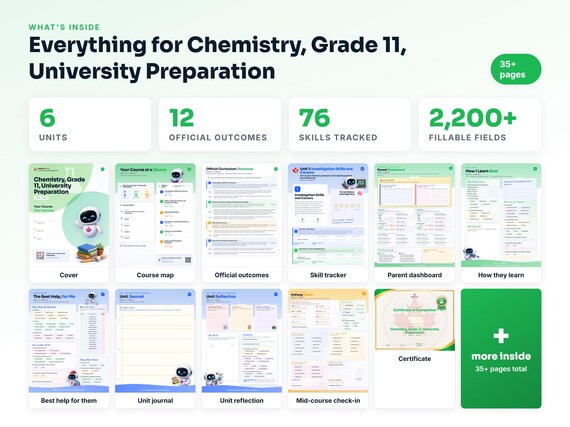

Printable workbook · A keepsake of the year
A Chemistry, Grade 11, University Preparation workbook worth keeping
Built from the same official curriculum as this page. Before and after each skill above, your student colours in how sure they feel — so the two of you can see, on one page, what's clicking and what needs another look. It's a quiet way to follow how the year is really going.
By June it's full of their own handwriting: units worked through, confidence grown, a mid-year check-in, notes from parent-teacher night, and a certificate at the end. Less a worksheet, more a record of the year worth keeping on the shelf.
Instant download · see every page, reviews and the full description · five or more workbooks are $2.99 each
What it looks like in the app



Common questions
Can MapleMind help me with Chemistry, Grade 11, University Preparation?
Yes. MapleMind's AI tutor covers all 76 skills in Ontario's Chemistry, Grade 11, University Preparation — you pick the exact skill, and the tutor teaches it step by step: a short lesson, a worked example, solving together, then a skill check to show it stuck.
Is MapleMind aligned to Ontario's official curriculum?
Yes. Every skill in this course maps to an official outcome code from Ontario's Grade 11 Science curriculum, and the ministry's own wording is quoted under each unit on this page — with the official government source linked so you can check it yourself.
What does MapleMind cost?
It's free to start — 5 tutoring chats and a practice quiz every day, no credit card. A Pro subscription ($9.99/month or $49.99/year CAD, 7-day free trial) unlocks unlimited tutoring, practice, and exam simulations.
What if I'm stuck on just one topic?
That's the point of skill-level tutoring: open Chemistry, Grade 11, University Preparation in the app, tap the exact skill from the list on this page, and the tutor teaches just that — no wading through lessons you don't need.
Does MapleMind work in French or other languages?
Yes — 14 languages, including French. Both the app and the tutor's explanations switch to the language you choose.
Where can I see the official Ontario curriculum for Chemistry, Grade 11, University Preparation?
The official source is linked on this page — Ontario's official science curriculum. The outline here follows it: every MapleMind skill carries its official outcome code, and the ministry's own wording is quoted under each unit.
Keep exploring
Ready when you are
Pick a skill from this page and see it taught properly — free, in the browser, in under a minute.