Get help with Biology, Grade 12, University Preparation
Most tutoring makes you sit through material you already know. MapleMind flips that: pick the exact skill that's causing trouble — any of the 56 below — and the tutor teaches just that one, step by step, as many times as it takes. Ask questions in plain words, any time of day, in English, French, or 12 other languages.
The official Ontario Biology, Grade 12, University Preparation curriculum
Ontario defines Biology, Grade 12, University Preparation by strands and outcomes. MapleMind teaches the same curriculum reorganized for one-skill-at-a-time tutoring — the table shows exactly where every official strand lands, and the ministry's own wording is quoted under each unit below.
Official source Ontario's official science curriculumRead it on the government site — dcp.edu.gov.on.ca ↗| Official strand | Outcomes | Where MapleMind teaches it |
|---|---|---|
| Strand A | 2 | Investigation Skills and Careers |
| Strand B | 13 | Biochemistry |
| Strand C | 9 | Metabolic Processes |
| Strand D | 13 | Molecular Genetics |
| Strand E | 9 | Homeostasis |
| Strand F | 10 | Population Dynamics |
Every skill below, taught one on one.
 Try the first session free
How MapleMind teaches Biology, Grade 12, University Preparation — every unit, lesson, and skill
Every skill below runs as a short session: a plain-words lesson, a worked example, solving it together, then a five-question skill check that earns up to three stars. Guided Mode keeps it teaching instead of answer-handing — turning it off needs a parent's password.
Unit 1Investigation Skills and CareersOfficial strand · Strand A
Careers related to the fields of science under study and the education and training they require, and scientists — including Canadians — who have contributed to those fields. The scientific investigation skills of strand A1 are woven through every lab and inquiry in the content strands rather than taught here on their own.
Careers in the Biological Sciences
- Careers in the biological sciencessbi4u.SBI4U.A2.1 — Identify and describe a variety of careers related to the fields of science under study and the education and training necessary for them.
Scientists and Their Contributions
- Scientists who contributed to biologysbi4u.SBI4U.A2.2 — Describe the contributions of scientists, including Canadians, to the fields under study.
The official wording — 2 outcomes in this unit
- sbi4u.SBI4U.A2.1
identify and describe a variety of careers re- lated to the fields of science under study (e.g., scientific journalist, fisheries and wildlife offi- cer, physician, infectious disease researcher, geneticist) and the education and training ne- cessary for these careers
- sbi4u.SBI4U.A2.2
describe the contributions of scientists, in- cluding Canadians (e.g., Evelyn Roden Nelson, Maude Menten, Albert Juan Aguayo, Kimberley J. Fernie, Michael Archer), to the fields under study
Unit 2BiochemistryOfficial strand · Strand B
The chemistry of life — biological molecules (carbohydrates, proteins, lipids, nucleic acids), enzymes, membrane transport, and the four main biochemical reactions — investigated through molecular models and biological tests, plus analysing enzyme applications in industry and evaluating advances in cellular biology.
Biochemistry, Industry, and Technology
- Industrial applications of enzymessbi4u.SBI4U.B1.1 — Analyse technological applications related to enzyme activity in the food and pharmaceutical industries.
- Advances in cellular biologysbi4u.SBI4U.B1.2 — Evaluate advances in cellular biology and related technological applications.
Investigating Biological Molecules
- Biochemistry terminologysbi4u.SBI4U.B2.1 — Use appropriate terminology related to biochemistry.
- Membrane transport investigationsbi4u.SBI4U.B2.2 — Plan and conduct an investigation to demonstrate the movement of substances across a membrane.
- Molecular models of biochemical compoundssbi4u.SBI4U.B2.3 — Construct and draw three-dimensional molecular models of important biochemical compounds.
- Testing for biochemical compoundssbi4u.SBI4U.B2.4 — Conduct biological tests to identify biochemical compounds in food samples and compare them.
- Investigating a cellular processsbi4u.SBI4U.B2.5 — Plan and conduct an investigation related to a cellular process and report the results.
- Organelles and cellular processessbi4u.SBI4U.B3.1 — Explain the roles of various organelles in cellular processes.
- Structure and function of biochemical compoundssbi4u.SBI4U.B3.2 — Describe the structure of important biochemical compounds and explain their function within cells.
- Functional groups in biological moleculessbi4u.SBI4U.B3.3 — Identify common functional groups within biological molecules and explain how they contribute to function.
- Enzyme structure and mechanismsbi4u.SBI4U.B3.4 — Describe the chemical structures and mechanisms of various enzymes.
- Four main biochemical reactionssbi4u.SBI4U.B3.5 — Identify and describe the four main types of biochemical reactions.
- Cell membranes and transportsbi4u.SBI4U.B3.6 — Describe cell membranes by the fluid mosaic model and explain passive transport, facilitated diffusion, endocytosis, and exocytosis.
The official wording — 13 outcomes in this unit
- sbi4u.SBI4U.B1.1
analyse technological applications related to enzyme activity in the food and pharmaceutical industries (e.g., the production of dairy products; breadmaking; the use of enzymes to control reaction rates in pharmaceuticals) [AI, C]
- sbi4u.SBI4U.B1.2
evaluate, on the basis of research, some advan- ces in cellular biology and related technological applications (e.g., new treatments for cancer, HIV / AIDS, and hepatitis C; radioisotopic label- ling to study the function of internal organs; fluorescence to study genetic material within cells; forensic biological techniques to aid in crime resolution) [IP, PR, AI, C]
- sbi4u.SBI4U.B2.1
use appropriate terminology related to bio- chemistry, including, but not limited to: active and passive transport, covalent and ionic bond, allosteric site, substrate, substrate-enzyme complex, and inhibition [C]
- sbi4u.SBI4U.B2.2
plan and conduct an investigation to demon- strate the movement of substances across a membrane (e.g., the effects of salt water and distilled water on a potato) [IP, PR]
- sbi4u.SBI4U.B2.3
construct and draw three-dimensional molecu- lar models of important biochemical compounds, including carbohydrates, proteins, lipids, and nucleic acids [PR, C]
- sbi4u.SBI4U.B2.4
conduct biological tests to identify biochem- ical compounds found in various food samples (e.g., use Benedict’s solution to test for carbohy- drates in food samples), and compare the bio- chemical compounds found in each food to those found in the others [PR, AI, C]
- sbi4u.SBI4U.B2.5
plan and conduct an investigation related to a cellular process (e.g., factors that affect enzyme activity; factors that affect transport of sub- stances across cell membranes), using appropriate laboratory equipment and techniques, and report the results in an appropriate format [IP, PR, C]
- sbi4u.SBI4U.B3.1
explain the roles of various organelles, such as lysosomes, vacuoles, mitochondria, internal cell membranes, ribosomes, smooth and rough endoplasmic reticulum, and Golgi bodies, in cellular processes
- sbi4u.SBI4U.B3.2
describe the structure of important biochem- ical compounds, including carbohydrates, proteins, lipids, and nucleic acids, and explain their function within cells
- sbi4u.SBI4U.B3.3
identify common functional groups within biological molecules (e.g., hydroxyl, carbonyl, carboxyl, amino, phosphate), and explain how they contribute to the function of each molecule
- sbi4u.SBI4U.B3.4
describe the chemical structures and mech- anisms of various enzymes
- sbi4u.SBI4U.B3.5
identify and describe the four main types of biochemical reactions (oxidation-reduction [redox], hydrolysis, condensation, and neutralization)
- sbi4u.SBI4U.B3.6
describe the structure of cell membranes ac- cording to the fluid mosaic model, and explain the dynamics of passive transport, facilitated diffusion, and the movement of large particles across the cell membrane by the processes of endocytosis and exocytosis
Unit 3Metabolic ProcessesOfficial strand · Strand C
Energy in the cell — cellular respiration (aerobic and anaerobic) and photosynthesis, the chemical changes and energy conversions they involve, and the laws of thermodynamics — investigated through laboratory work, plus analysing the role of metabolism in biotic and abiotic systems and assessing its relevance to everyday choices.
Metabolism in Systems and Everyday Life
- Metabolism in biotic and abiotic systemssbi4u.SBI4U.C1.1 — Analyse the role of metabolic processes in the functioning of and interactions between biotic and abiotic systems.
- Relevance of cell biology to personal lifesbi4u.SBI4U.C1.2 — Assess the relevance to personal life and community of an understanding of cell biology and related technologies.
Investigating Cellular Respiration and Photosynthesis
- Metabolism terminologysbi4u.SBI4U.C2.1 — Use appropriate terminology related to metabolism.
- Investigating cellular respirationsbi4u.SBI4U.C2.2 — Conduct a laboratory investigation into cellular respiration to identify its products and display observations.
- Investigating photosynthesissbi4u.SBI4U.C2.3 — Conduct a laboratory investigation of photosynthesis to identify its products and display observations.
- Chemistry and energy of cellular respirationsbi4u.SBI4U.C3.1 — Explain the chemical changes and energy conversions of aerobic and anaerobic cellular respiration.
- Chemistry and energy of photosynthesissbi4u.SBI4U.C3.2 — Explain the chemical changes and energy conversions of photosynthesis.
- Thermodynamics of metabolismsbi4u.SBI4U.C3.3 — Use the laws of thermodynamics to explain energy transfer during respiration and photosynthesis.
- Matter and energy transformationssbi4u.SBI4U.C3.4 — Describe, compare, and illustrate the matter and energy transformations in respiration and photosynthesis.
The official wording — 9 outcomes in this unit
- sbi4u.SBI4U.C1.1
analyse the role of metabolic processes in the functioning of and interactions between biotic and abiotic systems (e.g., specialized microbes and enzymes in biotechnological applications to treat wastewater in the pulp and paper industry; microbes and enzymes in bioremediation, such as in the cleanup of oil spills; energy transfer from producers to consumers) [AI, C]
- sbi4u.SBI4U.C1.2
assess the relevance, to their personal lives and to the community, of an understanding of cell biology and related technologies (e.g., knowledge of metabolic processes is relevant to personal choices about exercise, diet, and the use of pharmacological substances; knowledge of cellular processes aids in our understanding and treatment of mitochondrial diseases [a group of neuromuscular diseases]) [AI, C]
- sbi4u.SBI4U.C2.1
use appropriate terminology related to metabolism, including, but not limited to: en- ergy carriers, glycolysis, Krebs cycle, electron transport chain, ATP synthase, oxidative phos- phorylation, chemiosmosis, proton pump, photolysis, Calvin cycle, light and dark reactions, and cyclic and noncyclic phosphorylation [C]
- sbi4u.SBI4U.C2.2
conduct a laboratory investigation into the process of cellular respiration to identify the products of the process, interpret the qualita- tive observations, and display them in an appropriate format [PR, AI, C]
- sbi4u.SBI4U.C2.3
conduct a laboratory investigation of the process of photosynthesis to identify the prod- ucts of the process, interpret the qualitative observations, and display them in an appropri- ate format [PR, AI, C]
- sbi4u.SBI4U.C3.1
explain the chemical changes and energy conversions associated with the processes of aerobic and anaerobic cellular respiration (e.g., in aerobic cellular respiration, glucose and oxy- gen react to produce carbon dioxide, water, and energy in the form of heat and ATP; in anaer- obic cellular respiration, yeast reacts with glucose in the absence of oxygen to produce carbon dioxide and ethanol)
- sbi4u.SBI4U.C3.2
explain the chemical changes and energy conversions associated with the process of photosynthesis (e.g., carbon dioxide and water react with sunlight to produce oxygen and glucose)
- sbi4u.SBI4U.C3.3
use the laws of thermodynamics to explain energy transfer in the cell during the processes of cellular respiration and photosynthesis
- sbi4u.SBI4U.C3.4
describe, compare, and illustrate (e.g., using flow charts) the matter and energy transforma- tions that occur during the processes of cellular respiration (aerobic and anaerobic) and photo- synthesis, including the roles of oxygen and organelles such as mitochondria and chloroplasts
Unit 4Molecular GeneticsOfficial strand · Strand D
The molecular basis of inheritance — DNA replication and repair, RNA, protein synthesis, mutation, and genetic modification — investigated through DNA extraction and protein-synthesis modelling, plus analysing the social, ethical, and legal issues of biotechnology and Canadian regulation.
Biotechnology, Ethics, and Regulation
- Canadian biotechnology regulationsbi4u.SBI4U.D1.2 — Analyse key aspects of Canadian regulations on biotechnology and compare them to another jurisdiction.
Investigating Molecular Genetics
- Molecular genetics terminologysbi4u.SBI4U.D2.1 — Use appropriate terminology related to molecular genetics.
- Analysing a DNA strandsbi4u.SBI4U.D2.2 — Analyse a simulated strand of DNA to determine the genetic code and base pairing.
- Extracting DNAsbi4u.SBI4U.D2.3 — Conduct an investigation to extract DNA from a plant or animal specimen.
- Investigating protein synthesissbi4u.SBI4U.D2.4 — Investigate and analyse the cell components involved in protein synthesis.
- DNA replication and repairsbi4u.SBI4U.D3.1 — Explain the current model of DNA replication and describe DNA repair mechanisms.
- RNA and DNA in protein synthesissbi4u.SBI4U.D3.2 — Compare the structures and functions of RNA and DNA and explain their roles in protein synthesis.
- Steps of protein synthesis and gene controlsbi4u.SBI4U.D3.3 — Explain the steps of protein synthesis and how genetic expression is controlled in prokaryotes and eukaryotes.
- Mutations and mutagenssbi4u.SBI4U.D3.4 — Explain how mutagens cause mutations by changing the genetic material in cells.
- Genetic modification in industry and agriculturesbi4u.SBI4U.D3.5 — Describe examples of genetic modification and explain how it is applied in industry and agriculture.
- Cell components in biotechnologysbi4u.SBI4U.D3.6 — Describe the functions of cell components used in biotechnology.
- History of molecular geneticssbi4u.SBI4U.D3.7 — Describe historical scientific contributions that advanced our understanding of molecular genetics.
The official wording — 13 outcomes in this unit
- sbi4u.SBI4U.D1.1
analyse, on the basis of research, some of the social, ethical, and legal implications of biotech- nology (e.g., the bioengineering of animal species, especially those intended for human consumption; the cultivation of transgenic crops; the patenting of life forms; cloning) [IP, PR, AI, C]
- sbi4u.SBI4U.D1.2
analyse, on the basis of research, some key aspects of Canadian regulations pertaining to biotechnology (e.g., current or potential legisla- tion for mandatory DNA fingerprinting, human cloning, ownership of a genome, patenting of genetically modified organisms), and compare them to regulations from another jurisdiction [IP, PR, AI, C]
- sbi4u.SBI4U.D2.1
use appropriate terminology related to mo- lecular genetics, including, but not limited to: polymerase I, II, and III, DNA ligase, helicase, Okazaki fragment, mRNA, rRNA, tRNA, codon, anticodon, translation, transcription, and ribosome subunits [C]
- sbi4u.SBI4U.D2.2
analyse a simulated strand of DNA to deter- mine the genetic code and base pairing of DNA (e.g., determine base sequences of DNA for a protein; analyse base sequences in DNA to rec- ognize an anomaly) [AI]
- sbi4u.SBI4U.D2.3
conduct an investigation to extract DNA from a specimen of plant or animal protein [PR]
- sbi4u.SBI4U.D2.4
investigate and analyse the cell components involved in the process of protein synthesis, using appropriate laboratory equipment and techniques, or a computer simulation [PR, AI]
- sbi4u.SBI4U.D3.1
explain the current model of DNA replication, and describe the different repair mechanisms that can correct mistakes in DNA sequencing
- sbi4u.SBI4U.D3.2
compare the structures and functions of RNA and DNA, and explain their roles in the process of protein synthesis
- sbi4u.SBI4U.D3.3
explain the steps involved in the process of protein synthesis and how genetic expression is controlled in prokaryotes and eukaryotes by regulatory proteins (e.g., the role of operons in prokaryotic cells; the mechanism of gene ex- pression in eukaryotic cells)
- sbi4u.SBI4U.D3.4
explain how mutagens, such as radiation and chemicals, can cause mutations by chan- ging the genetic material in cells (e.g., the mechanisms and effects of point mutations and frameshift mutations)
- sbi4u.SBI4U.D3.5
describe some examples of genetic modifi- cation, and explain how it is applied in industry and agriculture (e.g., the processes involved in cloning, or in the sequencing of DNA bases; the processes involved in the manipulation of genetic material and protein synthesis; the development and mechanisms of the polymer- ization chain reaction)
- sbi4u.SBI4U.D3.6
describe the functions of some of the cell com- ponents used in biotechnology (e.g., the roles of plasmids, restriction enzymes, recombinant DNA, and vectors in genetic engineering)
- sbi4u.SBI4U.D3.7
describe, on the basis of research, some of the historical scientific contributions that have advanced our understanding of molecular genetics (e.g., discoveries made by Frederick Griffith, Watson and Crick, Hershey and Chase)
Unit 5HomeostasisOfficial strand · Strand E
How the body maintains a stable internal environment — the endocrine, excretory, and nervous systems, feedback mechanisms, and water, ionic, thermal, and acid-base balance — investigated through models and feedback-system studies, plus evaluating the impact of chemical substances and environmental factors on the human body.
The Body, Chemicals, and the Environment
- Chemical substances and the human bodysbi4u.SBI4U.E1.1 — Assess the effects on the human body of taking chemical substances to enhance performance or improve health.
- Human activity and healthsbi4u.SBI4U.E1.2 — Evaluate human health issues that arise from the impact of human activities on the environment.
Investigating Feedback and Body Systems
- Homeostasis terminologysbi4u.SBI4U.E2.1 — Use appropriate terminology related to homeostasis.
- Modelling the homeostatic processsbi4u.SBI4U.E2.2 — Plan and construct a model to illustrate the essential components of the homeostatic process.
- Investigating a feedback systemsbi4u.SBI4U.E2.3 — Plan and conduct an investigation to study a feedback system.
- Invertebrate response to stimulisbi4u.SBI4U.E2.4 — Plan and conduct an investigation to study the response mechanism of an invertebrate to external stimuli.
- Endocrine, excretory, and nervous systemssbi4u.SBI4U.E3.1 — Describe the anatomy and physiology of the endocrine, excretory, and nervous systems and how they maintain homeostasis.
- Reproductive hormones and feedbacksbi4u.SBI4U.E3.2 — Explain how reproductive hormones act in human feedback mechanisms to maintain homeostasis.
- Water, ionic, thermal, and acid-base balancesbi4u.SBI4U.E3.3 — Describe the homeostatic processes that maintain water, ionic, thermal, and acid-base equilibrium.
The official wording — 9 outcomes in this unit
- sbi4u.SBI4U.E1.1
assess, on the basis of findings from a case study, the effects on the human body of taking chemical substances to enhance performance or improve health (e.g., the risks and benefits of taking large quantities of vitamins or amino acids; the effects on the human body of sub- stances that people use to cope with stress) [PR, AI, C]
- sbi4u.SBI4U.E1.2
evaluate, on the basis of research, some of the human health issues that arise from the impact of human activities on the environment (e.g., the effects of synthetic estrogen compounds released into our water systems; the effects of leaching of compounds from plastic products into soil and water) [IP, PR, AI, C]
- sbi4u.SBI4U.E2.1
use appropriate terminology related to homeostasis, including, but not limited to: insulin, testosterone, estrogen, nephron, dialysis, pituitary, synapse, and acetylcholine [C]
- sbi4u.SBI4U.E2.2
plan and construct a model to illustrate the essential components of the homeostatic pro- cess (e.g., create a flow chart that illustrates representative feedback mechanisms in living things) [IP, AI, C]
- sbi4u.SBI4U.E2.3
plan and conduct an investigation to study a feedback system (e.g., stimulus response loop) [IP, PR, AI]
- sbi4u.SBI4U.E2.4
plan and conduct an investigation to study the response mechanism of an invertebrate to external stimuli (e.g., the instinctive behaviour of an invertebrate in response to a stimulus such as light), using appropriate laboratory equipment and techniques [IP, PR, AI]
- sbi4u.SBI4U.E3.1
describe the anatomy and physiology of the endocrine, excretory, and nervous systems, and explain how these systems interact to maintain homeostasis
- sbi4u.SBI4U.E3.2
explain how reproductive hormones act in human feedback mechanisms to maintain homeostasis (e.g., the actions of male and female reproductive hormones on their re- spective body systems)
- sbi4u.SBI4U.E3.3
describe the homeostatic processes involved in maintaining water, ionic, thermal, and acid–base equilibrium, and explain how these processes help body systems respond to both a change in environment and the effects of medical treatments (e.g., the role of feedback mechanisms in water balance or thermoregulation; how the buffering system of blood maintains the body’s pH balance; the effect of medical treatments on the endocrine system; the effects of chemotherapy on homeostasis)
Unit 6Population DynamicsOfficial strand · Strand F
How populations grow and interact — carrying capacity, growth models, species interactions, and energy transfer — investigated through growth calculations and laboratory or simulation studies, plus analysing our ecological footprint and assessing Canadian initiatives to nourish expanding populations.
Population, Consumption, and Our Footprint
- Population growth and ecological footprintsbi4u.SBI4U.F1.1 — Analyse the effects of human population growth, personal consumption, and technological development on our ecological footprint.
- Canadian technologies for expanding populationssbi4u.SBI4U.F1.2 — Assess the effectiveness of Canadian technologies and projects intended to nourish expanding populations.
Investigating Population Growth
- Population dynamics terminologysbi4u.SBI4U.F2.1 — Use appropriate terminology related to population dynamics.
- Calculating population growthsbi4u.SBI4U.F2.2 — Use conceptual and mathematical population growth models to calculate the growth of populations.
- Investigating two populations' growthsbi4u.SBI4U.F2.3 — Determine the characteristics of population growth of two different populations through inquiry or simulation.
- Interactions between speciessbi4u.SBI4U.F3.1 — Explain the concepts of interaction between different species.
- Characteristics of a populationsbi4u.SBI4U.F3.2 — Describe the characteristics of a given population.
- Factors causing population fluctuationsbi4u.SBI4U.F3.3 — Explain factors that cause fluctuation in populations and analyse the fluctuation of a species.
- Energy transfer in a human populationsbi4u.SBI4U.F3.4 — Explain energy transfer in a human population in terms of the flow of food energy.
- Population change through an ecosystemsbi4u.SBI4U.F3.5 — Explain how a change in one population can affect the entire hierarchy of living things in an ecosystem.
The official wording — 10 outcomes in this unit
- sbi4u.SBI4U.F1.1
analyse the effects of human population growth, personal consumption, and techno- logical development on our ecological footprint (e.g., the deforestation resulting from expand- ing development and demand for wood products causes the destruction of habitats that support biological diversity; the acidification of lakes associated with some industrial processes causes a decrease in fish populations) [AI, C]
- sbi4u.SBI4U.F1.2
assess, on the basis of research, the effective- ness of some Canadian technologies and projects intended to nourish expanding popula- tions (e.g., the risks and benefits of growing genetically modified canola; some of the sus- tainable development projects funded by the Canadian International Development Agency [CIDA]) [IP, PR, AI, C]
- sbi4u.SBI4U.F2.1
use appropriate terminology related to popu- lation dynamics, including, but not limited to: carrying capacity, population growth, population cycle, fecundity, and mortality [C]
- sbi4u.SBI4U.F2.2
use conceptual and mathematical population growth models to calculate the growth of popu- lations of various species in an ecosystem (e.g., use the concepts of exponential, sigmoid, and sinusoidal growth to estimate the sizes of vari- ous populations) [PR, AI, C]
- sbi4u.SBI4U.F2.3
determine, through laboratory inquiry or using computer simulations, the characteristics of population growth of two different popula- tions (e.g., the different population cycles of a predator and its prey; the population cycles of two populations that compete for food; the increase of Aboriginal compared to non-Aboriginal popu- lations and the significant difference in average age between the two groups) [PR, AI, C]
- sbi4u.SBI4U.F3.1
explain the concepts of interaction (e.g., competition, predation, defence mechanism, symbiotic relationship, parasitic relationship) between different species
- sbi4u.SBI4U.F3.2
describe the characteristics of a given popu- lation, such as its growth, density (e.g., fecundity, mortality), distribution, and min- imum viable size
- sbi4u.SBI4U.F3.3
explain factors such as carrying capacity, fe- cundity, density, and predation that cause fluctuation in populations, and analyse the fluc- tuation in the population of a species of plant, wild animal, or microorganism
- sbi4u.SBI4U.F3.4
explain the concept of energy transfer in a human population in terms of the flow of food energy in the production, distribution, and use of food resources
- sbi4u.SBI4U.F3.5
explain how a change in one population in an aquatic or terrestrial ecosystem can affect the entire hierarchy of living things in that system (e.g., how the disappearance of crayfish from a lake causes a decrease in the bass population of the lake; how the disappearance of beaver from an ecosystem causes a decrease in the wolf population in that ecosystem)
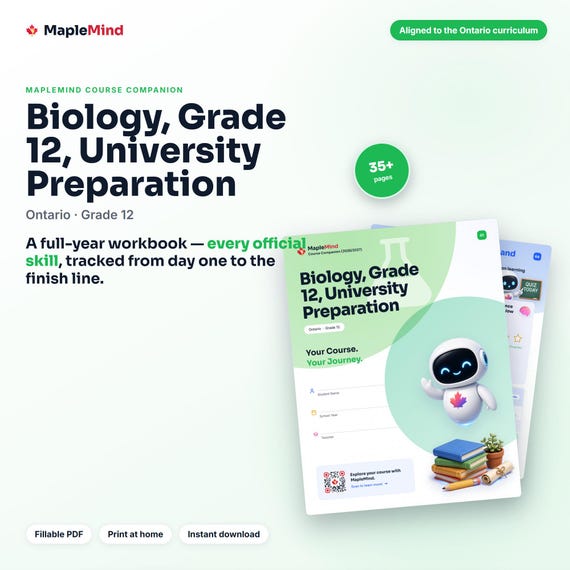
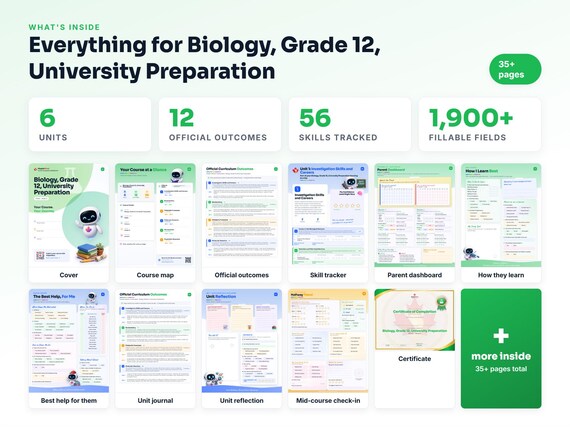
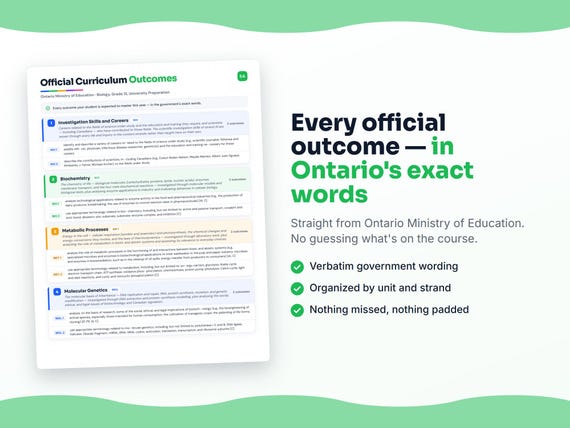

Printable workbook · A keepsake of the year
A Biology, Grade 12, University Preparation workbook worth keeping
Built from the same official curriculum as this page. Before and after each skill above, your student colours in how sure they feel — so the two of you can see, on one page, what's clicking and what needs another look. It's a quiet way to follow how the year is really going.
By June it's full of their own handwriting: units worked through, confidence grown, a mid-year check-in, notes from parent-teacher night, and a certificate at the end. Less a worksheet, more a record of the year worth keeping on the shelf.
Instant download · see every page, reviews and the full description · five or more workbooks are $2.99 each
What it looks like in the app



Common questions
Can MapleMind help me with Biology, Grade 12, University Preparation?
Yes. MapleMind's AI tutor covers all 56 skills in Ontario's Biology, Grade 12, University Preparation — you pick the exact skill, and the tutor teaches it step by step: a short lesson, a worked example, solving together, then a skill check to show it stuck.
Is MapleMind aligned to Ontario's official curriculum?
Yes. Every skill in this course maps to an official outcome code from Ontario's Grade 12 Science curriculum, and the ministry's own wording is quoted under each unit on this page — with the official government source linked so you can check it yourself.
What does MapleMind cost?
It's free to start — 5 tutoring chats and a practice quiz every day, no credit card. A Pro subscription ($9.99/month or $49.99/year CAD, 7-day free trial) unlocks unlimited tutoring, practice, and exam simulations.
What if I'm stuck on just one topic?
That's the point of skill-level tutoring: open Biology, Grade 12, University Preparation in the app, tap the exact skill from the list on this page, and the tutor teaches just that — no wading through lessons you don't need.
Does MapleMind work in French or other languages?
Yes — 14 languages, including French. Both the app and the tutor's explanations switch to the language you choose.
Where can I see the official Ontario curriculum for Biology, Grade 12, University Preparation?
The official source is linked on this page — Ontario's official science curriculum. The outline here follows it: every MapleMind skill carries its official outcome code, and the ministry's own wording is quoted under each unit.
Keep exploring
Ready when you are
Pick a skill from this page and see it taught properly — free, in the browser, in under a minute.