Get help with Chemistry, Grade 12, University Preparation
Most tutoring makes you sit through material you already know. MapleMind flips that: pick the exact skill that's causing trouble — any of the 72 below — and the tutor teaches just that one, step by step, as many times as it takes. Ask questions in plain words, any time of day, in English, French, or 12 other languages.
The official Ontario Chemistry, Grade 12, University Preparation curriculum
Ontario defines Chemistry, Grade 12, University Preparation by strands and outcomes. MapleMind teaches the same curriculum reorganized for one-skill-at-a-time tutoring — the table shows exactly where every official strand lands, and the ministry's own wording is quoted under each unit below.
Official source Ontario's official science curriculumRead it on the government site — dcp.edu.gov.on.ca ↗| Official strand | Outcomes | Where MapleMind teaches it |
|---|---|---|
| Strand A | 2 | Investigation Skills and Careers |
| Strand B | 11 | Organic Chemistry |
| Strand C | 13 | Structure and Properties of Matter |
| Strand D | 17 | Energy Changes and Rates of Reaction |
| Strand E | 15 | Chemical Systems and Equilibrium |
| Strand F | 14 | Electrochemistry |
Every skill below, taught one on one.
 Try the first session free
How MapleMind teaches Chemistry, Grade 12, University Preparation — every unit, lesson, and skill
Every skill below runs as a short session: a plain-words lesson, a worked example, solving it together, then a five-question skill check that earns up to three stars. Guided Mode keeps it teaching instead of answer-handing — turning it off needs a parent's password.
Unit 1Investigation Skills and CareersOfficial strand · Strand A
Careers related to the fields of science under study and the education and training they require, and scientists — including Canadians — who have contributed to those fields. The scientific investigation skills of strand A1 are woven through every lab and inquiry in the content strands rather than taught here on their own.
Careers in Chemistry
- Careers in chemistrysch4u.SCH4U.A2.1 — Identify and describe a variety of careers related to the fields of science under study and the education and training necessary for them.
Scientists and Their Contributions
- Scientists who contributed to chemistrysch4u.SCH4U.A2.2 — Describe the contributions of scientists, including Canadians, to the fields under study.
The official wording — 2 outcomes in this unit
- sch4u.SCH4U.A2.1
identify and describe a variety of careers related to the fields of science under study (e.g., food and drug analyst, chemical safety officer, nurse practitioner, consumer protection specialist, metallurgy technologist, environmental and waste management technician, geochemist) and the education and training necessary for these careers
- sch4u.SCH4U.A2.2
describe the contributions of scientists, including Canadians (e.g., Robert G. Ackman, Alice Wilson, Carol Ann Budd, Norman L. Bowen, Brian Evans Conway), to the fields under study
Unit 2Organic ChemistryOfficial strand · Strand B
The chemistry of carbon compounds — the classes of organic compounds, IUPAC naming, molecular models, organic reactions, and isomerism — investigated through inquiry, plus assessing the impact of organic compounds and proposing ways to reduce the use of harmful ones.
Organic Compounds in Everyday Life
- Impact of organic compoundssch4u.SCH4U.B1.1 — Assess the impact on human health, society, and the environment of organic compounds used in everyday life.
- Reducing harmful compoundssch4u.SCH4U.B1.2 — Propose a personal course of action to reduce the use of compounds harmful to health and the environment.
Investigating Organic Compounds
- Organic chemistry terminologysch4u.SCH4U.B2.1 — Use appropriate terminology related to organic chemistry.
- IUPAC naming of organic compoundssch4u.SCH4U.B2.2 — Use IUPAC nomenclature to name, write formulae, and create structural formulae for classes of organic compounds.
- Molecular models of organic compoundssch4u.SCH4U.B2.3 — Build molecular models for a variety of simple organic compounds.
- Analysing organic reactionssch4u.SCH4U.B2.4 — Analyse, on the basis of inquiry, various organic chemical reactions.
- Classes of organic compoundssch4u.SCH4U.B3.1 — Compare the different classes of organic compounds by their names and structural formulae.
- Physical properties of organic compoundssch4u.SCH4U.B3.2 — Describe the similarities and differences in physical properties within each class of organic compounds.
- Organic reaction typessch4u.SCH4U.B3.3 — Explain the chemical changes in various types of organic chemical reactions.
- Addition versus condensation polymerizationsch4u.SCH4U.B3.4 — Explain the difference between an addition reaction and a condensation polymerization reaction.
- Isomerism in organic compoundssch4u.SCH4U.B3.5 — Explain the concept of isomerism and how variations in isomer properties relate to their formulae.
The official wording — 11 outcomes in this unit
- sch4u.SCH4U.B1.1
assess the impact on human health, society, and the environment of organic compounds used in everyday life (e.g., polymers, nutritional supplements, food additives, pharmaceuticals, pesticides) [AI, C]
- sch4u.SCH4U.B1.2
propose a personal course of action to reduce the use of compounds that are harmful to human health and the environment (e.g., weed lawns by hand rather than using herbicides, use cloth bags for shopping to reduce the number of plastic bags in landfill sites, choose fuel-efficient or hybrid vehicles to reduce fossil fuel emissions) [AI, C]
- sch4u.SCH4U.B2.1
use appropriate terminology related to or- ganic chemistry, including, but not limited to: organic compound, functional group, saturated hydrocarbon, unsaturated hydrocarbon, structural isomer, stereoisomer, and polymer [C]
- sch4u.SCH4U.B2.2
use International Union of Pure and Applied Chemistry (IUPAC) nomenclature conventions to identify names, write chemical formulae, and create structural formulae for the different classes of organic compounds, including hydro- carbons, alcohols, aldehydes, ketones, carboxylic acids, esters, ethers, amines, amides, and simple aromatic compounds [AI, C]
- sch4u.SCH4U.B2.3
build molecular models for a variety of simple organic compounds [PR, AI, C]
- sch4u.SCH4U.B2.4
analyse, on the basis of inquiry, various organic chemical reactions (e.g., production of esters, polymerization, oxidation of alcohols, multiple bonds in an organic compound, com- bustion reactions, addition reactions) [PR, AI]
- sch4u.SCH4U.B3.1
compare the different classes of organic compounds, including hydrocarbons, alcohols, aldehydes, ketones, carboxylic acids, esters, ethers, amines, and amides, by describing the similarities and differences in names and structural formulae of the compounds within each class
- sch4u.SCH4U.B3.2
describe the similarities and differences in physical properties (e.g., solubility in different solvents, odour, melting point, boiling point) within each class of organic compounds
- sch4u.SCH4U.B3.3
explain the chemical changes that occur dur- ing various types of organic chemical reactions, including substitution, addition, elimination, oxidation, esterification, and hydrolysis
- sch4u.SCH4U.B3.4
explain the difference between an addition reac- tion and a condensation polymerization reaction
- sch4u.SCH4U.B3.5
explain the concept of isomerism in organic compounds, and how variations in the pro- perties of isomers relate to their structural and molecular formulae
Unit 3Structure and Properties of MatterOfficial strand · Strand C
Atomic structure and bonding — electron configurations, molecular shapes (VSEPR), polarity, and the properties of solids — investigated through inquiry, plus assessing technologies based on atomic and molecular structure and evaluating specialized materials.
Technologies from the Structure of Matter
- Technologies from atomic structuresch4u.SCH4U.C1.1 — Assess the benefits to society of technologies based on the principles of atomic and molecular structure.
- Specialized materialssch4u.SCH4U.C1.2 — Evaluate the benefits and environmental impact of specialized materials created from research into matter and bonding.
Investigating Atomic Structure and Bonding
- Structure terminologysch4u.SCH4U.C2.1 — Use appropriate terminology related to structure and properties of matter.
- Writing electron configurationssch4u.SCH4U.C2.2 — Use the Pauli exclusion principle, Hund's rule, and the aufbau principle to write electron configurations.
- Predicting molecular shapes with VSEPRsch4u.SCH4U.C2.3 — Predict the shapes of simple molecules and ions using the VSEPR model and draw diagrams.
- Predicting polaritysch4u.SCH4U.C2.4 — Predict the polarity of chemical compounds based on molecular shape and electronegativity.
- Predicting type of solidsch4u.SCH4U.C2.5 — Predict the type of solid formed by a substance and describe its properties.
- Investigating physical properties and bondingsch4u.SCH4U.C2.6 — Conduct an inquiry to observe physical properties and determine the type of bonding present.
- Rutherford, Bohr, and the atomic modelsch4u.SCH4U.C3.1 — Explain how observations by Rutherford and Bohr contributed to the planetary model of the atom.
- Electron configurations of elementssch4u.SCH4U.C3.2 — Describe the electron configurations of elements using energy levels, shells, subshells, and the key principles.
- s, p, and d block propertiessch4u.SCH4U.C3.3 — Identify the characteristic properties of elements in the s, p, and d blocks and relate position to configuration.
- Physical properties and intermolecular forcessch4u.SCH4U.C3.4 — Explain how the physical properties of a solid or liquid depend on the particles and forces present.
- Canadian contribution to atomic theorysch4u.SCH4U.C3.5 — Describe a Canadian contribution to the field of atomic and molecular theory.
The official wording — 13 outcomes in this unit
- sch4u.SCH4U.C1.1
assess the benefits to society of technologies that are based on the principles of atomic and molecular structures (e.g., magnetic resonance imaging [MRI], infrared spectroscopy, X-ray crystallography, nuclear energy, medical appli- cations of spectroscopy and mass spectrometry) [AI, C]
- sch4u.SCH4U.C1.2
evaluate the benefits to society, and the impact on the environment, of specialized materials that have been created on the basis of scientific research into the structure of matter and chemical bonding (e.g., bulletproof fabric, nanotechnolo- gies, superconductors, instant adhesives) [AI, C]
- sch4u.SCH4U.C2.1
use appropriate terminology related to struc- ture and properties of matter, including, but not limited to: orbital, emission spectrum, energy level, photon, and dipole [C]
- sch4u.SCH4U.C2.2
use the Pauli exclusion principle, Hund’s rule, and the aufbau principle to write electron configurations for a variety of elements in the periodic table [AI, C]
- sch4u.SCH4U.C2.3
predict the shapes of simple molecules and ions (e.g., CH 4 , SO 3 , O 2 , H 2 O, NH 4 +), using the valence shell electron pair repulsion (VSEPR) model, and draw diagrams to represent their molecular shapes [AI, C]
- sch4u.SCH4U.C2.4
predict the polarity of various chemical com- pounds, based on their molecular shapes and the difference in the electronegativity values of the atoms [AI]
- sch4u.SCH4U.C2.5
predict the type of solid (ionic, molecular, covalent network, metallic) formed by a given substance in a chemical reaction, and describe the properties of that solid [AI]
- sch4u.SCH4U.C2.6
conduct an inquiry to observe and analyse the physical properties of various substances (e.g., salts, metals) and to determine the type of chemical bonding present in each substance [PR, AI]
- sch4u.SCH4U.C3.1
explain how experimental observations and inferences made by Ernest Rutherford and Niels Bohr contributed to the development of the planetary model of the hydrogen atom
- sch4u.SCH4U.C3.2
describe the electron configurations of a var- iety of elements in the periodic table, using the concept of energy levels in shells and subshells, as well as the Pauli exclusion principle, Hund’s rule, and the aufbau principle
- sch4u.SCH4U.C3.3
identify the characteristic properties of ele- ments in each of the s, p, and d blocks of the periodic table, and explain the relationship be- tween the position of an element in the periodic table, its properties, and its electron configuration
- sch4u.SCH4U.C3.4
explain how the physical properties of a solid or liquid (e.g., solubility, boiling point, melting point, melting point suppression, hardness, electrical conductivity, surface tension) depend on the particles present and the types of intermolecular and intramolecular forces (e.g., covalent bonding, ionic bonding, Van der Waals forces, hydrogen bonding, metallic bonding)
- sch4u.SCH4U.C3.5
describe a Canadian contribution to the field of atomic and molecular theory (e.g., the work of Richard F.W. Bader of McMaster University on electronic density in small molecules; the work of Robert J. LeRoy of the University of Waterloo on the mathematical technique to determine the atomic radius of molecules known as the LeRoy Radius; the work of Ronald J. Gillespie of McMaster University on the VSEPR model)
Unit 4Energy Changes and Rates of ReactionOfficial strand · Strand D
Thermochemistry and kinetics — thermochemical equations, heat transfer, Hess's law, calorimetry, and the factors that control reaction rate — investigated through inquiry, plus analysing energy technologies and the conditions that maximize reaction efficiency.
Energy Technologies and Efficiency
- Analysing energy technologiessch4u.SCH4U.D1.1 — Analyse conventional and alternative energy technologies and evaluate their efficiency and environmental impact.
- Conditions for reaction efficiencysch4u.SCH4U.D1.2 — Analyse the conditions required to maximize reaction efficiency and explain how efficiency contributes to sustainability.
Investigating Thermochemistry and Kinetics
- Energy and rates terminologysch4u.SCH4U.D2.1 — Use appropriate terminology related to energy changes and rates of reaction.
- Writing thermochemical equationssch4u.SCH4U.D2.2 — Write thermochemical equations, expressing the energy change as a delta-H value or heat term.
- Heat transfer calculationssch4u.SCH4U.D2.3 — Solve problems involving heat transfer in a chemical reaction using Q = mc delta-T.
- Calorimetry inquirysch4u.SCH4U.D2.4 — Plan and conduct an inquiry to calculate the heat of reaction using a calorimeter.
- Hess's law calculationssch4u.SCH4U.D2.5 — Solve problems related to energy changes in a chemical reaction using Hess's law.
- Testing Hess's lawsch4u.SCH4U.D2.6 — Conduct an inquiry to test Hess's law.
- Standard enthalpies of formationsch4u.SCH4U.D2.7 — Calculate the heat of reaction for a formation reaction using standard enthalpies and Hess's law.
- Investigating factors affecting ratesch4u.SCH4U.D2.8 — Plan and conduct an inquiry to determine how various factors affect the rate of a reaction.
- Energy changes in physical, chemical, and nuclear reactionssch4u.SCH4U.D3.1 — Compare the energy changes from physical change, chemical reactions, and nuclear reactions.
- Bond energy and reaction typesch4u.SCH4U.D3.2 — Compare the energy change when bonds form versus break and explain endothermic and exothermic reactions.
- Mass, heat capacity, and heat changesch4u.SCH4U.D3.3 — Explain how mass, heat capacity, and temperature change determine the heat gained or lost.
- Hess's law explainedsch4u.SCH4U.D3.4 — State Hess's law and explain, using examples, how it finds the enthalpy changes of a reaction.
- Factors controlling reaction ratesch4u.SCH4U.D3.5 — Explain, using collision theory and potential energy diagrams, how factors control reaction rate.
- Potential energy diagramssch4u.SCH4U.D3.6 — Describe simple potential energy diagrams of chemical reactions.
- Reaction mechanismssch4u.SCH4U.D3.7 — Explain how the rate of a reaction is determined by the elementary steps of its mechanism.
The official wording — 17 outcomes in this unit
- sch4u.SCH4U.D1.1
analyse some conventional and alternative energy technologies (e.g., fossil fuel–burning power plants, hydro-powered generators, solar panels, wind turbines, fuel cells), and evaluate them in terms of their efficiency and impact on the environment [AI, C]
- sch4u.SCH4U.D1.2
analyse the conditions (e.g., temperature, pressure, presence of a catalyst) required to maximize the efficiency of some common natural or industrial chemical reactions (e.g., decomposition, combustion, neutralization), and explain how the improved efficiency of the reaction contributes to environmental sustainability [AI, C]
- sch4u.SCH4U.D2.1
use appropriate terminology related to energy changes and rates of reaction, including, but not limited to: enthalpy, activation energy, endothermic, exothermic, potential energy, and specific heat capacity [C]
- sch4u.SCH4U.D2.2
write thermochemical equations, expressing the energy change as a ΔH value or as a heat term in the equation [AI, C]
- sch4u.SCH4U.D2.3
solve problems involving analysis of heat transfer in a chemical reaction, using the equation Q = mcΔT (e.g., calculate the energy released in the combustion of an organic com- pound, and express the results in energy per mole of fuel [J/mol]) [AI, C]
- sch4u.SCH4U.D2.4
plan and conduct an inquiry to calculate, using a calorimeter, the heat of reaction of a substance (e.g., the heat of solution of ammonium nitrate, or of combustion of a hydrocarbon), compare the actual heat of reaction to the theoretical value, and suggest sources of experimental error [IP, PR, AI, C]
- sch4u.SCH4U.D2.5
solve problems related to energy changes in a chemical reaction, using Hess’s law [AI]
- sch4u.SCH4U.D2.6
conduct an inquiry to test Hess’s law (e.g., measure heats of reaction from the combustion of magnesium, and combine them to yield the ΔH value of the reaction) [PR, AI]
- sch4u.SCH4U.D2.7
calculate the heat of reaction for a formation reaction, using a table of standard enthalpies of formation and applying Hess’s law [AI]
- sch4u.SCH4U.D2.8
plan and conduct an inquiry to determine how various factors (e.g., change in temperature, addition of a catalyst, increase in surface area of a solid reactant) affect the rate of a chemical reaction [IP, PR, AI]
- sch4u.SCH4U.D3.1
compare the energy changes resulting from physical change (e.g., boiling water), chemical reactions (e.g., bleaching a stain), and nuclear reactions (e.g., fission, fusion), in terms of whether energy is released or absorbed
- sch4u.SCH4U.D3.2
compare the energy change from a reaction in which bonds are formed to one in which bonds are broken, and explain these changes in terms of endothermic and exothermic reactions
- sch4u.SCH4U.D3.3
explain how mass, heat capacity, and change in temperature of a substance determine the amount of heat gained or lost by the substance
- sch4u.SCH4U.D3.4
state Hess’s law, and explain, using examples, how it is applied to find the enthalpy changes of a reaction
- sch4u.SCH4U.D3.5
explain, using collision theory and potential energy diagrams, how factors such as temper- ature, the surface area of the reactants, the nature of the reactants, the addition of catalysts, and the concentration of the solution control the rate of a chemical reaction
- sch4u.SCH4U.D3.6
describe simple potential energy diagrams of chemical reactions (e.g., the relationships between the relative energies of reactants and products and the activation energy of the reaction)
- sch4u.SCH4U.D3.7
explain, with reference to a simple chemical reaction (e.g., combustion), how the rate of a reaction is determined by the series of elementary steps that make up the overall reaction mechanism
Unit 5Chemical Systems and EquilibriumOfficial strand · Strand E
Dynamic equilibrium — Le Chatelier's principle, equilibrium constants, solubility, and acid-base equilibrium — investigated through inquiry and calculation, plus analysing equilibrium processes and assessing their impact on biological, biochemical, and technological systems.
Equilibrium in Nature, Industry, and the Body
- Optimal conditions for an equilibrium processsch4u.SCH4U.E1.1 — Analyse the optimal conditions for a chemical process related to equilibrium in nature or industry.
- Impact of equilibrium on systemssch4u.SCH4U.E1.2 — Assess the impact of chemical equilibrium processes on biological, biochemical, and technological systems.
Investigating Chemical Equilibrium
- Equilibrium terminologysch4u.SCH4U.E2.1 — Use appropriate terminology related to chemical systems and equilibrium.
- Applying Le Chatelier's principlesch4u.SCH4U.E2.2 — Predict, using Le Chatelier's principle, how factors affect equilibrium, and conduct an inquiry to test the predictions.
- Determining an equilibrium constantsch4u.SCH4U.E2.3 — Conduct an inquiry to determine the value of an equilibrium constant for a reaction.
- Equilibrium calculationssch4u.SCH4U.E2.4 — Solve problems related to equilibrium by performing calculations involving concentrations.
- Acid-base equilibrium problemssch4u.SCH4U.E2.5 — Solve problems related to acid-base equilibrium using titration data and the pH at the equivalence point.
- Dynamic equilibriumsch4u.SCH4U.E3.1 — Explain the concept of dynamic equilibrium using examples of physical and chemical systems.
- Chemical equilibrium and concentrationsch4u.SCH4U.E3.2 — Explain chemical equilibrium and how it applies to the concentration of reactants and products.
- Le Chatelier's principle explainedsch4u.SCH4U.E3.3 — Explain Le Chatelier's principle and how it applies to a reaction at equilibrium.
- Equilibrium constants and expressionssch4u.SCH4U.E3.4 — Identify common equilibrium constants and write the expressions for each.
- Using the ionization constant of watersch4u.SCH4U.E3.5 — Use the ionization constant of water to calculate pH, pOH, and ion concentrations.
- Bronsted-Lowry theorysch4u.SCH4U.E3.6 — Explain the Bronsted-Lowry theory of acids and bases.
- Strong and weak acids and bases at equilibriumsch4u.SCH4U.E3.7 — Compare the properties of strong and weak acids and bases using dynamic equilibrium.
- Buffer solutionssch4u.SCH4U.E3.8 — Describe the chemical characteristics of buffer solutions.
The official wording — 15 outcomes in this unit
- sch4u.SCH4U.E1.1
analyse the optimal conditions for a specific chemical process related to the principles of equilibrium that takes place in nature or is used in industry (e.g., the production of sulfuric acid, electrolyte balance in the human body, sedimentation in water systems) [AI, C]
- sch4u.SCH4U.E1.2
assess the impact of chemical equilibrium processes on various biological, biochemical, and technological systems (e.g., remediation in areas of heavy metal contamination, development of gallstones, use of buffering in medications, use of barium sulfate in medical diagnosis) [AI, C]
- sch4u.SCH4U.E2.1
use appropriate terminology related to chemical systems and equilibrium, including, but not limited to: homogeneous, closed system, reversible reaction, equilibrium constant, equilibrium concentration, molar solubility, and buffer [C]
- sch4u.SCH4U.E2.2
predict, applying Le Châtelier’s principle or the reaction quotient for a given reaction, how various factors (e.g., changes in volume, temperature, or concentration of reactants or products in a solution) would affect a chemical system at equilibrium, and conduct an inquiry to test those predictions [PR, AI]
- sch4u.SCH4U.E2.3
conduct an inquiry to determine the value of an equilibrium constant for a chemical reaction (e.g., Keq for iron(III) thiocyanate, Ksp for calcium hydroxide, Ka for acetic acid) [PR, AI]
- sch4u.SCH4U.E2.4
solve problems related to equilibrium by performing calculations involving concentrations of reactants and products (e.g., Keq , Ksp , Ka , pH, pOH, Kp , Kb ) [AI]
- sch4u.SCH4U.E2.5
solve problems related to acid–base equilib- rium, using acid–base titration data and the pH at the equivalence point [AI]
- sch4u.SCH4U.E3.1
explain the concept of dynamic equilibrium, using examples of physical and chemical equilibrium systems (e.g., liquid–vapour equilibrium, weak electrolytes in solution, reversible chemical reactions)
- sch4u.SCH4U.E3.2
explain the concept of chemical equilibrium and how it applies to the concentration of reactants and products in a chemical reaction at equilibrium
- sch4u.SCH4U.E3.3
explain Le Châtelier’s principle and how it applies to changes to a chemical reaction at equilibrium
- sch4u.SCH4U.E3.4
identify common equilibrium constants, including Keq , Ksp , Kw , Ka , Kb , and Kp , and write the expressions for each
- sch4u.SCH4U.E3.5
use the ionization constant of water (K w ) to calculate pH, pOH, [H 3 O+], and [OH–] for chemical reactions
- sch4u.SCH4U.E3.6
explain the Brønsted-Lowry theory of acids and bases
- sch4u.SCH4U.E3.7
compare the properties of strong and weak acids, and strong and weak bases, using the concept of dynamic equilibrium
- sch4u.SCH4U.E3.8
describe the chemical characteristics of buffer solutions
Unit 6ElectrochemistryOfficial strand · Strand F
Oxidation-reduction and electrochemical cells — balancing redox equations, galvanic cells, cell potential, and standard reduction potentials — investigated through inquiry, plus assessing electrochemical technologies as energy sources and analysing related health and safety issues.
Electrochemistry, Energy, and Safety
- Electrochemical energy technologiessch4u.SCH4U.F1.1 — Assess the viability of electrochemical technologies as alternative energy sources and explain their impact.
- Health and safety in electrochemistrysch4u.SCH4U.F1.2 — Analyse health and safety issues involving electrochemistry.
Investigating Redox and Galvanic Cells
- Electrochemistry terminologysch4u.SCH4U.F2.1 — Use appropriate terminology related to electrochemistry.
- Analysing a redox reactionsch4u.SCH4U.F2.2 — Conduct an inquiry to analyse, in qualitative terms, an oxidation-reduction reaction.
- Balancing redox equationssch4u.SCH4U.F2.3 — Write balanced chemical equations for redox reactions using oxidation numbers and half-reactions.
- Building a galvanic cellsch4u.SCH4U.F2.4 — Build a galvanic cell and measure its cell potential.
- Analysing galvanic cellssch4u.SCH4U.F2.5 — Analyse the processes in galvanic cells and draw labelled diagrams of them.
- Predicting redox spontaneitysch4u.SCH4U.F2.6 — Predict the spontaneity of redox reactions based on overall cell potential using standard reduction potentials.
- Redox and oxidation numbersch4u.SCH4U.F3.1 — Explain redox reactions in terms of the loss and gain of electrons and change in oxidation number.
- Components of a galvanic cellsch4u.SCH4U.F3.2 — Identify the components of a galvanic cell and explain how each functions.
- Half-cells and cell potentialsch4u.SCH4U.F3.3 — Describe galvanic cells in terms of oxidation and reduction half-cells whose voltages give the cell potential.
- The standard hydrogen half-cellsch4u.SCH4U.F3.4 — Explain how the hydrogen half-cell is used as a standard reference to determine half-cell voltages.
- Applications of electrochemistrysch4u.SCH4U.F3.5 — Explain some applications of electrochemistry in common industrial processes.
- Corrosion and its preventionsch4u.SCH4U.F3.6 — Explain the corrosion of metals as an electrochemical process and describe corrosion-inhibiting techniques.
The official wording — 14 outcomes in this unit
- sch4u.SCH4U.F1.1
assess, on the basis of research, the viability of using electrochemical technologies as alterna- tive sources of energy (e.g., fuel cells for emergency power generation or as power sources in remote locations), and explain their potential impact on society and the environ- ment [IP, PR, AI, C]
- sch4u.SCH4U.F1.2
analyse health and safety issues involving electrochemistry (e.g., corrosion of metal pipes in drinking water systems) [AI, C]
- sch4u.SCH4U.F2.1
use appropriate terminology related to electrochemistry, including, but not limited to: half-reaction, electrochemical cell, reducing agent, oxidizing agent, redox reaction, and oxidation number [C]
- sch4u.SCH4U.F2.2
conduct an inquiry to analyse, in qualitative terms, an oxidation-reduction (redox) reaction [PR, AI, C]
- sch4u.SCH4U.F2.3
write balanced chemical equations for oxidation-reduction reactions, using various methods including oxidation numbers of atoms and the half-reaction method of balancing [AI, C]
- sch4u.SCH4U.F2.4
build a galvanic cell and measure its cell potential [PR, AI]
- sch4u.SCH4U.F2.5
analyse the processes in galvanic cells, and draw labelled diagrams of these cells to show the oxidation or reduction reaction that occurs in each of the half-cells, the direction of electron flow, the electrode polarity (anode and cathode), the cell potential, and the direction of ion movement [AI, C]
- sch4u.SCH4U.F2.6
predict the spontaneity of redox reactions, based on overall cell potential as determined using a table of standard reduction potentials for redox half-reactions [AI]
- sch4u.SCH4U.F3.1
explain redox reactions in terms of the loss and gain of electrons and the associated change in oxidation number
- sch4u.SCH4U.F3.2
identify the components of a galvanic cell, and explain how each component functions in a redox reaction
- sch4u.SCH4U.F3.3
describe galvanic cells in terms of oxidation and reduction half-cells whose voltages can be used to determine overall cell potential
- sch4u.SCH4U.F3.4
explain how the hydrogen half-cell is used as a standard reference to determine the volt- ages of another half-cell
- sch4u.SCH4U.F3.5
explain some applications of electrochem- istry in common industrial processes (e.g., in refining metals such as aluminum and zinc; in the production of hydrogen)
- sch4u.SCH4U.F3.6
explain the corrosion of metals in terms of an electrochemical process, and describe some common corrosion-inhibiting techniques (e.g., painting, galvanizing, cathodic protection)



Printable workbook · A keepsake of the year
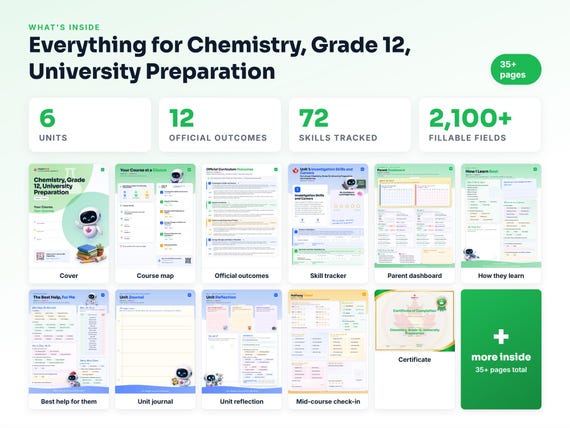
A Chemistry, Grade 12, University Preparation workbook worth keeping
Built from the same official curriculum as this page. Before and after each skill above, your student colours in how sure they feel — so the two of you can see, on one page, what's clicking and what needs another look. It's a quiet way to follow how the year is really going.
By June it's full of their own handwriting: units worked through, confidence grown, a mid-year check-in, notes from parent-teacher night, and a certificate at the end. Less a worksheet, more a record of the year worth keeping on the shelf.
Instant download · see every page, reviews and the full description · five or more workbooks are $2.99 each
What it looks like in the app



Common questions
Can MapleMind help me with Chemistry, Grade 12, University Preparation?
Yes. MapleMind's AI tutor covers all 72 skills in Ontario's Chemistry, Grade 12, University Preparation — you pick the exact skill, and the tutor teaches it step by step: a short lesson, a worked example, solving together, then a skill check to show it stuck.
Is MapleMind aligned to Ontario's official curriculum?
Yes. Every skill in this course maps to an official outcome code from Ontario's Grade 12 Science curriculum, and the ministry's own wording is quoted under each unit on this page — with the official government source linked so you can check it yourself.
What does MapleMind cost?
It's free to start — 5 tutoring chats and a practice quiz every day, no credit card. A Pro subscription ($9.99/month or $49.99/year CAD, 7-day free trial) unlocks unlimited tutoring, practice, and exam simulations.
What if I'm stuck on just one topic?
That's the point of skill-level tutoring: open Chemistry, Grade 12, University Preparation in the app, tap the exact skill from the list on this page, and the tutor teaches just that — no wading through lessons you don't need.
Does MapleMind work in French or other languages?
Yes — 14 languages, including French. Both the app and the tutor's explanations switch to the language you choose.
Where can I see the official Ontario curriculum for Chemistry, Grade 12, University Preparation?
The official source is linked on this page — Ontario's official science curriculum. The outline here follows it: every MapleMind skill carries its official outcome code, and the ministry's own wording is quoted under each unit.
Keep exploring
Ready when you are
Pick a skill from this page and see it taught properly — free, in the browser, in under a minute.