Get help with Environmental Science, Grade 11, University/College Preparation
Most tutoring makes you sit through material you already know. MapleMind flips that: pick the exact skill that's causing trouble — any of the 65 below — and the tutor teaches just that one, step by step, as many times as it takes. Ask questions in plain words, any time of day, in English, French, or 12 other languages.
The official Ontario Environmental Science, Grade 11, University/College Preparation curriculum
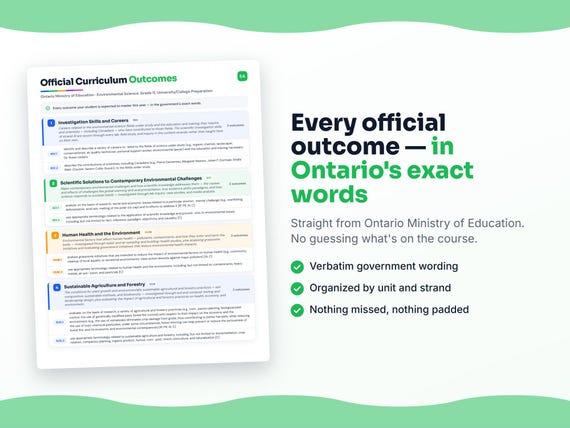
Ontario defines Environmental Science, Grade 11, University/College Preparation by strands and outcomes. MapleMind teaches the same curriculum reorganized for one-skill-at-a-time tutoring — the table shows exactly where every official strand lands, and the ministry's own wording is quoted under each unit below.
Official source Ontario's official science curriculumRead it on the government site — dcp.edu.gov.on.ca ↗| Official strand | Outcomes | Where MapleMind teaches it |
|---|---|---|
| Strand A | 2 | Investigation Skills and Careers |
| Strand B | 12 | Scientific Solutions to Contemporary Environmental Challenges |
| Strand C | 12 | Human Health and the Environment |
| Strand D | 14 | Sustainable Agriculture and Forestry |
| Strand E | 12 | Reducing and Managing Waste |
| Strand F | 12 | Conservation of Energy |
Every skill below, taught one on one.
 Try the first session free
How MapleMind teaches Environmental Science, Grade 11, University/College Preparation — every unit, lesson, and skill
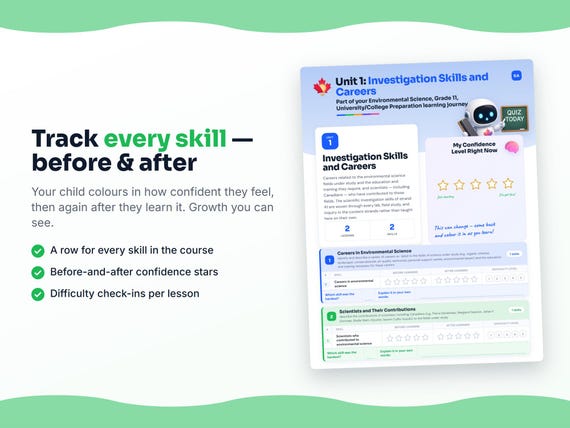
Every skill below runs as a short session: a plain-words lesson, a worked example, solving it together, then a five-question skill check that earns up to three stars. Guided Mode keeps it teaching instead of answer-handing — turning it off needs a parent's password.
Unit 1Investigation Skills and CareersOfficial strand · Strand A
Careers related to the environmental science fields under study and the education and training they require, and scientists — including Canadians — who have contributed to those fields. The scientific investigation skills of strand A1 are woven through every lab, field study, and inquiry in the content strands rather than taught here on their own.
Careers in Environmental Science
- Careers in environmental sciencesvn3m.SVN3M.A2.1 — Identify and describe a variety of careers related to the fields of science under study and the education and training necessary for them.
Scientists and Their Contributions
- Scientists who contributed to environmental sciencesvn3m.SVN3M.A2.2 — Describe the contributions of scientists, including Canadians, to the fields under study.
The official wording — 2 outcomes in this unit
- svn3m.SVN3M.A2.1
identify and describe a variety of careers re- lated to the fields of science under study (e.g., organic chemist, landscaper, conservationist, air quality technician, personal support worker, environmental lawyer) and the education and training necessary for these careers
- svn3m.SVN3M.A2.2
describe the contributions of scientists, including Canadians (e.g., Pierre Dansereau, Margaret Newton, Johan F. Dormaar, Sheila Watt-Cloutier, Severn Cullis-Suzuki), to the fields under study
Unit 2Scientific Solutions to Contemporary Environmental ChallengesOfficial strand · Strand B
Major contemporary environmental challenges and how scientific knowledge addresses them — the causes and effects of challenges like global warming and acid precipitation, how evidence shifts paradigms, and how science responds to societal needs — investigated through lab inquiry, case studies, and media analysis.
Environmental Challenges and Society
- Issues of an environmental challengesvn3m.SVN3M.B1.1 — Analyse the social and economic issues related to a particular environmental challenge and efforts to address it.
- Societal needs and environmental sciencesvn3m.SVN3M.B1.2 — Analyse ways in which societal needs or demands have influenced scientific endeavours related to the environment.
Investigating Scientific Solutions
- Scientific-solutions terminologysvn3m.SVN3M.B2.1 — Use appropriate terminology related to applying scientific knowledge to environmental issues.
- Testing an environmental proceduresvn3m.SVN3M.B2.2 — Plan and conduct a laboratory inquiry to test a scientific procedure used to address a contemporary environmental problem.
- Applying science to an environmental issuesvn3m.SVN3M.B2.3 — Investigate how scientific knowledge and procedures are applied to address a contemporary environmental issue.
- Perspectives on environmental knowledgesvn3m.SVN3M.B2.4 — Use a research process to investigate how evidence, theories, and paradigms reflecting a range of perspectives have contributed to environmental knowledge.
- Assessing a media reportsvn3m.SVN3M.B2.5 — Use a research process to locate a media report on a contemporary environmental issue, summarize its arguments, and assess their validity scientifically.
- Major environmental challengessvn3m.SVN3M.B3.1 — Identify major contemporary environmental challenges and explain their causes and effects.
- Scientific processes for the environmentsvn3m.SVN3M.B3.2 — Describe how scientists use a variety of processes to solve problems and answer environmental questions.
- New evidence and shifting paradigmssvn3m.SVN3M.B3.3 — Explain how new evidence affects scientific knowledge about the environment and leads to shifts in theory or paradigms.
- Challenges driving science and technologysvn3m.SVN3M.B3.4 — Explain how an environmental challenge has led to advances in science or technology.
- Human activities and the environmentsvn3m.SVN3M.B3.5 — Describe human activities that have led to environmental problems or contributed to their solution.
The official wording — 12 outcomes in this unit
- svn3m.SVN3M.B1.1
analyse, on the basis of research, social and economic issues related to a particular environ- mental challenge (e.g., overfishing, deforestation, acid rain, melting of the polar ice cap) and to efforts to address it [IP, PR, AI, C]
- svn3m.SVN3M.B1.2
analyse ways in which societal needs or demands have influenced scientific endeavours related to the environment (e.g., the development of drought- and pest-resistant crops to address the rising global need for food; research into alternative energy sources in response to demands to address the impact on climate change of burning fossil fuels) [AI, C]
- svn3m.SVN3M.B2.1
use appropriate terminology related to the application of scientific knowledge and proced- ures to environmental issues, including, but not limited to: fact, inference, paradigm, objectivity, and causality [C]
- svn3m.SVN3M.B2.2
plan and conduct a laboratory inquiry to test a scientific procedure used to address a contem- porary environmental problem (e.g., an oil spill, acid precipitation) [IP, PR, AI]
- svn3m.SVN3M.B2.3
investigate, through research or using case studies or computer simulation, how scientific knowledge and procedures are applied to address a particular contemporary environmental issue (e.g., scientific data on the needs and habits of endangered species are used to develop plans to protect threatened species; life-cycle assess- ments are conducted to determine the total environmental impact of a consumer product) [PR, AI]
- svn3m.SVN3M.B2.4
use a research process to investigate how evidence, theories, and paradigms reflecting a range of perspectives have contributed to our scientific knowledge about the environment (e.g., with respect to debates about climate change; regarding the relationship between the cod moratorium and seal populations in Atlantic Canada), and communicate their findings [IP, PR, AI, C]
- svn3m.SVN3M.B2.5
use a research process to locate a media report on a contemporary environmental issue (e.g., climate change, melting of the polar ice cap, deforestation), summarize its arguments, and assess their validity from a scientific perspective [IP, PR, AI, C]
- svn3m.SVN3M.B3.1
identify some major contemporary environ- mental challenges (e.g., global warming, acid precipitation), and explain their causes (e.g., deforestation, carbon and sulfur emissions) and effects (e.g., desertification, the creation of environmental refugees, the destruction of aquatic and terrestrial habitats)
- svn3m.SVN3M.B3.2
describe how scientists use a variety of pro- cesses (e.g., environmental impact assessments, environmental scans) to solve problems and answer questions related to the environment
- svn3m.SVN3M.B3.3
explain how new evidence affects scientific knowledge about the environment and leads to modifications of theory and/or shifts in para- digms (e.g., the impact of evidence of the effects of carbon dioxide emissions on theories of global warming)
- svn3m.SVN3M.B3.4
explain how an environmental challenge has led to advances in science or technology (e.g., scrubbers on smokestacks to decrease sulfur dioxide emissions, hybrid cars)
- svn3m.SVN3M.B3.5
describe a variety of human activities that have led to environmental problems (e.g., burning fossil fuels for transportation or power generation; waste disposal) and/or contributed to their solu- tion (e.g., the development of renewable sources of energy; programs to reduce, reuse, and recycle)
Unit 3Human Health and the EnvironmentOfficial strand · Strand C
Environmental factors that affect human health — pollutants, contaminants, and how they enter and harm the body — investigated through water and air sampling and building-health studies, plus analysing grassroots initiatives and evaluating government initiatives that reduce environmental health impacts.
Reducing Environmental Health Impacts
- Grassroots health initiativessvn3m.SVN3M.C1.1 — Analyse grassroots initiatives intended to reduce the impact of environmental factors on human health.
- Government health initiativessvn3m.SVN3M.C1.2 — Evaluate the effectiveness of government initiatives intended to reduce the impact of environmental factors on human health.
Investigating Health and the Environment
- Human health terminologysvn3m.SVN3M.C2.1 — Use appropriate terminology related to human health and the environment.
- Longitudinal health datasvn3m.SVN3M.C2.2 — Analyse longitudinal data to determine the impact of environmental factors on human health.
- Investigating water samplessvn3m.SVN3M.C2.3 — Investigate water samples from natural and disturbed environments and analyse the resulting data.
- Investigating air particulatessvn3m.SVN3M.C2.4 — Analyse particulate matter in air on the basis of a laboratory inquiry, simulation, or field study.
- Improving building healthsvn3m.SVN3M.C2.5 — Investigate health standards for buildings and methods to retrofit or improve structures to reduce their negative impact on health.
- Main pollutants and contaminantssvn3m.SVN3M.C3.1 — Identify the main pollutants and environmental contaminants that can affect human health.
- Effects of environmental factors on healthsvn3m.SVN3M.C3.2 — Describe the effects of a variety of environmental factors on human health.
- How contaminants enter the bodysvn3m.SVN3M.C3.3 — Describe ways in which environmental contaminants can enter the human body.
- Reducing exposure to contaminantssvn3m.SVN3M.C3.4 — Describe measures that can reduce exposure to environmental contaminants.
- Vulnerable populationssvn3m.SVN3M.C3.5 — Identify populations particularly vulnerable to environmental factors and explain why they are vulnerable.
The official wording — 12 outcomes in this unit
- svn3m.SVN3M.C1.1
analyse grassroots initiatives that are intended to reduce the impact of environmental factors on human health (e.g., community cleanup of local aquatic or terrestrial environments; class action lawsuits against major polluters) [AI, C]
- svn3m.SVN3M.C1.2
evaluate the effectiveness of government initiatives that are intended to reduce the impact of environmental factors on human health (e.g., Ontario Ministry of the Environment smog advisories; provincial laws regulating drinking water; WHMIS regulations on hazardous material) [AI, C]
- svn3m.SVN3M.C2.1
use appropriate terminology related to human health and the environment, including, but not limited to: contaminants, heavy metals, air pol- lution, and pesticide [C]
- svn3m.SVN3M.C2.2
analyse longitudinal data to determine the impact of various environmental factors that affect human health (e.g., air temperature, atmospheric greenhouse gases, contaminants in drinking water) [AI]
- svn3m.SVN3M.C2.3
investigate, through laboratory inquiry or field study, water samples from natural and disturbed environments (e.g., tap water; pond, river, or lake water from disturbed and undis- turbed areas; water from an outdoor pool), and analyse the resulting data [PR, AI]
- svn3m.SVN3M.C2.4
analyse, on the basis of a laboratory inquiry, computer simulation, or field study, particulate matter in air (e.g., an air sample from an ex- haust pipe or air vent, particles in a filter that cigarette smoke has passed through, particles caught on sticky paper set up in an open area) [PR, AI]
- svn3m.SVN3M.C2.5
investigate health standards for buildings and methods to retrofit or otherwise improve structures to reduce their negative impact on human health (e.g., the use of materials that do not contain volatile organic compounds, the use of biological air and water filters), and communicate their findings [PR, C]
- svn3m.SVN3M.C3.1
identify the main pollutants and environ- mental contaminants that can affect human health (e.g., air pollutants such as sulfur dioxide, nitrous oxide, and particulates; noise pollution; heavy metals such as lead and mercury; DDT; PCBs; mould; volatile organic compounds such as acetone and chlorinated solvents)
- svn3m.SVN3M.C3.2
describe the effects of a variety of environ- mental factors on human health (e.g., air pollutants are associated with disorders such as asthma; consumption of fish products from contaminated water may lead to increased levels of heavy metals in the human body; the thinning of the ozone layer may lead to increased incidence of skin cancer; noise pollution may impair hearing)
- svn3m.SVN3M.C3.3
describe ways in which a variety of environ- mental contaminants (e.g., volatile organic compounds in paints, carpets, and cleaning products; mercury in fish; E. coli in the water at public beaches) can enter the human body (e.g., inhalation, ingestion, absorption)
- svn3m.SVN3M.C3.4
describe measures that can reduce exposure to environmental contaminants (e.g., wearing protective clothing or sunscreen, or remaining indoors during peak UV hours, to prevent exposure to ultraviolet rays; avoiding the use of paints, solvents, and cleaning agents that contain volatile organic compounds)
- svn3m.SVN3M.C3.5
identify a variety of populations who are particularly vulnerable to the effects of environmental factors, and explain why these populations are vulnerable (e.g., seniors are vulnerable to extreme temperatures because the ability to regulate body temperature diminishes as people age; Inuit who follow a traditional diet are vulnerable to contaminants that accumulate in the fatty tissue of sea mammals because these animals are their main food source)
Unit 4Sustainable Agriculture and ForestryOfficial strand · Strand D
The conditions for plant growth and environmentally sustainable agricultural and forestry practices — soil composition, sustainable methods, and biodiversity — investigated through soil and compost testing and landscaping design, plus evaluating the impact of agricultural and forestry practices on health, economy, and environment.
Sustainable Practices and Their Impact
- Impact of practices on economy and environmentsvn3m.SVN3M.D1.1 — Evaluate agricultural and forestry practices with respect to their impact on the economy and the environment.
- Impact of practices on human healthsvn3m.SVN3M.D1.2 — Evaluate the impact, including the long-term impact, of agricultural and forestry practices on human health.
Investigating Plant Growth and Soil
- Sustainable agriculture terminologysvn3m.SVN3M.D2.1 — Use appropriate terminology related to sustainable agriculture and forestry.
- Testing soilsvn3m.SVN3M.D2.2 — Test samples of a variety of types of soil to determine their nutrients and composition.
- Investigating compostsvn3m.SVN3M.D2.3 — Use an inquiry process to investigate the nutrients and composition of compost samples and determine appropriate uses.
- Preparing a soil mixturesvn3m.SVN3M.D2.4 — Prepare a soil mixture for a selected plant species based on analysis of the criteria for optimal growth.
- Sustainable management methodssvn3m.SVN3M.D2.5 — Use a research process to investigate environmentally sustainable methods of managing agricultural zones and forests.
- Designing a landscaping projectsvn3m.SVN3M.D2.6 — Design a landscaping project for the local area, taking local conditions into account, and propose a course of action for its sustainability.
- Principles and regulation of practicessvn3m.SVN3M.D3.1 — Explain the basic principles of agricultural and forestry practices and identify the regulations and regulatory bodies associated with them.
- Requirements for plant growthsvn3m.SVN3M.D3.2 — Describe the basic requirements for plant growth.
- Soil components for plant growthsvn3m.SVN3M.D3.3 — Describe the soil components needed by a variety of plants for optimal growth.
- Maintaining soil structure and fertilitysvn3m.SVN3M.D3.4 — Explain ecologically sound practices for improving and maintaining soil structure and fertility.
- Maintaining biodiversity and productivitysvn3m.SVN3M.D3.5 — Explain agricultural and forestry techniques that maintain both biodiversity and long-term productivity.
- Sustainable water managementsvn3m.SVN3M.D3.6 — Describe sustainable water-management practices in agricultural and forestry settings.
The official wording — 14 outcomes in this unit
- svn3m.SVN3M.D1.1
evaluate, on the basis of research, a variety of agricultural and forestry practices (e.g., com- panion planting, biological pest control, the use of genetically modified seed, forest fire control) with respect to their impact on the economy and the environment (e.g., the use of nematodes eliminates crop damage from grubs, thus contributing to better harvests, while reducing the use of toxic chemical pesticides; under some circumstances, forest thinning can help prevent or reduce the seriousness of forest fire, and its economic and environmental consequences) [IP, PR, AI, C]
- svn3m.SVN3M.D1.2
evaluate, on the basis of research, the impact, including the long-term impact, of agricultural and forestry practices on human health (e.g., the use of chemical fertilizers and pesticides; the use of growth hormones and antibiotics in livestock; the use of feed containing animal by-products; the clear-cutting of forests) [IP, PR, AI, C]
- svn3m.SVN3M.D2.1
use appropriate terminology related to sustainable agriculture and forestry, including, but not limited to: bioremediation, crop rotation, companion planting, organic product, humus, com- post, mulch, silviculture, and naturalization [C]
- svn3m.SVN3M.D2.2
test samples of a variety of types of soil (e.g., clay, loam, commercial potting soil) to determine their nutrients and composition (e.g., pH; the percentage of nitrogen, phosphorus, and potassium; porosity; moisture) [PR, AI]
- svn3m.SVN3M.D2.3
use an inquiry process to investigate the nutrients in and composition of a variety of compost samples (e.g., nutrients such as nitrogen, phosphorous, potassium; composition with respect to pH, porosity), and analyse the findings to determine appropriate uses for each sample [IP, PR, AI]
- svn3m.SVN3M.D2.4
prepare a soil mixture (e.g., using compost, manure, vermiculite, black earth, top soil, peat moss, loam, and/or sand) for a selected plant species, based on analysis of the criteria for optimal growth for that species (e.g., cactus, tomato plants, wheat, jack pine) [PR, AI]
- svn3m.SVN3M.D2.5
use a research process to investigate environ- mentally sustainable methods of managing and maintaining healthy and productive agricultural zones and forests (e.g., companion planting, crop rotation, selective tree-harvesting, planting a diverse canopy) [IP, PR]
- svn3m.SVN3M.D2.6
design a landscaping project for their local area (e.g., a rooftop garden, a plot in a com- munity garden, a riparian restoration), taking into account local conditions (e.g., zone hardiness, soil composition, amount of sunlight and rainfall), and propose a course of action to ensure the sustainability of the project and its healthy interaction with the surrounding environment (e.g., companion gardening, the use of compost to fertilize the soil, the use of native plants, the inclusion of plants that attract birds or butterflies) [IP, PR, AI]
- svn3m.SVN3M.D3.1
explain the basic principles of various agri- cultural and forestry practices (e.g., Integrated Pest Management), and identify regulations and regulatory bodies associated with these practices (e.g., Health Canada’s Pest Management Regulatory Agency [PMRA], the Pest Control Products Act)
- svn3m.SVN3M.D3.2
describe the basic requirements for plant growth (e.g., growing medium, light, moisture, nutrients)
- svn3m.SVN3M.D3.3
describe the soil components (e.g., pH, mois- ture, the percentage of humus, porosity with respect to water and air) needed by a variety of plants for optimal growth
- svn3m.SVN3M.D3.4
explain different ecologically sound practices for improving and maintaining soil structure and fertility (e.g., crop rotation, fallowing, adding compost or manure, inter-seeding grains and legumes, mulching, tree harvesting using a shelterwood system)
- svn3m.SVN3M.D3.5
explain agricultural techniques and forestry practices that aim to maintain both biodiversity and long-term productivity (e.g., growing a variety of species, inter-planting crops, planting native and heritage varietals instead of hybrids or transgenic species, saving seeds, maintaining some older trees and snags for animal habitat)
- svn3m.SVN3M.D3.6
describe sustainable water-management practices in agricultural and forestry settings (e.g., regulating the frequency of watering, planting species suited to local precipitation levels, limiting run-off and erosion)
Unit 5Reducing and Managing WasteOfficial strand · Strand E
The nature and types of waste and strategies for its management — waste categories, remediation, and processing principles — investigated through micro-environment treatment, life-cycle studies, and a school waste audit, plus analysing the considerations affecting waste strategies and evaluating a specific waste's impact.
Waste Management and Society
- Considerations affecting waste strategiessvn3m.SVN3M.E1.1 — Analyse the impact of economic and political considerations on the development of waste management practices.
- Impact of a specific wastesvn3m.SVN3M.E1.2 — Evaluate the short- and long-term environmental impact of a specific type of waste.
Investigating Waste Management
- Waste management terminologysvn3m.SVN3M.E2.1 — Use appropriate terminology related to waste management.
- Treating waste in a micro-environmentsvn3m.SVN3M.E2.2 — Plan and conduct an inquiry in a micro-environment to treat a solid, liquid, or gaseous waste.
- Waste over a product's life cyclesvn3m.SVN3M.E2.3 — Use a research process to investigate the waste generated throughout the life cycle of a product.
- School waste auditsvn3m.SVN3M.E2.4 — Plan and conduct a waste audit within the school and propose a plan of action for waste reduction.
- Investigating a waste management practicesvn3m.SVN3M.E2.5 — Investigate a local, regional, national, or global waste management practice.
- Categories of wastesvn3m.SVN3M.E3.1 — Describe different categories of waste.
- Waste remediation practicessvn3m.SVN3M.E3.2 — Explain some current waste remediation practices used with products that are not environmentally friendly.
- Principles of waste processingsvn3m.SVN3M.E3.3 — Describe the scientific principles involved in processing solid, liquid, and gaseous waste.
- Collection and storage of wastesvn3m.SVN3M.E3.4 — Explain common strategies and technologies used in the collection and storage of waste.
- Science in waste managementsvn3m.SVN3M.E3.5 — Explain how scientific knowledge and technological processes have been applied in developing environmentally sound waste management strategies.
The official wording — 12 outcomes in this unit
- svn3m.SVN3M.E1.1
analyse, on the basis of research, the impact of economic and political considerations on the development of waste management practices or strategies (e.g., incineration of hazardous waste; biological filtration and reuse of greywater; user fees for garbage disposal; vermicomposting) [IP, PR, AI, C]
- svn3m.SVN3M.E1.2
evaluate the short- and long-term impact on the environment of a specific type of waste (e.g., waste products from animal farming; plastic shopping bags; tailings from mines) [AI, C]
- svn3m.SVN3M.E2.1
use appropriate terminology related to waste management, including, but not limited to: solid, liquid, and gaseous waste; toxic waste; heavy metal; chlorinated hydrocarbons; and polychlorinated biphenyls (PCBs) [C]
- svn3m.SVN3M.E2.2
plan and conduct an inquiry in a micro- environment to treat a solid, liquid, or gaseous waste (e.g., reduce the acidity in a closed bog system in an aquarium; use a vermicomposter to recycle solid organic matter) [IP, PR]
- svn3m.SVN3M.E2.3
use a research process to investigate the waste generated throughout the life cycle of a product (e.g., the waste associated with all the materials and energy that go into the development and disposal of a computer or a running shoe) [IP, PR]
- svn3m.SVN3M.E2.4
plan and conduct a waste audit within their school, and propose a plan of action for waste reduction based on their findings (e.g., review the school’s policy regarding paper and plastic recycling, monitor actual practices, and propose strategies to improve them) [IP, PR, AI, C]
- svn3m.SVN3M.E2.5
investigate a local, regional, national, or global waste management practice (e.g., local practices such as recycling or charging for residential and/or commercial garbage bags; shipping garbage to landfill sites in another region; disposal of nuclear waste; dumping raw sewage into rivers, lakes, oceans), and communicate their findings [PR, C]
- svn3m.SVN3M.E3.1
describe different categories of waste (e.g., bio- degradable, recyclable, toxic, organic, inorganic)
- svn3m.SVN3M.E3.2
explain some current waste remediation practices used with substances or products that are not environmentally friendly (e.g., “Toxic Taxi” for pick-up of household hazard- ous waste; the recycling of plastic to make furniture and “lumber”)
- svn3m.SVN3M.E3.3
describe the scientific principles involved in processing solid, liquid, and gaseous waste (e.g., combustion, decomposition, pyrolysis)
- svn3m.SVN3M.E3.4
explain common strategies and technologies used in the collection and storage of waste (e.g., strategies such as recycling, composting, dumping in landfill sites; technologies such as compacters, enzyme digesters, flocculation tanks)
- svn3m.SVN3M.E3.5
explain how scientific knowledge and technological processes have been applied in the development of environmentally sound waste management strategies (e.g., accelerated waste aeration, bioremediation)
Unit 6Conservation of EnergyOfficial strand · Strand F
Energy production, consumption, and conservation across renewable and non-renewable sources — sustainable energy systems, efficiency, and greenhouse-gas reduction — investigated through household and building energy audits, alternative-energy models, and insulation tests, plus assessing energy sources' impact and proposing a plan to reduce consumption.
Energy Sources and Society
- Impact of energy sourcessvn3m.SVN3M.F1.1 — Evaluate the impact on the environment of renewable and non-renewable energy sources.
- Reducing non-renewable energy consumptionsvn3m.SVN3M.F1.1 — Propose an environmentally friendly solution to reduce non-renewable energy consumption.
- Costs and benefits of energy sourcessvn3m.SVN3M.F1.2 — Assess the costs and benefits to society of using renewable and non-renewable energy sources.
Investigating Energy Conservation
- Energy conservation terminologysvn3m.SVN3M.F2.1 — Use appropriate terminology related to energy conservation.
- Household energy consumptionsvn3m.SVN3M.F2.2 — Investigate energy consumption and costs in the household over a period of time and suggest ways to conserve energy.
- Energy audit of a home or businesssvn3m.SVN3M.F2.3 — Plan and conduct an energy audit of a home or business and propose ways to improve its energy efficiency.
- Building an alternative-energy devicesvn3m.SVN3M.F2.4 — Design and construct a working model of a device that uses an alternative energy source.
- Testing insulationsvn3m.SVN3M.F2.5 — Plan and conduct an inquiry to evaluate the effectiveness of various insulation materials or techniques.
- History and impact of energy sourcessvn3m.SVN3M.F3.1 — Explain the historical significance of a variety of energy sources and their long-term environmental impact.
- Characteristics of a sustainable energy systemsvn3m.SVN3M.F3.2 — Describe the characteristics of a sustainable energy system.
- Renewable and non-renewable energy productionsvn3m.SVN3M.F3.3 — Explain the basic principles of various types of renewable and non-renewable energy production and their environmental impact.
- Reducing greenhouse gas emissionssvn3m.SVN3M.F3.4 — Describe methods of energy production and conservation intended to reduce greenhouse gas emissions.
- Technology to reduce energy consumptionsvn3m.SVN3M.F3.5 — Describe technological advances aimed at reducing energy consumption.
The official wording — 12 outcomes in this unit
- svn3m.SVN3M.F1.1
evaluate the impact on the environment of renewable and non-renewable energy sources
- svn3m.SVN3M.F1.2
assess the costs and benefits to society of the use of renewable and non-renewable energy sources, using a variety of criteria (e.g., associ- ated health concerns, reliability, ability to meet demand, start-up and production costs) [AI, C]
- svn3m.SVN3M.F2.1
use appropriate terminology related to energy conservation, including, but not limited to: renewable resource, non-renewable resource, and R-value
- svn3m.SVN3M.F2.2
investigate energy consumption and costs in their household over a given period of time, and suggest ways in which their household could conserve energy [PR, AI, C]
- svn3m.SVN3M.F2.3
plan and conduct an energy audit of a home or business, and propose ways to improve its energy efficiency [IP, PR, AI, C]
- svn3m.SVN3M.F2.4
design and construct a working model of a device that uses an alternative energy source (e.g., a wind generator, a solar-powered car, a “fan boat”) [IP, PR]
- svn3m.SVN3M.F2.5
plan and conduct an inquiry to evaluate the effectiveness of various insulation materials and/or techniques (e.g., straw, foam, fibreglass, blown cellulose) [IP, PR, AI]
- svn3m.SVN3M.F3.1
explain the historical significance of a variety of energy sources (e.g., whale oil, coal), and describe their long-term impact on the environment
- svn3m.SVN3M.F3.2
describe the characteristics of a sustainable energy system (e.g., equitable access to the source, long-term availability, limited environ- mental impact)
- svn3m.SVN3M.F3.3
explain the basic principles and characteristics of various types of renewable (e.g., tidal, geothermal, solar, wind) and non‑renewable (e.g., coal, oil, gas) energy production and their impact on the environment
- svn3m.SVN3M.F3.4
describe methods of energy production and conservation intended to reduce greenhouse gas emissions (e.g., energy production methods at the Prince Edward Island Wind-Hydrogen Village; charging higher prices for energy used during peak hours)
- svn3m.SVN3M.F3.5
describe technological advances aimed at reducing energy consumption (e.g., program- mable thermostats, improved R‑value in insulation, compact fluorescent light bulbs, rechargeable batteries, “smart meters”)
Printable workbook · A keepsake of the year
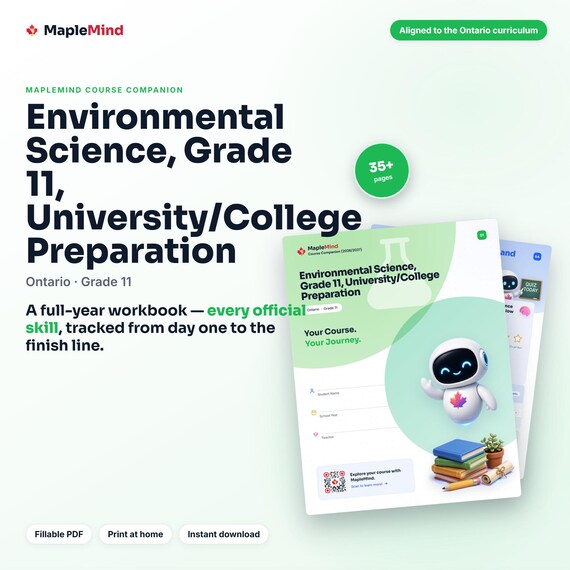
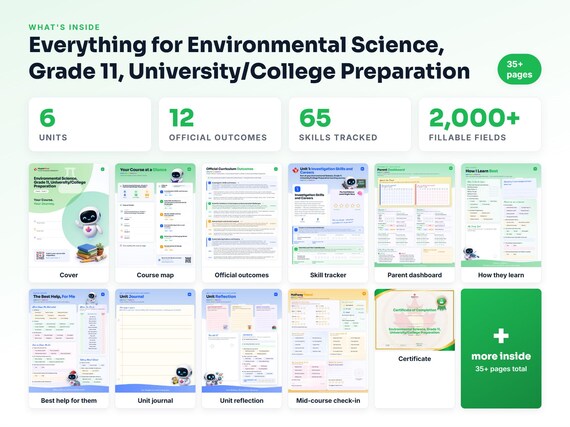
A Environmental Science, Grade 11, University/College Preparation workbook worth keeping
Built from the same official curriculum as this page. Before and after each skill above, your student colours in how sure they feel — so the two of you can see, on one page, what's clicking and what needs another look. It's a quiet way to follow how the year is really going.
By June it's full of their own handwriting: units worked through, confidence grown, a mid-year check-in, notes from parent-teacher night, and a certificate at the end. Less a worksheet, more a record of the year worth keeping on the shelf.
Instant download · see every page, reviews and the full description · five or more workbooks are $2.99 each
What it looks like in the app
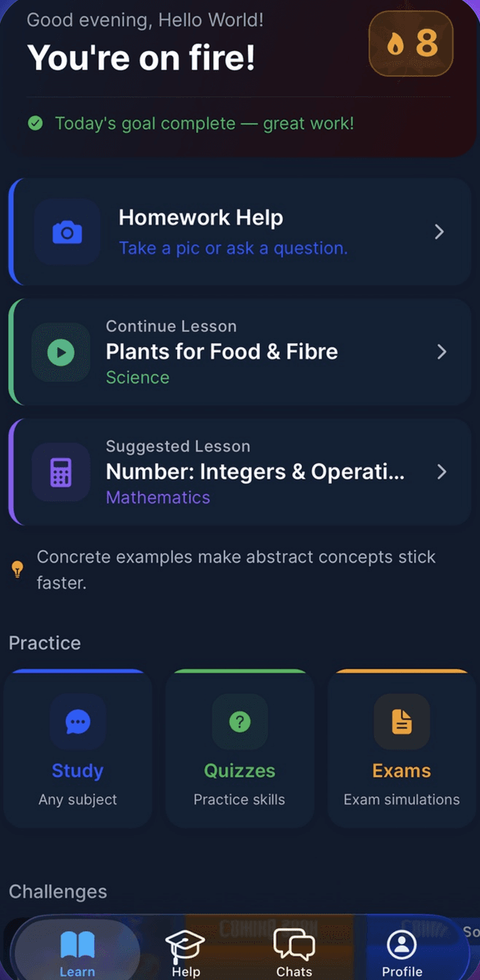

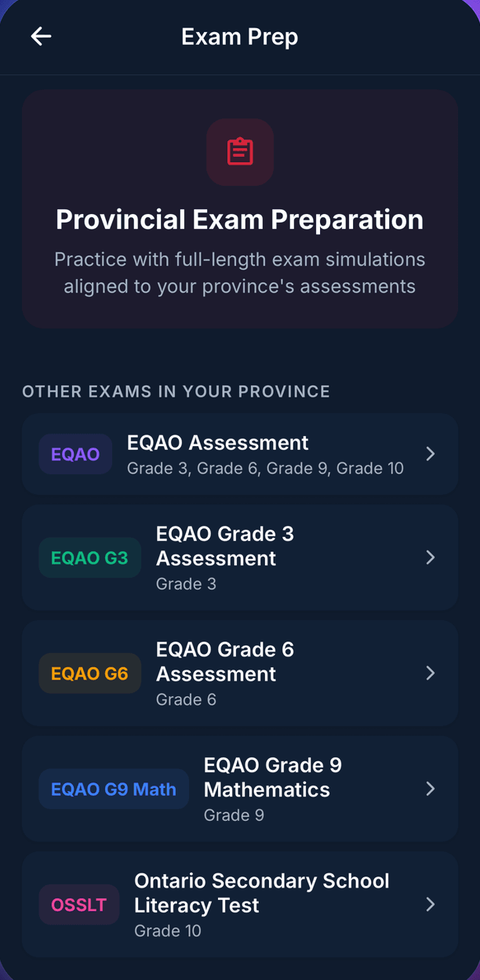
Common questions
Can MapleMind help me with Environmental Science, Grade 11, University/College Preparation?
Yes. MapleMind's AI tutor covers all 65 skills in Ontario's Environmental Science, Grade 11, University/College Preparation — you pick the exact skill, and the tutor teaches it step by step: a short lesson, a worked example, solving together, then a skill check to show it stuck.
Is MapleMind aligned to Ontario's official curriculum?
Yes. Every skill in this course maps to an official outcome code from Ontario's Grade 11 Science curriculum, and the ministry's own wording is quoted under each unit on this page — with the official government source linked so you can check it yourself.
What does MapleMind cost?
It's free to start — 5 tutoring chats and a practice quiz every day, no credit card. A Pro subscription ($9.99/month or $49.99/year CAD, 7-day free trial) unlocks unlimited tutoring, practice, and exam simulations.
What if I'm stuck on just one topic?
That's the point of skill-level tutoring: open Environmental Science, Grade 11, University/College Preparation in the app, tap the exact skill from the list on this page, and the tutor teaches just that — no wading through lessons you don't need.
Does MapleMind work in French or other languages?
Yes — 14 languages, including French. Both the app and the tutor's explanations switch to the language you choose.
Where can I see the official Ontario curriculum for Environmental Science, Grade 11, University/College Preparation?
The official source is linked on this page — Ontario's official science curriculum. The outline here follows it: every MapleMind skill carries its official outcome code, and the ministry's own wording is quoted under each unit.
Keep exploring
Ready when you are
Pick a skill from this page and see it taught properly — free, in the browser, in under a minute.