Get help with Biology, Grade 11, College Preparation
Most tutoring makes you sit through material you already know. MapleMind flips that: pick the exact skill that's causing trouble — any of the 58 below — and the tutor teaches just that one, step by step, as many times as it takes. Ask questions in plain words, any time of day, in English, French, or 12 other languages.
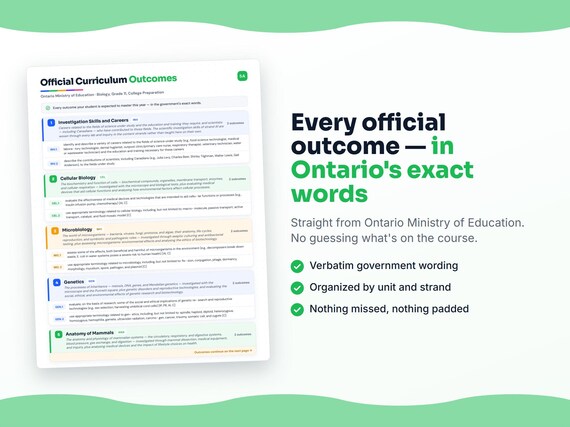
The official Ontario Biology, Grade 11, College Preparation curriculum
Ontario defines Biology, Grade 11, College Preparation by strands and outcomes. MapleMind teaches the same curriculum reorganized for one-skill-at-a-time tutoring — the table shows exactly where every official strand lands, and the ministry's own wording is quoted under each unit below.
Official source Ontario's official science curriculumRead it on the government site — dcp.edu.gov.on.ca ↗| Official strand | Outcomes | Where MapleMind teaches it |
|---|---|---|
| Strand A | 2 | Investigation Skills and Careers |
| Strand B | 11 | Cellular Biology |
| Strand C | 12 | Microbiology |
| Strand D | 11 | Genetics |
| Strand E | 10 | Anatomy of Mammals |
| Strand F | 12 | Plants in the Natural Environment |
Every skill below, taught one on one.
 Try the first session free
How MapleMind teaches Biology, Grade 11, College Preparation — every unit, lesson, and skill
Every skill below runs as a short session: a plain-words lesson, a worked example, solving it together, then a five-question skill check that earns up to three stars. Guided Mode keeps it teaching instead of answer-handing — turning it off needs a parent's password.
Unit 1Investigation Skills and CareersOfficial strand · Strand A
Careers related to the fields of science under study and the education and training they require, and scientists — including Canadians — who have contributed to those fields. The scientific investigation skills of strand A1 are woven through every lab and inquiry in the content strands rather than taught here on their own.
Careers in Applied Biology
- Careers in applied biologysbi3c.SBI3C.A2.1 — Identify and describe a variety of careers related to the fields of science under study and the education and training necessary for them.
Scientists and Their Contributions
- Scientists who contributed to biologysbi3c.SBI3C.A2.2 — Describe the contributions of scientists, including Canadians, to the fields under study.
The official wording — 2 outcomes in this unit
- sbi3c.SBI3C.A2.1
identify and describe a variety of careers related to the fields of science under study (e.g., food science technologist, medical labora- tory technologist, dental hygienist, outpost clinic/primary care nurse, respiratory therapist, veterinary technician, water or wastewater technician) and the education and training necessary for these careers
- sbi3c.SBI3C.A2.2
describe the contributions of scientists, including Canadians (e.g., Julia Levy, Charles Beer, Shirley Tilghman, Walter Lewis, Gail Anderson), to the fields under study
Unit 2Cellular BiologyOfficial strand · Strand B
The biochemistry and function of cells — biochemical compounds, organelles, membrane transport, enzymes, and cellular respiration — investigated with the microscope and biological tests, plus evaluating medical devices that aid cellular functions and analysing how environmental factors affect cellular processes.
Cells, Technology, and Environment
- Medical devices for cellular functionssbi3c.SBI3C.B1.1 — Evaluate the effectiveness of medical devices and technologies intended to aid cellular functions or processes.
- Environmental factors and cellssbi3c.SBI3C.B1.2 — Analyse the effects of environmental factors on cellular processes in the human body.
Investigating Cells and Biochemistry
- Cellular biology terminologysbi3c.SBI3C.B2.1 — Use appropriate terminology related to cellular biology.
- Factors affecting diffusionsbi3c.SBI3C.B2.2 — Investigate the effect of qualitative factors on the rate of diffusion of molecules across a plasma membrane.
- Microscopy and magnificationsbi3c.SBI3C.B2.3 — Identify visible organelles of a plant and animal cell under a light microscope, draw each accurately, and calculate the magnification.
- Investigating enzyme actionsbi3c.SBI3C.B2.4 — Investigate the effects of qualitative factors on the action of enzymes.
- Testing foods for biochemical compoundssbi3c.SBI3C.B2.5 — Conduct biological tests to identify biochemical compounds in food samples and compare the compounds found.
- Biochemical compoundssbi3c.SBI3C.B3.1 — Describe the structures and functions of important biochemical compounds — carbohydrates, proteins, enzymes, and lipids.
- Organelles and cellular processessbi3c.SBI3C.B3.2 — Explain the roles of various organelles in digestion, cellular respiration, and protein synthesis.
- Cellular respirationsbi3c.SBI3C.B3.3 — Explain the chemical changes and energy transformations of cellular respiration and compare reactants to products.
- Cellular processes in human systemssbi3c.SBI3C.B3.4 — Explain the importance of various cellular processes in human systems.
The official wording — 11 outcomes in this unit
- sbi3c.SBI3C.B1.1
evaluate the effectiveness of medical devices and technologies that are intended to aid cellu- lar functions or processes (e.g., insulin infusion pump, chemotherapy) [AI, C]
- sbi3c.SBI3C.B1.2
analyse the effects of environmental factors on cellular processes that occur in the human body (e.g., the effect of lead on nerve cells; the effect of electromagnetic radiation on brain cells) [AI, C]
- sbi3c.SBI3C.B2.1
use appropriate terminology related to cellular biology, including, but not limited to: macro- molecule, passive transport, active transport, catalyst, and fluid mosaic model [C]
- sbi3c.SBI3C.B2.2
investigate the effect of various qualitative factors (e.g., temperature) on the rate of diffu- sion of molecules across a plasma membrane [PR, AI]
- sbi3c.SBI3C.B2.3
using a light microscope, identify visible organelles of a plant cell in a wet mount and an animal cell from a prepared slide, produce an accurate labelled drawing of each cell, and calculate and properly express the magnification of each image [PR, AI, C]
- sbi3c.SBI3C.B2.4
investigate the effects of various qualitative factors on the action of enzymes (e.g., the effect of temperature or pH on the breakdown of starch by salivary enzymes) [PR, AI]
- sbi3c.SBI3C.B2.5
conduct biological tests to identify biochem- ical compounds found in various food samples (e.g., use a biuret solution to test for proteins in samples of gelatin and albumin), and compare the biochemical compounds found in each food to those found in the others [PR, AI]
- sbi3c.SBI3C.B3.1
describe the structures and functions of important biochemical compounds, including carbohydrates, proteins, enzymes, and lipids
- sbi3c.SBI3C.B3.2
explain the roles of various organelles, including lysosomes, vacuoles, mitochondria, cell membranes, ribosomes, the endoplasmic reticulum, and Golgi bodies, in the processes of digestion, cellular respiration, and protein synthesis
- sbi3c.SBI3C.B3.3
explain the chemical changes and energy transformations associated with the process of cellular respiration, and compare the reactants (i.e., glucose, oxygen) to the products (i.e., water, carbon dioxide, ATP)
- sbi3c.SBI3C.B3.4
explain the importance of various cellular processes in human systems (e.g., enzymes act as biological catalysts to regulate chemical processes in the cells of the digestive system)
Unit 3MicrobiologyOfficial strand · Strand C
The world of microorganisms — bacteria, viruses, fungi, protozoa, and algae, their anatomy, life cycles, reproduction, and symbiotic and pathogenic roles — investigated through aseptic culturing and antibacterial testing, plus assessing microorganisms' environmental effects and analysing the ethics of biotechnology.
Microorganisms, Environment, and Ethics
- Effects of microorganisms in the environmentsbi3c.SBI3C.C1.1 — Assess the beneficial and harmful effects of microorganisms in the environment.
- Ethics of microorganisms in biotechnologysbi3c.SBI3C.C1.2 — Analyse ethical issues related to the use of microorganisms in biotechnology.
Investigating Microorganisms
- Microbiology terminologysbi3c.SBI3C.C2.1 — Use appropriate terminology related to microbiology.
- Eukaryotic microorganism structuressbi3c.SBI3C.C2.2 — Compare and contrast the cell structures of eukaryotes such as fungi, protozoa, and algae.
- Culturing microorganismssbi3c.SBI3C.C2.3 — Prepare a laboratory culture of microorganisms on agar using proper aseptic techniques.
- Testing antibacterial agentssbi3c.SBI3C.C2.4 — Investigate the effect of antibacterial agents on different bacterial cultures.
- Conditions for microbial growthsbi3c.SBI3C.C2.5 — Investigate and analyse the conditions needed by microorganisms for growth.
- Anatomy of microorganismssbi3c.SBI3C.C3.1 — Describe the anatomy and morphology of various groups of microorganisms.
- Life cycles of microorganismssbi3c.SBI3C.C3.2 — Explain the differences between the life cycles of eukaryotic and prokaryotic microorganisms in terms of cell division.
- Microorganisms in symbiosissbi3c.SBI3C.C3.3 — Explain the vital roles of microorganisms in symbiotic relationships with other organisms.
- Reproduction in microorganismssbi3c.SBI3C.C3.4 — Explain the different methods of reproduction in various types of bacteria, viruses, and fungi.
- How microorganisms affect hostssbi3c.SBI3C.C3.5 — Describe how viruses, bacteria, and fungi affect host organisms and how those effects are treated or prevented.
The official wording — 12 outcomes in this unit
- sbi3c.SBI3C.C1.1
assess some of the effects, both beneficial and harmful, of microorganisms in the environment (e.g., decomposers break down waste, E. coli in water systems poses a severe risk to human health) [AI, C]
- sbi3c.SBI3C.C1.2
analyse ethical issues related to the use of microorganisms in biotechnology (e.g., with respect to the use of bacterial insecticides, the patenting of modified microorganisms) [AI, C]
- sbi3c.SBI3C.C2.1
use appropriate terminology related to microbiology, including, but not limited to: fis- sion, conjugation, phage, dormancy, morphology, mycelium, spore, pathogen, and plasmid [C]
- sbi3c.SBI3C.C2.2
compare and contrast the cell structures of eukaryotes such as fungi, protozoa, and algae [PR, AI]
- sbi3c.SBI3C.C2.3
prepare a laboratory culture of microorgan- isms (e.g., acidophilus) on agar, using proper aseptic techniques [PR]
- sbi3c.SBI3C.C2.4
investigate the effect of antibacterial agents on different bacterial cultures (e.g., the effects of antibacterial soap or mouthwash on a bacterial culture) [PR]
- sbi3c.SBI3C.C2.5
investigate and analyse the conditions (e.g., optimal temperature) needed by microorganisms for growth [PR, AI]
- sbi3c.SBI3C.C3.1
describe the anatomy and morphology of various groups of microorganisms (e.g., eukaryotes, prokaryotes, viruses)
- sbi3c.SBI3C.C3.2
explain the differences between the life cycles of eukaryotic and prokaryotic microorganisms in terms of cell division
- sbi3c.SBI3C.C3.3
explain the vital roles of microorganisms in symbiotic relationships with other organisms (e.g., gut bacteria in cows digest cellulose; mycorrhizal fungi penetrate and effectively extend a plant’s root system)
- sbi3c.SBI3C.C3.4
explain the different methods of reproduction in various types of bacteria, viruses, and fungi
- sbi3c.SBI3C.C3.5
describe how different viruses, bacteria, and fungi can affect host organisms, and how those effects are normally treated or prevented (e.g., hepatitis viruses can damage the liver, but vaccinations can prevent infections; streptococcus bacteria can cause respiratory infections, which are treated with antibiotics; ringworm is a fungal infection of the skin, treated with fungicides)
Unit 4GeneticsOfficial strand · Strand D
The processes of inheritance — meiosis, DNA, genes, and Mendelian genetics — investigated with the microscope and the Punnett square, plus genetic disorders and reproductive technologies, and evaluating the social, ethical, and environmental effects of genetic research and biotechnology.
Genetics, Ethics, and Environment
- Ethics of genetic researchsbi3c.SBI3C.D1.1 — Evaluate the social and ethical implications of genetic research and reproductive technologies.
- Environmental effects of biotechnologysbi3c.SBI3C.D1.2 — Evaluate the effects of genetic research and biotechnology on the environment.
Investigating Genetics
- Genetics terminologysbi3c.SBI3C.D2.1 — Use appropriate terminology related to genetics.
- Investigating meiosissbi3c.SBI3C.D2.2 — Investigate the process of meiosis using a microscope or simulation and draw biological diagrams of its phases.
- Solving monohybrid crossessbi3c.SBI3C.D2.3 — Solve basic genetics problems involving monohybrid crosses using the Punnett square method.
- Analysing cross datasbi3c.SBI3C.D2.4 — Compile and analyse data on monohybrid crosses through inquiry or simulation, and communicate the results.
- The process of meiosissbi3c.SBI3C.D3.1 — Explain the process of meiosis in terms of cell division and chromosome movement.
- DNA, genes, and inheritancesbi3c.SBI3C.D3.2 — Explain how DNA, genes, chromosomes, alleles, mitosis, and meiosis account for the transmission of hereditary characteristics.
- Genotype, phenotype, and inheritance patternssbi3c.SBI3C.D3.3 — Explain the concepts of genotype, phenotype, dominance, recessiveness, and sex linkage.
- Genetic disorderssbi3c.SBI3C.D3.4 — Describe genetic disorders caused by chromosomal abnormalities or other mutations.
- Reproductive technologiessbi3c.SBI3C.D3.5 — Describe reproductive technologies such as cloning, artificial insemination, and in vitro fertilization.
The official wording — 11 outcomes in this unit
- sbi3c.SBI3C.D1.1
evaluate, on the basis of research, some of the social and ethical implications of genetic re- search and reproductive technologies (e.g., sex selection, harvesting umbilical cord cells) [IP, PR, AI, C]
- sbi3c.SBI3C.D1.2
evaluate, on the basis of research, some of the effects of genetic research and biotechnol- ogy (e.g., genetically modified organisms [GMOs]) on the environment [IP, PR, AI, C]
- sbi3c.SBI3C.D2.1
use appropriate terminology related to gen- etics, including, but not limited to: spindle, haploid, diploid, heterozygous, homozygous, hemophilia, gamete, ultraviolet radiation, carcino- gen, cancer, trisomy, somatic cell, and zygote [C]
- sbi3c.SBI3C.D2.2
investigate the process of meiosis, using a microscope or computer simulation, and iden- tify, and draw biological diagrams of, the phases of meiosis [PR, C]
- sbi3c.SBI3C.D2.3
solve basic problems in genetics that involve monohybrid crosses, using the Punnett square method [AI, C]
- sbi3c.SBI3C.D2.4
compile and analyse qualitative and quanti- tative data, through laboratory inquiry or computer simulation, on monohybrid crosses, and communicate the results (e.g., record data obtained while performing a “virtual fly” lab, and analyse the results to create a karyotype chart) [PR, AI, C]
- sbi3c.SBI3C.D3.1
explain the process of meiosis in terms of cell division and the movement of chromosomes
- sbi3c.SBI3C.D3.2
explain how the concepts of DNA, genes, chromosomes, alleles, mitosis, and meiosis ac- count for the transmission of hereditary characteristics from generation to generation
- sbi3c.SBI3C.D3.3
explain the concepts of genotype, pheno- type, dominance, recessiveness, and sex linkage
- sbi3c.SBI3C.D3.4
describe some genetic disorders that are caused by chromosomal abnormalities (e.g., non-disjunction) or other genetic mutations
- sbi3c.SBI3C.D3.5
describe reproductive technologies such as cloning, artificial insemination, and in vitro fertilization
Unit 5Anatomy of MammalsOfficial strand · Strand E
The anatomy and physiology of mammalian systems — the circulatory, respiratory, and digestive systems, blood pressure, gas exchange, and digestion — investigated through mammal dissection, medical equipment, and inquiry, plus analysing medical devices and the impact of lifestyle choices on health.
Body Systems, Devices, and Lifestyle
- Medical devices for body systemssbi3c.SBI3C.E1.1 — Analyse the social or economic impact of a medical device related to the circulatory, respiratory, or digestive system.
- Lifestyle choices and healthsbi3c.SBI3C.E1.2 — Analyse the impact of various lifestyle choices on human health and body systems.
Investigating Mammal Anatomy
- Animal anatomy terminologysbi3c.SBI3C.E2.1 — Use appropriate terminology related to animal anatomy.
- Monitoring a human systemsbi3c.SBI3C.E2.2 — Use medical equipment to monitor a human system and interpret the data collected.
- Inquiry into body variablessbi3c.SBI3C.E2.3 — Plan and conduct an inquiry to determine the effects of specific variables on the human body.
- Dissecting a mammalsbi3c.SBI3C.E2.4 — Perform a dissection of a mammal to identify organs and explain the relationships between structures and functions of body systems.
- The circulatory systemsbi3c.SBI3C.E3.1 — Describe the anatomy and physiology of the circulatory system, the mechanisms of blood pressure, and the function of the spleen.
- The respiratory systemsbi3c.SBI3C.E3.2 — Describe the anatomy and physiology of the respiratory system and the mechanisms of gas exchange and respiration.
- The digestive systemsbi3c.SBI3C.E3.3 — Describe the anatomy and physiology of the digestive system, the mechanisms of digestion, and the function of the kidneys.
- Interaction of body systemssbi3c.SBI3C.E3.4 — Explain the mechanisms of interaction between a mammal's different body systems.
The official wording — 10 outcomes in this unit
- sbi3c.SBI3C.E1.1
analyse the social or economic impact of a medical device or technology related to the treatment of the human circulatory, respiratory, or digestive system (e.g., a pacemaker, a heart- lung bypass machine, kidney dialysis) [AI, C]
- sbi3c.SBI3C.E1.2
analyse the impact of various lifestyle choices on human health and body systems (e.g., the impact of excessive alcohol consumption on the liver; of smoking on the respiratory system; of loud noise on the auditory system)
- sbi3c.SBI3C.E2.1
use appropriate terminology related to animal anatomy, including, but not limited to: systolic contraction, diastolic pressure, diffusion gradient, inhalation, exhalation, coronary, cardiac, ulcer, asthma, and constipation [C]
- sbi3c.SBI3C.E2.2
use medical equipment (e.g., a stethoscope, a sphygmomanometer) to monitor a human system, and interpret the data collected [PR, AI]
- sbi3c.SBI3C.E2.3
plan and conduct an inquiry to determine the effects of specific variables on the human body (e.g., the effects of exercise and rest on heart rates) [IP, PR, AI]
- sbi3c.SBI3C.E2.4
perform a laboratory or computer-simulated dissection of a mammal to identify organs, and explain the relationships between the structures and functions of body systems [PR, AI]
- sbi3c.SBI3C.E3.1
describe the anatomy and physiology of the circulatory system (including the atrium, ven- tricles, valves, aorta, pulmonary artery, vena cava, capillaries, veins, arteries, blood cells, and platelets), the mechanisms of blood pressure, and the function of the spleen
- sbi3c.SBI3C.E3.2
describe the anatomy and physiology of the respiratory system (including the nasal cavity, trachea, larynx, bronchi, bronchioles, alveoli, and oxygenated and deoxygenated blood) and the mechanisms of gas exchange and respiration
- sbi3c.SBI3C.E3.3
describe the anatomy and physiology of the digestive system (including the mouth, epiglottis, esophagus, stomach, intestines, liver, and pancreas), the mechanisms of peristalsis, absorption, and mechanical and chemical digestion, and the function of the kidneys
- sbi3c.SBI3C.E3.4
explain some of the mechanisms of inter- action between a mammal’s different body systems (e.g., the exchange of oxygen and car- bon dioxide between the respiratory and circulatory systems)
Unit 6Plants in the Natural EnvironmentOfficial strand · Strand F
The structure, growth, and ecological role of plants — specialized tissues, photosynthesis, reproduction, tropism, and their role in sustaining the natural environment — investigated through propagation and growth inquiries, plus analysing how plants sustain ecosystems and assessing human impact on plants.
Plants and the Environment
- Plants sustaining ecosystemssbi3c.SBI3C.F1.1 — Analyse and report on ways in which plants can be used to sustain ecosystems.
- Human impact on plantssbi3c.SBI3C.F1.2 — Assess the positive and negative impact of human activities on the natural balance of plants.
Investigating Plant Growth and Function
- Plant terminologysbi3c.SBI3C.F2.1 — Use appropriate terminology related to plants in the environment.
- Plant propagation techniquessbi3c.SBI3C.F2.2 — Investigate various techniques of plant propagation.
- Factors affecting plant growthsbi3c.SBI3C.F2.3 — Investigate how chemical compounds and physical factors affect plant growth.
- Investigating plant tropismsbi3c.SBI3C.F2.4 — Investigate plant tropism by growing and observing plants in various environments.
- Specialized plant tissuessbi3c.SBI3C.F3.1 — Describe the structure and physiology of specialized plant tissues involved in conduction, support, storage, and photosynthesis.
- Photosynthesissbi3c.SBI3C.F3.2 — Explain the chemical changes and energy transformations of photosynthesis and compare reactants to products.
- Plant reproductionsbi3c.SBI3C.F3.3 — Compare the various means of sexual and asexual reproduction in plants.
- Plants and environmental sustainabilitysbi3c.SBI3C.F3.4 — Explain the various roles of plants in the sustainability of the natural environment.
- Plant structure and environmentsbi3c.SBI3C.F3.5 — Explain the relationship between a plant's structure and its environment, and describe adaptive attributes causing natural variation.
- The role of plant tropismsbi3c.SBI3C.F3.6 — Explain the role of plant tropism in a plant's survival.
The official wording — 12 outcomes in this unit
- sbi3c.SBI3C.F1.1
analyse, on the basis of research, and report on ways in which plants can be used to sustain ecosystems [IP, PR, AI, C]
- sbi3c.SBI3C.F1.2
assess the positive and negative impact of human activities on the natural balance of plants (e.g., crop rotation, the use of fertilizers and herbicides, the introduction of new species) [AI, C]
- sbi3c.SBI3C.F2.1
use appropriate terminology related to plants in the environment, including, but not limited to: xylem, phloem, chloroplast, pistil, sta- men, nitrogen fixation, and tropism [C]
- sbi3c.SBI3C.F2.2
investigate various techniques of plant propagation (e.g., leaf cutting, stem cutting, root cutting, seed germination, traditional Aboriginal practices) [PR]
- sbi3c.SBI3C.F2.3
investigate how chemical compounds (e.g., fertilizers, herbicides, pesticides) and physical factors (e.g., amount of sun and water, quality of soil, pH of soil) affect plant growth [PR, AI]
- sbi3c.SBI3C.F2.4
investigate plant tropism by growing and observing plants in a variety of natural and human-made environments [PR]
- sbi3c.SBI3C.F3.1
describe the structure and physiology of the specialized plant tissues involved in conduc- tion, support, storage, and photosynthesis
- sbi3c.SBI3C.F3.2
explain the chemical changes and energy transformations associated with the process of photosynthesis, and compare the reactants (i.e., carbon dioxide, radiant energy, water) to the products (i.e., glucose, oxygen)
- sbi3c.SBI3C.F3.3
compare the various means of sexual reproduc- tion (e.g., pollination) and asexual reproduction (e.g., grafting, vegetative propagation, cloning) in plants
- sbi3c.SBI3C.F3.4
explain the various roles of plants in the sus- tainability of the natural environment (e.g., in nutrient cycles, in the water cycle, in erosion control, in wildlife habitats)
- sbi3c.SBI3C.F3.5
explain the relationship between the struc- ture of a plant and its external environment, and describe the adaptive attributes that result in natural variation in plant structure (e.g., environmental variables cause variation in leaves within a single plant; in the Arctic, the wild crocus grows close to the ground and is covered with fine hairs)
- sbi3c.SBI3C.F3.6
explain the role of plant tropism (e.g., response to stimuli such as light, gravity, and humidity) in a plant’s survival


Printable workbook · A keepsake of the year
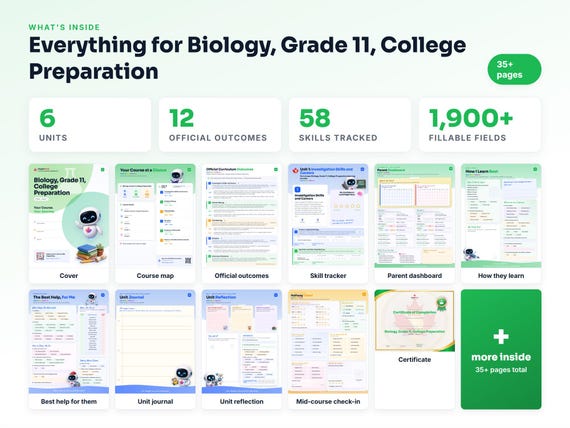
A Biology, Grade 11, College Preparation workbook worth keeping
Built from the same official curriculum as this page. Before and after each skill above, your student colours in how sure they feel — so the two of you can see, on one page, what's clicking and what needs another look. It's a quiet way to follow how the year is really going.
By June it's full of their own handwriting: units worked through, confidence grown, a mid-year check-in, notes from parent-teacher night, and a certificate at the end. Less a worksheet, more a record of the year worth keeping on the shelf.
Instant download · see every page, reviews and the full description · five or more workbooks are $2.99 each
What it looks like in the app



Common questions
Can MapleMind help me with Biology, Grade 11, College Preparation?
Yes. MapleMind's AI tutor covers all 58 skills in Ontario's Biology, Grade 11, College Preparation — you pick the exact skill, and the tutor teaches it step by step: a short lesson, a worked example, solving together, then a skill check to show it stuck.
Is MapleMind aligned to Ontario's official curriculum?
Yes. Every skill in this course maps to an official outcome code from Ontario's Grade 11 Science curriculum, and the ministry's own wording is quoted under each unit on this page — with the official government source linked so you can check it yourself.
What does MapleMind cost?
It's free to start — 5 tutoring chats and a practice quiz every day, no credit card. A Pro subscription ($9.99/month or $49.99/year CAD, 7-day free trial) unlocks unlimited tutoring, practice, and exam simulations.
What if I'm stuck on just one topic?
That's the point of skill-level tutoring: open Biology, Grade 11, College Preparation in the app, tap the exact skill from the list on this page, and the tutor teaches just that — no wading through lessons you don't need.
Does MapleMind work in French or other languages?
Yes — 14 languages, including French. Both the app and the tutor's explanations switch to the language you choose.
Where can I see the official Ontario curriculum for Biology, Grade 11, College Preparation?
The official source is linked on this page — Ontario's official science curriculum. The outline here follows it: every MapleMind skill carries its official outcome code, and the ministry's own wording is quoted under each unit.
Keep exploring
Ready when you are
Pick a skill from this page and see it taught properly — free, in the browser, in under a minute.