Get help with Earth and Space Science, Grade 12, University Preparation
Most tutoring makes you sit through material you already know. MapleMind flips that: pick the exact skill that's causing trouble — any of the 88 below — and the tutor teaches just that one, step by step, as many times as it takes. Ask questions in plain words, any time of day, in English, French, or 12 other languages.
The official Ontario Earth and Space Science, Grade 12, University Preparation curriculum
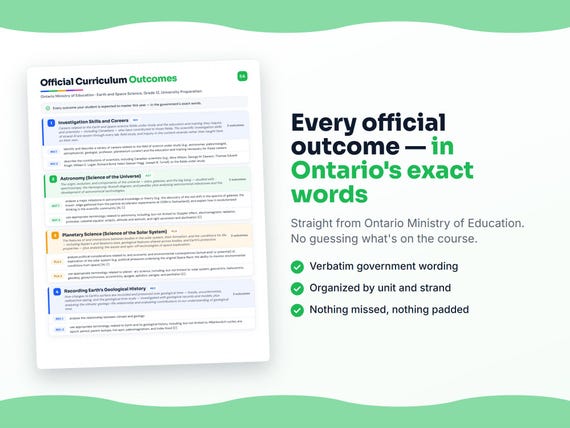
Ontario defines Earth and Space Science, Grade 12, University Preparation by strands and outcomes. MapleMind teaches the same curriculum reorganized for one-skill-at-a-time tutoring — the table shows exactly where every official strand lands, and the ministry's own wording is quoted under each unit below.
Official source Ontario's official science curriculumRead it on the government site — dcp.edu.gov.on.ca ↗| Official strand | Outcomes | Where MapleMind teaches it |
|---|---|---|
| Strand A | 2 | Investigation Skills and Careers |
| Strand B | 15 | Astronomy (Science of the Universe) |
| Strand C | 17 | Planetary Science (Science of the Solar System) |
| Strand D | 16 | Recording Earth's Geological History |
| Strand E | 15 | Earth Materials |
| Strand F | 20 | Geological Processes |
Every skill below, taught one on one.
 Try the first session free
How MapleMind teaches Earth and Space Science, Grade 12, University Preparation — every unit, lesson, and skill
Every skill below runs as a short session: a plain-words lesson, a worked example, solving it together, then a five-question skill check that earns up to three stars. Guided Mode keeps it teaching instead of answer-handing — turning it off needs a parent's password.
Unit 1Investigation Skills and CareersOfficial strand · Strand A
Careers related to the Earth and space science fields under study and the education and training they require, and scientists — including Canadians — who have contributed to those fields. The scientific investigation skills of strand A1 are woven through every lab, field study, and inquiry in the content strands rather than taught here on their own.
Careers in Earth and Space Science
- Careers in Earth and space scienceses4u.SES4U.A2.1 — Identify and describe a variety of careers related to the fields of science under study and the education and training necessary for them.
Scientists and Their Contributions
- Scientists who contributed to Earth and space scienceses4u.SES4U.A2.2 — Describe the contributions of scientists, including Canadians, to the fields under study.
The official wording — 2 outcomes in this unit
- ses4u.SES4U.A2.1
identify and describe a variety of careers related to the field of science under study (e.g., astronomer, paleontologist, astrophysicist, geologist, professor, planetarium curator) and the education and training necessary for these careers
- ses4u.SES4U.A2.2
describe the contributions of scientists, including Canadian scientists (e.g., Alice Wilson, George M. Dawson, Thomas Edvard Krogh, William E. Logan, Richard Bond, Helen Sawyer Hogg, Joseph B. Tyrrell), to the fields under study
Unit 2Astronomy (Science of the Universe)Official strand · Strand B
The origin, evolution, and components of the universe — stars, galaxies, and the big bang — studied with spectroscopy, the Hertzsprung-Russell diagram, and parallax, plus analysing astronomical milestones and the development of astronomical technologies.
Milestones and Tools of Astronomy
- Analysing an astronomical milestoneses4u.SES4U.B1.1 — Analyse a major milestone in astronomical knowledge or theory and explain how it revolutionized scientific thinking.
- Development of an astronomy technologyses4u.SES4U.B1.2 — Analyse why and how a technology related to astronomical research was developed and improved over time.
Investigating the Universe
- Astronomy terminologyses4u.SES4U.B2.1 — Use appropriate terminology related to astronomy.
- Locating features of the night skyses4u.SES4U.B2.2 — Locate observable features of the night sky and record their location using astronomical terms and systems.
- Analysing spectroscopic datases4u.SES4U.B2.3 — Analyse spectroscopic data mathematically or graphically to determine the properties of stars.
- Using the Hertzsprung-Russell diagramses4u.SES4U.B2.4 — Use the Hertzsprung-Russell diagram to determine the interrelationships between the properties of stars and investigate their evolution.
- Investigating properties of starsses4u.SES4U.B2.5 — Investigate, in quantitative terms, properties of stars including distance, surface temperature, absolute magnitude, and luminosity.
- Investigating galaxiesses4u.SES4U.B2.6 — Investigate, using photographs or diagrams, the basic features of different types of galaxies.
- The big bang theoryses4u.SES4U.B3.1 — Describe the theoretical and evidential underpinnings of the big bang theory and their implications for the evolution of the universe.
- The scale of cosmic distancesses4u.SES4U.B3.2 — Explain the scale of distances between celestial bodies and the methods astronomers use to determine them.
- Electromagnetic radiation in astronomyses4u.SES4U.B3.3 — Describe the characteristics of electromagnetic radiation and how each region of the spectrum is used in astronomical observations.
- Classifying starsses4u.SES4U.B3.4 — Explain how stars are classified on the basis of surface temperature, luminosity, and chemical composition.
- Determining stellar propertiesses4u.SES4U.B3.5 — Explain, with reference to a specific star, how astronomers use techniques to determine the properties of stars.
- The life cycle of a starses4u.SES4U.B3.6 — Describe the sequence of events in the life cycle of a star, with reference to the energy sources and forces involved.
- How stars dieses4u.SES4U.B3.7 — Explain the relationship between the type of death of a star and the star's initial mass.
The official wording — 15 outcomes in this unit
- ses4u.SES4U.B1.1
analyse a major milestone in astronomical knowledge or theory (e.g., the discovery of the red shift in the spectra of galaxies; the knowl- edge gathered from the particle accelerator experiments at CERN in Switzerland), and explain how it revolutionized thinking in the scientific community [AI, C]
- ses4u.SES4U.B1.2
analyse why and how a particular technology related to astronomical research was developed and how it has been improved over time (e.g., the evolution from optical to radio tele- scopes and to the Hubble telescope) [AI, C]
- ses4u.SES4U.B2.1
use appropriate terminology related to astronomy, including, but not limited to: Doppler effect, electromagnetic radiation, protostar, celestial equator, ecliptic, altitude and azimuth, and right ascension and declination [C]
- ses4u.SES4U.B2.2
locate observable features of the night sky using star charts, computer models, or direct observation, and record the location of these features using astronomical terms (e.g., celestial equator, ecliptic) and systems (e.g., altitude and azimuth, right ascension and declination) [PR, C]
- ses4u.SES4U.B2.3
analyse spectroscopic data mathematically or graphically to determine various properties of stars (e.g., determine surface temperature from peak wavelength using Wein’s law; predict chemical composition from spectral absorption lines; determine motion using the Doppler effect) [AI, C]
- ses4u.SES4U.B2.4
use the Hertzsprung-Russell diagram to determine the interrelationships between the properties of stars (e.g., between mass and luminosity, between colour and luminosity) and to investigate their evolutionary pathways [PR, AI]
- ses4u.SES4U.B2.5
investigate, in quantitative terms, properties of stars, including their distance from Earth (using the parallax method), surface temper- ature, absolute magnitude, and luminosity [PR, AI]
- ses4u.SES4U.B2.6
investigate, using photographs or diagrams, the basic features of different types of galaxies (e.g., elliptical, spiral, barred spiral, irregular, peculiar), including the Milky Way [PR]
- ses4u.SES4U.B3.1
describe the theoretical and evidential underpinnings of the big bang theory (e.g., the theory that cosmic microwave background radiation is an echo of the big bang; physical evidence of the mass of the universe, and the relationship between mass and gravity) and their implications for the evolution of the universe
- ses4u.SES4U.B3.2
explain the scale of distances between celestial bodies (e.g., with reference to astronomical units, light years, and parsecs) and the methods astronomers use to determine these distances (e.g., stellar parallax, cepheid variables)
- ses4u.SES4U.B3.3
describe the characteristics of electromagnetic radiation (e.g., the relationship between wave- length, frequency, and energy) and the ways in which each region of the electromagnetic spectrum is used in making astronomical observations (e.g., X-rays in the search for black holes; infrared radiation to see through interstellar dust)
- ses4u.SES4U.B3.4
explain how stars are classified on the basis of their surface temperature, luminosity, and chemical composition
- ses4u.SES4U.B3.5
explain, with reference to a specific star (e.g., Rigel, Sirius, Arcturus), how astronomers use techniques to determine the properties of stars (e.g., mass, diameter, magnitude, temperature, luminosity)
- ses4u.SES4U.B3.6
describe the sequence of events in the life cycle of a star, from its formation to the main sequence phase and beyond, with specific reference to energy sources and forces involved
- ses4u.SES4U.B3.7
explain the relationship between the type of death of a star and the star’s initial mass (e.g., a star with a low mass will form a planetary nebula and a white dwarf)
Unit 3Planetary Science (Science of the Solar System)Official strand · Strand C
The features of and interactions between bodies in the solar system, their formation, and the conditions for life — including Kepler's and Newton's laws, geological features shared across bodies, and Earth's protective properties — plus analysing the issues and spin-off technologies of space exploration.
Exploring the Solar System
- Issues of space explorationses4u.SES4U.C1.1 — Analyse political considerations and the economic and environmental consequences of exploration of the solar system.
- Space technology with other applicationsses4u.SES4U.C1.2 — Analyse a specific technology used in space exploration that has applications in other areas, and communicate the findings.
Investigating the Solar System
- Planetary science terminologyses4u.SES4U.C2.1 — Use appropriate terminology related to planetary science.
- Effects of radiation in the solar systemses4u.SES4U.C2.3 — Investigate the effects of various forms of radiation and high-energy particles on bodies, organisms, and devices in the solar system.
- Interactions shaping the solar systemses4u.SES4U.C2.4 — Investigate the ways interactions between solid bodies have helped shape the solar system, including Earth.
- Earth's protective propertiesses4u.SES4U.C2.5 — Investigate the properties of Earth that protect life from hazards such as radiation and collision.
- Techniques for studying solar-system objectsses4u.SES4U.C2.6 — Investigate techniques used to study and understand objects in the solar system.
- Composition of the solar systemses4u.SES4U.C3.1 — Explain the composition of the solar system and describe the characteristics of each component.
- Classes of objects orbiting the sunses4u.SES4U.C3.2 — Identify and explain the classes of objects orbiting the sun.
- Formation of the solar systemses4u.SES4U.C3.3 — Explain the formation of the solar system with reference to the fundamental forces and processes involved.
- Factors determining planetary propertiesses4u.SES4U.C3.4 — Identify the factors that determined the properties of bodies in the solar system.
- Conditions for life beyond Earthses4u.SES4U.C3.5 — Identify and explain the properties of celestial bodies, other than Earth, that might support life.
- Comparing Earth with other bodiesses4u.SES4U.C3.6 — Compare Earth with other objects in the solar system with respect to properties such as mass, size, composition, rotation, and fields.
- Kepler's lawsses4u.SES4U.C3.7 — Identify Kepler's laws and use them to describe planetary motions.
- Newton's laws and planetary motionses4u.SES4U.C3.8 — Identify Newton's laws and use them to explain planetary motion.
- External processes affecting Earthses4u.SES4U.C3.9 — Describe the major external processes and phenomena that affect Earth.
The official wording — 17 outcomes in this unit
- ses4u.SES4U.C1.1
analyse political considerations related to, and economic and environmental consequences (actual and/ or potential) of, exploration of the solar system (e.g., political pressures underlying the original Space Race; the ability to monitor environmental conditions from space) [AI, C]
- ses4u.SES4U.C1.2
analyse, on the basis of research, a specific technology that is used in space exploration and that has applications in other areas of re- search or in the environmental sector (e.g., Canadian satellites and robotics, spacecraft technologies, ground base and orbital tele- scopes, devices to mitigate the effects of the space environment on living organisms), and communicate their findings [IP, PR, AI, C]
- ses4u.SES4U.C2.1
use appropriate terminology related to planet- ary science, including, but not limited to: solar system, geocentric, heliocentric, geodesy, geosynchronous, eccentricity, apogee, aphelion, perigee, and perihelion [C]
- ses4u.SES4U.C2.2
identify geological features and processes that are common to Earth and other bodies in the solar system (e.g., craters, faults, volcanic eruptions), and create a model or illustration to show these features, using data and images from satellites and space probes [PR, AI, C]
- ses4u.SES4U.C2.3
use an inquiry or research process to investi- gate the effects of various forms of radiation and high-energy particles on bodies, organisms, and devices within the solar system (e.g., the effects of cosmic rays on atmospheric phenom- ena, of ultraviolet light on human and animal eyes and skin, of solar wind on radio communi- cations) [IP, PR]
- ses4u.SES4U.C2.4
investigate the ways in which interactions between solid bodies have helped to shape the solar system, including Earth (e.g., the accretion of minor bodies, the formation of moons, the formation of planetary rings) [PR]
- ses4u.SES4U.C2.5
investigate the properties of Earth that pro- tect life from hazards such as radiation and collision with other bodies (e.g., Earth’s orbital position helps protect it from asteroids, some of which are deflected by the Jovian planets; Earth’s magnetic field protects the planet from solar wind; atmospheric ozone minimizes in- coming ultraviolet radiation) [PR]
- ses4u.SES4U.C2.6
investigate techniques used to study and understand objects in the solar system (e.g., the measurement of gravitational pull on space probes to determine the mass of an object, the use of spectroscopy to study atmospheric com- positions, the use of the global positioning system to track plate movement and tectonic activity from space) [PR]
- ses4u.SES4U.C3.1
explain the composition of the solar system (e.g., the sun, terrestrial inner planets, the asteroid belt, gas giant outer planets, the Kuiper belt, the scattered disc, the heliopause, the Oort cloud), and describe the characteristics of each component
- ses4u.SES4U.C3.2
identify and explain the classes of objects orbiting the sun (e.g., planets, dwarf planets, small solar system bodies [SSSBs])
- ses4u.SES4U.C3.3
explain the formation of the solar system with reference to the fundamental forces and processes involved (e.g., how gravitational force led to the contraction of the original solar nebula)
- ses4u.SES4U.C3.4
identify the factors that determined the properties of bodies in the solar system (e.g., differences in distance from the sun result in temperature variations that determine whether substances on a planet, moon, or other body are solid or gaseous)
- ses4u.SES4U.C3.5
identify and explain the properties of celes- tial bodies within or beyond the solar system, other than Earth, that might support the exist- ence of life (e.g., the possible existence of liquid water on Europa; the proximity of a body to its host star)
- ses4u.SES4U.C3.6
compare Earth with other objects in the solar system with respect to properties such as mass, size, composition, rotation, magnetic field, and gravitational field
- ses4u.SES4U.C3.7
identify Kepler’s laws, and use them to describe planetary motions (e.g., the shape of their orbits; differences in their orbital velocity)
- ses4u.SES4U.C3.8
identify Newton’s laws, and use them to explain planetary motion
- ses4u.SES4U.C3.9
describe the major external processes and phenomena that affect Earth (e.g., radiation and particles from the “quiet” and “active” sun; cosmic rays; gravity of the sun and moon; asteroidal and cometary debris, including their force, energy, and matter)
Unit 4Recording Earth's Geological HistoryOfficial strand · Strand D
How changes to Earth's surface are recorded and preserved over geological time — fossils, unconformities, radioactive dating, and the geological time scale — investigated with geological records and models, plus analysing the climate-geology-life relationship and evaluating contributions to our understanding of geological time.
Climate, Geology, and Geological Time
- The climate-geology relationshipses4u.SES4U.D1.1 — Analyse the relationship between climate and geology.
- Climate change and life over geological timeses4u.SES4U.D1.1 — Using geological records, assess the impact of long-term climate change on life on Earth.
- Contributions to understanding geological timeses4u.SES4U.D1.2 — Evaluate the significance of contributions, including Canadian contributions, to our understanding of geological time and changes in Earth systems.
Reading the Geological Record
- Geological history terminologyses4u.SES4U.D2.1 — Use appropriate terminology related to Earth and its geological history.
- Geological history of an Ontario areases4u.SES4U.D2.2 — Use a research process to investigate the geological history of an area in Ontario.
- Evidence of major changes in Earth historyses4u.SES4U.D2.3 — Investigate various types of preserved geological evidence of major changes in Earth history.
- Geological versus human time scalesses4u.SES4U.D2.4 — Produce a model or diagram to illustrate how geological time scales compare to human time scales.
- Unconformitiesses4u.SES4U.D2.5 — Produce diagrams to illustrate the development of various types of unconformities in a sequence of strata.
- Modelling radioactive decayses4u.SES4U.D2.6 — Design and build a model to represent radioactive decay and the concept of half-life determination.
- Interacting processes over Earth historyses4u.SES4U.D2.7 — Investigate interactions between physical, chemical, and biological processes and explain how they affected environmental conditions over Earth history.
- Evolution of life through the erasses4u.SES4U.D3.1 — Describe evidence for the evolution of life through the Proterozoic, Paleozoic, Mesozoic, and Cenozoic eras using key fossils.
- Evidence of a changing Earthses4u.SES4U.D3.2 — Describe evidence that life forms, climate, continental positions, and Earth's crust have changed over time.
- How fossils formses4u.SES4U.D3.3 — Describe some processes by which fossils are produced or preserved.
- Relative and absolute datingses4u.SES4U.D3.4 — Compare and contrast relative and absolute dating principles and techniques as they apply to natural systems.
- Isotopic age determinationses4u.SES4U.D3.5 — Identify and describe methods of isotopic age determination, giving the isotope, half-life, dating range, and materials for each.
- Paradigm shifts in geologyses4u.SES4U.D3.6 — Explain the influence of paradigm shifts in the development of geological thinking.
- Determining the age of Earthses4u.SES4U.D3.7 — Explain the types of evidence used to determine the age of Earth and how they influenced our understanding.
The official wording — 16 outcomes in this unit
- ses4u.SES4U.D1.1
analyse the relationship between climate and geology
- ses4u.SES4U.D1.2
evaluate the significance of contributions, including Canadian contributions, to our under- standing of geological time and of changes in Earth systems over time (e.g., the contributions of Raymond A. Price; the Canadian contribution to the development of Landsat) [AI, C]
- ses4u.SES4U.D2.1
use appropriate terminology related to Earth and its geological history, including, but not limited to: Milankovitch cycles, era, epoch, period, parent isotope, hot spot, paleomagnetism, and index fossil [C]
- ses4u.SES4U.D2.2
use a research process to investigate the geo- logical history of an area in Ontario (e.g., use a sequence diagram, geological maps showing main geological units or associated rock types, and/or surficial/bedrock geology maps to investigate the Oak Ridges Moraine or Niagara Escarpment) [IP, PR]
- ses4u.SES4U.D2.3
investigate various types of preserved geo- logical evidence of major changes that have taken place in Earth history (e.g., fossil evidence of mass extinctions, topographic evidence of past glaciations, evidence of plate movement in igneous rocks with magnetic reversals) [PR]
- ses4u.SES4U.D2.4
produce a model or diagram to illustrate how geological time scales compare to human time scales (e.g., major events in Earth’s geo- logical history or the geological history of their region compared to major events in human history or students’ own lifespans) [PR, C]
- ses4u.SES4U.D2.5
produce diagrams to illustrate the develop- ment of various types of unconformities preserved in a sequence of strata (e.g., angular unconformity, disconformity, nonconformity) [PR, C]
- ses4u.SES4U.D2.6
design and build a model to represent radioactive decay and the concept of half-life determination [IP, PR]
- ses4u.SES4U.D2.7
investigate interactions over time between physical, chemical, and biological processes, and explain how they have affected environmental conditions throughout Earth’s geological history (e.g., the impact of increasing amounts of atmospheric oxygen on stromatolites; the impact of increasing amounts of atmospheric carbon dioxide on global warming; the influence of plants on the water cycle, other life forms, the atmosphere, weathering, and erosion) [PR, AI, C]
- ses4u.SES4U.D3.1
describe evidence for the evolution of life through the Proterozoic, Paleozoic, Mesozoic, and Cenozoic eras, using important groups of fossils that date from each era (e.g., stromatolites, trilobites, brachiopods, crinoids, fish, angio- sperms, gymnosperms, dinosaurs, mammals)
- ses4u.SES4U.D3.2
describe various kinds of evidence that life forms, climate, continental positions, and Earth’s crust have changed over time (e.g., evidence of mass extinction, of past glaciations, of the existence of Pangaea and Gondwanaland)
- ses4u.SES4U.D3.3
describe some processes by which fossils are produced and/or preserved (e.g., original preservation, carbonization, replacement, permineralization, mould and cast formations)
- ses4u.SES4U.D3.4
compare and contrast relative and absolute dating principles and techniques as they apply to natural systems (e.g., the law of superposition; the law of cross-cutting relationships; varve counts; carbon-14 or uranium-lead dating)
- ses4u.SES4U.D3.5
identify and describe the various methods of isotopic age determination, giving for each the name of the isotope, its half-life, its effective dating range, and some of the materials that it can be used to date (e.g., uranium-lead dating of rocks; carbon dating of organic materials)
- ses4u.SES4U.D3.6
explain the influence of paradigm shifts (e.g., from uniformitarianism to catastrophism) in the development of geological thinking
- ses4u.SES4U.D3.7
explain the different types of evidence used to determine the age of Earth (e.g., index fossils; evidence provided by radiometric dating of geological materials or lithostratigraphy) and how this evidence has influenced our under- standing of the age of the planet
Unit 5Earth MaterialsOfficial strand · Strand E
The properties of minerals and the formation and characteristics of rocks — the three rock classes, mineral identification tests, and crystal growth — investigated with the hand lens and streak plate, plus assessing the economic impact of Earth-material extraction and analysing exploration and extraction technologies.
Exploring and Extracting Earth Materials
- Economic impact of Earth materialsses4u.SES4U.E1.1 — Assess the direct and indirect impact on economies of the exploration for, extraction, and processing of Earth materials.
- Analysing exploration and extraction technologiesses4u.SES4U.E1.2 — Analyse technologies and techniques used to explore for and extract natural resources.
- Environmental repercussions of extractionses4u.SES4U.E1.2 — Assess the actual or potential environmental repercussions of technologies used to explore for and extract natural resources.
Investigating Minerals and Rocks
- Earth materials terminologyses4u.SES4U.E2.1 — Use appropriate terminology related to Earth materials.
- Properties and uses of Earth materialsses4u.SES4U.E2.2 — Investigate the properties of Earth materials and explain how these properties affect their use and the technologies used to explore or extract them.
- Identifying mineralsses4u.SES4U.E2.3 — Conduct a series of tests to identify and classify common minerals.
- Investigating igneous rocksses4u.SES4U.E2.4 — Investigate igneous rocks with a hand lens, classify them by texture and composition, and determine their origin.
- Investigating sedimentary rocksses4u.SES4U.E2.5 — Investigate sedimentary rocks with a hand lens, classify them by texture and composition, and determine their origin.
- Investigating metamorphic rocksses4u.SES4U.E2.6 — Investigate metamorphic rocks with a hand lens and classify them to identify their parent rock and formation conditions.
- Investigating a local geological settingses4u.SES4U.E2.7 — Investigate a geological setting in the local area and identify and classify rock samples collected there.
- Investigating crystal growthses4u.SES4U.E2.8 — Plan and conduct an inquiry to investigate the factors that determine the size and form of mineral crystals.
- Physical and chemical properties of mineralsses4u.SES4U.E3.1 — Identify the physical and chemical properties of selected minerals and describe the tests used to determine them.
- Formation of igneous rocksses4u.SES4U.E3.2 — Describe the formation and distinguishing characteristics of igneous rocks.
- Formation of sedimentary rocksses4u.SES4U.E3.3 — Describe the formation of clastic and chemical sediments and the characteristics of the corresponding sedimentary rocks.
- Formation of metamorphic rocksses4u.SES4U.E3.4 — Describe the ways metamorphic rocks form and the factors that contribute to their variety.
- Earth materials and waste disposalses4u.SES4U.E3.5 — Describe the role of Earth materials in the safe disposal of industrial and urban waste and toxic materials.
The official wording — 15 outcomes in this unit
- ses4u.SES4U.E1.1
assess the direct and indirect impact on local, provincial/regional, or national econ- omies of the exploration for and extraction and refinement/processing of Earth materials (e.g., gold, uranium, sand, gravel, dimension stone, fossil fuels) [AI, C]
- ses4u.SES4U.E1.2
analyse technologies and techniques used to explore for and extract natural resources
- ses4u.SES4U.E2.1
use appropriate terminology related to Earth materials, including, but not limited to: geothermal vents, porosity, permeability, cleavage, fracture, cementation, evaporite, and foliation [C]
- ses4u.SES4U.E2.2
investigate the properties of various Earth materials (e.g., density, conductivity, porosity; whether they are magnetic or radioactive), and explain how these properties affect how the materials are used and what technologies and techniques are used to explore for or extract them (e.g., radiometric instruments, electro- magnetic or gravity surveys) [PR, AI, C]
- ses4u.SES4U.E2.3
conduct a series of tests (e.g., hardness, streak, density) to identify and classify common minerals (e.g., quartz, calcite, potassium feldspar, plagioclase feldspar, muscovite, biotite, talc, graphite, hornblende) [PR, AI]
- ses4u.SES4U.E2.4
investigate common igneous rocks (e.g., granite, obsidian, andesite, basalt, gabbro), using a hand lens, classify them on the basis of their texture (e.g., porphyritic, phaneritic, aphanitic) and composition (e.g., acid, intermediate, basic), and use this information to determine their origins (i.e., extrusive or intrusive) [PR, AI]
- ses4u.SES4U.E2.5
investigate sedimentary rocks (e.g., con- glomerate, breccia, sandstone, shale, limestone, dolostone, chert, gypsum, rock salt, coal), using a hand lens, classify them on the basis of their texture (e.g., coarse- or fine-grained, detrital) and composition (e.g., clastic, chemical, fossil inclusions), and use this information to deter- mine their origin (e.g., clastic, chemical) [PR, AI]
- ses4u.SES4U.E2.6
investigate metamorphic rocks (e.g., slate, phyllite, schist, gneiss, quartzite, marble), using a hand lens, and classify them on the basis of their characteristics (e.g., foliation, crystallinity) in order to identify their parent rock and the temperature, pressure, and chemical conditions at their formation [PR, AI]
- ses4u.SES4U.E2.7
investigate a geological setting in their local area (e.g., a river/stream bed or lakeshore; a rock outcrop), and identify and classify rock samples collected from that area [PR, AI]
- ses4u.SES4U.E2.8
plan and conduct an inquiry to investigate the factors that determine the size and form of mineral crystals (e.g., the temperature of the solution, the type of salt, the level of saturation, the temperature of slides containing melted salol) [IP, PR]
- ses4u.SES4U.E3.1
identify the physical and chemical properties of selected minerals, and describe the tests used to determine these properties
- ses4u.SES4U.E3.2
describe the formation (i.e., intrusive or extrusive) and identify the distinguishing characteristics of igneous rocks (e.g., compos- ition and eruption type; mineralogical content indicating the type of volcano in which a rock was formed)
- ses4u.SES4U.E3.3
describe the formation of clastic and chem- ical sediments, and the characteristics of the corresponding sedimentary rocks (e.g., shape and size of particles, nature of their deposition)
- ses4u.SES4U.E3.4
describe the different ways in which meta- morphic rocks are formed (i.e., through changes in temperature, pressure, and chemical condi- tions) and the factors that contribute to their variety (e.g., variation in parent rock; regional or contact metamorphism)
- ses4u.SES4U.E3.5
describe the role of Earth materials in the safe disposal of industrial and urban waste and toxic materials (e.g., the low permeability of clays makes them suitable material for barriers in waste disposal sites)
Unit 6Geological ProcessesOfficial strand · Strand F
The processes at work within Earth and on its surface — plate tectonics, seismic waves, weathering, erosion, and the rock cycle — investigated with models and seismographic data, plus analysing technologies that reveal geological processes and the relationship between human activity and geological structures.
Monitoring Geological Processes
- Monitoring geological hazardsses4u.SES4U.F1.1 — Evaluate the accuracy and reliability of technological methods of monitoring and predicting earthquakes, tsunamis, and volcanic eruptions.
- Technologies revealing Earth's interiorses4u.SES4U.F1.2 — Analyse developments in technology or Earth-science endeavours that have contributed to our understanding of Earth's interior, crust, and surface.
- The human-geology relationshipses4u.SES4U.F1.3 — Analyse the relationship between human activities and various geological structures and processes.
- Managing the human-geology relationshipses4u.SES4U.F1.3 — Propose ways in which the relationship between human activities and geological structures and processes can be effectively or sustainably managed.
Investigating Geological Processes
- Geological processes terminologyses4u.SES4U.F2.1 — Use appropriate terminology related to geological processes.
- Weathering and erosionses4u.SES4U.F2.2 — Investigate the difference between weathering and erosion and construct models of physical, chemical, and biological weathering.
- Modelling sedimentary sequencesses4u.SES4U.F2.3 — Produce a model showing simple sedimentary sequences.
- Modelling seismic wavesses4u.SES4U.F2.4 — Investigate the main types of seismic waves and produce a model to illustrate their propagation and energy transfer.
- Locating an earthquake epicentreses4u.SES4U.F2.5 — Locate the epicentre of an earthquake given the appropriate seismographic data.
- Modelling Earth's interiorses4u.SES4U.F2.6 — Produce a scale model of the interior of Earth, differentiating between the layers and their characteristics.
- Modelling mass wastingses4u.SES4U.F2.7 — Design and test models that show the types and causes of mass wasting.
- Deducing geologic history from mapsses4u.SES4U.F2.8 — Analyse plan-view and sectional-view information to deduce the geologic history of an area.
- Plate boundaries and internal processesses4u.SES4U.F3.1 — Describe the types of boundaries between lithospheric plates and explain the internal processes at each.
- Types of seismic wavesses4u.SES4U.F3.2 — Describe the characteristics of the main types of seismic waves and explain their modes of travel and motion.
- Measuring earthquakesses4u.SES4U.F3.3 — Compare qualitative and quantitative methods used to measure earthquake intensity and magnitude.
- Erosional processes and landscapesses4u.SES4U.F3.4 — Explain how different erosional processes contribute to changing landscapes.
- Sediment transportses4u.SES4U.F3.5 — Identify and describe types of sediment transport and the types of load carried by each.
- Erosional landformsses4u.SES4U.F3.6 — Describe the landforms produced by water, wind, or ice erosion.
- Depositional structuresses4u.SES4U.F3.7 — Describe the sedimentary structures formed by wind, water, or ice deposition.
- Mapping tectonic activityses4u.SES4U.F3.8 — Identify major areas of tectonic activity by plotting earthquakes and volcanoes and distinguishing them by boundary type.
- The rock cycleses4u.SES4U.F3.9 — Explain the process of continuous recycling of major rock types through the rock cycle.
The official wording — 20 outcomes in this unit
- ses4u.SES4U.F1.1
evaluate the accuracy and reliability of technological methods of monitoring and predicting earthquakes, tsunamis, and volcanic eruptions [AI, C]
- ses4u.SES4U.F1.2
analyse developments in technology (e.g., sonar, seismology, magnetometers) or Earth science endeavours (e.g., Lithoprobe, Geosat, Ocean Drilling Program) that have contributed to our understanding of Earth’s interior, crust, and surface [AI, C]
- ses4u.SES4U.F1.3
analyse the relationship between human activities and various geological structures and processes
- ses4u.SES4U.F2.1
use appropriate terminology related to geo- logical processes, including, but not limited to: shear forces, compression forces, liquifaction, Benioff zone, aquifer, internal plastic flow, basal slip, mid- oceanic ridge, bedding, cross-cutting, isostasy, and lithification [C]
- ses4u.SES4U.F2.2
investigate the difference between weather- ing and erosion (e.g., weathering occurs when the edge of a riverbank disintegrates from the force of the water; erosion occurs when the water transports the soil downstream), and construct models of the processes of physical, chemical, and biological weathering (e.g., tap water dripping on a bar of soap; vinegar drip- ping on a marble chip; dried beans soaking in a sealed plastic jar) [PR]
- ses4u.SES4U.F2.3
produce a model showing simple sediment- ary sequences (e.g., successive layering, sorted sequences), using block diagrams or three- dimensional models (e.g., layering as sand settles in an aquarium) [PR, C]
- ses4u.SES4U.F2.4
investigate, through laboratory inquiry or computer simulation, the main types of seismic waves, and produce a model (e.g., using 3D block diagrams or springs and ropes) to illustrate for each the nature of its propagation, the transfer of energy, and its movement through rocks [PR, C]
- ses4u.SES4U.F2.5
locate the epicentre of an earthquake, given the appropriate seismographic data (e.g., the travel-time curves to three recording stations for a single event) [AI]
- ses4u.SES4U.F2.6
produce a scale model (e.g., a 3D block diagram) of the interior of Earth, differentiating between the layers and their characteristics (e.g., label cross-sections with the dimensions of the crust, mantle, and inner and outer core, and add travel-time curves for various seismic waves to provide data on the characteristics of the individual layers) [PR, C]
- ses4u.SES4U.F2.7
design and test models that show the types (i.e., falls, slides, or flows) and causes (e.g., effect of gravity [angle of repose], water content, earthquakes) of mass wasting [IP, PR, AI]
- ses4u.SES4U.F2.8
analyse information from a plan view (e.g., topographic map, air photo, geologic map) and sectional view (e.g., cross section, block diagram) in order to deduce the geologic history of an area [AI]
- ses4u.SES4U.F3.1
describe the types of boundaries (convergent, divergent, transform) between lithospheric plates, and explain the types of internal Earth processes occurring at each (e.g., subduction, divergence, convergence, hot spot activity, folding, faulting)
- ses4u.SES4U.F3.2
describe the characteristics of the main types of seismic waves (i.e., P- and S-waves; R- and L-waves), and explain the different modes of travel, travel times, and types of motion asso- ciated with each
- ses4u.SES4U.F3.3
compare qualitative and quantitative methods used to measure earthquake intensity and magni- tude (e.g., the Mercalli Scale, the Richter Scale)
- ses4u.SES4U.F3.4
explain how different erosional processes contribute to changing landscapes (e.g., channel erosion, mass-wasting events)
- ses4u.SES4U.F3.5
identify and describe types of sediment transport (e.g., water, wind, glacial) and the types of load (i.e., dissolved load, suspended load, bed load) as sediment is moved by each type of transport
- ses4u.SES4U.F3.6
describe the landforms produced by water, wind, or ice erosion
- ses4u.SES4U.F3.7
describe the sedimentary structures formed by wind, water, or ice deposition
- ses4u.SES4U.F3.8
identify major areas of tectonic activity in the world by plotting the location of major recorded earthquakes and active volcanoes on a map, and distinguish the areas by type of tectonic activity (e.g., Japan – convergent boundary; Iceland – divergent boundary; California – transform boundary)
- ses4u.SES4U.F3.9
explain the processes of continuous recycling of major rock types (i.e., the rock cycle) through- out Earth history
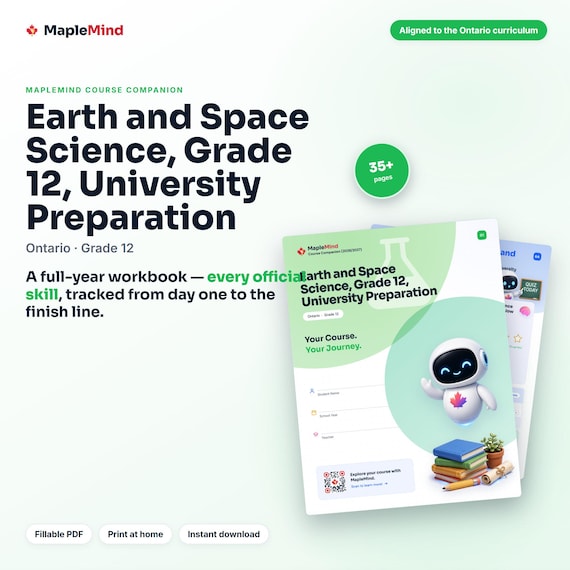
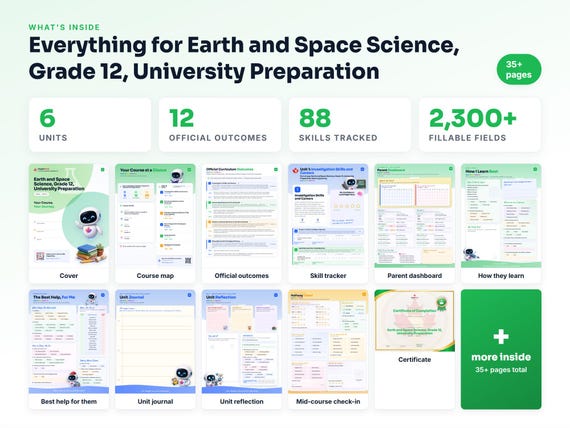

Printable workbook · A keepsake of the year
A Earth and Space Science, Grade 12, University Preparation workbook worth keeping
Built from the same official curriculum as this page. Before and after each skill above, your student colours in how sure they feel — so the two of you can see, on one page, what's clicking and what needs another look. It's a quiet way to follow how the year is really going.
By June it's full of their own handwriting: units worked through, confidence grown, a mid-year check-in, notes from parent-teacher night, and a certificate at the end. Less a worksheet, more a record of the year worth keeping on the shelf.
Instant download · see every page, reviews and the full description · five or more workbooks are $2.99 each
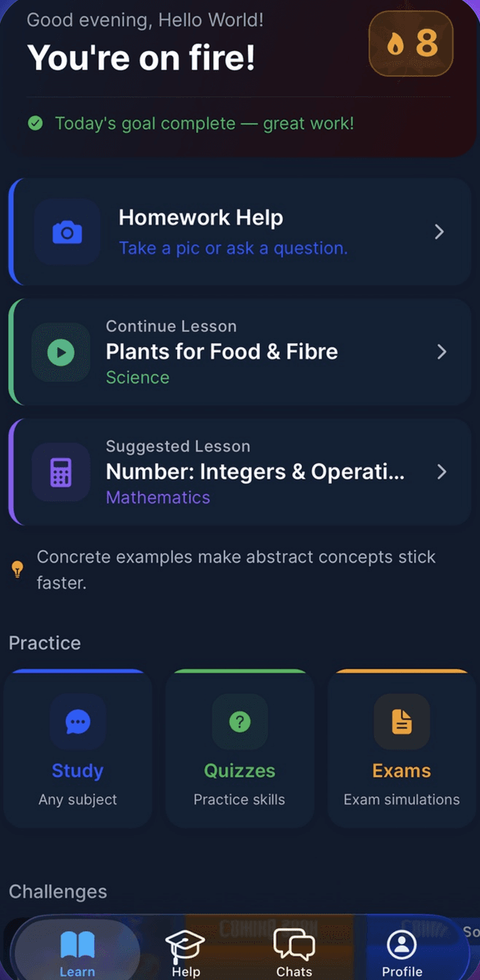
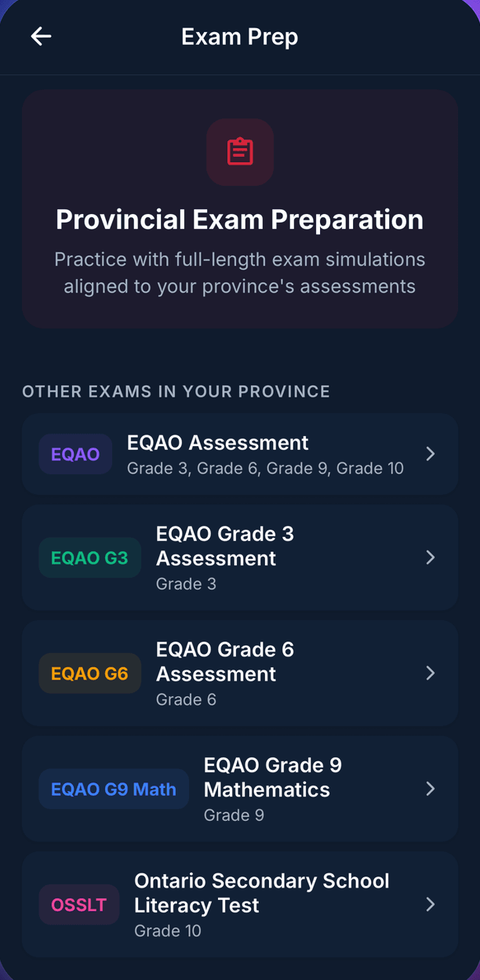
What it looks like in the app

Common questions
Can MapleMind help me with Earth and Space Science, Grade 12, University Preparation?
Yes. MapleMind's AI tutor covers all 88 skills in Ontario's Earth and Space Science, Grade 12, University Preparation — you pick the exact skill, and the tutor teaches it step by step: a short lesson, a worked example, solving together, then a skill check to show it stuck.
Is MapleMind aligned to Ontario's official curriculum?
Yes. Every skill in this course maps to an official outcome code from Ontario's Grade 12 Science curriculum, and the ministry's own wording is quoted under each unit on this page — with the official government source linked so you can check it yourself.
What does MapleMind cost?
It's free to start — 5 tutoring chats and a practice quiz every day, no credit card. A Pro subscription ($9.99/month or $49.99/year CAD, 7-day free trial) unlocks unlimited tutoring, practice, and exam simulations.
What if I'm stuck on just one topic?
That's the point of skill-level tutoring: open Earth and Space Science, Grade 12, University Preparation in the app, tap the exact skill from the list on this page, and the tutor teaches just that — no wading through lessons you don't need.
Does MapleMind work in French or other languages?
Yes — 14 languages, including French. Both the app and the tutor's explanations switch to the language you choose.
Where can I see the official Ontario curriculum for Earth and Space Science, Grade 12, University Preparation?
The official source is linked on this page — Ontario's official science curriculum. The outline here follows it: every MapleMind skill carries its official outcome code, and the ministry's own wording is quoted under each unit.
Keep exploring
Ready when you are
Pick a skill from this page and see it taught properly — free, in the browser, in under a minute.